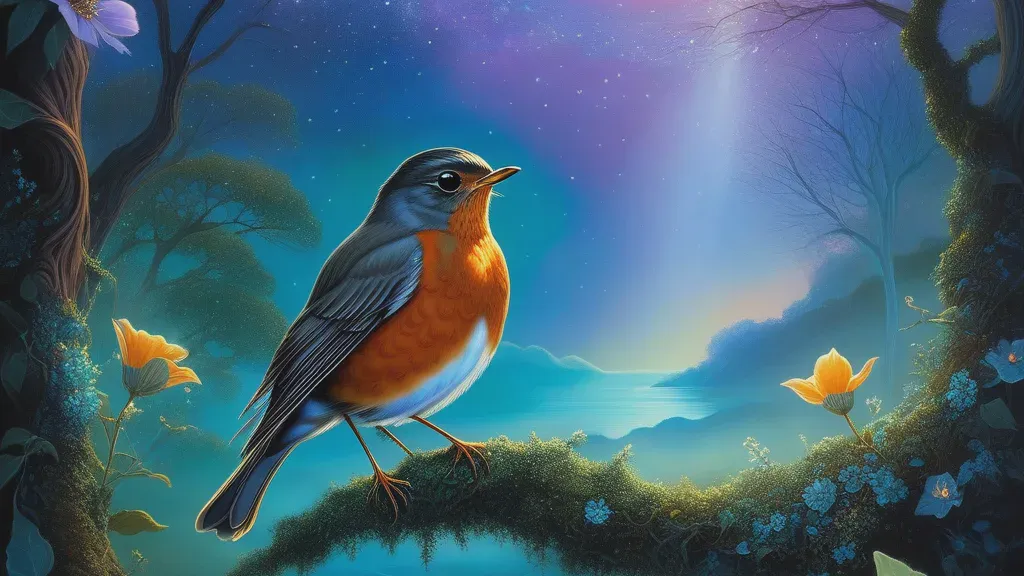
American Robin
Jungian Archetypes
Meaning
The American robin comes into a dream the way it comes onto a March lawn: ordinary, unhurried, and carrying a whole season on its back. Because this thrush sings before first light and keeps singing through rain, it stands in the dreaming mind for a confidence that does not wait for conditions to improve. Its rust-red breast holds warmth and appetite, its nest of mud and grass cradles eggs of an improbable blue, and its habit of pulling earthworms from the ground makes it a daylight creature that feeds on what lies beneath. A dream robin usually announces that something dormant in the dreamer is stirring again, and asks whether they are willing to be as visible about it as the bird is.
Psychological Interpretation
When a robin turns up in a dream, the psyche is rarely being subtle about timing. This is the bird North Americans treat as proof that winter is over, and the dream borrows that calendar: a stretch of dormancy, grief, illness or creative deadness is being declared finished. A robin singing at dawn or in rain is a voice inside the dreamer that has decided to speak whatever the weather in their life. One working the lawn, head tilted, then striking, is a patient earthbound intelligence pulling nourishment from memory and body rather than from ideas. A nest of blue eggs says something is being incubated in a humble structure and needs warmth and time more than announcement. The robin also lives on the line between wild and tame, close to people yet never owned by them, and dreams tend to place it exactly there: at a window or on a fence. The dream is testing how much of the dreamer's instinctive, song-making nature is allowed near their working and domestic life. A robin that flies off when approached is a nature still skittish; one that lets the dreamer come close, or enters the house, is ready to be lived with. A dead or injured robin reverses the symbol: the promised spring has been hurt, and the dream asks the dreamer to grieve a hope rather than skip past it.
Traditional Symbol Meaning
Folk tradition in North America reads the robin first as a calendar. The first robin of spring is a sighting people still announce to one another, and older custom attached a wish to it: see the first robin, make a wish before it flies, and the wish will hold through the year. Harming one was held to bring misfortune, and rural children were warned that breaking a robin's egg brought bad luck. To dream of a robin in this frame is to dream of a promise kept: the season turns, the ground softens, and what was buried comes back up. The English inheritance gives the bird a second, darker office. In the Babes in the Wood ballad and in widespread British belief, the robin tends the dead, and a robin entering a house was long read as a sign that a death was near. Victorian Christmas cards put the robin beside snow and holly partly because red-coated postmen were nicknamed robins, so the bird came to mean news arriving in the cold. This softened into the modern belief, now common in Britain and North America, that a robin who comes unusually close is a dead loved one paying a visit. The dream tradition holds the two together: the robin is the messenger who brings spring and the messenger who sits with loss, and often it is both. Indigenous North American stories treat the robin as a creature that chose people. In the Ojibwe tale recorded by Schoolcraft, Opeechee was once a boy whose father demanded a fast longer than any spirit required; his breast reddened, his body changed, and he flew to the roof of the lodge to say he would never leave the villages of his people, singing at dawn to tell them the cold was ending. Some Indigenous tellings credit the robin with carrying a spark of the sun or helping to bring the first fire. In these accounts the bird's closeness to human dwellings is loyalty rather than habit, and a dream robin on a windowsill carries a note of kinship, a wild thing that has decided to stay near. The popular dream books of the late nineteenth and early twentieth century, Gustavus Hindman Miller's among them, list singing birds as bearers of joy and good news, and later compilations single out the robin for reconciliation, a returning friend, or a letter long awaited; a nest was read as a happy home, a dead robin as a disappointed hope. Connecticut, Michigan and Wisconsin chose it as their state bird, which says how firmly it is fixed to the idea of home. The oldest layer survives underneath: the robin is the small, plain, undefeated thing that sings before the light, and dreaming of it has always meant that the light is coming.
Jungian / Archetypal
In Jung's psychology the Self rarely arrives in the form the ego expects, and the robin shows its preference for the plain. It is the first bird most North American children learn to name. Yet its nest is a rough mandala of mud and grass holding eggs the colour of the sky, the celestial cradled inside the earthly, an image an alchemist would have recognised as a small coniunctio. A dreamer who meets a robin's nest is often being shown that the centre of the personality is being reconstituted from humble materials, close to the house, at eye level. The bird singing before dawn adds the other essential quality of the Self: it announces a consciousness the ego cannot yet see. The robin sings into the dark on the strength of a light that has not arrived. The Child archetype gathers around the robin because the bird is so tightly bound to earliest memory: the egg found on a path, the fledgling rescued in a shoebox, the first spring one can recall. Jung described the child motif as the bearer of futurity, and the robin's arrival often compensates a consciousness settled into permanent winter, a mood, a job or a marriage in which nothing new is expected. Opeechee, the fasting boy of the Ojibwe tale, is the puer who refuses the crushing ideal and turns into something lighter, and a dreamer under a heavy inner father may be shown a robin for exactly that reason. The legend of the robin scorched while carrying fire makes it a modest Prometheus, a small theft of warmth from the gods. The robin has a shadow. Males defend territory fiercely and will batter their own reflection in a window for hours, an image the unconscious uses with precision when a dreamer is attacking a projected version of themselves. The red breast is warmth but also appetite and temper, the libido that keeps the bird singing and fighting through the wet. A dead robin can mark the death of a puer illusion, a hope that refused to mature, and the dreamer is asked to bury it properly rather than wait for another spring. Individuation, in the robin's terms, is the willingness to let the fledglings leave the nest: to stop guarding the eggs of a former self and to sing the next season's song before anyone has confirmed that it is time.
Gestalt / Parts of Self
Gestalt dreamwork asks you to stop watching the robin and to become it. Say it aloud, in the present tense: I am a robin. I sing before it is light. I do not wait for the sun to prove itself. I am red where you are careful. Then listen to how the sentences land in your body. Most dreamers who bring a robin to a session discover a sharp polarity: a part of them that sings without permission, and a part that waits at the window, checking the sky, deciding it is not yet warm enough to begin. The robin is the disowned singer. The dream did not send it to encourage you; it sent it because you have been keeping that voice outside on the lawn. Watch what the robin actually does in the dream, because its rhythm is a complete contact cycle in miniature. It runs, stops, tilts its head, strikes, pulls, swallows, and runs again. That is sensation, awareness, mobilisation, action, contact, satisfaction and withdrawal, the sequence Gestalt therapy uses to describe healthy living. Now find where you interrupt it. If you are watching from behind glass, you are in spectatorship, a deflection: the nourishment is in the ground three metres away and you are describing it instead of eating it. If the robin flies off when you approach, ask which of you is doing the leaving. If it keeps singing while you try to sleep, ask what in you refuses to be quiet, and what you would have to feel if you let it be heard. The nest deserves its own dialogue. Put the eggs on the empty chair and speak to them, then move chairs and speak as an egg that has been left in the cold, or as one that is being sat on and cannot breathe. What you are incubating, and what you refuse to warm, will usually come out in the first two minutes. A dead robin calls for ownership rather than interpretation: I am the robin that did not make it, I am the spring that got caught by a late frost. Say it, and notice the grief you have been treating as weather rather than as yours. Finally, if your robin attacks its reflection in a window, you are looking at retroflection, aggression turned back on the self. The question is not why the bird is angry but at whom you are angry, and what would happen if the blow went outward, cleanly, at its real target.
Psychodynamic / Freudian
The manifest content is modest: a common backyard bird. The latent content usually reaches back to the first house, the first lawn and the first mother. Dream robins are condensed objects, folding together spring, the childhood home and the caregiver who fed and sang and left each morning, and the affect the dream carries belongs to that early layer rather than to any bird. Winnicott's holding environment is almost illustrated by the robin's nest, a cup of mud and grass shaped by the bird's own breast, in which helpless things are kept warm until they can regulate themselves. A dreamer who finds a nest, or who is inside one, is often revisiting the question of whether they were held well enough, and whether they can hold what now depends on them. Klein would look at the broken egg. Nearly every North American child has found a robin's egg on the ground, blue and cracked, and felt the specific grief of a good thing damaged early. In the dream, a smashed egg or a fledgling that cannot be saved often revives the infant's fear that its own greed or rage has ruined the good object, and the dreamer's frantic efforts to rescue the bird are reparation, the attempt to restore what was harmed. Freud's reading of birds and flight in dreams as carriers of sexual wish is not wrong here, only incomplete: the robin at the window is also the excluded one who wants to be let back in, and the dreamer may be both the bird outside and the person who decides whether to open the glass. Transference shows in what the dreamer expects the robin to do. It is the object that returns every year, and for someone whose caregiver came and went unpredictably, its reliability is both the deepest wish and the thing they cannot quite believe; such dreamers often report the robin leaving just as they reach it, an old abandonment displaced onto a creature that can be forgiven for flying. Bion's notion of reverie, the mother who takes in the infant's raw state and gives it back digested, has an echo in the robin's dawn song, a sound that names the day before the child can. When a dead robin appears in the anniversary season of a loss, the timing is rarely accidental: a mourning that was postponed has found a small enough body to be carried in.
Contemporary Psychological
Cognitive science has a surprising stake in this bird. When Eleanor Rosch studied how people organise categories in the 1970s, American participants rated the robin as the most typical bird of all, more bird-like than an eagle or a penguin. That prototype effect matters for dreaming, because the sleeping brain generates content from stored schemas, and when it needs a bird it tends to reach for the most representative one available. A robin in a dream may therefore be the mind's default bird, the image that appears when a scene calls for birdness in general, which is why the specifics, the song, the nest, the worm, the injury, carry more signal than the species does. The continuity hypothesis, developed by Calvin Hall and extended by William Domhoff, holds that dreams reflect waking concerns and waking exposure, and robins are among the most frequently seen and heard birds on the continent. Their dawn chorus begins in the last hour of sleep, during the long REM periods when dreams are most vivid, and external sounds during REM are readily incorporated into dream narrative, so a dreamer who wakes from a singing robin has sometimes simply been listening to one. Rosalind Cartwright showed that dreams across the night tend to move mood from negative toward neutral, and a robin dream during a depressed stretch fits that pattern: the brain rehearsing a spring prediction, in predictive-processing terms, before the waking self has any evidence for one. Memory consolidation adds the seasonal layer. Sleep abstracts the gist from repeated experience, and decades of springs have bound this bird to the ending of cold, so it is available as shorthand whenever the brain processes a transition. Matthew Walker's description of REM sleep as overnight therapy, in which the emotional charge is stripped from memories while their content is kept, explains why a dead robin dream can be sad without being catastrophic: the loss is being handled, not forecast. Research on restorative environments, following Rachel and Stephen Kaplan, finds that birdsong and small wildlife reduce stress and replenish attention, and a dream that brings the robin indoors may be the mind doing its own version of that restoration, with no omen involved.
Cultural & Historical Origins
The American robin, Turdus migratorius, is a thrush that inherited its name and much of its folklore from a bird it barely resembles: English colonists, seeing an orange-red breast, named it after the small European robin of home, and the older bird's legends travelled with the name. British folk tradition held that the robin's breast was scorched when it carried fire to humankind, or stained when it plucked a thorn from Christ's crown, and the ballad of the Babes in the Wood has robins covering the abandoned children's bodies with leaves, which made the bird a tender attendant on the dead as well as a herald of life. The New World added stories of its own. Henry Rowe Schoolcraft's Algic Researches (1839) records the Ojibwe tale of Opeechee, the boy who became the robin when his father demanded a fast beyond his strength, a story that ties the bird to a child slipping free of a parent's demands. Emily Dickinson wrote of dreading the first robin because its song would find her inside her grief, and of helping one fainting robin back to its nest, fixing the bird in American letters as consolation and reproach at once. In Frances Hodgson Burnett's The Secret Garden (1911) a robin, admittedly the European kind, shows Mary Lennox the buried key and the hidden door, an image American readers readily transfer to their own bird: a small red-breasted guide to a locked, walled-off place inside.
Contextual Variations
A robin singing in the rain outside your bedroom window
A robin does not stop for rain, and the dream has chosen the one bird that sings hardest when the weather is worst. This image usually arrives when you have been waiting for conditions to improve before you speak, apply, create or leave, and it argues that the waiting is the problem. The window is your own boundary: the song is happening on the far side of the glass, close enough to hear but not yet inside. Ask what you would say if you were as unembarrassed as that bird, and whether the rain felt like an obstacle or like the thing the robin was singing about.
Finding a fallen nest with three unbroken blue eggs
Something you built from humble material has been knocked to the ground, and the dream wants you to see that what it holds is intact. The blue eggs are the future in its most fragile form: plans, a relationship, a piece of work, a child, a self you are becoming. That the nest fell suggests a structure failed, but the falling did not destroy what mattered. What you do next in the dream is the real message. Carrying the nest inside, leaving it, or putting it back in the tree each describe how you handle new beginnings when the support around them gives way.
A robin pulling an earthworm from the lawn at your feet
The robin feeds by reading the ground, tilting its head, then striking, and the dream puts that skill at your shoes. You are being shown how nourishment is actually found: by attending to what is under the surface of ordinary life, the body, memory, the unglamorous facts. Working at your feet, unafraid, the bird shows that this instinct is willing to operate close to you. If you felt disgust at the worm, the dream is about your reluctance to eat what is real. If you felt fascination, some part of you is ready to go down and get what it needs.
A dead robin lying on your doorstep in spring
Nothing in the robin's symbolism prepares you for this. The bird that means renewal has died at the threshold of your home, in the season it was supposed to announce. Usually this dream marks a hope that has quietly failed, a recovery, a reconciliation, a project, while you have carried on as though it were still alive. The doorstep says the failure sits where you cannot avoid stepping over it. The task the dream sets is not to force another spring but to bury this one honestly: to name the thing that did not survive and to let the grief come inside, where the robin never managed to.
Frequently Asked Questions
Is seeing a robin in a dream a good sign?
Why did I dream about a robin in the middle of winter?
Is a dead robin in a dream a bad omen?
Does a robin in my dream mean a dead loved one is visiting?
Journaling Prompts
- The robin sings before the light arrives and does not stop for rain. Write about one thing you have been postponing until conditions improve, a conversation, an application, a piece of work, a departure, and describe in detail what the first sentence of it would sound like if you sang it now, into the dark, without waiting for proof that it is spring.
- Picture the nest from your dream, or a robin's nest you once found as a child. What is in it right now, in your life: which fragile blue thing are you keeping warm, and which have you left to go cold because sitting on it felt like doing nothing? Write to the egg you have been neglecting and tell it, honestly, what you are afraid it will hatch into.
- The robin feeds by tilting its head, reading the ground, then striking. List three ordinary, unglamorous facts about your body, your money, your daily routine or your history that you have been avoiding looking at directly. Choose one and write for ten minutes about what nourishment might be under it, and what it would take to pull it up into daylight.
- If the robin in your dream was hurt, dead, or flew away before you reached it, write its obituary. Name the hope it was carrying for you, when it was born, what it fed on, and what late frost caught it. Then write one honest line about what you would need in order to let a different season begin, rather than a repeat of the one you lost.
Related Symbols
Dreamed about American Robin?
Get a personalized AI interpretation that connects this symbol to your specific life circumstances.
Interpret My Dream