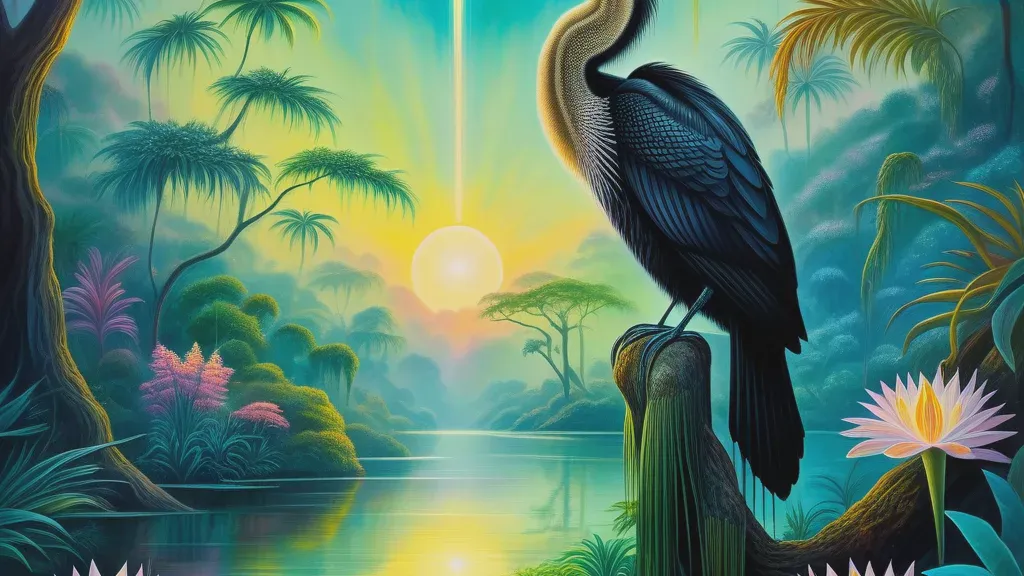
Anhinga
Jungian Archetypes
Meaning
The anhinga is the bird that refuses the one thing birds are supposed to do on water: float. Its feathers lack the oils that keep a duck dry, so it sinks, swims beneath the surface with its wings half open, and spears fish with a bill like a dagger; then it must climb onto a branch and stand for an hour with its wings spread wide until it is dry enough to fly. In dreams this makes it the creature of complete immersion and slow recovery. It appears when the dreamer is being asked to go all the way under into feeling, memory or grief, and it carries the warning and the promise together: the dreamer will not stay dry, and will need time in the sun afterwards before they can rise.
Psychological Interpretation
An anhinga in a dream usually concerns the dreamer's relationship to depth. Most waterbirds work the surface; this one goes under, and the psyche uses it to ask whether the dreamer will let themselves be fully wetted by something, a grief managed from above, a desire observed rather than felt, a truth about the family circled for years. Because the bird's snake-like neck is often all that shows, the dream may also be about how little of the dreamer's real activity is visible to others: a life that looks placid from the bank while something hungry hunts below. The spearing is an image of instinct that does not deliberate, and dreamers who spend their days weighing options often wake slightly envious of that single clean strike. An anhinga on a dead branch with its wings held open like a cross is not displaying; it is drying, and it cannot fly until it has. Whatever the dreamer goes down into will soak them, and the recovery cannot be hurried by will, only by exposure and time. A dreamer who watches the bird dry and feels impatient is being shown their own resistance to convalescence. One who sees it unable to rise is being warned that they have gone under without any plan for coming back up, and that the sun, some warming, witnessing presence, is missing.
Traditional Symbol Meaning
Folk imagination in the bird's range has always started from the neck. A creature that swims like a snake and soars like a hawk unites the two oldest animal omens, the serpent of water and the underworld and the bird of sky and soul, and the names people gave it record the unease: snakebird, devil bird, water turkey, darter. In the traditional grammar of omens a snake seen where a bird should be means the boundary between depths and heights has been crossed, and a dream anhinga inherits that charge. It is the hunter whose visible part is a periscope, and older readings lean toward caution: something is at work below a calm surface, in the dreamer or near them. The drying posture gathered a second tradition. In the Christian South an anhinga standing motionless on a dead limb with its wings stretched wide has been read as a bird on a cross, and the folk sense of the image is patience under exposure, a penance that consists of holding still in full view until one is fit to move again. Nature writers in Florida and along the Gulf have used the bird as a homily on convalescence: it goes under to eat and must then submit to the sun. In dream terms this makes the drying anhinga a figure of enforced rest after descent, the tradition's way of saying that whoever dives must also wait. The bird's cousins carry a working tradition the anhinga shares by association. Cormorants have been trained to fish for people in China and Japan for more than a thousand years, a cord at the throat allowing the bird to catch but not swallow, and the darters of Africa, India and Australia work the same waters as human fishers, who read a hunting bird as a sign of fish below. Dreams of the anhinga spearing and tossing a fish draw on this: the dreamer's own hunting instinct, precise and unglamorous, and the question of who benefits from the catch. In the twentieth century the anhinga became the totem of the Everglades, the animal on the signs and postcards of a wetland that was nearly drained and then, in part, defended, which gives the image a modern layer: the bird of a place that survived by refusing to be made into something else. Popular dream books rarely list the anhinga by name; where they treat diving birds at all, the reading tends toward something hidden coming to light, usually about the dreamer's own heart, with a bird trapped underwater as a secret kept too long. The snakebird brings both readings up at once, and adds its own: what is learned below has to be carried into the light and dried there, in the open, before it can be used.
Jungian / Archetypal
Jung would begin with the bird's peculiar relation to water, his oldest image of the unconscious. Ordinary waterbirds are Persona creatures, oiled against the medium they live on; the anhinga has no such oil. It is the part of the psyche that cannot keep the unconscious off, that goes under completely whenever it must feed. A dreamer who meets it is being told that the groomed surface they present will not serve for this piece of work; what they need is below, and they will be soaked in getting it. The serpent neck adds the chthonic note. Bird and snake fused in one body is an image the collective unconscious has produced repeatedly, from the plumed serpent Quetzalcoatl to the winged serpents of alchemy, and it signals the union of instinct with spirit. The drying posture is the picture's centre. An anhinga on a branch with wings spread is a living cross, and the cross in Jung's reading is a form of the quaternity, the four-armed image of wholeness the Self produces when opposites are held together. The bird holds air and water, hunger and stillness, the hidden and the exposed, and it holds them by doing nothing, only waiting in the sun. For a dreamer in the middle of a descent, this figure is the compensation the psyche offers: not rescue, but a model of how to remain visible and motionless while the unconscious drains out of the feathers. The Animus belongs here too, in the spear-bill and the single strike, a decisiveness that a dreamer who lives by accommodation may find only in the dream bird. The dark version of the image is the anhinga that cannot dry. A waterlogged bird that sinks, or beats its wings and cannot lift, describes an ego that has gone under into collective material without the counterweight of a warming, ordering consciousness. The dream is then a warning about inflation by depth, the fascination with one's own darkness that forgets the branch and the sun. Individuation with the anhinga as guide is a rhythm rather than a destination: descend fully, strike once, return, and then endure the long exposed drying in which what was caught below is made light enough to carry aloft. The Child archetype flickers at the end, in the fledgling that has not yet learned its feathers will not float and must learn the sequence by watching.
Gestalt / Parts of Self
Become the anhinga and say what it says. I have no oil. I do not repel the water; I let it all the way in. I hunt where you cannot see me. When I come up, I have to stand with my wings open for a long time, and I cannot fly until I have. Say those sentences slowly and notice which one makes you flinch, because that is the one you have been disowning. Most dreamers find that they have been living as an oiled bird, presentable on the surface, and that the dream has sent the unoiled one to show them what it costs to keep the water out: no fish, no depth, a hunger that never gets fed. The bird's day is a whole contact cycle, and the dream will show you where you break it. Sensation is the hunger; awareness is the bird reading the water; mobilisation is the dive; action is the strike; contact is the fish; withdrawal is the branch and the sun. Ask yourself where you stop. If you watched the anhinga from the boardwalk without going in, you are deflecting: you know where the nourishment is and you are narrating it. If you went under and could not come up, you have contact without withdrawal, an immersion in someone else's feelings or your own that has no branch to climb onto. If you were the bird drying and felt exposed and ashamed, you have found the polarity between the hidden hunter and the displayed one, and the shame belongs to the part of you that thinks recovery should happen out of sight. Put the fish on the empty chair. Speak to it as the anhinga, then swap and speak as the fish that was speared, tossed into the air and swallowed head first. Dreamers are often startled to discover that they identify with the fish, the thing caught cleanly by an instinct that did not hesitate, and that the envy they feel toward the bird is envy of their own capacity for one decisive act. The dead branch is worth a dialogue too. Be the branch: I hold you while you dry; I am dead, and that is why I can. That sentence usually opens something about the support in your life that does not need to be alive, exciting or reciprocal in order to be exactly what you need. Own the branch, own the fish, own the wet, heavy bird, and the dream has done its work.
Psychodynamic / Freudian
The manifest content is a strange bird that sinks. The latent content is nearly always about skin. Esther Bick described how the infant, before it has an inner sense of being held together, experiences its skin as the only thing keeping it from spilling out, and how a second skin of muscular tension or precocious talk is built when the first one fails. The anhinga has no waterproof layer; it is the part of the dreamer that never developed the oil, that takes everything in and gets soaked by the environment. A dreamer who is the bird in the dream is often someone whose early holding was patchy, and who now needs the drying branch that Winnicott would call the facilitating environment: a place to stand, exposed, while a steady presence lets them recover at their own pace. The spearing belongs to Klein. The bill is a weapon of oral aggression, and the fish is the object caught and swallowed whole, head first, the infant's earliest phantasy of taking in the breast entire. Dreamers disturbed by the strike usually carry guilt about their own hunger, the fear that wanting something fully destroys it. The dream's answer is the bird's calm: it eats and it is not punished. Freud's readings gather around the neck, a serpent that rises out of the water, a plainly phallic form emerging from the maternal element, and the dream may be staging a wish to penetrate what has been felt as engulfing, to hunt inside the mother's medium rather than be swallowed by it. Reversal is common: a dreamer who fears being taken over dreams of being the one who takes. Transference appears in who is on the bank. Many anhinga dreams include a watcher who sees the bird go under and waits, and that figure is the analyst, the parent, the partner whose gaze the dreamer is testing: will they stay while I am below, and will they still be there when I come up wet and ridiculous with my wings out? Bion's container is the sun in this dream, the presence that does nothing but warm, receiving the soaked bird's state and returning it as dry feathers and the capacity to fly. When the sun is missing and the bird cannot lift, the dream has named the absence of that presence, and the dreamer's task in waking life is to find the branch and the light rather than to dive again.
Contemporary Psychological
The continuity hypothesis explains most anhinga dreams before any symbolism is needed: the dreamer has seen one, on a boardwalk, in a documentary, in a photograph, and the sleeping brain has filed the image with whatever concerns were active at the time. G. William Domhoff's content analyses suggest that what appears in dreams tracks what occupies waking attention, unusual animals included. Predictive processing adds why it stuck. A bird that sinks violates the brain's model of birds, and prediction errors of that kind are prioritised for consolidation; the anhinga is memorable precisely because it breaks the rule that feathers float. The immersion-and-drying cycle maps unusually well onto what sleep science says dreaming does. Matthew Walker describes REM sleep as overnight therapy, a state in which noradrenaline is low and the brain can re-run emotional memories while stripping their charge. Rosalind Cartwright's studies of people going through divorce found that those who dreamed about the former partner vividly and with feeling were more likely to be out of their depression a year later than those who did not. The anhinga going under is the engaged version of that process, the dream that lets itself get wet, and the drying is the consolidation that follows, in which what was felt at depth becomes light enough to carry. A dream in which the bird cannot dry may reflect fragmented REM, where the immersion happens but the processing does not complete. Bodily state matters with this bird more than most. Anhingas sun themselves because they have a low metabolic rate and lose heat in water, and dreamers who are cold in bed or damp with sweat sometimes generate exactly this imagery, the brain folding thermal information into a scene of a soaked creature trying to warm up. Antti Revonsuo's threat simulation theory has a smaller role, since the bird is no threat, but the sinking variation, where the dreamer becomes the anhinga and cannot surface, has the structure of a drowning rehearsal. The waking takeaway is practical: an anhinga dream is often the brain reporting on its own recovery cycle, on whether the immersion of the previous days has been followed by enough warmth, rest and daylight to dry.
Cultural & Historical Origins
The word anhinga comes from the Tupi language of Brazil, where it named a water bird with a devil's or a snake's neck, and it reached European science through Georg Marcgrave's Historia Naturalis Brasiliae (1648), the first systematic natural history of the New World tropics; Linnaeus kept the name when he catalogued the bird in 1766. English speakers in the American South called it the snakebird, for the way its head and neck cut the surface while the body stayed submerged, and the water turkey, for its broad fanned tail. William Bartram, travelling the St. Johns River in Florida in the 1770s, described the snake bird sunning with outstretched wings on branches over the water, and his Travels (1791) fixed the image for later naturalists. John James Audubon painted it for The Birds of America and wrote in his Ornithological Biography of its habit of swimming with only the head and neck showing, like a serpent. In the Everglades, where the Anhinga Trail is now the park's most visited walk, the bird has become an emblem of the river of grass that Marjory Stoneman Douglas defended, and its cruciform drying posture has led some visitors from the Christian South to see a bird crucified over the water, a folk observation rather than a doctrine but one that shapes how the image lands in a dream. Indigenous meanings within the bird's range are poorly recorded; it is safest to say that Tupi speakers named it for its snake neck and that Florida's peoples knew it as a fishing neighbour.
Contextual Variations
An anhinga swimming with only its snake-like neck above the water
You are seeing the part of a life that shows. Body, wings and hunger are below the surface; what breaks the water is a thin periscope easily mistaken for a snake. The dream concerns something in you or near you that shows a small, calm, slightly unsettling face while most of its activity happens out of sight. If the neck belonged to a bird you were watching, ask whose composure in your life you do not fully trust. If you were the bird, the dream is describing how much of yourself you keep submerged.
An anhinga on a dead branch holding its wings open to dry
This is the dream of convalescence. The bird is not displaying or posing; it is waterlogged and cannot fly until the sun has done its work, so it stands, wings spread, exposed. If you felt peace watching it, you are being shown a model for recovery from something you went under into: hold still, stay visible, let time and warmth do what effort cannot. Impatience or embarrassment on the bird's behalf means the dream has found your resistance to being seen before you are ready. The dead branch matters: what holds you now need not be alive to be enough.
An anhinga spearing a fish and tossing it into the air
One clean strike, then the fish flipped and swallowed head first. This is an instinct that does not deliberate, and how you felt about it shows where you stand with your own decisiveness. Envy suggests you have been weighing options too long and want to act once, exactly. Disgust or pity for the fish suggests guilt about wanting things fully and taking them. Notice whether the bird ate or lost the fish; a catch that slips away is a decision made and then abandoned, and asks what you keep spearing but never let yourself have.
You become an anhinga and sink because your feathers will not float
The most alarming form, and the most direct. You have gone under into something, grief, a relationship, someone else's crisis, without the oil that lets other people skim it, and cannot get back to the surface by will. The image asks two questions: what are you immersed in that you did not plan to be, and where are your branch and your sun, the steady place and the warm presence that would let you dry? If the dream ended with you climbing out, the psyche has already located them. If it did not, waking life needs to.
Frequently Asked Questions
Why would I dream of an anhinga if I have never seen one in real life?
Is the anhinga in my dream a good omen or a warning?
Why was the bird just standing there with its wings spread and not moving?
Is there any difference between dreaming of an anhinga and dreaming of a cormorant?
Journaling Prompts
- The anhinga cannot float; it goes all the way under to feed. Write about the last time you let yourself be completely soaked by something, a grief, a love, a piece of work, a family truth, instead of skimming it. What did you bring up, and what did it cost you to come back to the surface? Be specific about the moment you decided to go under, or the moment you decided not to.
- Picture the bird on its dead branch, wings open, unable to fly until the sun has finished. Where is your branch, the place you can stand still and exposed while you recover, and who or what is your sun? If you cannot name them, write about what has been standing in for them, and whether it actually warms you or only keeps you busy while you stay wet.
- The strike is a single clean movement with no deliberation in it. Describe one decision you have been circling the way a bird circles a pool, and write down what the strike would look like: the exact sentence, the exact action, the exact day. Then write what you are afraid will happen to the fish, and whether that fear belongs to this decision or to an older one.
- Most of the anhinga stays below the waterline; what people see is a thin neck that looks like a snake. Write a description of yourself as seen from the bank by someone who knows only that visible part, then a second description of what is happening underneath. Where do the two accounts disagree most, and who in your life has ever seen the whole bird?
Related Symbols
Dreamed about Anhinga?
Get a personalized AI interpretation that connects this symbol to your specific life circumstances.
Interpret My Dream