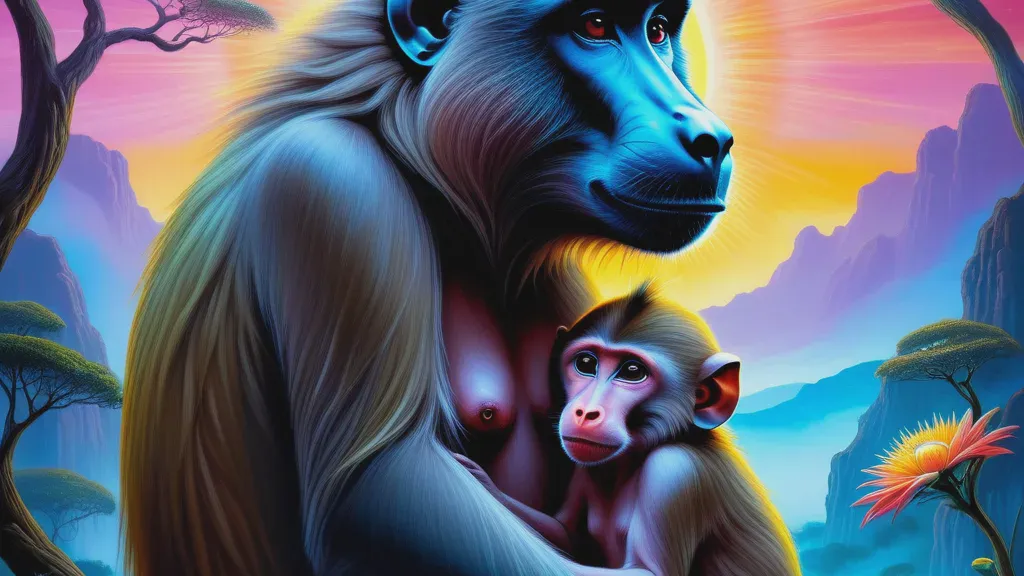
Baboon
Jungian Archetypes
Meaning
A baboon in a dream brings the whole primate troop into the psyche: rank, alliance, exposure, and the constant scanning of who stands where. Unlike the solitary wolf or the lone serpent, the baboon is never really one animal; it arrives with a hierarchy attached, and the dreamer's place in that hierarchy is usually the point. Its dog-like muzzle, bared canines and bright, unhidden rump make it a creature of appetite and display that refuses to be dignified. When it appears, the dreamer is being shown the social animal underneath the social self: the part that wants to be groomed, dreads being driven from the group, and knows exactly which glance means danger.
Psychological Interpretation
The baboon is the primate the dreamer would rather not be compared to, which is exactly why it is useful. Chimpanzees flatter the human self-image with tool use and tenderness; the baboon shows the raw politics of a troop, where a mother's rank passes to her daughters, where a male's tenure is won and lost by his canines, and where being alone at dusk means being eaten. In the dream, the baboon tends to stand for whatever social calculation the dreamer is running below awareness: who must be deferred to, who can be challenged, whose approval makes the day safe. A troop that blocks the path dramatizes a group the dreamer cannot get past without paying a toll of submission. A single baboon watching from a rock is often the dreamer's own vigilance, given a body. The animal's famous shamelessness, its bare and swollen rear, its screaming and snatching, points to the body and its needs shown without cover, and many baboon dreams carry a flush of embarrassment that belongs to the dreamer rather than the animal. Because the ancient Egyptians saw the same creature as Thoth's companion and as the first worshipper of the morning sun, the dream may also be pointing to something loud and undignified in the dreamer that is nevertheless closer to wisdom than the polished persona will ever be.
Traditional Symbol Meaning
The traditional dream books are not kind to the baboon. In the Oneirocritica of Artemidorus the ape stands for a rogue and a cheat, and later European interpreters folded every long-faced monkey into the medieval picture of the ape as the devil's imitation of a human being. To dream of a baboon, in this line of reading, was to be warned that a flatterer or a mimic was close, that one's own conduct had slipped toward the ridiculous, or that an enemy would grin while doing harm. The popular dream dictionaries of the nineteenth and early twentieth centuries keep the tone: a baboon foretells loss of reputation, an embarrassing exposure, or a suitor of low character. The Egyptian reading runs the other way and is far older. There the baboon was a colleague of the gods rather than a caricature of a person: scribe, keeper of hours, witness at the judgement of souls, and first creature to hail the sun. Egyptian dream interpretation survives in the Ramesside dream papyrus of the Chester Beatty collection, which sorts omens into good and bad, and although the surviving text is fragmentary and its baboon omens, if it had any, are lost, the animal's standing beside Thoth suggests where it would have belonged: among the auspicious signs, the kind that promised a true message, a fair judgement, or the return of light after darkness. In the folklore of southern and eastern Africa, where people actually live alongside baboons, the dream is read more practically and more ambivalently. Baboons raid fields and gardens, so a dream of baboons near the crops could be taken as a plain warning to post a watch. Trickster tales pair Baboon with Hare, usually to Baboon's cost, so the animal also stands for the strong but foolish rival who is outwitted. In parts of the region the baboon carries a darker association as the creature a witch sends or rides at night, and a baboon at the door in a dream might be read as evidence of malice directed at the household. Rock paintings attributed to San artists include baboon-like figures whose meaning is debated, suggesting the animal had a place in trance imagery long before written dream books. Modern popular dream symbolism inherits both strands and tries to reconcile them. Many dictionaries say the baboon warns of someone in the dreamer's circle behaving foolishly, or of the dreamer's own need to stop clowning and be taken seriously; others reverse it and read the baboon as a call to loosen up and reconnect with the body. The two readings, mockery and wisdom, are the same ambivalence the ancient world already held, and the useful move is to ask which one the dream's feeling supports. A baboon that shames the dreamer belongs to the Artemidorus line; a baboon that sits calmly at dawn belongs to Thoth.
Psychodynamic / Freudian
The manifest baboon is easy to describe; the latent content is a family. Freud's speculative primal horde in Totem and Taboo drew on Darwin's account of primate bands ruled by a jealous dominant male who drives out the younger ones, and a baboon dream frequently restages that family romance in fur: a father who must be deferred to, siblings sorted by rank, a mother whose standing the child inherits and cannot change. Displacement does the disguising. The boss who cannot be confronted at work becomes a male with canines on a rock; the sister who always got the larger portion becomes the adult who snatches food from the infant. Condensation lets one animal be several things at once, so the baboon can be the feared father, the envied rival and the dreamer's own greed in a single body. Melanie Klein would read the snatching, biting baboon as the oral-sadistic infant that every adult once was: the mouth that wants to take and tear when frustrated, and the envy that cannot bear to see food in another hand. A dreamer who feeds a baby baboon and watches an adult steal the food is enacting a split between the good, feeding object and the bad, depriving one, and the dream's helplessness is the helplessness of the early position before the two can be held together. Winnicott's holding environment is literalised in the infant baboon riding its mother's belly; the troop as a whole is the holding environment writ large, and a dream of being left behind by the troop at dusk is one of the psyche's clearest pictures of a holding that failed or was withdrawn too soon. Bion adds the alarm call. A baboon troop metabolises danger collectively: one animal barks and the fear is distributed, contained and acted on, which is what a mother's reverie does for the infant's raw sensations. The dreamer with no troop is left holding nameless dread alone. In treatment the troop reappears as transference: the analyst becomes the alpha to be placated or the groomer whose attention is craved, and contempt for the baboon, calling other people apes, is usually a reversal that hides the wish for rank and grooming in oneself. The exposed rump names the last layer, the shame of a body that wants, on view to the group, and the ego ideal's quiet failure to make that body disappear.
Contemporary Psychological
Dorothy Cheney and Robert Seyfarth's long field study, reported in Baboon Metaphysics, showed that a baboon tracks not only its own rank but the rank and kinship of every other troop member. Robin Dunbar's social brain hypothesis proposes that primate neocortex grew to handle exactly this bookkeeping. The human brain inherited the machinery, and dream research finds it running at night: G. William Domhoff's content analyses show that most dreams feature other people and social interaction, in line with the continuity hypothesis that dreams carry on the concerns of waking life. A baboon dream is often that machinery caught in the act, the ranking problem given a face. Robert Sapolsky's decades of cortisol sampling in Kenyan olive baboons found that low-ranking animals, and animals without stable friendships, carry chronically raised stress hormones, and that when the most aggressive males of one troop died after eating contaminated garbage, the surviving culture became gentler and stayed that way for years. REM sleep is where the human version of that stress gets processed. Matthew Walker describes REM as overnight therapy in which the emotional charge of memories is reduced, and Rosalind Cartwright's studies of people in painful transitions found that those who dreamed about the stressor recovered mood more reliably. A baboon that bares its teeth in a dream during a period of office politics or family ranking is a fair candidate for this process: the threat is being replayed, and its sting is being lowered. Antti Revonsuo's threat simulation theory offers a further layer. Early hominins shared savanna and cliff refuges with baboons, and a snarling adult male with two-inch canines is a plausible ancestral danger, so the dreaming brain may reach for the image when it wants to rehearse confrontation. Predictive processing accounts of dreaming describe the sleeping brain generating scenes and predicting how their actors will respond; a troop whose attention shifts as the dreamer moves is the social prediction system running without sensory input. An ordinary source, a documentary, a zoo, a raided picnic in Cape Town, may also have been promoted to a scene by memory consolidation. The useful question is which social scan was running in the days before the baboon appeared.
Jungian / Archetypal
Jung read the animals of dreams as the instinctual psyche appearing in its own shape, and the ape held a special place among them because it stands at the threshold between animal and human. The baboon, with a dog's muzzle on a body that sits and gestures like a person, is that threshold made visible. This is why it carries the shadow with such precision: not the shadow as evil, but the shadow as everything undignified that the persona has learned to hide. A dreamer who lives by composure and tact is a prime candidate for a screaming, teeth-baring baboon, because the psyche compensates one-sidedness with its opposite. The dog-headed baboon, the cynocephalus of Greek writers, was the animal of Thoth, whom the Greeks identified with Hermes and the alchemists with Mercurius, and Jung noted that Mercurius appears in base and animal forms before he appears as the sage. The baboon is the Wise Old Man before he has learned to cover his rump. The troop itself is a maternal image. Baboon society is built on female lineages that never disperse; daughters inherit their mother's rank and males come and go. A troop in a dream is therefore close to the Great Mother in her collective form, the matrix that feeds, grooms and ranks its members and from which nobody escapes unmarked. The infant baboon, carried on the mother's belly and later on her back, is the Child archetype in its clinging aspect: a baby baboon attached to the dreamer's chest shows either unfinished dependence or a caretaking role that has fused with identity. Individuation, in this imagery, is the adolescent male's departure from the natal troop: a lonely and dangerous crossing that the psyche stages as being driven out, and which is nonetheless the beginning of a self. At the collective level the troop also pictures what Jung called participation mystique, the state in which the individual is dissolved in the group's moods and rankings. A dreamer who fears the troop is often afraid of that dissolution; a dreamer who is the outcast baboon may be compensating for a waking life in which the group's judgement has been swallowed whole. Yet the same creature turns its face to the rising sun each morning and, in Egyptian eyes, was the first to worship it. That posture hints at the Self: an instinct that greets the light without a theology, and shows the dreamer that the noisy, ranked, bodily animal is not the opposite of wholeness but one of its roots.
Gestalt / Parts of Self
Gestalt dreamwork begins by refusing the safe distance. The baboon is not something you saw; it is something you are. So speak as it, in the present tense: I sit where I can see everyone. I know who is above me and who is below. I show my teeth before I bite. I show my backside and feel no shame about it. I take the food if you hesitate. Said aloud, most of those sentences land somewhere in the body with a jolt, and the jolt is the point. The baboon carries the qualities you have disowned in order to be the cooperative, modest, reasonable person you take yourself to be: the hunger for rank, the appetite, the exhibitionism, the vigilance that never quite switches off. Fritz Perls named the two voices of inner conflict top dog and underdog, and the baboon troop plays that polarity out almost literally. Put the alpha in the empty chair and answer him. Then sit in his chair and feel what it is like to hold the position everyone watches. If there was a baby baboon clinging to you, give it the chair too and let it say what it wants, then notice whether the wanting is yours. Baboons live in a rhythm of contact and withdrawal, grooming in the open by day and retreating to the cliff face at night, and the dream will often show you which half of that rhythm you have lost. If you were frozen while the troop moved around you, you are stuck in withdrawal; if you were in the middle of the screaming, you may have lost the cliff. The affect to stay with is usually embarrassment. Notice where it lives when you replay the dream: the heat in the face, the tightening of the jaw, the urge to explain. Gestalt asks you not to interpret the flush but to inhabit it, and then to exaggerate it, because the exaggeration reveals what the feeling protects. Try the baboon's threat-yawn with your whole face and see what wants to come out behind it. Then ask the simplest question the dream allows: what do you want from the troop? If the honest answer is to be groomed, to be touched and accepted without having to earn it, the dream has done its work, and the next task is to ask for that in waking life rather than to keep scanning for it.
Cultural & Historical Origins
Egypt gave the baboon its most exalted career. The hamadryas baboon was one of the two animal forms of Thoth, god of writing, measure and the moon, and baboon statues holding the lunar disk stood in his precinct at Hermopolis. Egyptian observers saw hamadryas troops chattering and raising their arms at sunrise and read the behaviour as adoration; a frieze of baboons greeting the dawn still runs along the top of the great temple at Abu Simbel. Hapy, one of the Four Sons of Horus, has a baboon's head and guards the lungs of the dead, while the older and fiercer Babi, called the bull of the baboons, presided over virility and devoured the unjust in the underworld. In the weighing of the heart from the Book of the Dead, a baboon often perches on the balance as Thoth's own witness, and the thousands of mummified baboons at Tuna el-Gebel and Saqqara show how far the cult went. Elsewhere the animal's reputation is earthier. Southern African folktales cast Baboon as the greedy or gullible foil to Hare, and in parts of the region baboons are feared as the night-riding familiars of witches. Charles Darwin wrote in an 1838 notebook that whoever understood baboon would do more for metaphysics than Locke, and the neuroscientist Robert Sapolsky spent decades with Kenyan olive baboons documenting how rank, stress and friendship shape a life.
Contextual Variations
A baboon troop blocking a narrow path and refusing to move
A troop across the path is a group you cannot get past on your own terms. Baboons hold ground by numbers and noise rather than by any single fighter, so the dream is usually about a collective in your life, a family, a team, a friend group, whose combined attention you must pass through to reach what you want. Notice what you did. Waiting them out suggests you are paying a toll of patience and deference in waking life; pushing through suggests you are ready to risk their displeasure. Ask what lies on the far side of the path and whether the troop is guarding it or simply sitting where it always sits.
A large male baboon baring its canines at you
The open-mouthed display is a baboon's way of avoiding a fight: the teeth are shown so that they need not be used. In the dream this is a test of rank rather than an attack. Someone in your life may be showing teeth, making a display of power you are meant to read and defer to, and your response in the dream tells you how you are handling it. If you looked away, the dream is describing a submission you may not have admitted. If you held the gaze, or showed your own teeth, the psyche is rehearsing a confrontation you are preparing for. It is also worth asking whether the one displaying is you.
A baby baboon clinging to your chest and refusing to let go
Infant baboons ride their mothers' bellies for weeks and then their backs, and an infant fastened to your chest is dependence in its most bodily form. The dream may be pointing to someone whose needs are attached to you so tightly that you cannot set them down, or to a part of you that never stopped clinging and is now carried by your adult self. Feel the weight and the warmth as you recall it. Tenderness suggests a caretaking you are willing to keep; suffocation suggests a role that has fused with your identity and needs prising off gently, not thrown away.
A baboon snatching food from your hands
Anyone who has picnicked near baboons knows the speed of the snatch, and the dream keeps that speed: something you were about to enjoy is taken before you have decided to eat it. Look for the hesitation. Baboons take from the hesitant, and the dream is often about an opportunity, a portion, a piece of recognition that went to someone bolder while you weighed whether you deserved it. The thief may also be your own appetite, kept so far out of sight that it has to steal from you. Ask what you would have done with the food had you eaten it at once.
Frequently Asked Questions
Is a baboon in a dream a bad omen?
Why did I dream that a baboon attacked me?
Why do I keep dreaming about baboons?
Is there a spiritual meaning to dreaming about a baboon?
Journaling Prompts
- Picture the troop from your dream and place yourself in it honestly. Who sat above you, who below, who was grooming whom? Now name the waking group that troop most resembles and ask whether your dreamed position matches the one you actually hold there, or the one you fear you hold.
- A baboon shows its teeth so that it does not have to use them. Where in your life are you currently showing teeth, and where are you being shown them? Write down the last time you deferred to a display of power, and what it cost you to look away.
- If a baby baboon was clinging to you, describe its weight and warmth in detail. Then ask who or what in your waking life is attached to you that tightly, and whether you carry it from love, from habit, or because you have never been shown how to set it down.
- Young male baboons must eventually leave the troop they were born into and win a place in another. Write about a group, a family, a workplace, a circle of friends, that you have outgrown but not yet left, and what you imagine the crossing would cost you. Then name one thing from the old troop that you would want to carry with you.
Related Symbols
Dreamed about Baboon?
Get a personalized AI interpretation that connects this symbol to your specific life circumstances.
Interpret My Dream