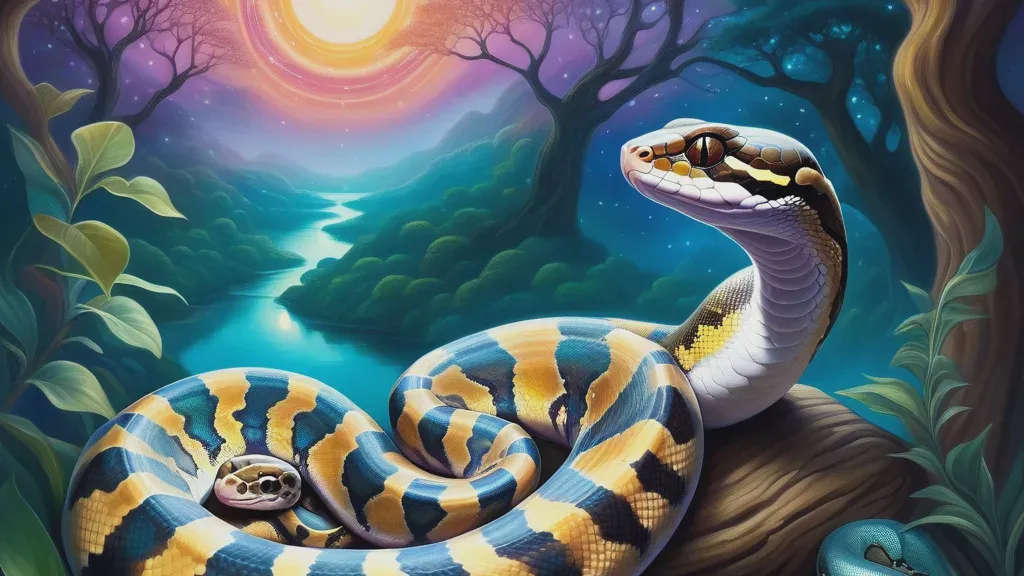
Ball Python
Jungian Archetypes
Meaning
The ball python is the serpent that answers threat by folding up. Rather than strike, it tucks its head into the middle of its own coils and becomes a warm, muscular sphere that can be lifted and carried, and it is this gesture, not venom or size, that the dream borrows. To dream of a ball python is to meet the part of the self that protects itself by withdrawal, that goes quiet and dense rather than loud, and that is capable of far more than its curled posture suggests. Because it is also the most common pet snake in the world, the dream often arrives with tenderness attached: a wild instinct that has been tamed, housed, handled, and is now waiting to see whether it will be understood or merely kept.
Psychological Interpretation
Every snake in a dream carries the old freight of the serpent, instinct, sexuality, healing, the unconscious itself, but the ball python edits that freight in a particular direction. It is small, slow, nocturnal and famously reluctant to bite; its whole strategy is to make itself compact and wait. When it appears, the dreamer is usually being shown how they handle their own power under pressure. A python curled tightly in the hands is a self that has withdrawn into a manageable shape, and the dream asks whether that shape is wise self-containment or fear that has hardened into habit. A python that uncoils and explores is an instinct testing whether it is safe to extend. The pet context adds a second layer. A ball python in a glass tank is an instinct that has been domesticated, fed on a schedule and admired for its pattern, and the dream may be asking whether the dreamer's own wildness has been housed so comfortably that it has stopped moving. In West Africa the same animal is sacred and walks free through a temple town; the dream can carry that dignity too, arriving as a quiet, heavy presence that wants to be held rather than feared and that, when it finally lifts its head from the coil, has something to show.
Traditional Symbol Meaning
The dream books of the nineteenth and early twentieth centuries did not distinguish one python from another, but they were confident about constrictors. Where a viper meant a hidden enemy or a poisoned tongue, a snake that coiled and squeezed meant an entanglement: a debt, a lawsuit, a jealous lover, a situation closing slowly around the dreamer. To be wrapped by a python was to be warned that an obligation had grown stronger than one's freedom, and to kill one was to break free of it. Older serpent lore ran beneath this, the shed skin as renewal, so that even the constricting snake carried a promise for the dreamer who survived its embrace. West Africa read the same animal as a blessing. In Ouidah the royal python belongs to Dangbe, and a python that enters a house is not chased out but welcomed, fed and returned to the temple; a child circled or touched by one may be understood as claimed by the vodun. To dream of the python there is closer to receiving a visit from an ancestor than to meeting a threat. Among the Igbo the royal python is in many communities the messenger of Idemili, is addressed with kinship terms, and if found dead is given something like a funeral; Achebe's novel treats even the rumour of one being killed as an outrage that sets a village against its converts. In these readings the snake's habit of curling into a ball is not fear but composure, the dignified stillness of a being that does not need to strike. Haitian Vodou carried the python across the water and made him Damballa Wedo, the great white serpent among the oldest and most respected of the loa, husband of the rainbow serpent Ayida, associated with water, eggs, white cloth and the wisdom of great age. Damballa does not speak when he comes to a ceremony; those he rides slither and hiss, and he is fed white foods and offered an egg on a mound of flour. A dream of a pale, calm python is read in that tradition as his presence, a favourable and serious visitation calling for cleanliness, calm and respect. Modern dream culture inherits both lines and adds a third from the pet trade. The ball python is now the safe snake, the one recommended for children and first-time keepers, bred in a spectrum of colours, and its appearance in dreams has softened the old fear of the serpent into curiosity. Popular readings treat a pet snake as a friendship with one's own instincts, an escaped snake as a lost handle on them, and a snake that refuses to eat as a part of the self on strike. What survives from every tradition is the ball itself: the coil as protection, patience and contained power, and the question of whether the sphere is a refuge the dreamer has chosen or a hiding place they have forgotten how to leave.
Jungian / Archetypal
Jung placed the snake at the bottom of the psyche, in the cold-blooded layer older than emotion that thinks in reflex; he linked it to the oldest, reflex layers of the nervous system, the part of the psyche furthest from consciousness and least persuadable. The ball python keeps all of that and adds a gesture Jung would have recognised at once. When threatened, it makes itself round. A serpent curled into a sphere with its head hidden at the centre is a mandala with a pulse, and very nearly the ouroboros caught at the moment before the mouth finds the tail. In dream terms this is the unconscious pictured as self-containing: a power that has drawn its libido inward, away from the world and toward the subject. The ball python is the introvert's serpent, and it appears when the dreamer's energy has withdrawn into a compact, unreachable shape. The archetypes gather naturally. In Dangbe of Ouidah and Damballa of Haiti the python is the Wise Old Man in animal form, silent, ancient and white, whose wisdom hisses rather than explains. In the female python that coils around her clutch and does not eat for two months, the Great Mother appears at her most literal: a body that becomes a wall around what it protects, warmth at the cost of hunger, so a dreamer who finds a python coiled around eggs is being shown a maternal instinct that has gone all the way to self-denial. The Anima enters through the pattern. Bred in hundreds of morphs, the ball python is admired for its skin, and a man who dreams of holding a beautiful, cool, patterned snake in a glass tank may be looking at his own soul-image, kept and displayed rather than related to. The compensatory reading turns on the ball. For a dreamer who lives in extension, always reaching, deciding, producing, the coiled python is the psyche's insistence on withdrawal and digestion, and its refusal to eat is a refusal to take in one more thing. For a dreamer who has been curled up too long, the python lifting its head from the coil is the summons to uncoil, and the fear that attends it is the fear of one's own length. The pet in the tank warns against a false individuation: a shadow fed on schedule and admired for its colours is not a shadow integrated, only a shadow housed. The task is to open the tank, let the animal cross the floor, and discover that the instinct which balled up in fear is also the one that can hold, climb and, if it must, constrict.
Gestalt / Parts of Self
The ball python in your dream is you, so speak as it. Use the present tense and keep the sentences short: I fold up when you frighten me. I hide my head inside my own body. I am heavy and warm and I do not need to move fast. I can wait longer than you can. I can hold you without hurting you. I eat when I decide to. Say them aloud and notice which one you cannot say without a change in your voice, because that is the disowned part talking. For many dreamers it is the waiting; they have never allowed themselves to be slow. For others it is the holding; they have spent years being held and have never tested their own grip. Fritz Perls described healthy functioning as a rhythm of contact and withdrawal, and the ball python is withdrawal made flesh. It is not a failed snake but a snake that has chosen the other half of the rhythm, and the dream usually shows you which half you have lost. Set up the chairs. Put the coiled python in one and speak to it from the other: tell it what you think of its hiding, what you need from it, what you are afraid it will do if it opens. Then change seats and answer as the snake. If there was a tank in the dream, give the tank a chair too, because the glass has something to say about who built it and why. The polarities will surface on their own, coiled and uncoiled, held and holding, kept and free, and the work is to stand in each pole long enough to feel that both belong to you. The body carries the rest. Notice where you coil: the shoulders rounding, the gut drawing in, the jaw closing over a head that wants to stay hidden. Gestalt calls the energy that should go out into contact and is instead turned back on the self retroflection, and a python wrapped around its own head is retroflection drawn in one line. Try the experiment. Curl as tightly as the snake did, hold it until the muscles speak, and then uncoil as slowly as you can, one vertebra at a time, noticing at which point fear arrives and what it is afraid of. When you are fully extended, ask the question the dream left open: who or what do you want to reach now that you are long enough to reach it? Say the answer out loud, to the empty chair if no one else is there, and feel whether the snake in you agrees.
Psychodynamic / Freudian
Freud read the snake as the phallic symbol par excellence, and most snake dreams answer to that reading, but the ball python does something the dream-work finds useful: it reverses it. Here is a phallus that retreats, tucks its head inside its own body and makes itself round, and reversal is one of the classic disguises. The manifest content is a docile pet; the latent content may be a potency in hiding, a desire that has learned to curl up rather than be seen, or a fear of one's own aggression so thorough that the aggressor becomes a ball. Regression is written into the posture as well. The coil is close to the foetal curl, and the wish underneath many ball-python dreams is simply to be held, warm and unbothered, in a hand that will not drop the sleeper. A snake that swallows a mouse whole is oral incorporation in its plainest form: taking the object in entire, so that nothing has to be chewed. Klein supplies the split. A constrictor is the engulfing object, the breast that surrounds and suffocates, and a dreamer wrapped by a python is often replaying an early experience of a love that held too tightly. The same animal coiled around her eggs is the good mother, feeding by starving herself, and the dream can shift between the two without warning because the infant psyche keeps them apart. Winnicott's language fits the handling: a ball python lifted from its tank and allowed to settle in the hands is a holding environment in miniature, and how the dreamer holds it, too tightly, too loosely, with dread of the moment it moves, tends to reproduce how they were held. Bion's container is the last layer. The python's coil is a container that keeps its contents safe and warm, while the glass tank is a container that has failed: it holds without reverie, displays without understanding, and the snake that will not eat inside it is the child who refuses food from a parent who cannot think about them. Early attachment shows in the ball itself; avoidant strategies look exactly like this, a small being that goes still and self-contained when approached because approach has not been safe. In treatment the transference often makes the analyst the hand that lifts the coil, and the patient's fear that the snake will uncoil is the fear that the work will release what has been so carefully rolled up. The aim is not to keep the ball closed but to make the hand reliable enough that the head, in time, comes out.
Contemporary Psychological
Snakes are the animal the primate brain was built to notice. Lynne Isbell's snake detection theory proposes that the expansion of primate vision was driven by the need to spot serpents, and Arne Öhman and Susan Mineka described an evolved fear module that learns snake fear faster than almost any other. What is interesting about the ball python is that the brain has chosen the low-threat version, a slow, non-venomous animal that hides its head rather than striking. Read through Antti Revonsuo's threat simulation theory, the choice suggests a threat system running but muted, rehearsing an encounter with something that could hurt but probably will not, which describes most social and emotional risks in adult life. The continuity hypothesis, the claim that dreams carry on the concerns of waking life, explains the most common ball-python dreams directly. People who keep the snakes dream about them, and their dreams reproduce their real worries: the animal that has stopped eating for weeks, which ball pythons famously do; the escape from a tank with an unlatched lid; the shed that came off in pieces. For these dreamers the snake is not first a symbol but a responsibility being consolidated in sleep, since sleep preferentially replays what was emotionally engaging in the previous days. The heavy, warm, muscular feel that many dreamers report has a bodily source too: sleep incorporates tactile signals, a weighted blanket, a partner's arm, pressure on the chest, and the dreaming brain will fit a python to a sensation before it will leave the sensation unexplained. Emotional regulation research completes the picture. Matthew Walker's studies of REM sleep describe it as a period in which the emotional charge of memories is reduced while their content is preserved, and Rosalind Cartwright's work found that dreaming through a stressor predicted better mood on waking. A python that stays calm in the hands is, in that light, a model the brain is rehearsing: a threat-shaped thing that can be held without harm. Predictive processing adds that the sleeping brain constantly forecasts what the animal will do next, and the tension of watching a coiled snake is a prediction that will not resolve. For the dreamer who has never touched a snake, the questions are what the body was feeling as sleep began and which relationship has recently gone quiet, dense and hard to read.
Cultural & Historical Origins
The ball python, Python regius, is native to the savannas of West and Central Africa, and its most important cultural home is the coastal town of Ouidah in Benin, where the Temple of Pythons keeps dozens of royal pythons sacred to Dangbe, the python vodun. The snakes wander the town at night and are carried back to the temple by residents, and killing one was by tradition a grave offence. The cult crossed the Atlantic with enslaved Fon people and became Damballa, the serpent loa of Haitian Vodou, a sky father associated with whiteness, water, purity and the wisdom of great age. Among the Igbo of Nigeria the royal python is likewise revered in many communities as a messenger of water spirits, and in Chinua Achebe's Things Fall Apart the rumour that a convert has killed and eaten the sacred python, which the people of Mbanta addressed as Our Father, is enough to have the Christians outlawed from the village. The English name royal python preserves a folk story that African rulers, and in the popular version Cleopatra, wore the small snakes coiled about their wrists as living bracelets. The name ball python is plainer and describes the defensive posture that made the species easy to catch and, since the 1990s, easy to sell: bred in thousands of colour morphs, it is now the most widely kept pet snake on earth.
Contextual Variations
A ball python curling into a tight ball in your hands
The snake has done in your hands exactly what it does in the wild when a predator arrives: hidden its head at the centre of its own body and become a sphere. The dream is telling you that something you are holding, a person, a project, a part of yourself, has gone into protective withdrawal in response to you. Notice how you held it. If you gripped harder, you may be the pressure it is hiding from. If you waited, palms open, you already know the only thing that works, which is patience. Ask what in your life has recently gone quiet and compact, and whether it needs coaxing out or simply time.
Your ball python escaping its tank and hiding somewhere in the house
An escaped snake is an instinct that has slipped its container and is now somewhere in the structure of your life, unseen but present. Ball pythons that escape usually hide in the warmest, darkest place they can find, and the dream may be pointing to a hidden corner of your household or your relationships where something you thought you had housed has gone to ground. The feeling is the guide. Panic suggests you fear what your own wildness might do unsupervised; a quieter concern suggests you miss it and want it back where you can see it. Either way, the tank was not holding what you thought it held.
A ball python that refuses to eat for weeks
Keepers know this worry well, because ball pythons can fast for months, and the dream borrows it for a strike of a different kind. Some part of you, or someone in your care, has stopped taking anything in: no comfort, no advice, no food you have offered. The snake is not dying; it is waiting for conditions to change, and the dream is asking what those conditions are. Too much handling, the wrong temperature, a tank that is too exposed: translate each into your waking life. The refusal may be the healthiest thing in the dream, a digestion that needs to finish before anything new can be swallowed.
A pale ball python wrapped loosely around your wrist like a bracelet
The old story that African queens wore royal pythons as bracelets gives this image its charge: the serpent as ornament, instinct worn on the body where everyone can see it. A snake resting loosely on your wrist is power you are comfortable displaying and in no danger from, and in West African and Haitian traditions a pale python is the calm white presence of an ancestral serpent, a favourable visit. The looseness matters. A bracelet that tightens is a display becoming a bond; one that stays easy is a relationship with your own wildness that has found its right pressure. Ask who was meant to see it.
Frequently Asked Questions
Is a ball python in a dream good or bad?
Why did I dream that my ball python escaped?
I have never owned a snake, so why did I dream of a ball python?
Is there a spiritual meaning to a ball python in a dream?
Journaling Prompts
- Recall the exact moment in the dream when the python made itself into a ball. What had just happened? Now find the last time you did the same thing, went quiet, dense and self-contained in response to someone, and write down what you were protecting and whether it worked.
- A ball python can go months without eating and be perfectly well. What are you currently refusing to take in, advice, comfort, food, a conversation, and is the refusal a strike, a digestion, or a fear? Write about what conditions would have to change before you would open your mouth.
- Imagine lifting the snake from the dream and letting it settle in your hands. Describe its weight and temperature as precisely as you can. Then ask what in your life has that same heaviness and warmth, something alive that you are holding and that could, if you let it, hold you back.
- A ball python sheds in one piece when conditions are right and in ragged patches when they are not. Think of the last version of yourself you tried to leave behind. Did it come off whole or in pieces, and what was missing, time, warmth, a rough surface to push against? Write about what you still find clinging, and what it would take to finish the shed.
Related Symbols
Dreamed about Ball Python?
Get a personalized AI interpretation that connects this symbol to your specific life circumstances.
Interpret My Dream