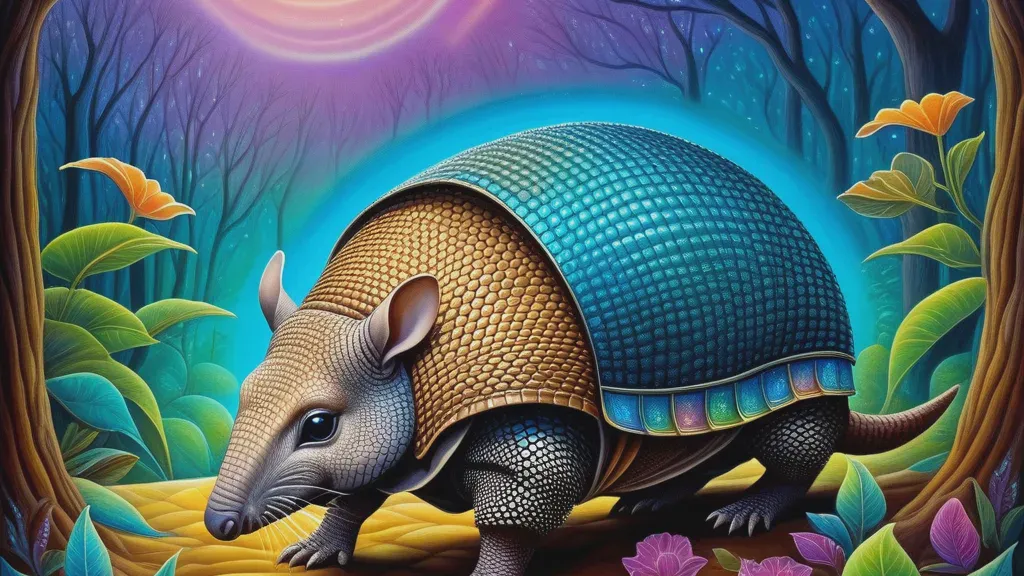
Armadillo
Jungian Archetypes
Meaning
The armadillo is the animal that carries its defence on its back: a bony, jointed shell over a soft belly, a body built to dig, to hide and, in one species, to close into a perfect ball. In a dream it pictures the dreamer's own architecture of protection — the layers of reserve, humour, competence or silence worn over something tender — and the trade the shell demands. Armour keeps out harm, but it also keeps out contact, slows movement and makes the wearer strange to touch. The dream tends to arrive when a boundary is either doing its job too well or failing, and it asks the dreamer where the shell ends, what it was grown to protect, and whether the creature inside can still uncurl.
Psychological Interpretation
An armadillo dream is nearly always about the cost and necessity of protection, and its details tell which. The species matters: only the three-banded armadillo can roll into a closed sphere, while the common nine-banded animal, startled, leaps straight up into the air, an instinct that gets it killed on roads. The psyche seems to know both options. A dreamer who watches an armadillo curl tight is looking at withdrawal, at a self that has learned to become unreachable when approached; a dreamer whose armadillo jumps or bolts is looking at a startle response, a reflex rather than a choice, and one that may do more damage than the threat. The shell itself is the second theme. Wearing it, carrying it, being unable to remove it, or finding it cracked all describe the state of the dreamer's boundaries — rigid, burdensome, breached. And the armadillo is a digger, a creature of burrows, which gives the dream a third register: the private underground where the soft-bodied self lives and to which it retreats. A friendly armadillo, one that lets itself be touched or leads the dreamer to its burrow, points toward a boundary that is beginning to flex. The animal is rarely threatening in dreams. What it threatens is the dreamer's story that being armoured and being alive are the same thing.
Traditional Symbol Meaning
The armadillo does not appear in the classical dream manuals; Artemidorus never saw one, and the Victorian dream books that catalogued every barnyard animal passed it by. Its dream lore is therefore younger and more local, drawn from the peoples who lived alongside it and from the modern habit of assigning animals a character. In the folklore of northern Mexico and the American South the armadillo is above all a survivor of hard times: the Hoover hog eaten when nothing else was available, the poor man's pig, the animal that goes on digging whatever happens above ground. To dream of it, in that vernacular, is to dream of getting by. Indigenous South American stories give the animal a more ambiguous role. The armadillo digs, and digging in myth connects the surface world with what lies beneath it. In several tellings from the Gran Chaco and the Amazon it is the creature whose burrow first joined the underworld to the world of the living, a small, unglamorous opener of ways. Elsewhere it is a trickster who wins by patience rather than cleverness, hiding until the powerful have exhausted themselves. The K'iche' Maya put its dance in the repertoire of the hero twins, who entertain the death lords of Xibalba with the dance of the armadillo before overturning them; the animal's slow, shuffling comedy is a mask worn in the presence of death. The Andean charango turns the folklore inside out. The instrument's rounded back was traditionally the dried shell of the quirquincho, and the animal's armour, meant to keep the world out, became the body that made music resonate. Andean folklore surrounds the instrument with its own legends, among them the sirena who is said to tune a charango left overnight beside a spring, and in dream terms the image is precise: a shell that has been emptied of its fear becomes a chamber for sound. Modern spirit-animal lore, which has adopted the armadillo as an emblem of boundaries and self-protection, keeps the first half of that idea and usually forgets the second. Kipling's fable supplies the last element. His armadillos come into being when a hedgehog learns to swim and a tortoise learns to curl, each borrowing the other's defence until they become a new animal that the jaguar cannot classify. Read as dream lore, the story says that the armadillo is not a fixed suit of armour but an improvisation, a creature that assembled its protection out of whatever it had. That is the tradition's most useful gift to the dreamer: the shell was learned, and what was learned can be revised.
Gestalt / Parts of Self
Become the armadillo and speak in the first person. I am hard on top and soft underneath. When you come near me I close. I can dig myself out of anything. Nobody can reach me unless I decide. Most people find that the voice is entirely their own, and that the pride in it is as strong as the loneliness. Gestalt dreamwork treats every element as a disowned part, and the armadillo is usually the part that took responsibility for safety when nobody else did. Ask it what it is protecting and how old it was when it started. Then become the belly, the soft unarmoured self, and let it say what it misses. Wilhelm Reich, with whom Fritz Perls trained, described character armour: chronic muscular tension that holds unwanted feeling out of awareness and fixes the body in a defensive posture. The armadillo is the animal picture of that idea, and Gestalt work goes straight to the body. Where do you harden when someone approaches? Jaw, shoulders, belly, breath? The dream shell has a location in your waking musculature, and the polarity to explore is closed and open: exaggerate the closing, curl completely, hold it, then find out what the first movement of opening feels like and what you are afraid will happen if you complete it. Contact and withdrawal are both legitimate. The armadillo dream is not a verdict against the shell; it is a question about whether withdrawal has become the only available response at the contact boundary. Set up the empty chair: the armadillo on one side, the person it curls up against on the other, and let the two speak until something shifts. Often the shift is small, a claim of the kind Gestalt calls owning: I close because I was hurt, not because you are dangerous. From there the experiment is concrete. In the coming week, in one safe encounter, leave the shell open a second longer than you usually would, and notice what your body does with the extra time.
Psychodynamic / Freudian
The manifest armadillo is a strange animal seen once in a documentary; the latent armadillo is the dreamer's own defensive organisation. Psychoanalysis has a precise vocabulary for it. Esther Bick described the second skin: when an infant's early experience of being held together by a caregiver fails, the child may develop a muscular or intellectual pseudo-independence, a self-made container that substitutes for the containing other. The armadillo's shell, grown from its own skin, is that second skin in animal form, and dreams of it often trace back to a childhood in which self-sufficiency was required too early. Object relations reads the curling-up as a schizoid manoeuvre. Harry Guntrip wrote of the in and out programme, the oscillation between a longing for closeness and a terror of being engulfed or hurt by it, so that the person approaches and then withdraws before contact can wound. The armadillo that tightens the more the dreamer reaches for it is that oscillation seen from outside. Winnicott's distinction between the true and the false self adds the belly: the true self, in his account, must remain hidden and uncommunicated in order to survive, and the false self manages the world on its behalf. The shell is not a lie, but it is a manager, and the dream is often a report that the manager is exhausted. Freud borrowed Schopenhauer's parable of the porcupines, which huddle together against the cold and prick one another, and must find the distance at which they can be warm without wounding. The armadillo dream poses the same problem in the transference. In treatment such dreams commonly appear when interpretation has come too close, and the patient's response is to curl: to become polite, factual, unreachable. The analyst's task is not to pry the shell open but to be the reliably non-wounding presence the burrow was built to replace. Displacement is at work when the armadillo stands in for a partner or parent who cannot be criticised directly; reversal is at work when the dreamer, who is in fact the one who withdraws, dreams of being shut out. Either way the wish beneath the dream is the oldest one: to be held without being hurt.
Contemporary Psychological
Cognitive science would first ask where the image came from. Most dreamers have never met an armadillo, so the animal enters the dream from memory sources such as documentaries, a road trip or a picture book, and memory-consolidation research suggests that the dreaming brain recombines such fragments in the service of current concerns rather than at random. Content analysis in the tradition of Calvin Hall and Robert Van de Castle shows that animal characters are far more common in children's dreams than in adults', and that when they appear in adult dreams they tend to carry emotional themes rather than to represent the species literally. The armadillo is chosen for what it does: it armours, digs and closes. That behaviour maps onto well-described defensive circuitry. The nine-banded armadillo's vertical leap when startled is a fixed action pattern, and the human startle and freeze responses, mediated by the amygdala and brainstem, are its close relatives. Antti Revonsuo's threat simulation theory proposes that dreams rehearse responses to danger in a safe offline setting; an armadillo dream may be the brain rehearsing withdrawal, evaluating whether the dreamer's habitual defence, curling up, actually works against the threats it is currently modelling. Predictive processing offers a complementary view. The shell is a prior, an expectation that contact will hurt, and the dream tests that prior against the evidence of a reaching hand. The continuity hypothesis, supported by William Domhoff's decades of dream-report analysis, holds that dream content tracks waking preoccupations, so the armadillo most often appears when boundaries are the live issue: a relationship pressing for more openness, a period of recovery in which the dreamer is deciding how much to let people in. Rosalind Cartwright's studies of dreaming during divorce found that people whose dreams engaged actively with the stressor adjusted better than those whose dreams avoided it, and Matthew Walker has described REM sleep as a setting in which emotional memories are re-experienced with their charge reduced. An armadillo that uncurls during the dream is, on this account, evidence of that processing under way: the brain trying out contact with the alarm turned down.
Jungian / Archetypal
Jung would begin with the shape. The three-banded armadillo closed into a sphere is a living mandala, a rounded whole with a soft centre and a hard circumference, and the dream image belongs to the symbolism of the Self as a protected totality. But a mandala that will not open is a problem, and the dream usually shows the armour in tension with the life it encloses. The shell is persona in its most literal form: the face shown to the world, adapted for survival, useful and necessary, but fatal if the dreamer forgets that it is not the whole animal. An armadillo that cannot uncurl, or a dreamer wearing a shell they cannot remove, shows a persona that has fused with the ego and cut it off from its own tenderness. The trickster in the armadillo is real and worth amplifying. Kipling's origin fable makes the animal a shape-shifter born of a hedgehog and a tortoise pooling their tricks, and the Maya hero twins dance the armadillo before the lords of death, using comedy and disguise where force would fail. In the Popol Vuh the twins survive Xibalba by being underestimated. The dreamer's armadillo may be that part of the psyche which survives by seeming harmless and slow while it digs, an intelligence Jung associated with Mercurius: elusive, earthbound, doubled in nature. Where the conscious attitude prizes confrontation, the dream compensates with an animal that wins by burrowing. The soft underside is where the anima or animus lives in this image, the unarmoured relational self that the shell was grown to protect and has come to hide. Individuation, in armadillo terms, is not shedding the armour but learning the joints: the bands that let the animal bend, dig and, at the right moment, close. A dream in which the armadillo is touched, opens its face to the dreamer or leads the way into its burrow shows the Self proposing a different relationship between protection and contact. The dreamer who follows it underground is being taken, as Persephone and Inanna were, into the place beneath the persona where the real work of wholeness is done.
Cultural & Historical Origins
The armadillo is a creature of the Americas and its symbolism is rooted there. The Spanish name means little armoured one; the Nahuatl name recorded by Bernardino de Sahagún in the Florentine Codex, ayotochtli, means turtle-rabbit, a compound of hard and soft, slow and quick. In the Popol Vuh of the K'iche' Maya the hero twins, performing before the lords of Xibalba, dance the dance of the armadillo alongside those of the weasel and the whippoorwill, a trickster's show in the realm of death. Among peoples of the Gran Chaco and the Amazon basin it appears in many tellings as a digger and cunning survivor, sometimes credited with opening the passage between the underworld and the surface. In the Andes the shell of the quirquincho was traditionally used to make the sound box of the charango, so that its armour became a singing instrument. Charles Darwin, collecting fossils in Argentina during the voyage of the Beagle, found remains of Glyptodon, a giant extinct relative, and the likeness between fossil and living armadillos fed his thinking on the transmutation of species. Rudyard Kipling's Just So Story The Beginning of the Armadillos, published in 1902, imagines the animal as the invention of a hedgehog and a tortoise who blend their defences to confuse the Painted Jaguar. In the United States it became Depression-era food known as Hoover hog and later the state small mammal of Texas, and in 2014 a three-banded armadillo, Fuleco, was the mascot of the World Cup in Brazil.
Contextual Variations
An armadillo curling into a ball the moment you reach for it
The reflex is faster than any decision, and that is the point. This dream shows a defence that fires before you can choose, and the animal you are reaching for is usually a part of yourself that closes the instant intimacy is offered. Notice what you do next. Waiting quietly beside the ball is a very different response from prodding it, and the dream is testing which one you actually practise with the people who curl up on you. If the armadillo opens while you wait, your psyche is showing you the pace at which trust becomes possible.
A nine-banded armadillo leaping straight up in front of your car
The real animal jumps when startled, an instinct that would foil a coyote and gets it killed by a bumper. In a dream the image describes a defence that has become dangerous because it no longer fits the threat: a reflexive overreaction, a burst of panic or defiance at exactly the wrong moment, an old survival trick misfiring in a new environment. You are the driver as well as the animal. Ask what you have been bearing down on lately, fast and without looking, and which part of you keeps jumping into the headlights instead of stepping aside.
Wearing an armadillo's shell that you cannot take off
This is the shell as burden. Protection that cannot be removed has stopped being a choice and become an identity, and the dream usually arrives when a role you built for safety, the competent one, the funny one, the one who needs nothing, has started to cost more than it saves. The weight and stiffness are information about what the armour prevents. Look for the seams. Even in the dream the shell is jointed, and the first band you can move is the place in waking life where a little more flexibility is already possible.
An armadillo digging a burrow beneath your house
The house is your inner life; the burrow beneath it is the retreat you keep even from the people you live with. An armadillo excavating there says that some part of you has been quietly making room to hide, and whether that is healthy depends on the dream's feeling. A burrow that makes the foundations shift describes a withdrawal that is undermining your relationships; a burrow you can follow into a warm chamber describes a legitimate need for solitude. Either way, something soft is living under the floor.
Frequently Asked Questions
Why did I dream of an armadillo when I have never seen one?
Is an armadillo in a dream a warning to protect myself?
Can an armadillo dream mean I am too closed off?
Is it bad luck to see a dead armadillo in a dream?
Journaling Prompts
- Describe your shell in plain terms: the habits, tones of voice, jokes or silences that keep people at a distance. Next to each one, write when you first learned it and whom it was protecting you from. Then mark which of those people are still in your life.
- Think of the last time someone reached for you and you closed. Write the scene twice: once from inside the shell, with everything you felt, and once from their side, seeing only the armour. What did they miss, and what did you?
- In the Andes the armadillo's shell was hollowed out and became the body of the charango, a small guitar. Write about one defence of yours that has already turned into something that resonates, a talent, a humour, a way of listening, and about one that is still only a shell. What would it take to hollow that one out?
- Picture the burrow: the private place beneath your private life. What lives there that nobody sees, and is it resting or hiding? Write down one thing from the burrow you would be willing to bring up into the house, and to whom.
Related Symbols
Dreamed about Armadillo?
Get a personalized AI interpretation that connects this symbol to your specific life circumstances.
Interpret My Dream