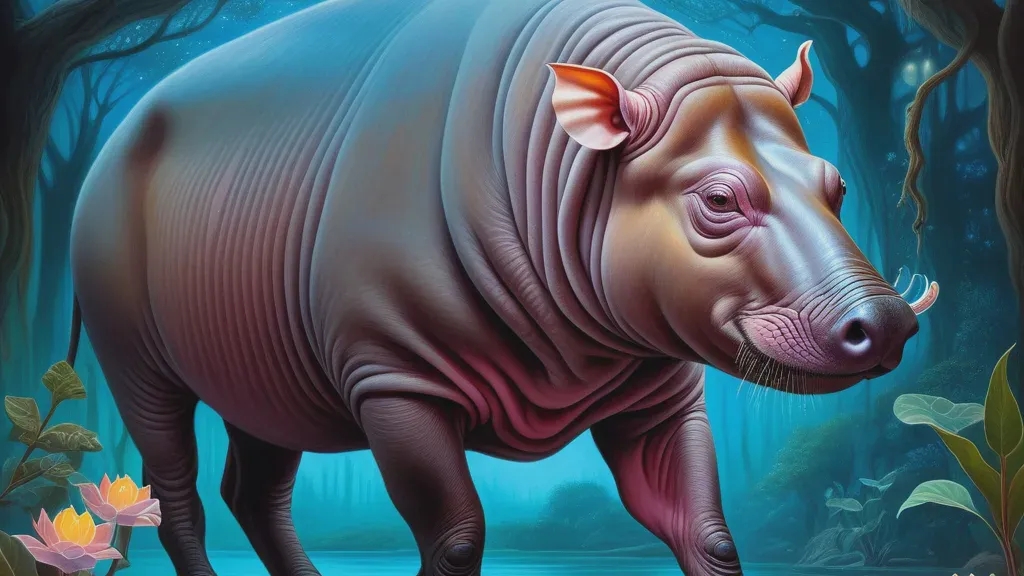
Babirusa
Jungian Archetypes
Meaning
The babirusa, the pig-deer of Sulawesi, carries its meaning in its anatomy: the male's upper canines grow up through the snout and curve back toward the forehead, ornament and weapon at once, and in old males they can curve back until they press against the animal's own skull. A dreamer who meets this creature is usually being shown a defence that has begun to wound its owner, a sharpness grown for display or protection that now points inward. Around that central image sit the animal's other qualities: shyness, island rarity, a body that fits no category, a habit of slipping through dense forest by finding the one gap that will take it. The dream tends to arrive when the dreamer feels both armed and cornered, and unsure whether the danger is outside or in.
Psychological Interpretation
Two readings compete in most babirusa dreams, and the details decide between them. The first concerns the tusks. When they curl back toward the eyes or already press into the forehead, the psyche is drawing a portrait of self-directed aggression: the critical inner voice, the anger with nowhere safe to go that turns on its owner. A dreamer who pities the animal rather than fears it has already recognised the portrait. The second reading concerns behaviour: the babirusa is a shy browser that avoids confrontation, threads narrow passages through the undergrowth and takes to water when pressed, so a dream emphasising this side is about how the dreamer moves through hostile territory, by force or by finding the gap. The animal's unclassifiable body adds a third layer. Early naturalists could not decide whether they were looking at a pig or a deer, and dreamers who feel they belong to no clear category often meet it. What the dreamer does matters most: following it suggests a willingness to learn its way through the thicket; feeding it suggests the dangerous part of the self can be approached without a weapon; hunting or fleeing means the strategy is still fight or flight. The dream asks which of the dreamer's sharp edges were grown for others, and what it would cost to let them wear down.
Traditional Symbol Meaning
Traditional dream lore has no entry for the babirusa, so it borrowed from the animals on either side of it. The pig was read for prosperity and appetite: a fat pig in the Victorian dream books meant money coming, a lean one meant want, and in the Chinese zodiac the pig stands for generosity, honesty and comfortable wealth. The wild boar was read for danger and courage; Artemidorus, the second-century author of the Oneirocritica, treats the boar roughly as a savage enemy and, for sailors, a coming storm, while Celtic tale and Norse myth make it the warrior's animal, from the great boar Twrch Trwyth hunted across Wales in the Mabinogion to Gullinbursti, the golden-bristled boar of the god Freyr. The deer, by contrast, was the gentle and hunted soul, the hart that pants for water in the Psalms. A creature that is all three at once was bound to unsettle any omen table. On Sulawesi itself the babirusa was a hunting animal before it was a symbol. The Minahasa and Toraja took it with nets, dogs and spears, sold it in the highland markets, and told stories about a pig that slept hanging from a branch by its tusks. For Muslim communities on the coast the animal's uncertain status raised a practical question about whether a pig-deer counted as pork, and there are reports of the matter being argued both ways. That ambivalence, meat to one village and taboo to the next, is a fair summary of how the animal has always been received: something between a prize and a prohibition. European naturalists gave the babirusa a moral reading almost as soon as they saw it, and from their puzzlement over a weapon that could wound its owner grew the modern parable in which the babirusa stands for display that turns into self-injury, the peacock's tail with an edge. Popular natural history has retold the story so often, sometimes with more drama than the evidence supports, that a dreamer who has never opened a book on evolution still tends to know the animal as the pig that stabs itself. The parable is worth keeping even where the anatomy is exaggerated, because it names a real pattern: a defence that was rewarded for a while and then kept growing after the reward stopped. Read together, the traditions offer the dreamer three things. From the pig comes appetite and plenty, from the boar force and the warning of a formidable opponent, from the deer timidity and grace, and from the babirusa's own strange anatomy the caution that a weapon grown for show can end up pointed at its owner. A traditional reader would have called the dream an omen of an unusual enemy or an unusual gift; a modern reader is more likely to ask which of the two the dreamer has been to themselves.
Jungian / Archetypal
The pig belongs to the Great Mother. Demeter's worshippers threw piglets into pits at the Thesmophoria, the sow suckling her litter was a fertility image from Neolithic Anatolia to Celtic Britain, and Jung's circle read the boar that gores Adonis as the devouring side of the same goddess. The babirusa is that lineage turned strange: a pig grown slender and deer-legged, with tusks that are pure ornament until they become self-harm. As a dream animal it carries the Mother's fertility and appetite together with a warning that the nurturing instinct, when it has no outlet, grows inward. Dreamers who are caretakers by role or temperament, and who have begun to resent it, meet this creature often. The tusks give the Animus his clearest anatomical portrait. In a woman's psyche the Animus is the inner voice of judgement and opinion, useful when it faces the world and destructive when it turns on her, and a tusk that curls back toward its owner's forehead is that reversal made bone. Men meet the same structure as a Shadow figure: the aggression that was never allowed out, sharpened for years and now pressing into the skull from inside. Amplification widens the picture. Varaha, Vishnu's boar avatar, lifts the drowned earth on his tusks, which is what the weapon is for when it faces outward; the Calydonian boar lays waste to a kingdom because a goddess was slighted, which is what happens when the instinct is ignored. The babirusa sits between those two, neither saviour nor scourge, a creature whose danger is chiefly to itself. Compensation explains the visit. A person who has been all deer in waking life, gentle, accommodating, quick to find the gap rather than push through, is shown the tusks they have been growing in secret; a person who has been all boar is shown how shy the animal underneath really is, and how it prefers water and salt licks to fighting. Individuation here means letting the two halves of the pig-deer meet: allowing the aggression a direction, so that it stops boring into its own head, and allowing the shyness its dignity, so that avoidance becomes discernment. The Self often signals progress in a later dream by showing the same animal with its tusks worn short, sparring harmlessly with another of its kind, which is what babirusa actually do.
Gestalt / Parts of Self
Gestalt has a word for what the babirusa's tusks do, and it is retroflection: energy meant for the environment turned back on the self. You wanted to bite, push, refuse or claim, the situation did not allow it, and so the movement completed itself against your own body, as a clenched jaw, a headache, a habit of self-criticism sharp enough to draw blood. The animal in your dream is you performing that reversal in slow motion over a lifetime. Take the empty chair. Be the tusk and speak in the present tense: 'I am growing toward your forehead, and I was made for' and finish the sentence. Whatever you were made for is the contact you have been withholding from someone else. Now be the rest of the animal, the shy, slender, deer-legged part that looks for the gap in the brush and takes to the river when pressed. This is the pole you probably identify with, and Gestalt would ask you to notice how much work it does to keep the tusked pole out of the room. The polarity is not aggression against gentleness but expression against avoidance, and both belong to you. In the dialogue, let the shy one tell the tusk why it is not allowed to face outward, and listen for the name of the person or the rule that made the decision. Then let the tusk answer. Most people find the tusk is not cruel, only cramped. Watch the contact boundary in the dream itself. A babirusa that bumps someone in a market and does not fight back is deflecting, letting the impact pass without registering it; one that refuses to drink at the water is withholding from itself what the environment is offering, a retroflection of receiving rather than giving. Try the experiment awake: the next time you catch yourself apologising for taking up space, say instead what you actually want, out loud, to the person in front of you, and notice what your jaw does. Held tension is the old reversal beginning; a breath that goes all the way out is the tusk turning, at last, toward the world.
Psychodynamic / Freudian
Freud's account of melancholia describes aggression that cannot be directed at a lost or forbidden object being turned back upon the ego, where it appears as self-reproach and, in severe cases, as a wish for punishment. The babirusa dreams that anatomy without the theory: a weapon that has grown until it bores into its own skull. The manifest content is an exotic animal, the sort of thing seen in a documentary; the latent content is usually a rage the dreamer has never been permitted to aim, at a parent, a partner, an employer, a body that failed them. The pig half supplies a further layer, since the pig is the oral animal of the nursery, greedy and unashamed, and a dreamer whose appetites were treated as disgusting in childhood may borrow its shape to picture the wish and its punishment at once. Klein extends the reading. The infant's attacks on the frustrating breast are, in phantasy, also attacks on the self that depends on it, and the guilt that follows is what the tusks describe, a sharpness that turns inward because it cannot bear to land on the object. Winnicott would notice the animal's timidity, the way it finds gaps and refuses to fight, and hear in it the compliant false self that grew up to protect a spontaneous one. Bion's notion of experience that cannot be digested is relevant when the babirusa refuses to drink: nourishment offered but not taken in because the apparatus for taking it in was never built. The dream's persistent gentleness, the fact that the creature bumps people and does not retaliate, is the defence at work, and should be read as such rather than admired. Defences shape the plot. Displacement puts the rage into an animal from the far side of the world, where it can be felt without consequence; condensation makes one body carry pig and deer, greed and fear, weapon and ornament; reversal turns the wish to hurt into an animal that hurts only itself. Object relations asks who the babirusa was fed by, and what happened when it showed its teeth. In the transference, patients bring this dream when the treatment has begun to touch anger at the analyst that they cannot yet voice, and the tusk pressing into the forehead is often the headache they arrive with. The task is to give the tusk an object, in words, before it finishes its curve.
Contemporary Psychological
Most people who dream of a babirusa met it in a documentary, a zoo or a photograph, and the continuity hypothesis predicts exactly that: the sleeping brain builds its scenes from recent, salient material, and an animal that violates the categories of pig and deer is about as salient as a stimulus gets. Predictive processing explains why. The brain holds a model of what animals look like, and a body that returns a large prediction error, tusks growing the wrong way, a pig with a deer's legs, is flagged for further processing, which includes replay during sleep. Robert Stickgold's work on novel tasks surfacing in hypnagogic imagery shows the same principle: what surprised the brain by day is rehearsed by night. Antti Revonsuo's threat simulation theory would expect a tusked animal to appear as a danger to be escaped, and some babirusa dreams do run that script. More often the dreamer reports the opposite, a shy animal that avoids conflict, and that fits better with the social simulation extension of the theory, in which dreams rehearse the reading of intentions and the negotiation of shared space. A creature threading a crowded market without pushing is a model of how the dreamer moves among others, and the dream may be testing whether that strategy still works. Ernest Hartmann's idea of the central image applies too: a weapon turned toward its owner is an unusually precise picture for a specific emotional state, self-directed anger, that the dreamer may not have named while awake. Memory consolidation and emotional regulation do the rest. Matthew Walker's laboratory describes REM sleep as replaying emotional experiences while the stress chemistry of waking is switched off, which allows a difficult content, in this case the recognition of one's own inward-pointing hostility, to be inspected calmly. Rosalind Cartwright's findings on dreams and mood suggest that a dream which lets the dreamer feel compassion for the wounded animal, rather than fear of it, has already done some regulatory work. The practical reading is modest. The brain has combined a novel image with an ongoing concern about self-criticism or self-sabotage, and the surprising animal is the tag that made the concern memorable enough to survive until morning.
Cultural & Historical Origins
The babirusa is native to Sulawesi and a few neighbouring Indonesian islands, and its Malay name, from babi, pig, and rusa, deer, records the confusion it has caused since people first tried to name it. That acquaintance is very old: among the rock paintings of the Maros caves in South Sulawesi, a figure identified as a babirusa at Leang Timpuseng was dated in 2014 to at least thirty-five thousand years, making it one of the earliest known figurative paintings of an animal anywhere. Alfred Russel Wallace, who studied the creature during his years in the archipelago, puzzled in The Malay Archipelago over tusks that seemed useless for fighting, and reported, with some scepticism, the local belief that the animal hooked them over a branch to sleep. Darwin cited the same tusks in The Descent of Man among the ornaments of sexual selection that appear to have outgrown any use. Among the Christian Minahasa and Toraja peoples the babirusa has long been hunted and eaten, while for the Muslim Bugis and Makassarese it falls under the prohibition on pork, so the same animal is game to one neighbour and forbidden to another; Indonesian law has protected it since 1931. It is sometimes suggested that the curling tusks inspired the fanged demon masks of Bali and Sulawesi, a claim repeated in travel writing more often than in scholarship. The wider pig family supplies its symbolic relatives: the boar that killed Adonis, the Calydonian boar of Greek myth, and Varaha, the boar avatar of Vishnu who lifted the drowned earth on his tusks.
Contextual Variations
A babirusa whose tusks curve back into its own forehead
This is the animal's defining image and the dream's most direct statement. Something you grew to protect yourself or to impress others, a sharp tongue, an impossible standard, a habit of striking first, has kept growing and now points at you. In waking life this often matches a stretch of harsh self-criticism or a private sense of being your own worst enemy. The dream is not asking you to file the tusks off; it is asking where they were meant to point. Notice whether the animal seemed to be in pain or unaware.
A shy babirusa threading its way through a crowded market
The market is social space at its most crowded, and an armed animal that chooses to find gaps rather than push through is a portrait of how you handle other people. You are not weak; you are tusked and choosing not to use it. The dream is usually about the cost of that choice, the small bumps absorbed without protest, the routes taken to avoid escalation, and it tends to appear when a situation at work or in a family has begun to ask more of you than avoidance can supply. Ask where in your life you are moving like this, and whether the crowd is really as dangerous as the strategy assumes.
A babirusa standing at a water source and refusing to drink
Babirusa are drawn to water and salt licks, so an animal that stands at the river and will not drink is going against its own nature, and the dream is about withholding. Something you need, rest, help, affection, food, is available and you are not taking it, usually because accepting it feels unsafe or like an admission. The animal watching you while you hesitate doubles the image: you are both the one refusing and the one wondering why. Look for a recent offer you turned down out of reflex, and consider whether survival mode has outlasted the emergency that switched it on.
Feeding a babirusa from your hand
Feeding a tusked, wary animal by hand is an act of trust in both directions, and it means the part of you that is both hurt and armed is being approached with care rather than fear. Dreamers report this scene when they have begun to treat their own harshness as something to tend instead of punish. Notice what you fed it and whether it took the food; a babirusa that eats is an anger turned inward that can be softened, one that refuses is still on guard. The scene is favourable either way, because you are the one holding out the hand.
Frequently Asked Questions
Why would I dream about a babirusa if I have never seen one?
Is the babirusa in my dream a warning about hurting myself?
Are pig dreams bad luck, and is a babirusa different?
Why was the babirusa in my dream so calm and gentle?
Journaling Prompts
- Draw or describe the tusks from your dream: their length, their curve, how close they came to the animal's own skull. Then write about the sharp thing in you that they resemble, the standard, the tongue, the vigilance, and who or what it was originally grown to face.
- Recall how the babirusa moved through its surroundings, whether it found gaps, hid, swam or stood still. Write about a current situation in which you move the same way, and list what that strategy has cost you this month in things unsaid or untaken.
- The babirusa is neither quite pig nor quite deer. Write about the categories you do not fit, at work, in your family, in your own idea of yourself, and describe one moment when being unclassifiable was a strength rather than a loneliness.
- On Sulawesi the same animal is game to one village and forbidden to the next. Name an appetite or ambition of yours that one part of your life treats as a prize and another treats as taboo, and write about who set each rule, which table you sit at more often, and what it would take to stop living between the two.
Related Symbols
Dreamed about Babirusa?
Get a personalized AI interpretation that connects this symbol to your specific life circumstances.
Interpret My Dream