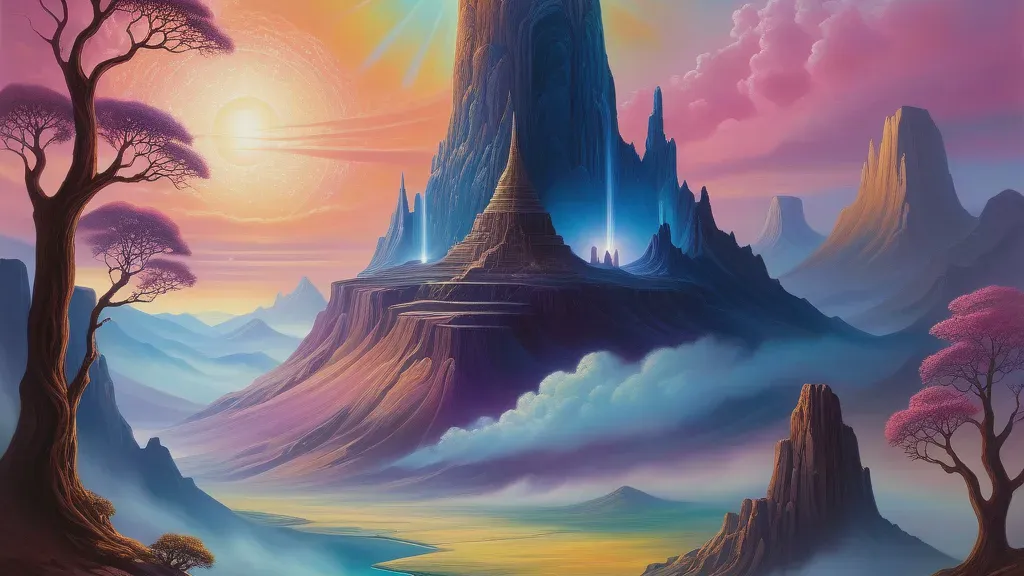
Butte
Jungian Archetypes
Meaning
A butte is what erosion could not take. Rain, wind and running water stripped the surrounding country down to a plain, and this one block, capped by harder rock, stayed standing with its flat top and sheer walls. In dreams the butte carries that geological biography into the psyche: it is the part of the dreamer that has outlasted the wearing-down of years, disappointments and other people's expectations, and it stands alone precisely because everything softer around it has gone. It is a landmark rather than a summit, a place to orient by rather than a peak to conquer, and its isolation can read as steadfastness or as loneliness depending on where the dreamer is standing in relation to it.
Psychological Interpretation
The first question a butte dream poses is one of position. A dreamer at its base looks up at a vertical wall with no obvious route, and the butte becomes an image of something admired but not yet reachable, a standard of endurance or self-possession beyond present strength. A dreamer on the rim looks down over a flattened country and finds that the summit is not a point but a platform: there is room up there to walk around, and nothing higher to aim at. That flatness matters. Mountains in dreams tend to speak of striving; the butte speaks of what remains once striving is over, and it can leave the dreamer with an unexpected question about what to do with an elevation that offers no further ascent. The second question is one of erosion. Because a butte exists only because the land around it was carried away, the dream often arrives in seasons of loss or attrition, when a marriage, a job, a belief or a body has been worn down and the dreamer is discovering which part of themselves is hard enough to persist. The psyche uses the image to say that something has survived the weathering, but also to show its cost: the survivor stands in a great emptiness, and the hard cap that saved it is not the whole of it. Beneath the resistant rock lie softer layers, and dreams in which the butte crumbles, or the dreamer cannot get down, point at the fear that the protective hardness is thinner than it looks.
Traditional Symbol Meaning
In the folk memory of the plains, a butte is first of all a place to steer by. Emigrant diaries from the 1840s and 1850s count the days to Chimney Rock and Courthouse Rock the way sailors count days to a headland, because on a flat route a single vertical remnant is the only proof that one is not walking in circles. The older European dream books never had a word for the butte, but they had words for its parts: a rock meant firmness that would not yield, a height meant a view and an ambition, a precipice meant a danger the dreamer was walking toward. The butte gathers all three into one body, and the traditional reading depends on which of the three the dream chose to emphasise. Among the nations of the plains and the Southwest the butte was never merely useful. Bear Butte is where Lakota and Cheyenne people still go to fast, to pray and to cry for a vision, and the flat summit of an isolated rock is the archetypal setting for that ordeal: high enough to be alone with the sky, small enough that the seeker cannot wander, exposed on every side. Ácoma Pueblo in New Mexico, the settlement its people call Sky City, has stood on a sandstone mesa for something like eight centuries, the larger cousin of the butte chosen for defence and for nearness to the heavens. In these traditions the top of the rock is an altar and a threshold, and the climb is a preparation rather than an achievement: something is supposed to be received up there, not merely seen. The geologists added a third layer that folk symbolism has quietly absorbed. A butte is an erosional remnant, an outlier, a witness: its strata record a landscape that has otherwise vanished, so that to read the layers in its cliff face is to read the biography of a country that no longer exists. The butte came to stand for memory that outlasts its context, for the survivor who carries the history of what was lost, and, in the western film, for the solitary figure against the horizon who belongs to the land more than to any town. That romance has its shadow: the pioneer buttes of Monument Valley are on Navajo land, and the rock that cinema made into an emblem of freedom has always been, for the people beneath it, a relative and a boundary marker rather than a backdrop. For the dreamer, these layers converge on a few messages. The butte orients, telling the dreamer where they are in a life that has lost its landmarks. The butte endures, showing what has survived a long weathering. The butte isolates, raising the dreamer above the plain and leaving them there with the sky, a blessing in the vision-quest reading and a warning in the folk reading of heights. And the butte remembers, holding in its cliffs the layers of a self the rest of the landscape has forgotten.
Jungian / Archetypal
Jung noticed early that the Self prefers to show itself in dreams as something mineral and enduring: a stone, a crystal, a mountain, a rock in the sea. He described sitting as a boy on a stone in the family garden and being unable to decide whether he was the boy on the stone or the stone being sat upon, and he later carved his own stone at Bollingen as an image of a centre he could not otherwise express. The butte belongs to this family of images with its own inflection. A mountain has a peak, and the ego can turn it into a heroic project; a butte has a level top, sheer sides and no summit to plant a flag on. It is closer to the omphalos at Delphi or the world-axis of a cosmology than to a climbing route, an earthly mandala offering, once reached, a platform where the dreamer can only stand and look in every direction. Individuation, as Jung described it, has a subtractive side: the false wrappings of the persona and the borrowed, collective parts of the personality are worn away until a form remains that is distinctly one's own. The butte is that form seen from outside, and the plain around it is the cost, a great expanse of what had to be carried off. The dream frequently arrives as compensation. To a dreamer whose waking life has become flat and identical to everyone else's, the butte rises as the vertical the conscious attitude lacks. To a dreamer who has hardened into self-sufficiency and mistaken a persona of endurance for the whole of themselves, the same rock appears crumbling, or offers a summit with no way down, because the Self insists on the soft strata beneath the cap. The shadow the butte throws across the plain each evening is an apt image for what the standing-apart posture has disowned: need, dependence, the wish to be part of the level country rather than above it. The anima enters where the isolated rock meets its surroundings. In Navajo and Lakota understanding the great buttes are living relatives, and in the dream the red rock at sunset, the wind on the rim or the figure who climbs alongside the dreamer often carries the relational function that the ego-as-butte has lost. Amplified through the vision quest, the summit becomes the place where the dreamer, having exhausted the heroic ascent, waits for something not of their own making. Jung would ask not whether the dreamer reached the top, but what came to them there, and whether they could bring it back down to the plain.
Gestalt / Parts of Self
In Gestalt dreamwork the butte is not a piece of scenery you happened to dream about; it is you, presented as a landform. So begin by becoming it. Speak in the first person and the present tense: I am the one that stayed. Everything around me was carried away and I did not move. I have a hard cap on top and softer rock underneath. My top is level and nothing grows on me. I can be seen from forty miles away and no one can climb me easily. Say the sentences aloud and notice which ones land in your body with a jolt of recognition and which ones you want to argue with. The ones you resist are usually the projections: the steadfastness you refuse to claim, or the aloofness you would rather not admit. The dream also contains the plain, and the plain is you as well. It is the part that was worn down, that gave way, that did not hold. Put the butte in one chair and the plain in the other and let them talk. The butte tends to speak as top dog: hold firm, stand apart, never let them see the soft layers. The plain tends to speak as underdog: I could not keep it together, I got washed away, at least I am not alone up there. Both voices belong to you, and the polarity between standing apart and lying flat, between the hard cap and the eroded ground, is the real subject of the dream. Ownership begins when you can say I am hard and I am worn down in the same breath without choosing one. Then attend to what you actually did in the dream, because the action is where contact and withdrawal show themselves. Climbing is reaching for contact with the withdrawn part of yourself. Sitting on the rim looking out is withdrawal that has become a stance. Being unable to get down is an interrupted cycle, a contact that cannot complete itself, and it is worth finishing in imagination: what happens if you find the route, or call for help, or simply stay until morning? Notice where in your body the butte's hardness lives right now, in the jaw, the shoulders, the held breath, and ask that place what it is protecting and what it would need in order to soften without collapsing.
Psychodynamic / Freudian
The manifest content is simple: a rock in a dry country, the dreamer at its foot, on its top or watching from a distance. Freud read dream landscapes as disguised bodies, and a classical reading would take a hard, upright, isolated mass over a flat plain as a paternal figure, the climb as an oedipal approach and the fear of falling as the anxiety attached to it. The reading is not wrong, but it is rarely the most useful layer. The latent content of a butte dream is usually less about the rock than about what happened to everything around it, because the dream stages an object that has survived an enormous, slow attack while the rest of the world gave way. Winnicott gave that image a theory. In The Use of an Object he argued that another person becomes fully real to us only after we have, in fantasy, destroyed them and found that they survive without collapsing and without retaliating; the surviving object can then be used, relied on, loved. The butte is the surviving object in mineral form. For some dreamers it recalls a parent who withstood a child's rage and stayed standing, and the dream carries a kind of gratitude. For others it shows the object they never had: a rock that crumbles as soon as it is touched, or one that survived only by becoming so hard that nothing could reach it. In Kleinian terms the split between the indestructible rock and the washed-away plain reproduces the infant's split between the good object that must be kept safe and the destruction the infant fears its own aggression will cause. The water that carved the plain is the dreamer's own unacknowledged attack. The defences the butte embodies are easy to name because the landform enacts them. Isolation, in the technical sense, keeps thought and feeling apart, and the butte is thought stranded above a plain of feeling. Reaction formation turns a soft interior into a hard surface, and the cap rock is exactly that. The persona of self-sufficiency many patients bring to the consulting room is a butte, and the dream tends to appear when treatment begins to work on it and the patient fears that, without the hardness, they will be carried away like the rest of the country. In the transference the analyst may be the rock the patient circles at a distance and cannot climb, or the patient may present as the rock and test whether the analyst will try to wear them down.
Contemporary Psychological
The dreaming brain is, among other things, a navigation system rehearsing its maps. Hippocampal place cells that fire in particular locations during waking exploration replay the same sequences during sleep, a finding first reported in rats by Wilson and McNaughton in 1994, and the cognitive-map theory of O'Keefe and Nadel gives landmarks a central role in how those maps are built. A butte is the landmark par excellence, a salient isolated object visible from everywhere on the plain, and a dream centred on one is often the mind doing spatial work: consolidating a recent journey, or reaching for an anchor when the waking situation has too few fixed points. Jay Appleton's prospect-refuge theory adds a second layer, proposing that humans are drawn to positions that offer a wide view from a protected place. The summit of a butte gives prospect without refuge, and the vertigo many dreamers report on its rim is what that mismatch feels like. Emotion enters through the sleep-dependent processing of feeling. Rosalind Cartwright's work suggested that dreams help regulate mood across the night, and Ernest Hartmann argued that dreaming finds a picture that contextualises an emotion, so that a survivor of loss may dream not of the loss but of an image that carries its feeling. The butte is a precise picture for having outlasted something: exposure, pride, fatigue and isolation in one frame. Antti Revonsuo's threat-simulation theory accounts for the version in which the dreamer cannot get down; heights and falls are among the ancestral dangers the brain rehearses, and a sheer drop on every side is a compact simulation of a situation with no safe exit. The continuity hypothesis associated with William Domhoff predicts that dream content tracks waking concerns and recent input, and a butte frequently follows a drive through the Southwest, a western film or a photograph seen that week; the image is borrowed, the feeling is the dreamer's own. Predictive-processing accounts treat the sleeping brain as a generative model sampling scenes from its priors, and an isolated rock on a plain is the sort of low-complexity, high-salience scene such a model produces when it needs to represent stability or aloneness with the fewest elements. If the butte recurs, the useful data are the variables around it: whether the dreamer is climbing or stranded, whether the top is empty or occupied, and what in waking life has recently been worn down to a single hard thing.
Cultural & Historical Origins
The word came into English from French-speaking trappers and voyageurs, who used butte, an ordinary French term for a small hill, for the abrupt flat-topped remnants they met along the Missouri and across the high plains; Butte, Montana still carries the name of the hill it was built beside. The peoples who lived among these rocks long before the French treated them as anything but scenery. Bear Butte in South Dakota, Mato Paha to the Lakota and Noahvose to the Cheyenne, is where the Cheyenne prophet Sweet Medicine is said to have received the four sacred arrows, and it remains a place of fasting and vision seeking for both nations. Devils Tower in Wyoming, Mato Tipila or Bear Lodge, often classed as an igneous butte, carries the Kiowa story retold by N. Scott Momaday in The Way to Rainy Mountain: seven sisters fleeing their brother, who had turned into a bear, climbed onto a tree stump that rose into the sky, the bear scoring the rock with its claws as the girls became the stars of the Big Dipper. The buttes of Monument Valley, Tsé Biiʼ Ndzisgaii, stand inside the Navajo Nation and were fixed in the world's imagination by John Ford's westerns from Stagecoach in 1939 onward, so that one silhouette of a Mitten Butte can now stand for the whole American frontier. Along the Oregon Trail, emigrants steered by Chimney Rock and Scotts Bluff, and Chimney Rock is the landmark named more often than any other in their surviving diaries, a measure of how much one upright rock meant to people crossing a country with no other fixed points.
Contextual Variations
Climbing a butte and finding the top flat and empty
You expected a summit and found a floor. This version of the dream is about arrival rather than ascent: the effort you have been making, in work, in a relationship or in some private project of self-improvement, has reached its elevation and there is nothing higher to aim at. The emptiness is not failure. It is the discovery that the goal was a platform for looking around, not a point for standing on, and the dream is asking what you will do with a view once you stop climbing. Many dreamers feel deflated; some feel the first real rest in years.
A butte crumbling under your feet
The hard thing you have relied on is giving way. When the rock breaks up while you stand on it, the dream is usually pointing at a self-image of endurance or independence that has been carrying more than it can bear. The cap rock is thinner than you thought, the soft layers are showing, and the psyche is warning that pure hardness is not a foundation. Ask what you have been holding up alone, and who might take some of the weight before the dream has to repeat itself with a bigger fall.
A lone butte on the horizon that you never reach
You are walking toward a fixed point that does not get closer. This is the dream of orientation without arrival: something in your life, a person, a standard, an older and steadier version of yourself, is serving as a landmark you steer by while never becoming a place you live. That can be exactly right, since a landmark's job is to be seen rather than reached, but if the dream carries longing, it may be showing you a quality you keep admiring from a distance instead of claiming. Try imagining what is on top before you decide you cannot get there.
Standing on the rim of a butte with no way down
You got yourself up and cannot get yourself back. This is the shadow of every dream of standing apart: the position that felt like strength turns out to have no exit, and the plain you rose above is now the only place you want to be. The dream often follows a period of pride or self-sufficiency that has quietly become isolation. Its practical question is who you would call from that rim, and why you have not called them awake. The way down in these dreams is almost always social rather than athletic.
Frequently Asked Questions
Is dreaming about a butte different from dreaming about a mountain?
Why did the butte in my dream feel lonely rather than triumphant?
I have never seen a butte in real life, so why did I dream of one?
Does climbing a butte in a dream mean I will succeed at something?
Journaling Prompts
- Picture the land around your butte before it was worn away, when the plain stood as high as the rock. Name three things in your life that have been carried off in the last few years, and then write about the one hard thing that is still standing. Is that thing the best of you, or only the most resistant part?
- Stand on the summit in your imagination and turn slowly through a full circle. Describe what you can see in each direction, in the language of your actual life: what is behind you, what is ahead, what is off to the sides that you usually do not look at. Then write down what you could not see from down on the plain.
- The butte has a cap of hard rock protecting softer layers underneath. Write about your own cap: the quality people can see from a distance, the thing you are known for withstanding. Then write about the softer strata it protects, and about what would happen if someone saw them. Who, if anyone, already has?
- Imagine that you have been sent to the top of the butte to fast and wait, as people have done on Bear Butte for centuries, and that something will be given to you there that you could not have earned by climbing. Write what you think it would be, and what you would have to leave at the bottom to receive it.
Related Symbols
Dreamed about Butte?
Get a personalized AI interpretation that connects this symbol to your specific life circumstances.
Interpret My Dream