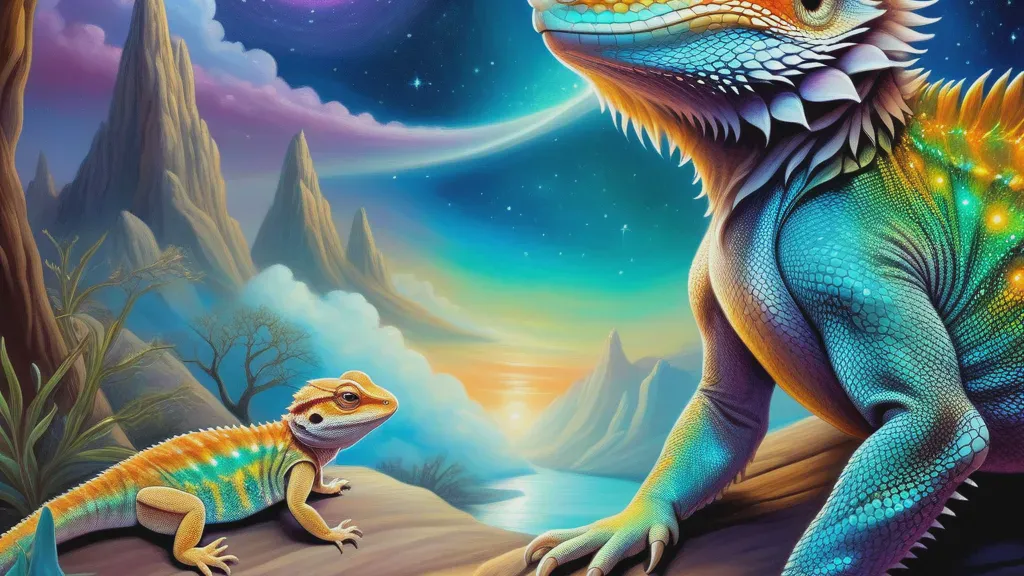
Bearded Dragon
Jungian Archetypes
Meaning
Dreams featuring a bearded dragon can symbolize transformation and wisdom. Psychologically, they may reflect an integration of diverse aspects of self, as these creatures embody adaptability and ancient knowledge.
Psychological Interpretation
In Jungian terms, the bearded dragon may represent the Wise Old Man archetype, suggesting inner guidance. Cognitive psychology interprets it as a representation of resilience and adaptability, while practical psychology focuses on the need for personal growth and change.
Cultural & Historical Origins
In Australian Aboriginal mythology, bearded dragons are seen as totem animals, symbolizing strength and adaptability. Similarly, in Chinese culture, dragons symbolize wisdom and power, often associated with transformation.
Contextual Variations
A bearded dragon sits calmly on your shoulder, watching your surroundings. When you move too quickly, it closes its eyes and relaxes, as if telling you to slow down.
This symbol often points to integrating primal impulses with grounded wisdom—your instinct is present, but it doesn’t need to run the show. The calm on your shoulder suggests guidance that helps you regulate pace and reactivity.
You’re caring for a bearded dragon in a terrarium, adjusting heat lamps and water. As you get the conditions right, the dragon becomes more alert and starts “communicating” with head bobs that feel like instructions.
The dream highlights adaptation through environment—how your inner state responds to conditions you can influence. Psychologically, it may reflect learning to tune boundaries, routines, and self-care so your instincts become allies.
A bearded dragon appears in a classroom and answers questions you didn’t study for. You realize it’s “teaching” you through observation rather than direct explanation.
This can represent an integration of the Anima/inner nature with learning—wisdom arriving through intuition and attention. The classroom setting suggests you’re developing maturity, not just knowledge.
Frequently Asked Questions
Why did the bearded dragon feel like a teacher?
What does it mean if the dragon’s behavior changed after I adjusted something?
Is this dream about my personality or my instincts?
Journaling Prompts
- Where in my life do I need to slow down and observe before acting—and what did the dragon do that modeled that?
- What “conditions” (environment, relationships, habits) affect my mood most, and how might I adjust them like the terrarium?
- What primal impulse do I tend to fear or suppress, and how could I relate to it with the dragon’s calm curiosity?
Related Symbols
Dreamed about Bearded Dragon?
Get a personalized AI interpretation that connects this symbol to your specific life circumstances.
Interpret My Dream