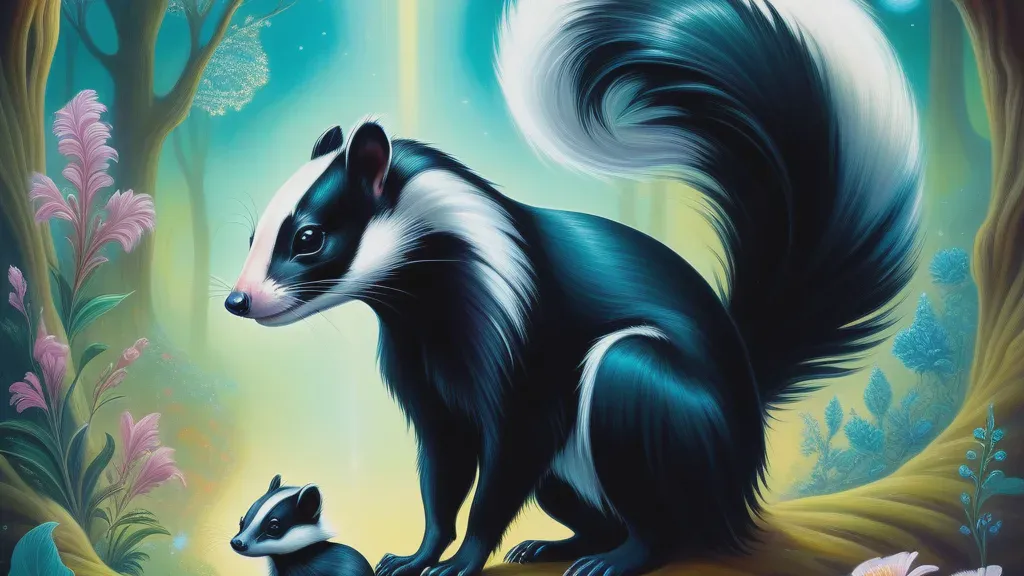
Skunk
Jungian Archetypes
Meaning
The skunk in dreams carries the quiet power of a boundary enforced not through aggression but through unmistakable presence — a threat that requires no actual deployment to command respect. It represents the parts of the self kept carefully contained because we fear their expression will drive others away, yet which, when owned with composure, become a source of genuine authority. To dream of a skunk is to stand at the threshold between suppression and self-possession.
Psychological Interpretation
In the symbolic language of dreams, the skunk encodes a paradox central to psychological maturity: that genuine power often looks nothing like power at all. It moves slowly, gives fair warning, and never strikes first — yet commands a wide berth from everything around it. The skunk represents the latent force of authentic self-expression, particularly the kind that has been suppressed out of fear of social rejection. Its spray, kept in reserve, is the most honest image the dreaming mind can produce for the concept of a real boundary: consequential, activated only when respect has been exhausted, and impossible to ignore once released.
Traditional Symbol Meaning
The skunk’s presence in human symbolic systems reaches deepest in the Indigenous Americas, where it developed layered significance across numerous Nations long before European contact. For many Plains and Woodland peoples, the skunk was a medicine animal whose central teaching concerned the relationship between self-respect and reputation. The skunk did not need to make itself larger, louder, or more threatening to command respect — it simply knew its own nature and moved in full possession of it. In some Mesoamerican symbolic traditions, the skunk appears in contexts of purification — a placement that becomes coherent when one considers the underlying logic: the spray drives away what should not be present. What repels also protects; what smells can also cleanse. This association positioned the skunk not as an agent of contamination but as a guardian of sacred space through the assertion of elemental truth. In Western European and American folk culture, the skunk accumulated a more comic and shameful reputation — the creature no gathering wants near it, the stock figure of social disaster. This coding reflects a specific and revealing anxiety: the skunk is small, slow, and non-threatening in almost every respect, yet can render a carefully maintained social environment completely uninhabitable. In twentieth-century American popular culture, the skunk was largely domesticated into comedy — Looney Tunes’ Pepe Le Pew being the most recognizable example — which had the psychological effect of defusing its charge into pure embarrassment. Turning the skunk into a buffoon is itself a form of containment: a way of managing the anxiety the creature genuinely generates. The dreaming mind, however, tends to bypass the comic layer and access what lies beneath it — the older understanding that the skunk’s composure is entirely genuine, and that its power, however small and slow the body carrying it, is real.
Psychodynamic / Freudian
From a psychodynamic standpoint, the skunk dream condenses several interlocking psychological pressures into a single precise image. The manifest content — an animal capable of releasing an irreversible chemical defense — carries latent meaning rooted in the dreamer’s relationship to their own threatening or unacceptable self-aspects. The skunk body, loaded and ready but not yet deployed, is a remarkably accurate image for reaction formation: the conversion of felt vulnerability into its powerful opposite, the transformation of the fear of being hurt into a readiness to be avoided. The olfactory dimension carries its own psychodynamic weight. Freudian analysis has long connected smell to the primal and the repressed — the body’s truth cutting through the polite surfaces of social presentation. What cannot be said can be smelled; what cannot be openly acknowledged announces itself anyway through channels the conscious mind did not authorize. The skunk’s spray represents precisely this dynamic: repressed material that, once released, pervades everything and cannot be recalled. The childhood origins of skunk dreams often trace to early experiences of social shame — specifically the discovery that certain authentic expressions of self had the effect of driving others away. The child who learned that their anger, their strangeness, or their inconvenient emotional needs cleared the room built a containment structure around those qualities. The skunk dream replays this foundational equation: the link between authentic self-expression and social abandonment, now being reexamined by an adult psyche to see whether it still holds. What the psychodynamic lens uniquely offers is attention to the defense structure itself. The dreamer encountering a skunk is not merely encountering a symbol of suppressed material — they are encountering the suppression mechanism in its animal form. The question is not only what lies behind the raised tail but also how long the dreamer has been living in a state of perpetual readiness, and at what cost.
Contemporary Psychological
Contemporary sleep and dream research frames dreams as functional cognitive events: the brain processing emotional residue, consolidating recent experience, and running threat-simulation scenarios in a consequence-free environment. From this perspective, a skunk dream is the neural system working with whatever waking-life material carries the specific emotional signature the skunk encodes — something simultaneously high-stakes and containable, something kept carefully managed but present and real. Threat simulation theory proposes that a primary function of dreaming is rehearsing responses to real-world challenges in safe conditions. The skunk is a near-ideal threat-simulation subject: it presents genuine danger that is entirely avoidable if you respond correctly — stay calm, move slowly, do not startle it. Recurring skunk dreams may indicate the brain is actively practicing a specific regulatory skill: the capacity to remain non-reactive under pressure, to resist the impulse to escalate, to trust that holding steady is more effective than fight-or-flight. Emotional regulation research adds another layer. The amygdala remains highly active during REM sleep, flagging emotional material that waking consciousness has not fully processed. When a dreamer is carrying chronic unexpressed defensive emotion — suppressed anger, unvoiced limits, enforced patience wearing thin — the brain produces imagery that externalizes this internal state. The skunk, visibly loaded with tail raised and weapon present but unused, is a precise neurological metaphor for an emotional system under sustained pressure. From a cognitive-behavioral perspective, skunk dreams may also reflect boundary schema stress: situations in waking life where the dreamer’s limits have been tested or quietly breached without explicit acknowledgment. The brain, processing these events during sleep, selects imagery that captures the felt threat-level accurately. The skunk delivers a specific message: something important is at risk here, your calm is doing real work, and the effort this is costing you deserves more recognition than you are giving it.
Gestalt / Parts of Self
In Gestalt dreamwork, every figure in a dream is a part of the dreamer’s own psyche, and the skunk asks to be inhabited rather than merely interpreted. Rather than asking what the skunk means, a Gestalt approach invites the dreamer to become the skunk: to speak in its voice, to feel what it feels, to discover what it knows that the conscious self has been pretending not to know. When you step into the skunk, you almost always find something that has been waiting with great patience — something that knows exactly what it needs, knows what it will do if those needs continue to be ignored, and has already been offering signals that went unread. The skunk as a part of self most often carries the energy of legitimate self-protection that has been culturally delegitimized. Many dreamers — particularly those socialized to manage others’ comfort before their own — have exiled the part of themselves that knows how to protect what matters. That part never agreed to the arrangement. It has been standing at the margins of awareness in full warning posture while the adaptive self kept insisting that everything was manageable, that the situation did not warrant a response, that keeping the peace was worth more than keeping the boundary. Gestalt attention falls equally on what the dreamer does in relation to the skunk. Running from it means running from your own protective capacity. Freezing near it suggests awareness of need without permission to act. Approaching with curiosity — or finding the skunk is already tame and already yours — signals a significant development: a growing willingness to accept this defensive intelligence as an ally rather than a liability. The Gestalt invitation in a skunk dream is ultimately one of ownership: to stop treating your own limits as though they are someone else’s problem to solve, to stop apologizing for having a nature that is not infinitely accommodating. The spray is always the last resort. What the skunk demonstrates first — and what the dream is teaching — is the dignity of simply being what you are, without performance and without apology.
Jungian / Archetypal
In Jungian analytical psychology, the skunk is among the most precise dream images for the social Shadow — not the monstrous Shadow of violence or moral failure, but the quieter Shadow of shame: the collection of genuine qualities, authentic needs, and inconvenient truths that have been exiled from the conscious personality because their expression risks the social belonging the self depends on. The skunk does not attack; it simply exists with a capacity that others find intolerable. This mirrors exactly what the Shadow is: authentic material — anger, power, unmediated need — made acceptable to the psyche only by being kept permanently out of sight. What distinguishes the skunk within Jungian symbolic work is its warning sequence. Before it sprays, it stamps its feet, raises its tail, and makes every available signal. Only when those warnings are ignored does it act. This maps with remarkable fidelity onto the psyche’s own process: it communicates its needs through discomfort, through resentment, through dreams themselves — and the skunk encounter is the unconscious asking whether the dreamer has been listening. The dream-skunk often arrives as an announcement that the warnings have been running for some time and the window for easy adjustment is closing. The Trickster archetype enters here as well. The Trickster disrupts social order through transgression, often in ways that are simultaneously humiliating and liberating. Few things disrupt a carefully managed social scene more completely than a skunk, and the psyche recruits this image deliberately. When the Trickster arrives in skunk form, it delivers the message that the maintenance of perfect social composure — the suppression required to remain perpetually acceptable — has a cost, and that the disruption one most fears may actually be the relief the self has been building toward all along. Individuation — Jung’s term for the lifelong process of becoming fully oneself — requires confronting and integrating the Shadow rather than endlessly suppressing it. A dream skunk moving with calm self-possession, unhurried and unashamed, simply occupying its place in the world, is a direct individuation image: an invitation to inhabit one’s authentic nature with the same groundedness. The skunk is not a problem. It is simply honest. The dreamer who can identify with its composure rather than recoiling from it may be approaching a threshold in the deepest sense of the word.
Cultural & Historical Origins
In many Native American traditions, the skunk holds the medicine of self-respect and reputation — the understanding that true authority does not need to announce itself loudly. Plains and Woodland peoples recognized in the skunk a teacher of restraint and clarity: it demonstrates, more vividly than almost any other creature, that character leaves an impression long after one has passed through. Skunk medicine was invoked for those who needed to learn that standing your ground is not the same as fighting, and that a calm certainty of self is more powerful than any display of force. In European and American folk culture, the skunk accumulated a more ambivalent reputation — simultaneously comic and shameful, the creature no gathering wants near it. This folk coding maps precisely onto the social anxiety of exposure: the fear of being the one whose truth, if known, would empty the room.
Contextual Variations
Seeing a skunk calmly in your dream
A calm, unhurried skunk reflects the psyche's invitation to embody the same quality in waking life. This image often surfaces when you have been managing a boundary situation with quiet grace but at real internal cost.
Being sprayed by a skunk
Being sprayed signals a breakthrough of something long contained — truth that can no longer be managed into silence, an emotion that has exceeded its container, or a disclosure that cannot be recalled.
A skunk crossing your path
A skunk moving across your path is a threshold image: something carrying significant self-protective power is passing through your field, and your response determines the outcome.
A friendly or pet skunk
A tame or affectionate skunk signals that a meaningful integration is underway. The self-protective capacity the skunk represents is becoming a trusted companion rather than a threat to be managed.
Frequently Asked Questions
What does a skunk symbolize in dreams?
Is dreaming of a skunk a bad sign?
What does it mean to be sprayed by a skunk in a dream?
Journaling Prompts
- What boundary in your life needs stronger protection right now?
- Is there a part of yourself you keep hidden because you fear others will pull away?
- When was the last time you stood your ground calmly, without aggression — and how did it feel?
Related Symbols
Dreamed about Skunk?
Get a personalized AI interpretation that connects this symbol to your specific life circumstances.
Interpret My Dream