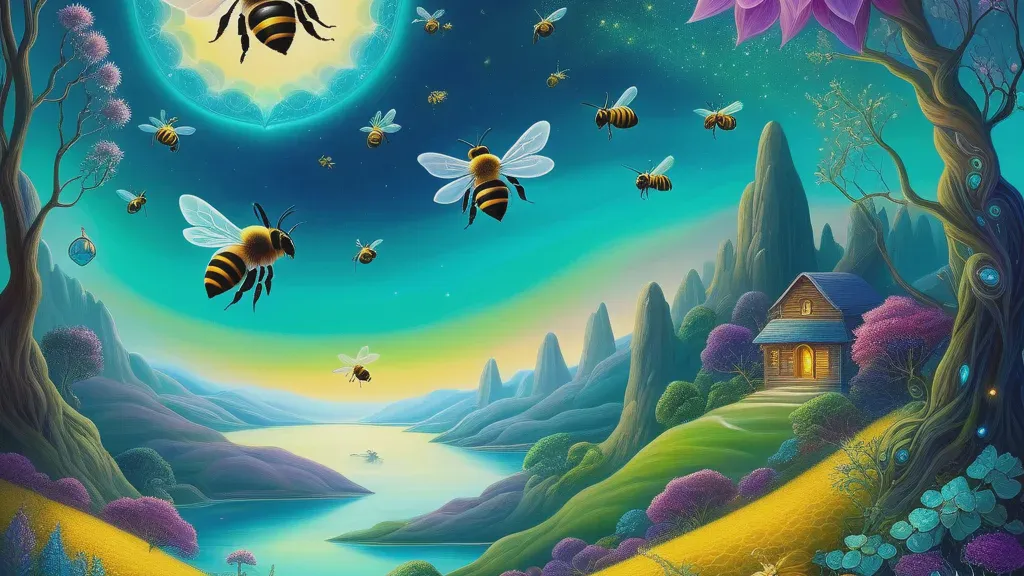
Bee
Jungian Archetypes
Meaning
Bees in dreams symbolize hard work, community, and the sweetness of life. They represent productivity, cooperation, and the ability to transform raw materials into something precious. Bees often signal the need to focus on your goals or to recognize the value of collective effort.
Psychological Interpretation
The Self archetype in the bee represents wholeness, integration, and the divine spark within. The Great Mother aspect embodies nurturing, fertility, and the generative power of nature. Dreams of bees suggest the importance of balancing individual effort with community support and recognizing your role in the larger whole.
Psychodynamic / Freudian
The bee in dreams represents a condensation of the productivity compulsion and the superego's relentless demand for achievement. At the manifest level, the bee appears as a simple insect engaged in work—gathering, building, serving the hive. But latently, the bee embodies the internalized voice of parental expectation and the dreamer's own driven self, the part that cannot rest, cannot fail, cannot be anything other than productive. The sting, then, becomes the punishment that follows any deviation from this ideal: guilt, shame, the superego's retaliatory strike against the forbidden wish to slow down, to be lazy, to simply exist without producing. This is a wish-defense structure—the wish to escape the tyranny of productivity is defended against by the very symbol that enforces it, turning the dreamer into the bee itself, identifying with the aggressor. The hive functions as a displacement of the family system and, more broadly, the conformity pressures of society. In the latent content, the hive represents the collective superego—the internalized voices of parents, teachers, and culture demanding that the individual subsume their own desires into the group's needs. The bee's role in the hive is fixed, predetermined, and unquestioned; there is no room for individuation or rebellion. Defense mechanisms at work include displacement (the external hive becomes the container for internal conformity pressure) and projection (the dreamer's own rigid self-demands are experienced as coming from outside, from the hive's demands). The sting operates as a reaction formation—the dreamer's repressed anger at being forced into this role is turned inward, becoming self-punishment rather than outward rebellion. Childhood origins of this symbol often trace to early experiences of conditional love—affection and approval granted only when the child performed, achieved, or met parental standards. The bee dream may replay a pattern in which the child learned that rest equals abandonment, that slowing down invites criticism or withdrawal of care. The hive becomes the internalized family system, and the sting becomes the internalized parent's disapproval. What presses toward consciousness in this dream is the repressed rage at having been instrumentalized, at having been valued only for output rather than for being. The bee's tireless work is both the defense (proving worth through productivity) and the symptom (the exhaustion and self-punishment that result). The dream invites the dreamer to recognize that the hive's demands and the sting's punishment are not external facts but internalized structures that can be questioned and, potentially, renegotiated.
Contemporary Psychological
Bees in dreams often reflect the brain's processing of collective dynamics and social coordination—the tension between individual autonomy and group obligation. From a contemporary psychology perspective, bee imagery frequently emerges when the dreamer is navigating complex social hierarchies, managing competing demands from multiple people, or integrating experiences of being part of a larger system. The hive structure itself mirrors how the brain consolidates memories of social roles and responsibilities, particularly when recent waking life has involved coordinating with others, meeting group expectations, or experiencing pressure to contribute to collective goals. This symbol often appears during periods of memory consolidation around workplace dynamics, family obligations, or community involvement. The threat simulation function of bee dreams typically involves rehearsing scenarios around social vulnerability—fear of being excluded from the group, anxiety about not meeting productivity expectations, or worry about conflict within a collective. Bees can also simulate the experience of being stung, which neurologically maps onto the brain's processing of social pain and rejection. When bees appear as threatening or aggressive in dreams, the brain may be running "what if" scenarios about social consequences: What if I fail to contribute? What if I'm seen as a burden? What if the group turns against me? This threat simulation helps the dreamer emotionally prepare for or process actual social pressures experienced during waking hours. Productivity and pain/reward processing are central to bee symbolism in contemporary dream interpretation. Bees work within a reward structure—their labor directly produces resources (honey, survival). Dreams featuring bees often emerge when the dreamer is processing their own relationship to productivity, effort, and reward. The brain may be consolidating recent experiences of hard work, examining whether effort is being adequately rewarded, or working through frustration about feeling exploited or undervalued. The pain element—the sting—represents the brain's integration of social or professional setbacks, criticism, or the emotional cost of maintaining group harmony. These dreams frequently occur during periods of high work stress, burnout processing, or when the dreamer is reassessing their effort-to-reward ratio in relationships or professional contexts. Cognitively, bee dreams reveal patterns of systematic thinking and problem-solving around efficiency and organization. The dreamer's brain may be processing how to optimize their own "hive"—their schedule, relationships, or responsibilities. Recurring bee imagery can indicate a cognitive loop where the dreamer repeatedly evaluates their contribution to groups, worries about productivity, or struggles with the balance between individual needs and collective demands. The emotional regulation function here involves the brain working through guilt, obligation, and the anxiety of interdependence. By simulating bee behavior—organized, purposeful, but also vulnerable to the group's needs—the brain helps the dreamer process and integrate their own experience of being simultaneously autonomous and embedded in social systems.
Gestalt / Parts of Self
The bee in dreams represents the industrious, productive part of the self—the worker who knows how to organize, create value, and contribute to something larger than itself. In Gestalt terms, the bee is the part of you that is driven, purposeful, and capable of sustained effort. It is the aspect that takes raw materials (nectar, pollen) and transforms them into something sweet and nourishing. When a bee appears in a dream, it often signals that this productive, organized part of self is active, or that the dreamer is being invited to claim or reclaim this capacity. The bee's industriousness is not frantic or anxious—it is purposeful, rhythmic, and aligned with a larger collective goal. The sting of the bee introduces a crucial Gestalt tension: the dreamer may be projecting their own capacity to defend boundaries, to assert themselves, or to cause harm onto the bee, rather than owning these qualities as their own. The sting represents the part of self that can say "no," that has teeth, that will protect itself and its work. Often, dreamers who fear their own aggression, assertiveness, or power will encounter the bee's sting as something external and threatening, when in fact it belongs to them. The dialogue here is between the sweet, nurturing producer and the fierce protector—both are necessary parts of a whole self. The projection happens when the dreamer sees the bee as dangerous or aggressive, rather than recognizing that they themselves contain both the capacity to create sweetness and the capacity to defend it. Ownership of the bee means integrating both its gifts and its defenses. It means claiming the part of you that works steadily, that builds something of value, that contributes to the collective good—without apology. It also means owning the part that will sting if necessary, that has boundaries, that will not be exploited or taken for granted. The bee invites the dreamer to ask: Am I allowing myself to work toward something meaningful? Am I defending my own efforts and boundaries, or am I giving away my sweetness without protection? The integration being called for is the recognition that productivity and protection, sweetness and assertion, are not opposites—they are complementary parts of a mature, whole self that knows both how to create and how to defend what it has created.
Jungian / Archetypal
The bee in dreams embodies a profound archetypal figure representing the tension between individual will and collective purpose, a living mandala of the Self in motion. In Jungian psychology, the bee carries the sacred feminine principle—the Great Mother's creative generative power—while simultaneously manifesting the Hero archetype through its tireless industry and purposeful action. The hive itself becomes a symbol of the Self, that central organizing principle of the psyche where individual consciousness dissolves into the greater whole without losing its essential nature. This paradox—the bee's fierce autonomy within absolute collective submission—mirrors the individuation process itself: the journey toward wholeness requires surrendering the ego's illusions of separation while maintaining authentic individual expression. The bee's duality of sweetness and sting reveals the Shadow's presence in this archetype. The honey represents the fruits of disciplined labor, nourishment, and the sweetness of connection; yet the sting embodies the Shadow's protective aggression, the necessary capacity to defend boundaries and inflict pain when the collective or sacred space is threatened. In dreams, the bee often appears when the dreamer is avoiding this Shadow integration—when they are either over-identifying with the collective (losing themselves in service, duty, or group conformity) or rejecting collective responsibility in favor of isolated individualism. The unconscious sends the bee as a compensatory message: true individuation requires honoring both the sweetness of belonging and the sting of necessary separation. From the perspective of collective meaning, the bee functions as a divine messenger between worlds—the pollinator that bridges flower and fruit, individual and community, matter and spirit. Ancient cultures recognized the bee as sacred to the Great Goddess, associated with prophecy, resurrection, and the soul's journey. In the alchemical tradition, the bee represents the transformation of base matter (pollen, nectar) into gold (honey), a metaphor for the individuation process itself. When the bee appears in dreams, it calls the dreamer toward conscious participation in something larger than themselves while simultaneously demanding respect for the individual's unique gifts and boundaries. The bee's appearance signals that the psyche is ready to integrate the paradox of being both utterly alone and utterly connected—the core realization of psychological maturity and spiritual awakening.
Cultural & Historical Origins
In ancient Egypt, bees were sacred to the sun god Ra and symbolized royalty and divine order. Greek mythology associates bees with the Muses and divine inspiration. In Christian symbolism, bees represent industry, obedience, and the sweetness of virtue.
Contextual Variations
Bee collecting nectar
Gathering resources, knowledge, or experiences; productive engagement with life
Bee stinging
Warning about consequences of actions; the need to set boundaries or defend yourself
Frequently Asked Questions
What does a beehive symbolize?
Why do bees appear in dreams about productivity?
Journaling Prompts
- What sweetness or reward are you working toward?
- How can you balance your individual goals with your role in your community?
Related Symbols
Dreamed about Bee?
Get a personalized AI interpretation that connects this symbol to your specific life circumstances.
Interpret My Dream