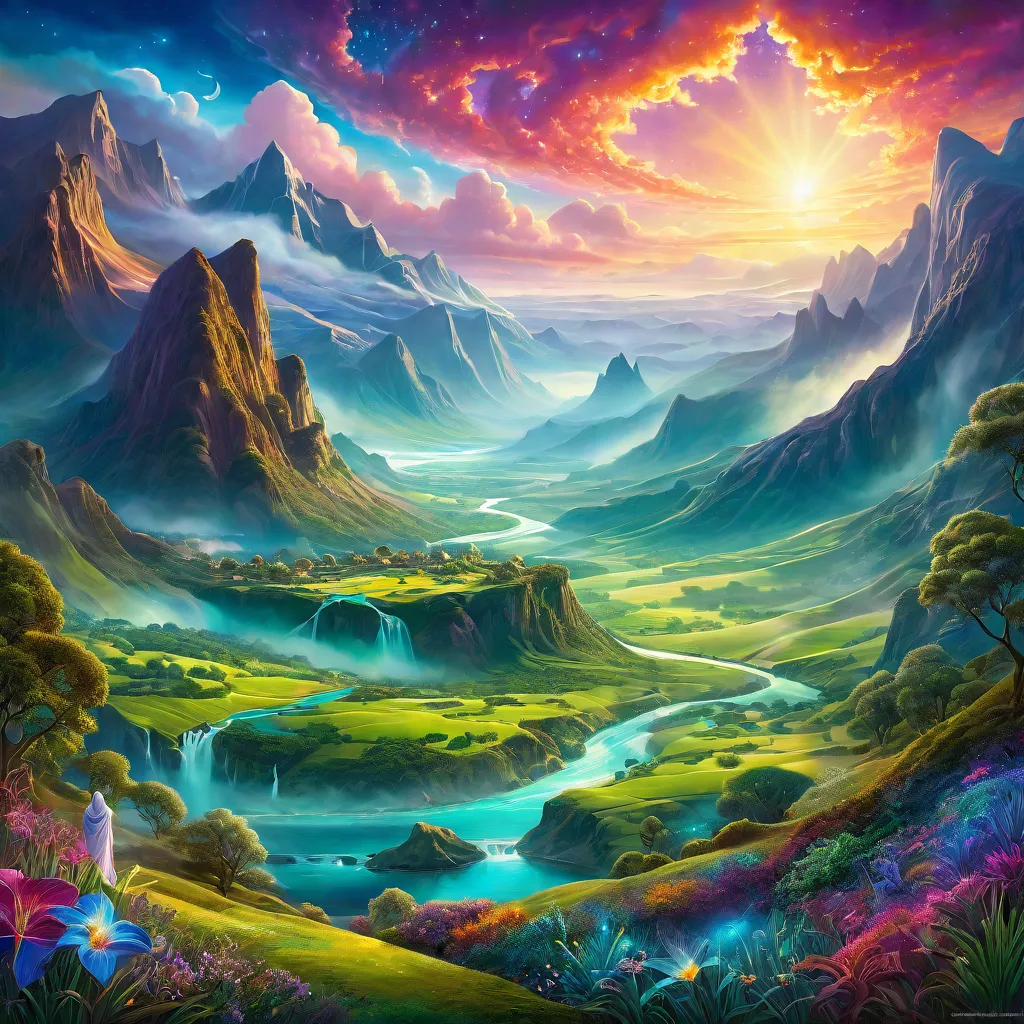
Valley
Jungian Archetypes
Meaning
A valley in a dream is low ground defined entirely by what rises around it — the place where runoff collects, where wind slows, where a traveler is sheltered from view and from weather alike by higher terrain on every side. To dream of standing in a valley is to dream of a particular relationship to exposure: contained rather than commanding, gathered rather than surveying. The psyche typically reaches for this shape when it wants to register a period of consolidation — feelings settling after being stirred, or a life narrowing, briefly, into a single low, quiet channel.
Psychological Interpretation
Where a mountain in a dream dramatizes ambition and a summit dramatizes achievement, a valley dramatizes the ground those peaks are measured against — the place a person returns to, is held by, or gets stuck in, depending on the dream's tone. Its low position is rarely a demotion; more often it marks proximity to whatever runs through a life without being consciously directed, since valleys are literally where water collects because gravity, not intention, brought it there. A dreamer who finds the valley peaceful, fertile, or sheltering is typically in a season where being held matters more than climbing, where rest or consolidation has more to offer than further ascent. A dreamer who finds the valley confining, foggy, or hard to leave is usually registering the same low ground as something closer to a rut: emotional material has settled here and is not yet moving on its own, and the dream's discomfort is less a warning than an honest description of feeling stuck at the bottom of something. The valley's edges, whatever encloses it, usually deserve as much attention as the valley floor itself, since what a dreamer sees ringing the horizon often names the very thing currently keeping them contained.
Traditional Symbol Meaning
Folk dream traditions influenced by the biblical valley of the shadow generally treated any valley dream with initial caution, reading the enclosing high ground as a source of concealed threat rather than protection. A fog-filled or dark valley was frequently interpreted as an approaching period of hardship or grief that the dreamer would have to pass through rather than avoid, the surrounding hills standing for obstacles or dangers not yet fully visible. Where the valley in the dream was green, sunlit, or fertile, older interpreters generally reversed this reading entirely, drawing on the pastoral tradition's opposite association of the valley with shelter, abundance, and rest after hardship. A lush valley dream was widely taken as an omen of coming peace or provision, the same low ground that signified danger in one condition signifying safety in another — the deciding factor, in almost every older tradition, being light and growth rather than the mere fact of low terrain. Contemporary interpretation keeps this same weather-dependent logic while translating omen into mood. A valley dream is now generally read less as a forecast and more as an emotional register already in progress: fog and darkness pointing to feelings not yet clarified, light and growth pointing to a settling that has already begun to feel restorative. The valley's condition in the dream, in other words, tends to describe where the dreamer's feelings currently stand rather than predict where events are headed.
Jungian / Archetypal
The valley belongs unmistakably to the Great Mother's terrain in Jung's symbolic geography — low, enclosed, receptive ground that holds rather than exposes, in direct contrast to the peak's association with the masculine drive toward achievement and separation. A dream set in a valley often marks a temporary shift away from the ego's habitual orientation toward striving and toward a more receptive, held mode of being. This shift is not regression, in Jung's account, but a necessary counterweight: psychic material that has been driven hard toward some summit eventually needs low ground in which to settle and integrate, much as water that has been forced uphill must eventually be allowed to pool and rest. A dreamer who resists the valley, straining to climb back out immediately, may be resisting exactly the consolidation the dream is trying to offer. The Anima frequently colors the emotional tone of the valley itself — the quality of feeling, rather than achievement, that the dreamer is being asked to attend to while there. A valley experienced as gentle and nourishing suggests the Anima is currently well integrated, offering feeling as a resource rather than a threat; a valley experienced as oppressive or trapping suggests the dreamer's relationship to their own emotional life currently feels more like confinement than like ground to stand on.
Gestalt / Parts of Self
The valley in your dream is not a place you have wandered into by accident — it is the shape your own need for shelter has taken tonight, built from whatever in you currently wants to be surrounded rather than exposed. Even the hills ringing it are you, playing the part of whatever currently keeps you contained. If the valley feels confining, speak as the hills that enclose it rather than as the person trapped below them: I am keeping you here because. Let the sentence complete itself before you judge it, and notice whether the reason sounds more like protection or more like control, since dreamers often discover it is some of each. Ask the hills directly what they are afraid would happen if they let you climb out today. If the valley feels sheltering, own that experience as your own creation rather than good fortune. Ask what you did, recently, that allowed you to feel held rather than exposed, and consider deliberately building more of that condition into your waking life instead of waiting for it to arrive again on its own. Notice, too, whether any part of you is already restless at the bottom of this valley, since that restlessness deserves its own voice as much as the relief does.
Psychodynamic / Freudian
A valley setting in a dream frequently marks a temporary retreat from an ego position that has become exhausting to maintain, offering the dreamer's psyche a lower-stakes, less exposed stage on which unresolved feeling can be processed without the added pressure of visibility. The specific quality of enclosure matters diagnostically. A valley that feels safely bounded, where the surrounding hills read as protective rather than confining, often reflects an internalized sense of secure holding, likely traceable to early experiences of being adequately contained by a caregiver rather than left too exposed or too restricted. A valley that feels inescapable, by contrast, may echo an earlier experience of containment that tipped into control, where safety and confinement were not clearly distinguished from each other. Fog or mist filling the valley floor is frequently a condensation image, standing in for feeling that has not yet been differentiated into a name: grief, resentment, and fear can all look identical from inside a dream fog, and the dream's task is less to resolve the emotion than to represent how undifferentiated it currently still is. Clarity arriving as the fog lifts, in dreams that resolve this way, often mirrors real psychic progress the dreamer has already begun making toward naming what, until recently, could only be felt as an undifferentiated weight.
Contemporary Psychological
Landscape preference research consistently finds that people across cultures rate enclosed, gently sloping terrain with visible water and vegetation, a description that fits many dream valleys closely, as more restorative and lower in perceived threat than open, exposed, or elevated terrain, a pattern some researchers connect to prospect-refuge theory and its account of which landscapes felt safest to early hominins scanning for both visibility and shelter. This preference offers a plausible, non-symbolic account of why the dreaming brain reaches for a valley specifically during periods of stress or overstimulation: the shape itself is neurologically associated with lowered vigilance, making it a fitting backdrop whenever a dream's underlying task is to lower arousal rather than to rehearse threat, the opposite function served by dreams set on exposed cliffs or open plains. What makes a given valley dream worth examining individually, rather than filed under generic restoration, is whether the enclosure in the dream reads as chosen or as trapping, since that single distinction, more than any generic reading of valleys as peaceful, tracks which side of prospect-refuge the dreamer's nervous system is currently favoring — the safety of being surrounded, or the claustrophobia of not being able to see past it.
Cultural & Historical Origins
Few landscapes carry as much accumulated symbolic freight as the valley, running from dread to sanctuary depending on the tradition invoked. The twenty-third Psalm gives the valley its most famous dark inflection in the phrase valley of the shadow of death, a passage that has shaped centuries of Western imagination around the valley as the low, shadowed passage a person must walk through, trusting protection they cannot yet see, before arriving anywhere safer. James Hilton's 1933 novel Lost Horizon reversed this valence entirely, inventing Shangri-La, a hidden Himalayan valley sealed off from time and conflict by the surrounding peaks, so thoroughly that the name has since entered everyday English as shorthand for any secluded utopia. Paleoanthropology adds a very different, non-mythic layer: East Africa's Great Rift Valley has yielded many of the oldest known hominin fossils, earning it the popular title cradle of humankind, so that in scientific as well as scriptural terms the valley has long stood for both the lowest point of a landscape and the origin point of an entire lineage.
Contextual Variations
Fog fills the valley floor until you name what you feel
Fog that lifts specifically in response to naming a feeling suggests the confusion was never about the situation itself but about your reluctance to call it by its actual name. The dream is showing you that clarity here is available the moment you stop describing the feeling in vaguer terms than it deserves.
You keep slipping on the valley floor until you slow your pace
Ground that only steadies once you stop rushing suggests the instability was a pacing problem rather than a terrain problem. The dream is proposing that whatever emotional territory you are currently crossing needs a slower rhythm than the one you have been forcing onto it.
You sit at the valley's rim watching a storm build and pass
Watching weather move through from a fixed, elevated vantage suggests you are developing the capacity to observe a difficult emotional period without being swept into its center. The dream frames this distance as a genuine skill rather than avoidance, one that lets the storm finish without asking you to be flattened by it.
The hills around the valley feel too close to climb out
Enclosure that reads as trapping rather than sheltering points to a situation where containment has tipped into restriction. The dream is drawing a distinction worth taking seriously in waking life: between being held and simply being unable to leave, which can feel identical at first but call for very different responses.
Frequently Asked Questions
Why do I keep dreaming of walking through a valley?
Is a foggy valley in a dream a bad sign?
Why does a peaceful valley feel different from a trapped one in dreams?
Does dreaming of a valley mean I need to rest?
Journaling Prompts
- Think of an emotion you have been feeling without yet being able to name precisely. Sit with it for a moment and try out several possible names for it, even ones that do not seem quite right, until one feels closer than the others.
- Recall a period in your life defined more by settling and gathering than by active pursuit of a goal. What did that period give you that a more driven stretch of time would not have?
- Notice a situation in your life where you cannot tell whether you are being protected or restricted. What would help you tell the difference, and who could you ask if you are unsure?
- Picture yourself watching a difficult situation from a slight distance, the way you might watch a storm pass over a valley from its rim. What changes about the situation when you imagine observing it rather than standing inside it?
Related Symbols
Dreamed about Valley?
Get a personalized AI interpretation that connects this symbol to your specific life circumstances.
Interpret My Dream