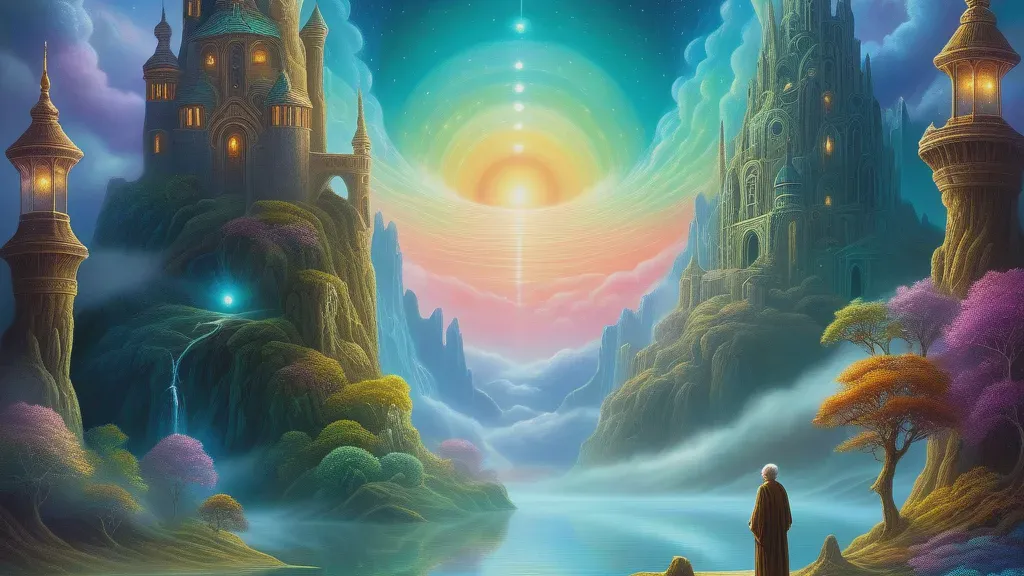
Keep
Jungian Archetypes
Meaning
A keep is the last defensible room of a castle, the tower a garrison withdraws into when the walls have been lost. Its whole design is a statement about trust: thick stone, one guarded entrance, windows narrowed to slits, supplies for a siege. In dreams it represents the innermost structure the dreamer has built for safety, the position held when negotiation has failed and everything outward has been given up. Because that refuge is also a confinement, the image carries its own cost inside it, and a keep usually appears in dreams at moments when a person is deciding how much of life to conduct from behind a door that only opens from within.
Psychological Interpretation
The dream turns on whether the dreamer is holding the keep or trying to get into it. Withdrawing into the tower and finding the door sound is a picture of successful defence, and it often arrives after a week of exposure, conflict or scrutiny, when the psyche is rehearsing the relief of an unassailable position. The relief is real but time-limited, because a keep is not a house. It is built for a siege, and dreams tend to make that plain by supplying the details of a siege: rationed food, a well, a watch to be kept, nobody to talk to. Structural detail carries the diagnosis. A keep with a working gate, a garrison and a road running to it describes a boundary that functions, protection that can still be opened for trade and company. A keep that has been sealed, whose door has been walled or whose stairs have collapsed, describes a defence that has become the situation rather than a response to it, and the dreamer inside is usually no longer sure who the enemy is. Approaching from outside reverses the question and asks about access: who in waking life keeps a last room the dreamer is not admitted to, or which part of the dreamer's own history is being defended against inspection. The emotional tone at the threshold, whether awe, exhaustion, resentment or homecoming, tells more than the architecture.
Traditional Symbol Meaning
The oldest readings of fortified places follow from what the buildings were for: entering a strong tower is protection and favour, being besieged in one is pressure from rivals or creditors, and a stronghold falling is a reversal of fortune. The readings are practical rather than mystical because the buildings were practical, and everyone who dreamed of them in the centuries when they were garrisoned knew exactly what a keep did. The questions that follow are equally plain: whether the gate held, whether the well ran, and whether the dreamer was inside by choice. The devotional tradition reworked the same architecture as an image of the soul. In Teresa of Ávila's castle the outer chambers are the distracted life most people live in, with the vermin of the courtyard following the soul in, and the movement inward is progress rather than retreat; the strong tower of Proverbs gave devotional writers a fortified conscience that no siege could take. In that light, entering a keep in a dream is consolation, a sign that the dreamer has a refuge circumstances cannot remove, and the older the walls look, the more the dream is saying that the refuge was there before the trouble was. A darker current runs alongside. Bunyan's Doubting Castle gave English readers the enduring image of a stronghold as a prison of one's own convictions, and folk narrative supplies the same reversal in the towers where daughters are shut away for their protection, Danaë in her bronze chamber and Rapunzel in the witch's tower, where safety and captivity are indistinguishable from inside. Read through these stories, a locked keep is a warning about a defence that has changed sides. The useful inheritance from all of this is a set of questions rather than a verdict: what is being defended, who declared the siege, whether the supplies are real or assumed, and whether the door is barred from inside or outside. A keep dream in that light is a report on the state of a defence, and its meaning depends entirely on whether the emergency that justified building it is still happening.
Gestalt / Parts of Self
Give the tower a voice before you give it a meaning. Speak as it: I am thick, I am cold, my walls are four feet of stone and my windows are cut so narrow that an arrow can come out but very little light gets in. Then say the next sentence in the first person too, the one about what you are for. Most dreamers arrive at something like I was built the year something happened, and that sentence tends to land in the body before the mind agrees to it. Every element of the dream is yours, which means you are also the besiegers outside, the empty rooms, the well, the barred door. Take the door in particular. Ask which side of it you were on, and where in waking life you occupy the same position: the conversation you conduct through an arrow slit, the friendship maintained at exactly the distance that keeps you safe. Perls called it retroflection when a person turns outward energy back against themselves, and a fortified life is retroflection in architecture, with the strength that could have gone into meeting people spent instead on holding the ground behind you. Set two chairs and let the keep and the one who wants in speak in turn. Let the argument run longer than is comfortable, since the defence has had years to prepare its case and the other side has mostly been kept silent. Let the defence say precisely what it is protecting and what year it thinks it is; let the other side say what it wants and how long it has been waiting. Withdrawal is a legitimate part of the contact cycle rather than a failure, and the aim of the work is not to demolish the tower. It is to be the one who decides when the gate is open, instead of living in a building that made that decision for you a long time ago.
Psychodynamic / Freudian
The keep is a nearly literal picture of what analysts describe as a defensive organisation: not a single defence but a whole structure, built over years, with its own economy and its own garrison. Anna Freud's survey of the ego's defences establishes the vocabulary, and John Steiner's account of psychic retreats supplies the exact match, describing the fantasy refuges patients construct as fortresses or private worlds where they can escape both external reality and unbearable internal states. Such retreats work. They keep out anxiety, guilt and dependence alike, and their price is a life conducted at a distance from experience, which is why the dreams that portray them so often combine safety with a flat, muffled atmosphere. The developmental history is usually legible in the details. Fairbairn described the schizoid withdrawal that follows early relationships in which needing someone proved dangerous, and Winnicott traced the false self that grows over a true one when the environment could not be trusted with what was underneath. A dreamer who cannot open the gate has generally learned that opening it once produced something unbearable, and the manifest content, an enemy at the wall, will often condense several figures at once: a parent, a former partner, a critical internal voice, and the dreamer's own repudiated longing. The latent wish inside such dreams tends to be the opposite of the manifest scene. Behind the image of holding out alone sits a wish to be found, relieved, taken seriously enough that someone would mount a rescue, and this is the point at which the transference becomes visible: a patient may dream of a keep at exactly the stage of treatment when the analyst has become someone worth admitting and therefore someone dangerous. Dreams in which the walls begin to crumble are not usually reports of collapse. They tend to mark a defence loosening because it is no longer needed at full strength.
Contemporary Psychological
A keep is prospect and refuge built in stone, and environmental psychology has a name for the preference it satisfies. Jay Appleton's prospect-refuge theory proposes that humans prefer settings which combine a wide view with a protected position, the ability to see without being seen, and a dream that places a person at the top of a tower looking out over open ground stages the resolved version of that old survival calculation, which is one reason the image can produce a physical sense of relief that outlasts waking. Irwin Altman's work on privacy supplies the correction the image needs. Privacy in his account is not a quantity to be maximised but a process of boundary regulation, opening and closing access to oneself to match what a situation requires, and both too much contact and too little count as failures of the same system. A keep dream shows the closed setting held past the point of usefulness, and the siege details the dream supplies, the rationed food, the watch, the well, the absence of anyone to talk to, are the cost side of the ledger presented with unusual honesty. Dreams of this kind tend to cluster in waking periods of scrutiny, conflict or overexposure, when the regulator has been pushed toward closure and has not yet come back. Attachment research draws the distinction that decides these dreams. Bowlby's secure base describes protection that a person leaves from and returns to, and the distinction between a base and a fortress is the whole clinical question in these dreams: one supports exploration, the other replaces it. Research on avoidance in anxiety consistently finds that safety behaviours reduce distress in the moment while preserving the belief that made them necessary, which maps onto the sealed keep with some precision. A defence never tested keeps its walls at full height, and dreams of a locked tower recur for as long as the outside world remains unvisited enough to be assumed hostile.
Jungian / Archetypal
Enclosed and centred structures belong to the imagery Jung associated with the Self, and a keep is one of the sterner examples: a defined centre, a boundary, a single point of entry. He gave the pattern a biography as well as a theory, spending decades building the stone tower at Bollingen and describing it as a confession in stone, a place where an older layer of the personality could exist without adaptation. Teresa of Ávila's interior castle offers the classical amplification, since her innermost room is the seat of encounter rather than a bunker. Both suggest that a dream keep can be a temenos, a protected precinct where something essential is preserved from a life that would otherwise consume it. The same image turns easily into its opposite. Where the keep is sealed, unlit and defended against an enemy the dreamer cannot describe, it depicts an ego position fortified past its usefulness, and the fortification is often built out of a virtue rather than a fault: competence, self-sufficiency, discretion, the refusal to be a burden. The Shadow in these dreams is not the besieging army but the disowned need that made the walls necessary, which is why the figure who knocks is so frequently someone the dreamer regards as weak or intrusive. The castellan matters as much as the castle. When an old keeper of the tower appears, showing the way to a stair or handing over a set of keys, the Wise Old Man is doing his proper work, which is not to defend the structure but to reveal what it was built around. Individuation asks for the gate to function in both directions, so that the keep becomes a place of retreat and return rather than a permanent address. The image of a keep left unlocked but still standing, with its contents intact, is one of the more precise pictures of what integration actually looks like.
Cultural & Historical Origins
The great towers the Normans raised across England and France were called donjons, from a Latin root meaning lordship, and the English word dungeon descends from that term because the strongest room in a castle was also the securest place to hold prisoners. The noun keep, in the sense of the tower itself, is a later English usage carrying the plain meaning of that which keeps. William the Conqueror's White Tower at the Tower of London, the twelfth-century keeps at Rochester and Dover, and Richard the Lionheart's Château Gaillard above the Seine established the form in the European imagination: a rectangular or cylindrical mass with the entrance raised above ground level and the living quarters stacked in a single defensible column. Japan produced an independent version in the tenshu, the towering keep at the heart of castles such as Himeji, where the upper storeys served as command post, treasury and symbol of a lord's authority. Scripture had already made the fortified tower a religious image, with Proverbs describing the name of God as a strong tower into which the righteous run and are safe. Bunyan turned the same architecture against his pilgrim in The Pilgrim's Progress, imprisoning Christian in the dungeon of Doubting Castle until he remembers the key called Promise. Teresa of Ávila, writing in 1577, made the castle interior rather than exterior, describing the soul as a castle of many rooms with the innermost chamber reserved for encounter with God.
Contextual Variations
Bolting the last door of a keep behind you
A relief dream with a sting in it. The act of closing the final door usually follows a stretch of waking life spent exposed, whether under scrutiny at work, in a conflict at home, or in a period of being needed by too many people at once. Your psyche is rehearsing the sensation of an unassailable position. Pay attention to what happened next in the dream, since the image is honest about consequences: if you turned around to a cold room, a dark stair or a silence, the dream is showing you both halves of the arrangement at once, and asking how many days of this you have actually budgeted for.
A keep whose door will not open from the inside
The reversal is the point. A structure built to keep others out has become the thing that holds you, which typically corresponds to a protective habit that has outlived the threat it answered: a reticence, a self-sufficiency, a rule about not asking. Notice how you responded. Searching for another way out suggests you are still looking for a solution that does not require anyone else, while calling from a window suggests something in you has begun to accept that release will have to involve another person. The identity of whoever hears you, or fails to, is worth recording carefully.
Climbing to the top of the keep to watch the road
Height in this dream buys perspective and costs contact. Standing on the roof looking out over open country is the resolved form of an old instinct, seeing without being seen, and it often appears when you have gained clarity about a situation by stepping back from it. The information tends to be genuine. The question the image raises is what you do with a vantage point: whether you eventually come down with what you have seen, or whether the watching has quietly become the activity, a way of following a life at a distance where nothing can arrive without warning.
Finding that the well inside the keep has run dry
Real keeps lived or died by their water, and the dream uses that fact precisely. A dry well signals that the defence is intact while the thing sustaining it is not, which is the specific condition of a person still performing competence on depleted reserves. The walls are holding and the supply is gone. Look at how you reacted, because denial is common in this image and instructive: lowering the bucket again, or telling nobody, matches a waking pattern of maintaining a position past the point where it is supportable. The dream is arguing for resupply rather than for surrender.
Frequently Asked Questions
Is dreaming of a castle keep a sign that I feel unsafe?
Why would I dream of being locked inside a place that was built to protect me?
Does a ruined or abandoned keep mean my defences have failed?
Why do I dream about a keep when nothing in my life feels threatening?
Journaling Prompts
- Draw the keep from your dream, roughly, and mark three things on the drawing: where the entrance was, where you were standing, and where the threat was supposed to be coming from. Then write about what occupies each of those positions in your waking life right now. Pay particular attention to the third one, and note whether you can name the enemy specifically or whether the direction is simply where you have always faced.
- Make a list of everyone who has ever been let inside: the people who have seen you without the walls up, even briefly. Beside each name write what happened afterwards, whether they handled what they saw carelessly, kindly or not at all, and whether they are still around. Then read the list as evidence and write what it actually shows about the risk of letting someone in, as distinct from what the tower assumes it shows.
- List the last five times you declined help you could have accepted: a lift, an offer to listen, a colleague's suggestion, an invitation you had the energy for. For each, write the reason you gave and the reason underneath it. Then choose one and write what would realistically have happened if you had said yes, in as much detail as you can manage without softening the risk.
- Describe the supplies in your keep. Write about what you actually have in reserve at the moment, in energy, in money, in people who would answer a call at midnight, and be exact rather than reassuring. Then write about how long the current arrangement can run on those reserves, and what the first sign would be that the well has gone dry, and who you would tell.
Related Symbols
Dreamed about Keep?
Get a personalized AI interpretation that connects this symbol to your specific life circumstances.
Interpret My Dream