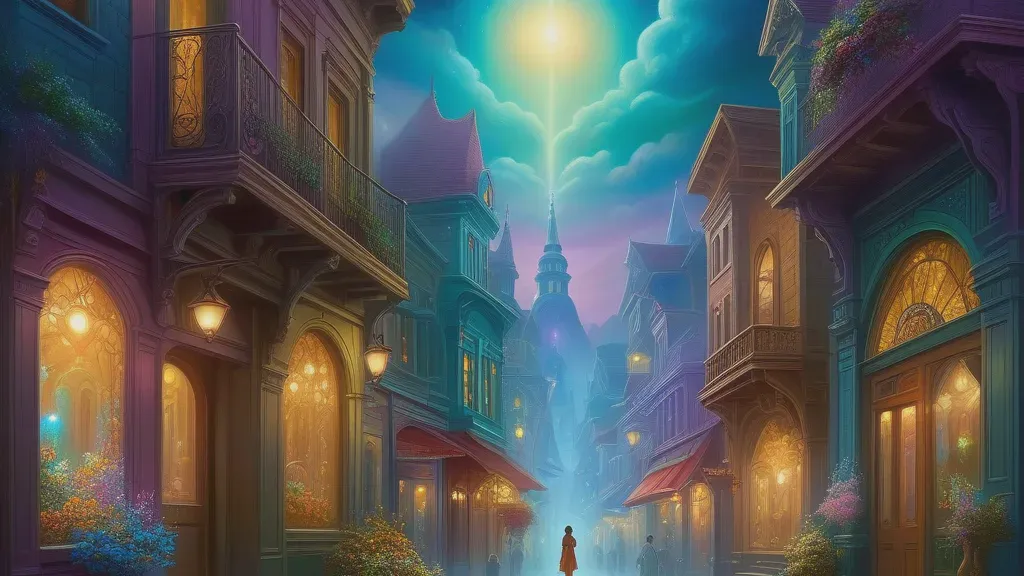
Main Street
Jungian Archetypes
Meaning
Main Street is the psyche's picture of the socialised self in public: the one road where private life is conducted in front of people who know the dreamer's name. Shopfronts, kerbs, awnings and the drift of pedestrians compress a whole community into a single navigable line, so the dream asks two things at once — where the dreamer belongs, and how much of that belonging is performance. Because the same road leads out of town, it also holds the pull between staying and leaving, between the comfort of recognition and the cost of visibility. Dreams of this street tend to arrive when a person's standing in a group is shifting: a move, a promotion, a separation, or a return to a hometown that rearranged itself while they were gone.
Psychological Interpretation
To dream of Main Street is to dream of the collective as architecture. The buildings stand shoulder to shoulder with their windows facing the dreamer, which is exactly how a community feels to someone unsure of their place in it: continuous, frontal, impossible to walk past unnoticed. Detail carries the weight. A street that is busy and legible, where the hardware store sits where it always sat, usually reports a settled sense of membership, and the dream offers it as a resource rather than a problem. A street whose shopfronts rearrange themselves, whose numbers refuse to run in order, or whose familiar signs have been replaced by names the dreamer cannot read, tends to accompany a real shift in social ground. Movement matters as much as scenery. Walking the length of the street puts the dreamer inside the town's rhythm; driving through without stopping suggests someone passing their own social life at a speed that prevents contact. Turning off into a side street can be a clean act of separation or a quiet desertion, and the feeling in the dream is what distinguishes them. Being watched from behind glass, greeted warmly by strangers, or hunting an address that will not appear are variations on one question the psyche keeps working at: whether the dreamer is held by this shared world or merely displayed in it.
Traditional Symbol Meaning
In older European towns the main street was where the community made itself legally visible. Proclamations were read there, banns were called, market courts were held near the cross, and punishments such as the pillory or a public procession of shame were deliberately staged along the busiest stretch. Traditional feeling about such a street is therefore double: it is the artery that feeds the town, and it is the place where a reputation can be made or destroyed within an afternoon. Folk speech preserves the second half of that in phrases about being talked about up and down the street, or being run out of town along the same road everyone else uses. Procession is the street's oldest ritual use. Weddings, funerals, saints' days, guild parades, harvest and homecoming marches all move along the main way rather than through the back lanes, because the point is to be witnessed. The route stitches private events into public memory, and it is why the same street can hold the memory of a burial and a carnival within the same year. Traditions that keep an evening promenade alive treat the street as a stage where the community rehearses who belongs to whom, and where absence is noticed as clearly as presence. Printed dream books of the eighteenth and nineteenth centuries generally read streets through their condition rather than their name. A broad, straight, well-lit thoroughfare was taken as a favourable sign for reputation and business; a narrow, muddy, obstructed or dead-ended one was read as a warning about gossip, debt or a plan that would not carry. These readings are folk psychology rather than analysis, but they preserve an accurate intuition that the state of the road stands for the state of a person's social path, and that dreamers notice pavement and shop windows because those details already carry social information in waking life. Since 1980 an American preservation movement has organised around the phrase Main Street, working to restore old commercial districts emptied by highways and out-of-town retail, and British writing about the decline of the high street covers the same ground. That history has quietly entered the dream vocabulary. A boarded, shuttered or half-abandoned main street now reads to most dreamers as loss of a shared centre rather than personal failure, and the emotion it produces is closer to grief for a place than anxiety about oneself.
Gestalt / Parts of Self
Gestalt work refuses to treat the street as scenery. You dreamed all of it, so all of it is yours: the road, the shopfronts, the awning that needs mending, the neighbour who greets you, the empty parking space, the traffic that will not let you cross. Begin by becoming the street and speaking in the present tense. I am Main Street. Everyone walks on me. I hold the whole town in a line and nothing happens on me privately. Say it aloud and notice what tightens. A person who has spent years being useful and available often hears their own life in that sentence before they can name the resentment in it. The polarity in these dreams is usually the walker and the watcher. One part of you moves along the pavement in the open; another sits behind glass, appraising. Both are you. Put the watcher in the empty chair, let it speak, and it will generally turn out to be voicing standards you learned early and have never revised. Contact and withdrawal are equally visible here. Going into a shop, stopping to talk, buying something is contact; the side street, the closed car window, the walk taken at an hour when nobody is out is withdrawal. Neither is wrong, but chronic withdrawal dressed up as independence leaves a hunger that the dream keeps staging as a street full of people who almost reach you. Stay with the body in the moment of being greeted by name. Warmth, dread and a rush of self-consciousness are all common, and the sensation is more reliable than any interpretation. If your chest tightens when someone recognises you, ask what you are afraid they will see, and let the answer be a specific thing rather than a general shame. Then work the boarded shop, if there was one, in the same way. Speak as it: I used to be open. Nobody comes in now. That figure often carries an abandoned interest, a friendship left to lapse, a competence stopped mid-sentence. Ownership here does not mean fixing the town. It means retrieving what you parked in it.
Psychodynamic / Freudian
The manifest content of a Main Street dream is a public place; the latent content is usually a private family. A crowd is an efficient piece of dream work, because condensation allows many separate people to be represented by a single anonymous mass, and displacement allows the judgement of one specific person to be transferred onto passers-by who are safely faceless. A dreamer who cannot yet think a critical thought about a parent, a partner or a supervisor may dream instead of a whole town noticing them. The affect is accurate even when the cast has been replaced, which is why the feeling in the street matters more than its geography. Freud discussed the common dream of being undressed in a street among strangers who take no notice, connecting it to early childhood pleasure in nakedness and to the shame that later covers it. Main Street dreams sit in that family. Object relations widens the frame: Winnicott's account of a holding environment describes exactly what a functioning town does, which is to persist reliably in the background so that ordinary life can go on without effort. When that background fails, dreams tend to produce shuttered shops and streets that have lost their order. Klein's idea of reparation is visible in the impulse many dreamers report to reopen the closed shop or clean the street, an attempt to restore an internal object that was damaged by the dreamer's own anger. Transference makes these dreams frequent in therapy, particularly when a patient is beginning to depend on the work and feels exposed by that. The consulting room becomes another street with a window. The central wish is often modest and hard to say: to be recognised without having to ask, to be given a place rather than having to earn one each morning. Homesickness for a hometown street usually turns out to be mourning that has not been completed, not for the buildings but for the version of the self who was known there without explanation. Working through it means grieving that recognition rather than trying to reconstruct it somewhere new.
Contemporary Psychological
Dream research is unglamorous about settings, and that is useful here. Content analysis by Calvin Hall and Robert Van de Castle established that most dream environments are mundane and familiar rather than exotic, and G. William Domhoff's continuity hypothesis holds that dream content tracks waking concerns and habitual activities. A dreamer who spent a childhood walking one commercial street has an over-learned model of it, and the sleeping brain reaches for cheap, well-consolidated material. That alone explains why the main street of a town someone left twenty years ago keeps reappearing while last month's unfamiliar city does not. Spatial memory research gives the mechanism more detail. The discovery of place cells in the hippocampus by John O'Keefe and Jonathan Dostrovsky, and the later finding by Matthew Wilson and Bruce McNaughton that sequences of hippocampal activity recorded while rodents ran a route are replayed during subsequent sleep, describe a system that rehearses paths offline. Human route knowledge appears to be consolidated in comparable ways. A remembered street is a long, ordered sequence of landmarks, and it is exactly the kind of structure this system stores well, which is why dreamers can often report shop windows in order even when the shops themselves have changed. The social content asks for a different account. The social simulation view of dreaming, developed by Antti Revonsuo with Katja Valli and Ilkka Tuominen, proposes that dreams preferentially rehearse bonds, alliances and reputational standing rather than solitary problem solving, and a street full of half-known faces is close to an ideal training environment for that. Emotional regulation research points the same way: Rosalind Cartwright's studies of people dreaming through divorce found that the emotional processing visible in their dreams tracked how well they recovered. Main Street dreams cluster around social upheaval for the same reason, and their frequency during a move, a redundancy or a return home is a sign of active work rather than of trouble.
Jungian / Archetypal
Analytical psychology treats the town street as the visible face of the collective, the place where the persona is worn because it is required. The dreamer walking there is negotiating with something larger than any individual: the shared expectations, manners and unspoken rules that a community keeps in circulation. The Great Mother is often close in these dreams, not as a woman but as the town itself, the container that feeds, gossips, remembers and refuses to let anyone become entirely unknown. Where the street feels warm and well provisioned, that maternal aspect is holding the dreamer; where it feels sticky, watchful and impossible to leave, the same archetype has turned devouring, keeping a person small in exchange for keeping them safe. The Hero enters as the counter-movement, since the road that runs through town is also the road out of it. Individuation asks for a differentiation from the collective that does not curdle into contempt for it, and Main Street dreams stage that task precisely. Compensation is worth watching for: someone who has over-adapted to a group, saying yes to every expectation, often dreams the street deserted and the shops dark, while someone living in real isolation may dream it crowded and greeting them by name. The unconscious supplies the missing half. Amplification points to the Greek agora, the Roman forum and the processional avenues of older cities, all of them places where private persons became public figures for an hour. The crossroads at the middle of such a street carries its own weight. Where four directions meet, the psyche has a natural image of the Self as centre, and a market cross or a central intersection in a dream frequently marks the point where a decision must be made in view of others rather than in private. Shadow appears in this landscape as the watcher behind the glass, the neighbour who knows too much, the small-town judgement the dreamer left home to escape and then installed internally. Returning to that street in a dream at midlife is rarely simple nostalgia. More often it is the psyche proposing a second visit to the place that formed the persona, this time carrying a self solid enough to walk it without being absorbed.
Cultural & Historical Origins
The main street of a town is old civic technology. Roman colonial towns were laid out along a cardo and a decumanus crossing at the forum, with shopfronts opening directly onto the paved way, and the medieval European market street inherited that logic: a chartered market, a market cross, a road wide enough for stalls and processions. English usage still calls it the high street, and the phrase carries the same weight of ordinary commerce and local reputation that Americans give to Main Street. In Italy the evening passeggiata along the corso turned the street into a formal social occasion, a slow parade where families were seen and young people were assessed, and the paseo around the plaza in Spanish-speaking towns does much the same work. The American version acquired a literary and political charge in the twentieth century. Sinclair Lewis published his novel 'Main Street' in 1920, using Gopher Prairie and the frustrated Carol Kennicott to expose the conformity beneath small-town warmth, and the title became shorthand for provincial life itself. Norman Rockwell painted the main street of Stockbridge, Massachusetts, at Christmas in 1967, fixing the opposite reading in the popular eye: continuity, safety, a place that holds its people. Walt Disney opened Main Street, U.S.A. in 1955 as the entrance to Disneyland, drawing on memories of Marceline, Missouri and building a street that is deliberately slightly under full scale. American political speech still sets Main Street against Wall Street whenever it wants to name ordinary people. A dreamer inherits all of this: a street that means belonging, surveillance and nostalgia at the same time.
Contextual Variations
Walking down Main Street while strangers greet you by name
Being recognised by people you cannot place inverts the usual social arithmetic: you are known without having done the work of becoming known. If the feeling is warm, the dream is showing you a reservoir of belonging you have been discounting, often at a time when you feel like an outsider in waking life. If it makes you uneasy, look at where you are currently expected to be someone before you have agreed to it — a new role, a family reputation, a title that arrived with assumptions attached. The greeting is pleasant and unearned, which is precisely what makes it worth examining.
Every shopfront on Main Street boarded up and dark
A shuttered street usually shows up during withdrawal rather than crisis. Ask which of your ordinary points of contact have quietly closed: the friend you no longer call, the group you stopped attending, the work that used to bring people to you. The dream stages this as economic rather than emotional collapse, which is the psyche's way of describing something structural instead of dramatic. Grief is the common feeling, and it is appropriate. Reopening one shop is more useful here than mourning the whole row, so notice which single dark window your attention returns to.
Driving Main Street looking for an address that never appears
Searching dreams turn on what you were looking for. A house number, a shop, a person's office — each names a specific need currently unmet: shelter, supply, help. Driving rather than walking is the detail that matters most, since the car keeps you sealed from the street you are searching. When the address refuses to appear no matter how many times you pass, the psyche is often reporting that the thing you want is not available in this social world, or not available at the speed and distance you are willing to approach it. Try the dream again on foot in imagination and see what changes.
Your childhood house standing in the middle of Main Street
A private house moved into the commercial row collapses two worlds that are usually kept apart, and the effect is exposure. Family life is suddenly at street level with its curtains open. This image often arrives when something domestic has become public — an illness talked about at work, a separation everyone knows of, a family difficulty that has stopped being containable. It can also mark a life stage where the dreamer's origins are becoming visible in their adult manner, for better or worse. Notice whether you wanted to go in, and whether the front door was where it should have been.
Frequently Asked Questions
Why do I keep dreaming about the main street of my hometown?
Why does an empty Main Street feel so unsettling in a dream?
Does dreaming of Main Street mean I should move back home?
Is a Main Street dream about my family or about my wider community?
Journaling Prompts
- Draw the main street of the town you grew up in from memory, marking the shops in the order you remember them. Then mark the two buildings you were most and least comfortable walking past as a child. Write about what each of those buildings represented socially, and where those same feelings show up in the street you live on now.
- Think about the last time someone greeted you in public when you did not recognise them. Write down what your body did in that first second — before politeness arrived. Then describe a situation in your current life where you are being treated as a known quantity by people who have not actually met the person you are today.
- List the ordinary places where you are currently seen in the course of a normal week: the counter, the school gate, the corridor, the group chat. Which of these give you a real sense of being placed, and which are performances you would drop tomorrow if there were no cost? Write about what would remain of your social life if you kept only the first list.
- Describe the shuttered shop in your own life — the interest, friendship, skill or place you let close without deciding to. Write about why it shut, without defending yourself. Then write down the smallest concrete act that would open its door by an inch this month, and note honestly whether you intend to do it.
Related Symbols
Dreamed about Main Street?
Get a personalized AI interpretation that connects this symbol to your specific life circumstances.
Interpret My Dream