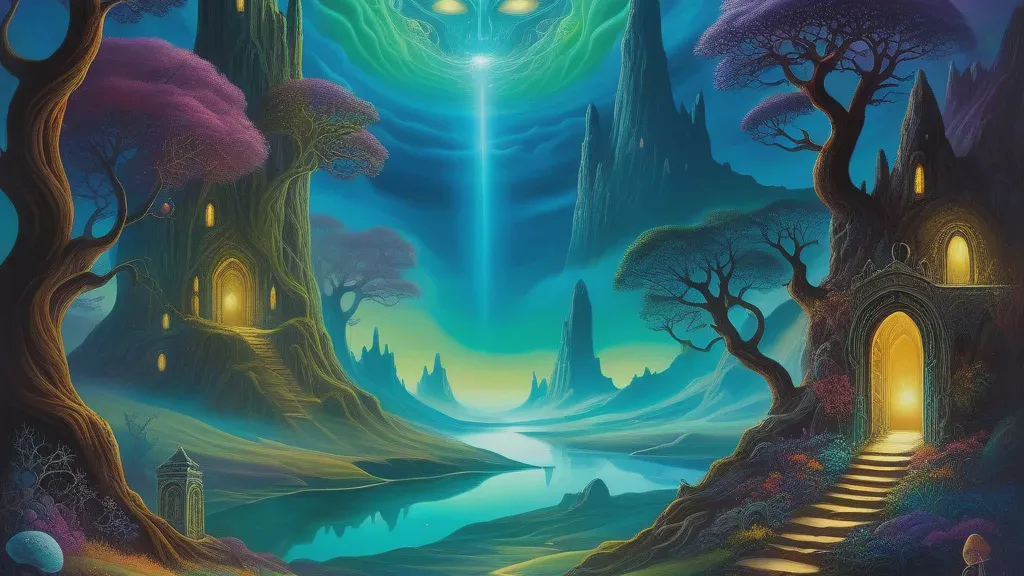
Land Of Dead
Jungian Archetypes
Meaning
Dreaming of the land of the dead often reflects fears of mortality or unresolved issues, symbolizing the subconscious processing of loss.
Psychological Interpretation
From a Jungian perspective, this land represents the Shadow and Persona, reflecting inner conflicts. Cognitively, it suggests confronting fears of death, while practical psychology emphasizes the importance of emotional closure.
Cultural & Historical Origins
In ancient Egyptian mythology, the afterlife was essential, with the Duat symbolizing the land of the dead. Similarly, in Greek mythology, Hades represents the realm of the deceased, emphasizing themes of mortality and legacy.
Contextual Variations
You walk through a quiet plain where the ground looks familiar but your footsteps make no sound; you see a distant figure calling your name, then the air turns cold and still.
This often mirrors processing of grief or a “pause” in life after loss—your mind revisits the emotional terrain where something ended. The silent steps suggest avoidance of acknowledging feelings, while the calling figure points to an unresolved attachment.
You arrive at a gate with no guards; instead, you’re asked to choose which memory to carry forward, and you feel torn between several loved moments.
The land of the dead becomes a symbolic courtroom for memories—your psyche sorting what to release and what to integrate. The choice indicates you’re ready to metabolize loss, but ambivalence remains about what staying faithful should look like.
In the dead landscape, you try to run back to the living world but every path loops to the same crossroads; the loop feels less terrifying than frustrating.
Looping paths can represent stuck mourning or unfinished emotional business. Frustration rather than terror suggests you’re not only afraid—you’re also demanding closure and a clearer direction for how to continue.
Frequently Asked Questions
Does dreaming of the land of the dead mean I’m afraid of dying?
Why do I keep seeing familiar places in that land?
What if someone I know is there and they look peaceful?
Journaling Prompts
- What loss, transition, or “ended chapter” feels most active in me right now, even if I’m not naming it?
- What emotion is strongest in the land of the dead—fear, numbness, longing, anger—and when do I typically feel it awake?
- If the landscape could speak, what would it ask me to carry, release, or reconcile?
Related Symbols
Dreamed about Land Of Dead?
Get a personalized AI interpretation that connects this symbol to your specific life circumstances.
Interpret My Dream