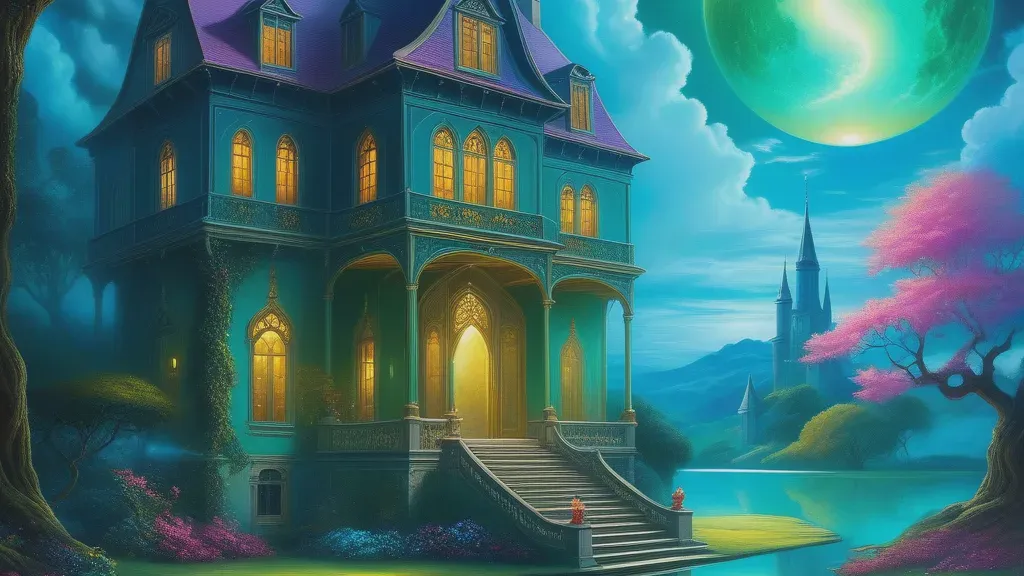
Manor
Jungian Archetypes
Meaning
A manor is not simply a large house. It is the head house of an estate, built to hold land, tenants, servants and a family name in one structure, and it is designed on two circuits at once: reception rooms meant to be seen, and back stairs, sculleries and service corridors meant to stay invisible while doing all the work. In dreams that double plan is the whole point. The manor stages a self that has acquired standing and now has to be maintained, with a public storey that must look effortless and a lower one that carries the labour and the family history. Dreams of it cluster around inheritance in the widest sense: money, reputation, a role in a family, an achievement that arrived with expectations already attached to it.
Psychological Interpretation
The dreamer's relation to the manor matters more than the building. Arriving as a guest, inheriting it, discovering that it has somehow always belonged to the dreamer, working in its kitchens, or being unable to find the way back to the front hall are four quite different psychological positions, and the dream usually chooses with precision. Inheritance dreams are the most common, and they carry a characteristic mixture of pride and dread, because a house of that size cannot be simply enjoyed. It has a roof, a name, dependents and a standard, and the dreamer wakes knowing they have been handed something they are expected to keep up. Condition is the second key. Fresh paint and lit rooms suggest a standing the dreamer currently inhabits with some ease; damp on the walls, a closed wing, dust sheets or a leaking roof point to the maintenance cost of an identity that looks solid from the road. Rooms the dreamer cannot enter, or corridors that lead only to service areas, generally mark parts of a life that support the whole arrangement while going unacknowledged: the money that actually pays for it, the family member who does the emotional work, the compromise nobody mentions at dinner. When the manor is grand and the dreamer feels like an intruder in it, the dream is asking a precise question about whether the achievement has been internalised or is still being performed for an absent owner.
Traditional Symbol Meaning
Folk tradition treats the great house as a place where the past does not leave. Ghost stories cluster around manors more than any other building type in the British and Irish repertoire, and the recurring cast is telling: the ancestor whose portrait watches the hall, the walled-up room, the servant wronged generations ago, the family curse triggered by a broken promise about land. These tales encode a real social observation, that inherited property carries inherited obligation, and that a house built on someone's dispossession keeps the memory of it in the fabric. Inheritance customs gave the manor its second layer of meaning. Under primogeniture the house passed whole to the eldest son, and the entail could bind an estate so that no single generation could sell or divide it, making heirs custodians rather than owners. Younger children left. Whole plots of nineteenth century fiction and a great deal of real family bitterness follow from that arrangement, and the emotional residue survives in dreams as the sense that a large house is a duty rather than a prize, and that being given it is not the same as being free in it. The decayed manor became its own tradition. Irish 'big house' novels, English writing about estates broken up after the world wars, and the Russian literature of sold and shuttered country places all read the great house as a body in decline, with damp, ivy, closed wings and sold-off contents standing for a family's loss of authority. Traditional sympathy in these stories is rarely simple. The house is mourned and its passing is understood as just, and dreamers often report exactly that split feeling, grief for the grandeur and relief that it is ending. Older dream lore read houses through their scale and state. A large, well-lit, well-provisioned house was taken as a favourable sign of position and security, while a great house in disrepair, or one the dreamer could not leave, was read as a warning that ambition had outrun means or that a family matter would demand attention. Beneath the fortune telling sits a workable observation still worth keeping: the state of the house in a dream tends to match the state of the structure a person is living inside, whether that structure is a job, a marriage, a reputation or a name.
Jungian / Archetypal
Analytical psychology reads any house in a dream as an image of the psyche, and the manor is the version of that image with history and staff. Jung himself gave the tradition its founding example: in a dream recorded in his memoirs he moved down through a house whose upper floor was in a recent style, whose ground floor was medieval, whose cellar was Roman, and beneath which he found a cave containing old bones and two skulls. He took the descent as a picture of layered consciousness reaching down into ancestral material, and a manor with its state rooms, service basement and older core offers the psyche a ready-made structure of exactly that kind. The Hero and the Self both have business in such dreams, and they pull in different directions. The Hero built or won the house: the achievement, the qualification, the position that was fought for and is now on display in the reception rooms. The Self is closer to the whole property, including the wings nobody uses, the kitchens, the damp, and the graves in the churchyard on the estate. Individuation in these dreams is generally a move from the first to the second, from identification with the impressive front to ownership of the entire structure. This is why so many manor dreams turn on a locked wing or a door that will not open. The unconscious is indicating the parts of a life not yet included, and it will keep placing them behind doors until they are. Ancestry gives the manor its particular archetypal weight. A family house carries what Jung described as the load of the ancestors, the unlived lives and unresolved conflicts of previous generations pressing on the present one, and a dreamer who inherits a house in a dream is frequently dealing with a family script rather than a building. The portrait that follows the dreamer with its eyes, the ancestor's study kept as it was, the rule that certain rooms are never used: each is an image of an internal figure still exercising authority. The task the dream proposes is not to demolish the place. It is to become the current occupant in fact, to change the use of the rooms, and to stop maintaining a standard set by someone who is no longer there to be pleased.
Gestalt / Parts of Self
Gestalt work starts by refusing the tour and taking the parts. You are the manor. You are also its front steps, its unheated wing, its kitchen, the damp behind the plaster and whoever is expected to pay for the roof. Speak as each in turn, in the present tense. I am the reception room. I am kept ready for people who rarely come. I am the back stairs. Nobody sees me and everything travels through me. Notice which sentence lands in your body, because that is where you are living at the moment. The manor's built-in polarity is front of house and back of house, and most dreamers recognise it instantly as the split between the version of themselves that is presentable and the machinery that keeps that version running. Put them in two chairs. Let the reception room state what it requires: standards, guests, an appearance of ease. Let the service corridor answer with what it actually does and what it never gets. The dialogue often exposes a bargain made years ago, in which one part of you agreed to be impressive so that another part could avoid being seen at all. Do not resolve it too quickly. The point is to hear both, out loud, in your own voice. If there was a locked wing, go back into the dream in imagination and stand at its door without opening it. Say what you expect is behind it. Then be the door, and say why you are shut. Contact and withdrawal are the live issue in these dreams: hosting is contact, and it can also be an elaborate way of never being alone with anyone. Ask what happens in your body when the last guest leaves. If your dream ended with you alone in a large room, stay there in imagination longer than is comfortable and notice what arrives. The house is not asking to be filled. It is asking to be inhabited, which is a different action and usually a quieter one.
Psychodynamic / Freudian
The manifest content is property; the latent content is usually the family. A dreamed house of this scale routinely condenses a parent's authority, a childhood home enlarged by memory, and the dreamer's own current status into a single facade, and displacement lets the dreamer worry about a roof rather than about the relative whose approval the roof stands for. The affect is the reliable part. Pride in a dreamed house tends to be pride borrowed from a family standard; dread in one tends to be the dread of failing an inspection that was internalised long before any real property was involved. Object relations makes better sense of the emptiness these dreams often carry. Winnicott described the false self as a competent, adapted surface built to satisfy an environment that could not meet the infant's spontaneous gestures, and a magnificent house with nobody living in the good rooms is close to a literal picture of that arrangement. Klein's reparation is visible in the dreamer who inherits a neglected place and immediately starts repairing it, an impulse to restore something damaged in the internal world that no amount of actual redecoration will settle. The locked room, in this frame, is repression given a floor plan: material kept out of circulation because admitting it would disturb the household's official story. These dreams intensify around real transitions in standing, particularly promotion, inheritance, marriage into a different class, and the death of a parent. Freud noted that dreams often stage a wish alongside the defence against it, and the manor is efficient at this, since the same image supplies the fantasy of arriving and the anxiety of being exposed as a guest in one's own success. In treatment such dreams commonly appear when a patient begins to have more than the parent they compare themselves to, and the guilt attached to surpassing a family is one of the most reliable pieces of latent content the image carries. The work is not to renounce the house. It is to discover whose permission the dreamer is still waiting for before living in it.
Contemporary Psychological
Cognitive research on dreaming keeps returning to how heavily dreams recycle familiar architecture. Dream settings tend to be reconstructed from well consolidated spatial memory, which is why dreamed houses so often merge the layout of a childhood home with a building the dreamer has seen recently, and why they can be navigated confidently while being impossible in plan. Sleep-dependent memory consolidation is thought to abstract the gist of experience rather than store episodes intact, and a composite manor with the wrong number of rooms is a good example of what such abstraction produces: the emotional and structural pattern of a home, assembled from parts. The continuity hypothesis described by G. William Domhoff predicts that what preoccupies a person while awake will appear in their dreams, and status is a durable human preoccupation. Social rank, comparison and reputation engage the brain heavily, and the sense of standing relative to others predicts stress and wellbeing well enough that dream content tracking it is unsurprising. A person recently promoted, recently enriched, or recently unable to keep up with the neighbourhood they moved into supplies obvious daytime material for a house dream, and the frequency of such dreams during a house purchase or a change in income is a plain instance of continuity rather than prophecy. The anxiety in these dreams has a functional reading too. Antti Revonsuo's threat simulation account proposes that dreaming rehearses responses to danger in a safe environment, and while its evidence base is drawn mainly from physical threat, contemporary social life generates more threats to standing than to survival. A dream of a house one cannot afford to keep, or of guests discovering a room in disrepair, has the structure of a rehearsal for social exposure. Emotional processing work in the tradition of Rosalind Cartwright suggests a further point: dreams that carry strong affect through several scenes tend to accompany better waking adjustment, so a vivid, uncomfortable manor dream during a genuine change of status is more plausibly the mind working than a sign that something is wrong.
Cultural & Historical Origins
The manor is a specific historical institution before it is an image. In medieval England a manor was a unit of landholding with a lord's demesne, tenant holdings, and a manorial court that settled local disputes; the Domesday survey of 1086 recorded the kingdom manor by manor, which is why the word still carries a sense of property, jurisdiction and record all at once. The great house at the centre grew into the country house of later centuries, and with it a rigid internal geography of family rooms and service quarters, back stairs, and the baize-covered door that muffled the noise of work and kept staff out of sight. English literature turned that architecture into a moral instrument. Jane Austen used Pemberley in 'Pride and Prejudice' to show a man's character through his estate and its management, and in 'Mansfield Park' she set the Bertram family's comfort against a plantation in Antigua, a connection Edward Said later drew out in 'Culture and Imperialism'. Charlotte Bronte put a locked wife in the attic of Thornfield Hall in 'Jane Eyre', an image so durable that Sandra Gilbert and Susan Gubar took it for the title of their 1979 study 'The Madwoman in the Attic'. Daphne du Maurier opened 'Rebecca' with a woman dreaming of a burnt estate, and Anton Chekhov built 'The Cherry Orchard' around a family unable to keep one. Gaston Bachelard, writing about the poetics of houses, argued that the vertical structure of cellar and attic maps the structure of an inner life, which is precisely the use dreams make of the manor's floors.
Contextual Variations
Inheriting a manor you have never seen before
An unfamiliar house that is suddenly yours describes a position arriving faster than your sense of yourself can follow. Promotions, sudden money, a parent's death and marriages that change your social footing all produce this dream. The unfamiliarity is the significant part: you cannot yet picture the rooms, which is to say you do not yet know what the new standing will require of you day to day. Notice whether you started exploring or started calculating the cost. Curiosity suggests you are ready to occupy it. Immediate arithmetic about the roof suggests the inheritance already feels like a debt.
Grand rooms with damp spreading up the walls
Damp is slow, structural and embarrassing, and it works its way up from the foundation rather than falling from the sky. As an image it points to a problem in the base of an arrangement that is still being presented as sound: finances behind a comfortable appearance, a marriage that entertains well, a role you can perform but no longer have the underlying strength for. The dream is not predicting collapse. It is noting that the maintenance has been deferred and that the evidence is now visible on the good walls. Ask which part of your life you have been decorating instead of repairing.
Finding a locked wing behind the kitchen stairs
The locked wing reached through the service quarters is one of the most precise images the psyche makes: the excluded part of your life is behind the working part, not behind the presentable one. Whatever is shut in there was closed off in the era when you were still doing the labour yourself. Common contents are an early ambition dropped for practical reasons, a period of your history the family does not discuss, and a relationship that ended without a conversation. You do not have to open it in the dream. Naming what you assume is inside is usually enough to start the process.
Hosting guests in a manor that is not yours
Acting as host in a borrowed house is the anatomy of impostor feeling laid out as a floor plan. You know the rooms well enough to run an evening in them, and you know you have no title to the place. Look at who the guests were, since dreams are specific about the audience whose good opinion is at stake. If nobody questioned you, the dream is likely showing that the performance is working and costing you something. If someone asked how you came to live there, notice your answer, because the story you told in the dream is usually the story you tell yourself while awake.
Frequently Asked Questions
Why do I dream of owning a huge house when I have no interest in wealth?
Why do the empty rooms in a manor dream feel so uneasy?
Does dreaming of a decaying manor mean my finances are in trouble?
Why does the manor in my dream feel like it belongs to my family?
Journaling Prompts
- Sketch the manor from your dream as a floor plan, marking every room you entered, every room you knew about but did not enter, and the way you moved between them. Then label the rooms with parts of your actual life. Write about the largest space on the plan that you never visited during the dream, and what that area of your life has cost you by staying shut.
- Write about the standard you are currently trying to meet, without justifying it. Whose voice states it, in what words, and how old were you when you first heard it? Then write what would concretely change in an ordinary week if you decided that standard had been met, or that it was never yours to meet in the first place.
- List the things in your life that require upkeep to remain what they are: relationships, a title, a body, a house, a reputation. Note next to each how much of your week it takes and whether you would choose it again today. Write about the one you would let go of first if the cost rose, and what stops you from letting it go now.
- Describe a time you were praised for something and felt like a guest at your own achievement. Write down what you believed the praisers had failed to notice. Then set that belief against the evidence, in writing, and note what you would have to accept about yourself for the praise to be simply accurate.
Related Symbols
Dreamed about Manor?
Get a personalized AI interpretation that connects this symbol to your specific life circumstances.
Interpret My Dream