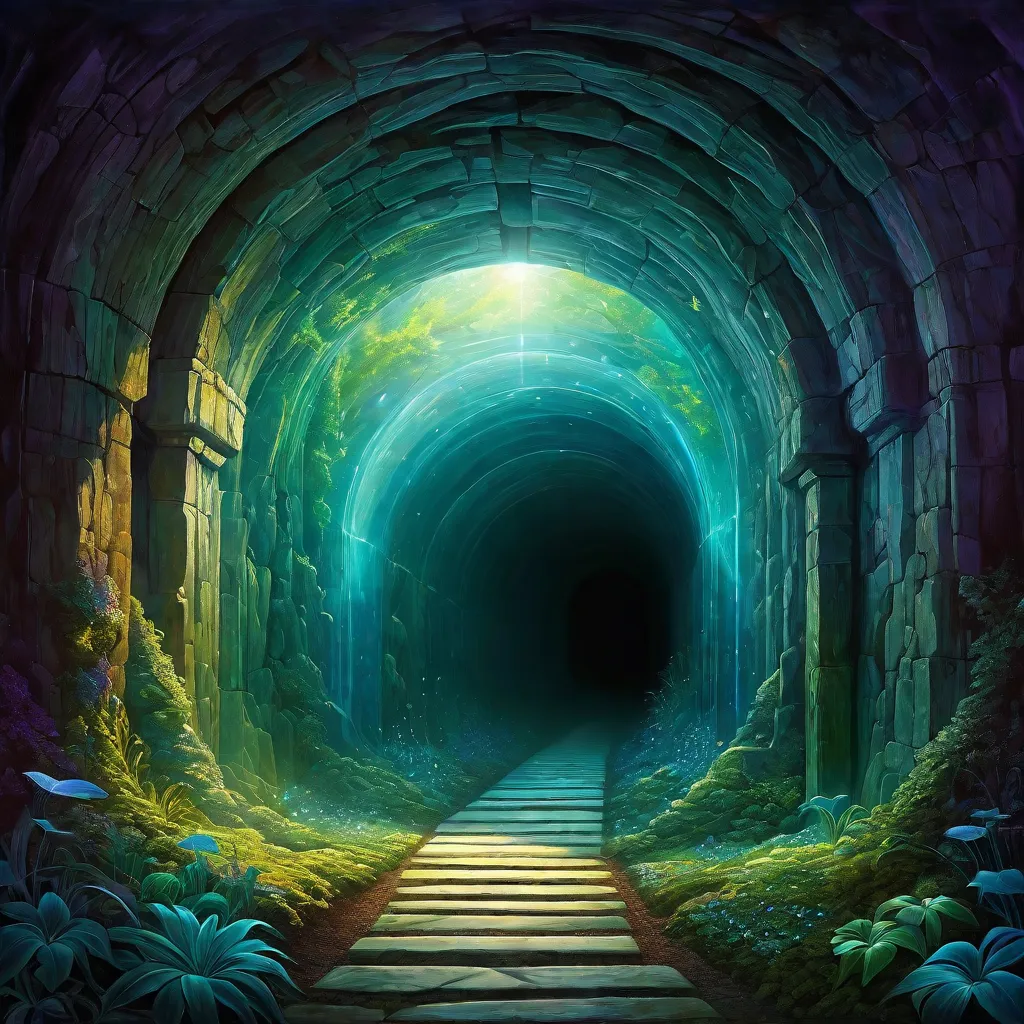
Tunnel
Jungian Archetypes
Meaning
A tunnel dream isolates the passage itself as the entire point, rather than treating transition as a byproduct of moving from one place to another. There is no ambiguity about direction inside a tunnel the way there is on an open road: forward is the only route back to open space, and turning around usually means returning to where the difficulty first began. What the tunnel is made of, carved rock, poured concrete, dug earth, and how the light behaves inside it says more about the transition itself than any object the dreamer might meet along the way, since the tunnel is less a place than a condition to be endured until it ends.
Psychological Interpretation
A tunnel commits the dreamer to a passage they cannot abandon halfway without effectively reversing whatever progress they've made, which is what separates it from a corridor, a cave, or an open field. The length of the tunnel and whether its end is visible carry more weight than almost any other detail: a short tunnel with light already showing suggests the dreamer already knows, on some level, that the current difficulty is finite, while a tunnel extending into total darkness with no visible end reflects a transition whose duration or outcome the dreamer genuinely cannot yet estimate. Sounds inside the tunnel, dripping water, distant trains, echoing footsteps, often mark background anxieties the dreamer hasn't consciously registered but that are shaping the tone of the passage regardless. A tunnel that narrows as the dreamer advances signals a transition that is closing off alternatives rather than opening them, pressure building precisely because turning back has become less viable the further in they go. Emerging from a tunnel matters as much as entering it: what the dreamer finds on the other side, whether it resembles anything they recognize, usually indicates what they expect this current transition to cost or produce.
Traditional Symbol Meaning
Plato's Republic gives the passage through darkness its most influential Western formulation in the Allegory of the Cave, where a prisoner is dragged against his will up a steep, dark passage away from a lifetime of watching shadows, and only gradually, painfully, becomes able to tolerate the light waiting at the top. The allegory insists that the tunnel is not optional scenery on the way to enlightenment; the difficulty of the passage itself, the resistance, the eyes that ache in unfamiliar light, is inseparable from what is gained at the other end. Hopi and other Pueblo traditions locate humanity's actual arrival into this present world at a sipapu, a hole or passage said to lead up from an earlier world beneath this one, a point of emergence still marked in the floor of many kiva ceremonial chambers. Unlike Plato's philosophical metaphor, the sipapu is treated as a literal place of origin, and passing through a tunnel-like opening from a lower world into this one is remembered not as one person's private enlightenment but as an entire people's founding transition. Roman initiates into the Mithraic mysteries built and used artificial underground chambers, mithraea, deliberately shaped to resemble the cave in which the god Mithras was believed to have slain the primordial bull, and conducted their initiation rites inside this enclosed, tunnel-like darkness specifically to stage symbolic death before a return to ordinary daylight. Considered together, these three traditions treat the passage through darkness as functionally necessary rather than incidental: none of them offer a shortcut to the light that skips the tunnel, because in each case the tunnel is where the actual transformation, not merely the travel, takes place.
Jungian / Archetypal
Jung borrowed the term nekyia from the eleventh book of Homer's Odyssey, where Odysseus descends to consult the dead, to describe a necessary confrontation with the unconscious that individuation periodically requires. A tunnel dream frequently stages a nekyia in miniature: a forced, linear descent into unfamiliar darkness undertaken not for its own sake but because something on the far side, information, integration, a missing piece of the self, cannot be reached any other way. The Shadow inhabits the tunnel's darkness less as a specific figure than as an atmosphere, the unprocessed material the ego has not yet examined pressing in from every side at once. Unlike a dream where the Shadow appears as a distinct pursuing figure, a tunnel dream's Shadow work is ambient and total, which is part of why tunnels often produce a diffuse, hard-to-localize dread rather than fear of any one thing. A dream tunnel's exit functions as a genuine threshold in the Jungian sense, a boundary the dreamer cannot cross without leaving something of their prior identity behind in the dark. Waking with the tunnel unfinished, still walking, still searching for light, indicates the individuation process has identified a necessary passage the dreamer has not yet completed, and the psyche is likely to keep returning to it in some form until the crossing actually happens.
Gestalt / Parts of Self
Gestalt dreamwork asks you to become the tunnel itself before deciding what it means. Speak as the walls: what are you compressing? Speak as the darkness: what are you concealing on purpose, and what are you protecting by concealing it? A tunnel that seems to have its own intention, narrowing, lengthening, changing course, is very often carrying a part of your own will that your waking self has disowned as merely an obstacle. The direction you cannot see, whichever way you're not currently facing, deserves attention too. If you're moving forward and dread what's behind you, become what's behind you and speak from there: what unfinished business are you actually walking away from rather than through? Tunnels often let people believe they're moving toward something when the more honest description is that they're moving away. If the dream tunnel has an exit you reach, sit with the shift between the enclosed dark and the open light on the other side as its own experience, distinct from either endpoint. That transitional moment, the instant contact is made with open space again, often holds more useful information than either the tunnel or the destination, because it is where your body registers relief before your mind has caught up enough to explain it.
Psychodynamic / Freudian
A tunnel offers dream logic one of its more literal anatomical stagings, and the birth canal reading long associated with tunnel imagery in psychoanalytic literature treats the passage as a re-enactment of birth itself, compression, darkness, and a forced emergence into a different state entirely. This reading holds most convincingly when the tunnel dream is accompanied by genuine anxiety about beginnings, a new job, a diagnosis, a relationship's early stage, rather than applied automatically to every tunnel. More broadly, the tunnel's manifest content, a forced, linear passage with no side exits, often conceals a latent feeling about a situation in the dreamer's life that currently allows no negotiation: a deadline, a medical process, a legal proceeding, anything experienced as a corridor rather than a choice. The absence of visible alternatives inside the tunnel mirrors the absence of felt alternatives in whatever situation prompted the dream. Defense mechanisms show up in how the dreamer handles the tunnel's darkness rather than in the tunnel itself: denial might produce a tunnel that seems shorter than it later turns out to be, while displacement might relocate real anxiety about a relationship or health concern onto invented details, cave-ins, strange sounds, that have no equivalent in the dreamer's actual circumstances. Tracking which specific fear got attached to the tunnel, rather than assuming the tunnel is inherently frightening, usually locates the real conflict faster.
Contemporary Psychological
The psychologist Heinrich Klüver, studying hallucinations induced by mescaline in the 1920s, identified a tunnel or funnel shape as one of only four recurring geometric patterns, form constants, that the human visual system tends to generate under a wide range of altered states, from drug intoxication to migraine to oxygen deprivation. This suggests part of the tunnel image's power in dreams may be genuinely wired into how the visual cortex organizes disorganized input, rather than something the dreaming mind invents fresh each time. Susan Blackmore's research on near-death experience proposed that the classic tunnel-and-light perception reported by people near death may result from oxygen deprivation disinhibiting neurons in the visual cortex, producing exactly the kind of radiating, tunnel-shaped pattern Klüver had already documented decades earlier under entirely different conditions. Whether or not a given tunnel dream relates to any physiological stress, this research suggests the tunnel is one of the brain's default shapes for representing a forced narrowing of awareness, biologically available even without dramatic circumstances to trigger it. This gives the tunnel dream a slightly different status than most symbolic imagery: it may be one of the few dream shapes the brain reaches for based partly on its own visual architecture rather than purely on personal or cultural association. That doesn't make the dream's emotional content any less worth examining, but it does mean the tunnel itself, as a shape, may be telling the dreamer less about their specific situation than the mood and outcome experienced inside it.
Cultural & Historical Origins
The passage through darkness toward understanding has one of its most influential expressions in Plato's Republic, where the Allegory of the Cave stages enlightenment itself as a forced journey up a dark, tunnel-like passage away from shadows and toward a light the prisoner initially cannot bear to look at directly. Hopi and other Pueblo emergence narratives describe humanity's arrival into this world through a sipapu, a hole or passage leading up from a prior underground world, treating the tunnel not as metaphor but as the literal, sacred point of origin still marked in kiva floors today. Roman devotees of the Mithraic mysteries conducted their initiation rites inside artificial underground chambers built to resemble caves, deliberately using the enclosed, tunnel-like darkness of the mithraeum to stage the initiate's symbolic death and rebirth before returning them to the light outside.
Contextual Variations
A tunnel that keeps getting narrower as you walk
A tunnel narrowing around you usually reflects a transition that is closing off your options the further you commit to it, whether that's a decision, a relationship, or a plan that felt more open when you started. The physical pressure of the walls closing in mirrors a real sense that turning back is no longer realistically available to you. Consider whether this narrowing feels like necessary focus or like a trap you walked into gradually.
Seeing light at the far end of a long tunnel
Visible light at a tunnel's end is one of dreaming's more reliable markers of confidence that a current hardship has a genuine limit, even if you can't yet see exactly what's waiting there. The specific quality of the light, warm, harsh, distant, faint, often tracks how convinced you actually are that the difficulty will resolve rather than simply change shape. Trust this signal more than any content that appears once you actually step through it.
A tunnel that forks into two unmarked directions
A fork inside a tunnel raises the stakes of an ordinary choice by removing your ability to see either option clearly before committing. This usually surfaces when you're facing a decision in waking life where the available information genuinely isn't enough to choose safely, and the dream is registering that discomfort rather than resolving it for you. Notice which direction, if either, felt more familiar underfoot even in the dark.
Being stuck in a tunnel that won't let you turn back
Being unable to turn back inside a tunnel usually means some process you've already started, a commitment, a treatment, a confrontation, has passed the point where reversing course is genuinely available to you. This can feel frightening in the dream, but it often coincides with situations where continuing forward, however uncertain, is actually the safer option compared to the risks of undoing what's already been set in motion.
Frequently Asked Questions
Why do I dream about being trapped in a tunnel that never ends?
Is a tunnel dream a sign of anxiety or depression?
Why do tunnels in dreams feel more frightening than other dark places?
Why did the light disappear before I reached the end of the tunnel?
Journaling Prompts
- Think about a transition you're currently in the middle of that has no clear end date. If that transition were a tunnel, would you say you're near the entrance, deep in the dark middle, or close enough to see light ahead?
- Recall a moment when turning back from something felt less possible than continuing forward, even though continuing scared you. What made going back the less viable option?
- If a fork appeared in your path right now with not enough information to choose safely, which direction would your gut lean toward, and what is that instinct actually based on?
- Notice whether your confidence in a current difficulty resolving has grown stronger or weaker recently. What specific event shifted it in that direction?
Related Symbols
Dreamed about Tunnel?
Get a personalized AI interpretation that connects this symbol to your specific life circumstances.
Interpret My Dream