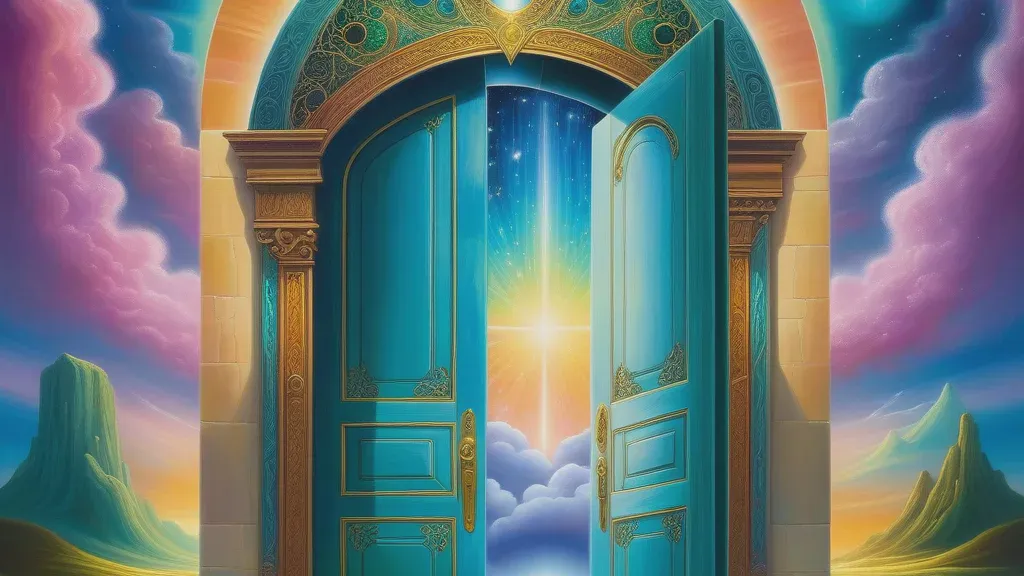
Door
Jungian Archetypes
Meaning
Doors do work in dreams that almost no other object manages: they promise passage where a wall would only promise a stop. A door draws a hard line between a state of life the dreamer can currently see and one they cannot, and the dream's entire charge usually sits in whether that line feels like an invitation or a refusal. The question a door dream raises is rarely whether change is possible; it is whether the dreamer is actually willing to go through with it.
Psychological Interpretation
How the door behaves under the dreamer's hand is the most reliable detail to track. A door that opens easily onto something unexpected suggests a readiness for change the conscious mind has not yet caught up with, while one that resists, locks, or reveals a blank wall behind it points to an opportunity the dreamer suspects is not really available, or one they are keeping shut on purpose. The number and arrangement of doors matters too, a single door narrows the dream to one specific decision, while a hallway of many doors usually means the dreamer is weighing several possible directions at once and has not yet let themselves settle on any of them. Knocking is its own category: a knock from outside the door often signals an obligation or a demand pressing in from the world, while a knock the dreamer hears from inside a room they thought was empty suggests something in their own inner life is trying to get their attention before they are ready to answer it.
Traditional Symbol Meaning
Roman religion is unusually direct about what a door actually is: not a barrier but a threshold with its own presiding god. Janus, shown with one face turned backward and one forward, watched over every doorway in the Roman world and lent his name to January, the month that looks simultaneously at the year departing and the year arriving. To stand in a Roman doorway was, symbolically, to stand briefly outside ordinary time, belonging fully to neither the space behind nor the space ahead. Ancient Egypt built doors that were never meant to open. The false doors carved into tomb walls provided no physical passage for the living, only a symbolic one for the ka to pass through in order to receive food and offerings left at the tomb. The door's power here had nothing to do with hinges or a threshold a body could cross; it worked purely as an image, proof that a doorway could move something as it needed to move even when no one could ever actually walk through it. European folk belief treated everyday domestic doors as similarly porous to unseen forces. Thresholds were considered vulnerable points where spirits, luck, or ill fortune might cross along with visitors, the root of customs from carrying a new bride over the threshold to nailing an iron horseshoe above a doorframe. Charles Perrault's Bluebeard turned one interior door, kept locked and forbidden, into the moral center of an entire folktale, using it to ask what a person will risk to know what has deliberately been hidden from them. Across these traditions, the door is rarely neutral carpentry; it is a place where something is either protected or exposed.
Jungian / Archetypal
The door is one of the clearest images the unconscious has for the Threshold Guardian and the Anima working together: a barrier that both protects the ego from material it is not ready for and, at the same time, withholds a connection to the unconscious the dreamer genuinely needs. Its being locked is not necessarily hostile. Jung treated many such obstacles as timed rather than punitive, present because the ego has not yet built the capacity the room beyond requires. A door standing open onto an unfamiliar space is frequently read as compensation, the unconscious offering access to material the dreamer's conscious attitude has been too narrow to include on its own. The specific room matters less than the fact of the invitation; refusing to enter, in the dream or afterward in reflection, tends to leave the same door reappearing in slightly different disguises until the dreamer finally goes through. Bluebeard's forbidden chamber is worth holding alongside clinical dream material here, since fairy tales function for Jung as a kind of collective dreaming: the door that must not be opened almost always turns out to be the one the story needs opened for its real business to begin. A door a dreamer feels strongly warned away from is frequently guarding exactly the material individuation most needs them to face.
Gestalt / Parts of Self
Gestalt dreamwork asks the dreamer to become the door rather than only the person standing in front of it, to speak as something built specifically to be either opened or kept shut, and to notice which of those two functions it seems more attached to performing. A door that describes itself as relieved to finally swing open is telling the dreamer something different from one that describes itself as built to keep people out. Locked and open are the door's core polarity, and each side deserves a voice rather than a verdict. Speak briefly as the locked door, explaining what it is protecting and from whom; then speak as the version of the door that opens freely, and notice what changes once it does. The dreamer's job is not to decide which door is correct but to notice which voice they recognize more readily as their own. Whoever is knocking, or whoever is on the other side once the door opens, deserves the same direct address. Ask that figure what they actually want, and let the answer surprise you rather than assuming in advance that it will be dangerous. Gestalt treats the demand behind the knock as disowned material belonging to the dreamer, not an external threat that has wandered in from somewhere else.
Psychodynamic / Freudian
Freud's own dream lexicon treated some architectural openings, doors among them, as bodily stand-ins, and a few contemporary psychodynamic clinicians still note that a door dreamed at a moment of major bodily change, pregnancy, illness, a physical transition, can carry that older reading. Most practice today treats this cautiously, though, and gives more weight to the dreamer's own specific associations than to any fixed symbolic dictionary. More reliably, the locked door functions as a picture of repression doing its ordinary work: material kept out of conscious awareness not because it has vanished but because a specific structure is actively holding it there. The dreamer's own behavior at the door is diagnostic, trying every key before giving up, walking away without trying the handle, or breaking the door down each reveal a different relationship to whatever the mind has shut away. A door that will not stay shut, reopening no matter how many times it is closed, often points to material under active pressure rather than material that is settled, the kind of half-repressed content Freud associated with the return of the repressed. The dream is less concerned with what is behind the door than with how much energy the dreamer is currently spending trying to keep it closed.
Contemporary Psychological
Cognitive research on real doorways gives this symbol an unusually direct experimental backing. Psychologist Gabriel Radvansky and colleagues found that people are measurably more likely to forget what they were just thinking about immediately after walking through a doorway, because the brain treats a new room as a new context and flushes short-term information tied to the old one, a phenomenon now generally known as the doorway effect. That finding gives the dream door a plausible mechanism rather than only a metaphor: a threshold the sleeping brain constructs may reflect the same event-boundary process, marking the place where the mind is segmenting one situation from the next rather than simply depicting an object. A dream in which crossing a doorway erases a memory or changes the scene entirely may be dramatizing this ordinary cognitive habit rather than encoding anything mystical about doors themselves. Beyond that specific mechanism, door dreams cluster reliably around real decisions the dreamer is actively weighing, consistent with the broader finding that dream content tracks waking concerns more than it invents unrelated scenery. A hallway lined with doors, in particular, tends to appear when several real options are open at once and the dreamer has not yet let the field narrow, making the dream a fairly faithful picture of present indecision rather than a prediction of any specific outcome.
Cultural & Historical Origins
Ancient Egyptian funerary art carved false doors into tomb walls, architectural features meant for no living visitor to pass through but for the ka, the spirit of the deceased, to travel out and back to receive offerings, making the door a literal technology for crossing between the world of the living and the dead. Roman religion assigned an entire god to the threshold itself: Janus, depicted with two faces looking in opposite directions at once, presided over doorways, beginnings, and transitions, and gave his name to the month that opens the year. Charles Perrault's 1697 tale of Bluebeard turns a single forbidden door into the engine of the whole story, its locked room holding the proof of a husband's murders and testing his new wife's obedience against her curiosity. Celtic folk tradition treated certain doorways and thresholds as places where the boundary between the human world and the world of the fair folk grew thin, part of why the custom of carrying a bride over the threshold survives as a way of protecting a vulnerable crossing point.
Contextual Variations
A door that opens onto a different room every time
A door whose far side keeps changing usually reflects a decision the dreamer has not yet narrowed down, where every time they consider taking the step, the imagined outcome shifts. Rather than signaling instability, this often just means the real choice genuinely has multiple live possibilities right now, and the dream is refusing to commit to one outcome before the dreamer has.
Finding a door where a wall used to be
A new door appearing where the dreamer expected solid wall usually points to an option that has only recently become available, a possibility that did not exist, or that the dreamer did not let themselves see, until circumstances shifted. The dream's mild disorientation matches the real disorientation of realizing an old limit has quietly stopped applying.
A door with no handle on your own side
A door that can only be opened from the other side describes a situation the dreamer cannot resolve through their own effort alone, an outcome that depends on someone else's decision, timing, or willingness. This is frequently less about helplessness than about a real limit worth accepting: some doors are not the dreamer's to open, no matter how directly they approach them.
Someone locking a door right as you reach it
A door locked at the exact moment of arrival usually names an opportunity the dreamer feels they missed by a narrow margin, whether through hesitation, timing, or someone else's decision made just ahead of theirs. The sting in the dream is proportional to how close the dreamer feels they came, and is worth examining for what the delay leading up to that moment actually was.
Frequently Asked Questions
Why am I afraid to open the door in my dream?
Does the appearance of the door actually matter?
Why do I dream about a hallway full of doors instead of just one?
Is a locked door always a bad sign?
Journaling Prompts
- Describe the door from your dream in detail, its material, its condition, whatever was on the handle. What real decision in your life does that specific door remind you of when you picture it closely?
- If the door in your dream was locked, imagine it unlocking right now. Notice the very first thing you see in the room, and consider what that detail reveals about what you actually expect to find there.
- Think about the last time you hesitated in front of a real decision the way you hesitated at that door. What finally got you to move, or what is still keeping your hand on the handle without turning it?
- If someone else in your life is standing on the other side of that door, imagine what they would say if you asked them honestly what they wanted from you. Write their answer exactly as you imagine they'd say it.
Related Symbols
Dreamed about Door?
Get a personalized AI interpretation that connects this symbol to your specific life circumstances.
Interpret My Dream