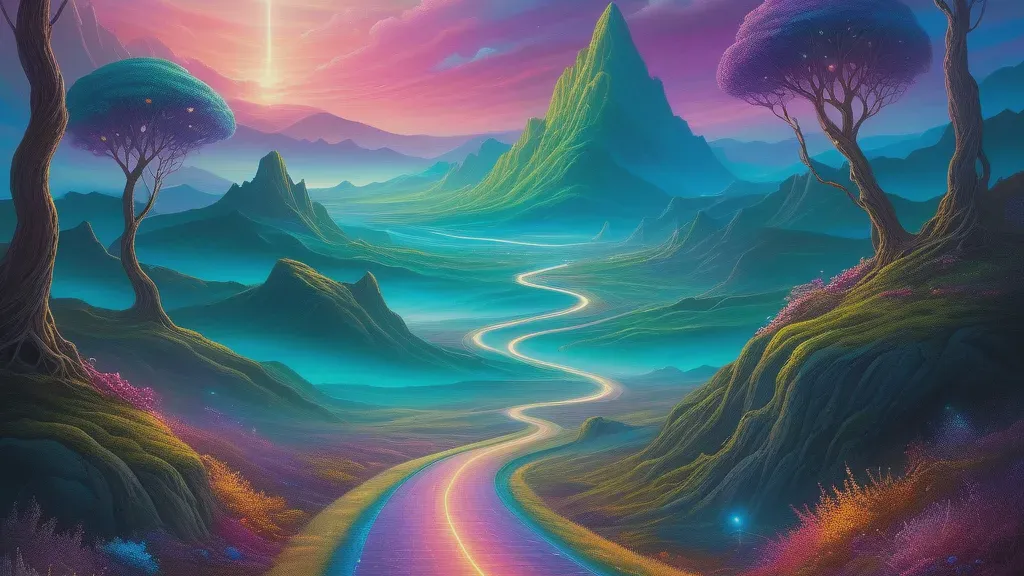
Road
Jungian Archetypes
Meaning
A road in a dream turns the vague idea of a life direction into something the dreamer can actually see and measure: its surface, its width, how far ahead it's visible, whether it's shared with other travelers or empty. Unlike a path through wilderness, a road implies infrastructure someone built with a destination already in mind, so dreaming of one raises the question of whose plan the dreamer is currently following, their own or a route laid down by someone else. Condition matters more than scenery: a road under repair, a road that dead-ends, or a road that keeps splitting all describe the felt shape of a decision in progress rather than the decision's content.
Psychological Interpretation
How a dreamer relates to a road, walking it, driving it, watching it from the shoulder, changes what the image is actually about. Walking suggests a pace and effort the dreamer still controls directly, while driving introduces a vehicle, and therefore a second variable, whether the dreamer trusts the mechanism carrying them as much as the direction it's carrying them in. A straight road disappearing to a vanishing point often marks confidence, or at least a settled acceptance, about where current choices are leading, even without full visibility of the destination. Curves, forks, and intersections escalate in what they demand of the dreamer: a curve requires only adjustment, a fork requires a choice with a real cost of foreclosure, and a full intersection puts multiple, differently weighted options in play at once. A road that ends abruptly, pavement simply stopping in open field, tends to appear when planning has outpaced the actual information available, when the dreamer has committed further than what they can currently see supports. Traffic, other cars, pedestrians, obstacles, usually represents everyone else's claim on the same route the dreamer is trying to use for their own purposes.
Traditional Symbol Meaning
Dante Alighieri opens the Inferno at the exact moment a road disappears rather than at any destination: midway through his life, he finds himself in a dark wood because, as he puts it, the straight road had been lost. The entire architecture of the Divine Comedy follows from this single failure of direction, and Dante's choice to begin there rather than at a clear crossroads suggests something dream logic often confirms, that the most consequential moment on a road is frequently not a fork but a stretch where the path simply stops being legible at all. Buddhist teaching answers the same problem with structure rather than crisis. The Eightfold Path, preserved in the Pali Canon as the Buddha's prescribed route out of suffering, treats the road not as something a traveler discovers by getting lost, but as a sequence that can be practiced deliberately, one correct action, intention, or effort placed after another. Where Dante's road vanishes without warning, the Eightfold Path insists a road can be built step by step even when no path was visible beforehand. Ancient Greek religious life located genuine risk at the road's junctions rather than along its straight stretches, leaving food and offerings for Hecate at three-way crossroads and marking boundaries with herms, pillars sacred to Hermes as god of travelers, at points where one route split into several. A comparable respect for the road as a spiritually significant path rather than mere infrastructure appears in the Lakota concept of the Red Road, a way of living in right relationship with community and spirit that a person is understood to walk rather than simply follow. Across each tradition, a road only becomes meaningful at the moments it stops being automatic: where it vanishes, where it must be built step by step, or where it forks and asks something of the traveler standing at the junction.
Psychodynamic / Freudian
Freud famously called the interpretation of dreams the royal road to the unconscious, and a dream that literalizes a road invites the same idea back onto itself: the route the dreamer travels within the dream can be read as a manifest stand-in for the psychic route the dream itself is offering toward material the dreamer has not consciously accessed. A road dream is, in this sense, doubly a road, one inside the story and one the story itself provides. The specific obstacles placed along a dream road, traffic, closures, detours, often displace a resistance the dreamer is exercising toward something in waking life without naming it directly. A detour forcing an unwanted route change can stand in for having to accommodate someone else's needs at the cost of the dreamer's original plan, while a closed road ahead may condense several separate blocked ambitions into one shared image. Object relations theory would attend closely to who else appears on the road, since a companion traveling the same route, a driver the dreamer depends on, or a figure standing at the roadside watching, usually encodes an internalized relationship the dreamer is currently measuring their own direction against, whether or not that person plays any comparable role in the dreamer's actual life right now.
Contemporary Psychological
Cognitive linguists George Lakoff and Mark Johnson argued that life is a journey functions as one of the most basic conceptual metaphors structuring ordinary thought and language, so deeply embedded that people describe decisions, relationships, and careers in terms of paths, directions, and destinations without noticing they're using a metaphor at all. A road dream may simply be this everyday linguistic structure rendered as a literal image while the analytical, language-generating parts of the brain are offline, the same underlying concept surfacing in picture form instead of speech. The continuity hypothesis of dreaming, which holds that dream content largely reflects waking concerns and activities, predicts that people currently facing an unresolved decision should dream about roads, forks, and detours more than people whose lives feel settled, and case-based dream content studies do tend to show exactly this clustering around periods of active choice. The road itself is not the message so much as reliable proof that a directional decision is currently occupying real cognitive bandwidth. What makes a road dream worth tracking over time, more than most single-image dreams, is that its details tend to update as the underlying decision does: a fork that resolves in waking life often stops appearing, or reappears already resolved in one direction, without the dreamer consciously deciding to dream it that way. Watched across several nights rather than interpreted once, a recurring road dream can function less like a symbol to decode and more like a rough, self-updating map of a decision still in progress.
Jungian / Archetypal
Jung observed that psychological growth rarely follows the straight line a road promises visually; he described individuation more often as a spiral or circumambulation, a repeated circling around a center that only looks, from any single point along it, like forward progress on a line. A dream road that curves back on itself, loops, or returns the dreamer to a landmark already passed may be showing this more accurately than a road running straight to the horizon ever could. The Hero archetype governs the more literal reading of a road dream, since a road is one of the few dream settings built entirely around forward motion toward a goal. A road that feels purposeful, even when its destination is unclear, usually indicates the Hero is currently active in the dreamer's psyche, oriented toward a real ordeal or achievement in waking life rather than dormant or in retreat. The Self appears less as a destination reached at the road's end than as the coherence of the whole route looked back on, since individuation is recognized retrospectively far more often than it is announced in advance. A road dream in which the dreamer cannot see the end but nonetheless keeps walking with some confidence often reflects trust, conscious or not, that the pattern will make sense from a vantage point not yet available to them.
Gestalt / Parts of Self
Become the road in this dream before analyzing where it leads. What are you asking the traveler to give up, speed, certainty, company, in exchange for using you? A road that feels alive, resistant, or oddly cooperative is carrying a disowned intention of your own, dressed up as terrain rather than acknowledged as will. At a fork, speak from each direction in turn rather than deciding from the intersection itself. One direction usually voices the part of you that wants safety, familiarity, or approval, while the other voices the part that wants risk, novelty, or freedom from an obligation. Neither voice is more legitimate than the other; the fork exists because both are genuinely yours. If the road disappears or dead-ends, resist the urge to treat this as the dream failing to finish its own logic. Become the field or the emptiness where the road should continue, and ask what you know that the traveler-you doesn't yet, perhaps that this particular route was never going to lead anywhere, and the dream is refusing to pretend otherwise on your behalf.
Cultural & Historical Origins
Few images render a life's uncertain middle stretch as precisely as Dante does at the opening of the Inferno, waking in a dark wood because, in his own words, the straight road had been lost, treating the loss of a clear path as the exact condition that forces the poem's entire journey to begin. Buddhist teaching gives the road a more structured, achievable form in the Eightfold Path, the sequence of right views, actions, and efforts the Pali Canon prescribes as the route out of suffering, framing the road not as something found but as something practiced, one correct step folded into the next. Ancient Greek religious practice located real spiritual danger at the crossroads itself, leaving offerings for Hecate at three-way junctions and marking roadside boundaries with herms, pillars sacred to Hermes, treating any point where a road divided as a genuinely liminal place requiring its own ritual attention.
Contextual Variations
A road that splits into several directions with no signs
A road splitting into unmarked directions usually appears when you're facing a decision where no outside authority, expert, mentor, tradition, is going to hand you a clearly labeled answer. The absence of signs is the point: this dream tends to arrive precisely when a choice has become yours to make without the guidance you'd prefer to have. Notice which direction felt least frightening rather than which felt most correct, since dreams often surface preference before they surface justification.
Driving down a road that suddenly turns to dirt or gravel
Pavement giving way to dirt or gravel usually marks a shift from a well-supported plan into territory with less structure and more friction, even if you're still moving in the same overall direction. This can reflect leaving an institution, a relationship, or a career track that provided more scaffolding than you realized until it disappeared. The rougher ride isn't necessarily a warning; it may simply be the honest texture of doing something with less established support.
A road that dead-ends in an open field
A road that stops without warning in open field usually means a plan you've been following has outpaced the information you actually have, and you've arrived at the limit of what's currently mapped. Rather than reading this as failure, treat it as accurate feedback: the plan was sound as far as it went, and now requires either new information or a willingness to move forward without a marked route.
Walking down a familiar road that looks slightly wrong
A familiar road that looks subtly wrong, a missing landmark, a turn in the wrong place, often shows up when you're re-evaluating a path you've been on so long you stopped actually looking at it. The wrongness isn't really about the road; it's your attention returning to a route you'd been running on autopilot. Ask what you'd notice about this direction if you were seeing it for the first time today.
Frequently Asked Questions
Why do I dream about being lost on a road I should know?
Is a fork in the road dream about a real decision I'm avoiding?
Why do I dream about driving on a road I can't control?
Why does the road in my dream keep changing behind me?
Journaling Prompts
- Think about the road you're currently on in your life, career, relationship, or otherwise. Does it feel like one you chose, or one you're following because it was already built when you arrived?
- Recall the last time you reached a fork with no clear signs pointing either way. What did you actually decide, and what told you that direction over the other?
- Notice where the smooth, well-supported part of your current path ended and the rougher, less certain part began. What changed right around that point?
- If you looked at your current direction as though seeing it for the first time today, without the habit of years behind it, what would you actually notice about where it's headed?
Related Symbols
Dreamed about Road?
Get a personalized AI interpretation that connects this symbol to your specific life circumstances.
Interpret My Dream