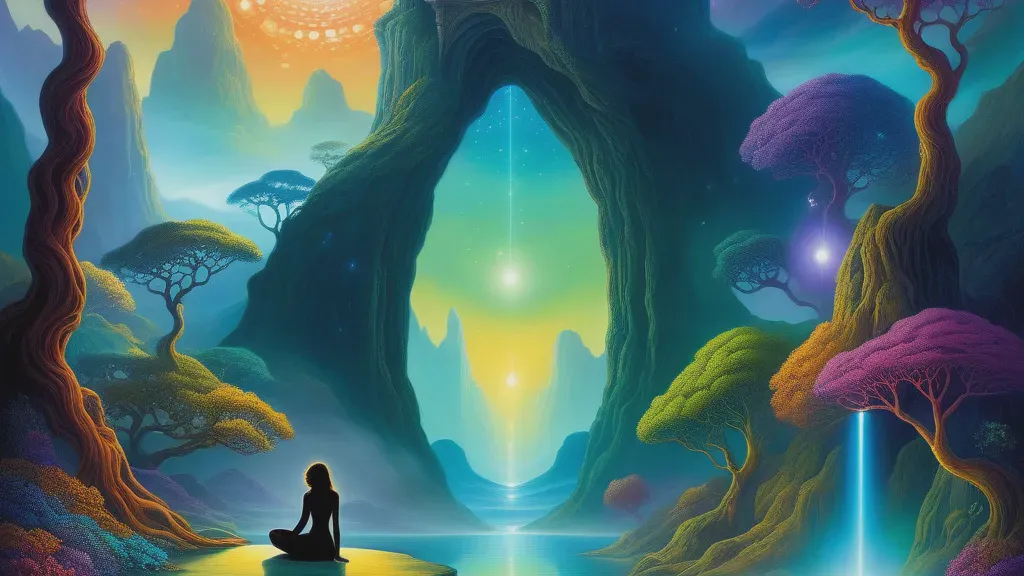
Shadow World
Jungian Archetypes
Meaning
A shadow world is what the dreaming mind builds when it needs to represent knowledge that has not yet come fully into view — a landscape lit only enough to suggest shapes rather than confirm them. The dreamer who enters one is rarely meant to see clearly; the entire point of the place is that its contents are still forming, half-glimpsed rather than denied. Streets rearrange and voices arrive without visible speakers because the material being represented is itself unsettled, not yet organized into a story the waking mind could tell. Unlike an ordinary nightmare location, the shadow world tends to provoke curiosity as much as fear, since some part of the dreamer recognizes it as an extension of their own terrain rather than an invading threat.
Psychological Interpretation
The defining feature of a shadow-world dream is not danger but partial visibility, and that distinction should guide how the dream is read. A route that keeps changing when the dreamer looks back suggests that the story being told about the past is still under revision — memory and interpretation actively renegotiating rather than settling into a fixed account. A trickster figure who offers a key to doors the dreamer does not want opened typically represents an approach to difficult material that arrives sideways, through temptation or misdirection, because a direct route has already been tried and failed. Disembodied voices, common in these dreams, often externalize an internal dialogue that has grown loud enough to feel like it belongs to someone else; when a figure finally becomes visible and speaks in riddles rather than plainly, the dream is usually less interested in giving an answer than in forcing the dreamer to commit to one. Because everything in this terrain is dim rather than hidden, the appropriate response is rarely retreat — it is closer attention, since what the shadow world withholds is detail, not the existence of the thing itself.
Traditional Symbol Meaning
Nearly every tradition that imagines a shadow world treats it as a place defined by incomplete perception rather than by evil, and the distinction has held remarkably steady across cultures that had no contact with one another. Plato's cave gave Western philosophy its clearest statement of the idea: the shadow is not a lie but an underdeveloped version of the truth, mistaken for the whole only by those who have never turned to look at what casts it. Homer's underworld operated on a related principle in the ancient Greek imagination — the dead in the Odyssey are not tormented so much as diminished, present but faint, requiring the living to supply ritual and blood before communication becomes possible at all. Norse cosmology, as Snorri Sturluson recorded it, placed a comparable realm of mist and half-visibility at the edge of its cosmic map, a border territory rather than a place of punishment, reserved less for wrongdoing than for an unremarkable death. The Tibetan Buddhist bardo tradition pushed the idea furthest by making the shadow realm's character depend entirely on the mind passing through it: a consciousness burdened by unresolved attachment or fear generates a correspondingly dim and threatening intermediate state, while a more settled mind moves through the same passage with far less distortion. Each of these four traditions ends up treating the shadow realm less as punishment than as a diagnostic instrument, a landscape that reveals, by its very dimness, exactly how much has been resolved and how much has not.
Contemporary Psychological
Low-light or ambiguous dream environments are a well-documented feature of REM cognition, in which visual cortex activity runs high while the input that would normally sharpen and confirm detail is absent, producing scenes that feel visually real yet remain persistently underspecified. A shadow world is a fairly direct expression of this neural condition: enough activation to generate a convincing sense of place, not enough constraint to fix its details into something stable. The instability of the terrain itself — paths that change, voices without bodies — is consistent with memory consolidation captured mid-process rather than completed, since consolidation involves reactivating and modifying stored material rather than replaying it intact. A dreamer navigating a shifting shadow-world route may be watching, in something close to real time, an autobiographical memory being updated rather than simply retrieved. What distinguishes a shadow world from an ordinary anxiety dream is the frequent presence of curiosity alongside unease, and that mixture is itself informative. Fear paired with active exploration, rather than pure avoidance, tends to mark material the dreamer is genuinely working to integrate rather than material being purely defended against — a psychologically productive state, however uncomfortable it is to wake from.
Jungian / Archetypal
A shadow world in dreams gives spatial form to the Shadow as Jung described it — not a single hidden figure but an entire unintegrated region of the psyche, dim because it has been kept out of the light of conscious attention rather than because it is inherently dark. Entering such a place is less an intrusion than an invitation, since the unconscious rarely constructs elaborate terrain around content it wants permanently avoided. The Trickster is a natural inhabitant of this landscape, and its presence should be read functionally rather than morally. Where the ego wants direct answers, the Trickster deals in riddles, keys to unwanted doors, and routes that change when looked at twice, disrupting the dreamer's habitual method of approach precisely because that method has already failed to produce integration. Its offers are rarely traps; they are provocations designed to force an encounter the ego keeps successfully postponing. The Anima frequently appears in shadow-world dreams as the dim figure who is finally, if reluctantly, found — recognizable but altered, speaking indirectly because direct communication would collapse the dreamer's remaining defenses too quickly. Her riddles are not withholding for its own sake; they require the dreamer to actively construct meaning rather than passively receive it, which is itself the work individuation asks for at this stage.
Gestalt / Parts of Self
Every feature of the shadow world is a part of you speaking in the only register it currently has available, which is dimness rather than plain speech. The changing route behind you is not confusion imposed from outside; it is your own uncertainty about your history, given a shape you can walk through. Address it directly: what version of the past are you still revising, and why has no single account of it settled yet? The trickster who offers a key to unwanted memories deserves the same direct address. Speak as that figure and admit what it actually wants from you — not harm, in most cases, but disruption of a strategy that has stopped working. If you keep declining the key, ask what you fear will happen the moment one of those doors is opened, and notice whether that fear matches anything the door has actually shown you so far. When a figure in the shadow world speaks only in riddles, resist the urge to decode from a distance. Become the figure and finish its sentence yourself, out loud if possible. The riddle is not being withheld out of cruelty; it is structured that way because the shadow world only ever gives back exactly as much clarity as you are willing to supply from your own voice.
Psychodynamic / Freudian
The dimness that defines a shadow world is itself a defense in miniature: material too charged for direct representation is allowed to surface, but only under conditions of reduced visibility, a compromise between the wish to know and the wish to remain protected from knowing too much at once. This is closer to screening than to true repression, since the material is present and moving rather than fully walled off. A route that rearranges every time the dreamer looks back suggests active revision of autobiographical narrative under emotional pressure — the psyche reworking how a past event is remembered in light of present feeling, a process closer to Freud's account of deferred action than to simple distortion. The trickster who offers a key functions as a displaced version of the dreamer's own curiosity, relocated onto an external figure so that the wish to know can be entertained without the ego having to own it outright. Voices without visible sources are a common way dream-work handles material too fragmentary to attach to a single figure yet; several distinct impulses, memories, or internalized voices may be condensed into a single unlocated sound. When one voice finally consolidates into a recognizable figure who speaks in riddles, the material has typically become organized enough to personify, even if it has not yet become organized enough to state plainly.
Cultural & Historical Origins
Plato's Republic contains the most influential shadow-world in Western thought: prisoners chained in a cave who take the shadows cast on its wall for the whole of reality, mistaking a dim, secondhand representation for the substantial world that casts it. The image was built as an argument about knowledge rather than about the afterlife, but it fixed shadow terrain permanently in Western imagination as a place of partial, provisional truth rather than simple darkness. Homer's Odyssey offers an older and more literal version in the episode scholars call the Nekyia, in which Odysseus travels to the edge of the underworld and speaks with the shades of the dead, insubstantial figures who can be recognized but not fully embraced, requiring blood and ritual before they can even speak clearly. Norse mythology, as recorded by Snorri Sturluson in the Prose Edda, describes Niflheim, a realm of mist and cold at one root of the world tree, bordering Hel, the shadowy dwelling of those who died without glory. The Tibetan Buddhist Bardo Thodol, known in the West as the Book of the Dead, describes a sequence of intermediate states, or bardos, in which the recently deceased consciousness encounters increasingly dim and unstable realms shaped directly by its own unresolved karma, a tradition that treats the shadow realm not as a fixed location but as a mirror of the mind entering it.
Contextual Variations
A city of darkness where the route home keeps changing
A shifting route in a dim dream city usually reflects an account of the past that is still being revised rather than confusion about direction itself. The dreamer's confident walking pace, despite the changes, suggests real capability navigating uncertainty; what unsettles is not the terrain's difficulty but its refusal to stay fixed long enough to be memorized.
A playful figure offering a key to unwanted memories
A key offered with mischief rather than menace points to an approach to difficult material that works sideways rather than head-on, since a more direct route has likely already been tried without success. Overwhelm on waking suggests the timing was premature rather than the offer itself being wrong; the material is real, but readiness has not yet caught up to access.
Disembodied voices echoing underground without visible speakers
Voices with no source usually represent internal dialogue that has grown too loud or too fragmented to feel like it belongs entirely to the dreamer, so it is externalized into the surrounding dark instead. Searching for someone familiar among them suggests a wish to consolidate scattered thoughts or feelings into one recognizable, addressable presence rather than an ongoing chorus.
A riddling figure who demands you choose what to believe
A figure who answers in riddles instead of plainly is rarely withholding out of cruelty; the shadow world tends to return only as much clarity as the dreamer is willing to supply themselves. Being asked to choose what to believe about your own identity signals that the dream has reached the point where interpretation must become active rather than passively received.
Frequently Asked Questions
Why do I feel curious as well as afraid in a shadow-world dream?
Why does the shadow world keep changing shape when I look back at it?
Is a trickster figure in a shadow world dangerous or helpful?
Does a shadow-world dream mean something is psychologically wrong with me?
Journaling Prompts
- Describe one story about your own past that keeps changing slightly each time you tell it, the way the route through the shadow world rearranges when you look back. What would it take for that account to finally hold still?
- If a trickster figure in your dreams offered you a key to something you have avoided knowing, what door would you most want it to open, and what has stopped you from trying that key on your own so far?
- Think of a feeling or thought lately that has felt like a voice without a clear source. Whose voice would you guess it actually belongs to, and what is it trying to say that you have not yet said in your own words?
- If a riddling figure in a dim, unfamiliar place asked you to choose right now what you believe about who you are, what answer would you give, and how confident are you in it compared to a year ago?
Related Symbols
Dreamed about Shadow World?
Get a personalized AI interpretation that connects this symbol to your specific life circumstances.
Interpret My Dream