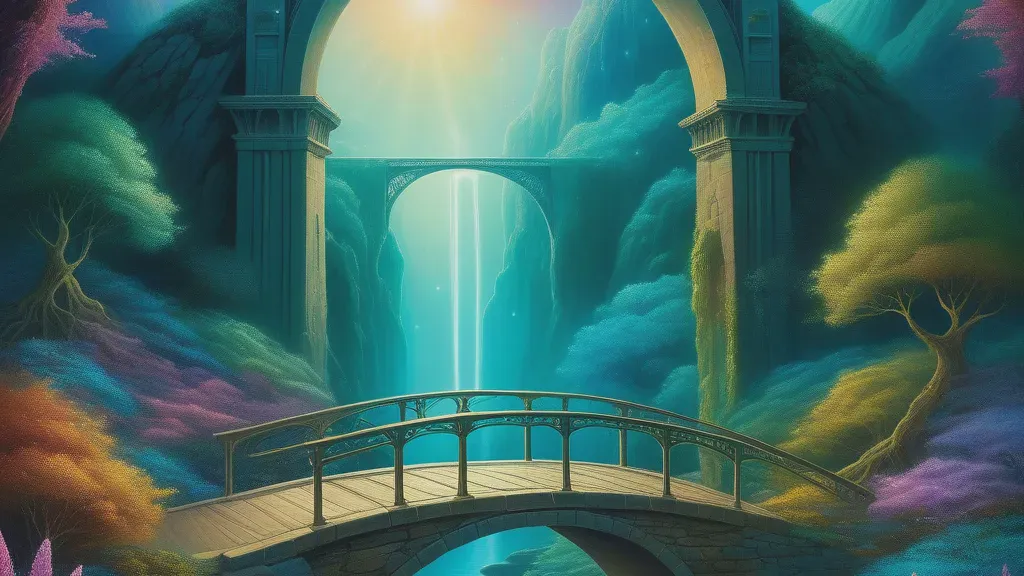
Bridge
Jungian Archetypes
Meaning
A bridge in a dream marks the exact point where a familiar path runs out and something must be trusted to carry the dreamer across a gap it cannot see the bottom of. Unlike a road, which simply continues, the bridge is suspended over what lies beneath it, water, a ravine, open air, so it carries risk alongside connection in a way plain ground never does. It surfaces when two states of a life, once separate, now require a deliberate span between them, and asks whether the dreamer trusts the structure enough to commit their full weight to the crossing.
Psychological Interpretation
What the bridge is doing underfoot matters more than the fact of the bridge itself. One that holds firm under the dreamer's full weight names a transition they are more ready for than they consciously feel; one that sways, narrows, or gives way mid-crossing names a passage being attempted before the groundwork that would make it safe. What lies below is rarely incidental: water beneath the span points to emotional material being crossed over rather than moved through, while a dry ravine or a canyon suggests a rift already open between two parts of a life or a sense of self. Company on the bridge changes the reading again, a crowd making the same crossing suggests a transition that is shared or publicly visible, a solitary crossing suggests one the dreamer has to make without witnesses, and a figure blocking the far end asks what condition still has to be met before the arrival counts as real.
Traditional Symbol Meaning
Three unrelated traditions independently arrived at the same image for the passage of the soul after death: a bridge that tests rather than simply transports. The Zoroastrian Chinvat bridge widens or narrows according to a person's deeds, the Islamic As-Sirat is described in hadith literature as finer than a hair and sharper than a sword, and Chinese Naihe Bridge is crossed under judgment on the way to rebirth. None of these are bridges in the ordinary engineering sense of a structure that simply gets a traveler from one bank to the other; they are moral instruments, and the crossing itself is the verdict. A second cluster of traditions makes the bridge cosmic rather than judicial, the site where worlds meet rather than where a life is weighed. Norse Bifrost connects the human world to the realm of the gods and is guarded at its threshold by Heimdall, watchman of the Aesir. Japan's Kojiki goes further still, placing its creator deities on a floating bridge of heaven at the very moment the physical world comes into being, so that the bridge precedes the land rather than joining two lands already there. In both cases the bridge marks not an ending or a debt but an origin, the place from which something is made. European folk tradition adds a third, more domestic strand: the bridge as a place where something must be paid. Scandinavian folktale populates the space under the bridge with trolls demanding a toll or a fight before safe passage is granted, a motif still told to children in stories about goats crossing to better pasture. Stripped of its literal monster, the belief underneath is consistent with the older traditions: a bridge is never a neutral shortcut. Whether the price is a soul's deeds, a god's permission, or a troll's demand, something is asked of the traveler in exchange for reaching the other side.
Psychodynamic / Freudian
Winnicott's idea of potential space, the zone that is neither strictly internal fantasy nor strictly external reality, where a child first plays with the gap between self and world, maps onto the bridge dream more precisely than most architectural symbols manage. The bridge is that space made visible: neither the old ground nor the new one, but the negotiated area between them where the dreamer is permitted to be unfinished for a while without being penalized for it. How the dreamer moves across the bridge often encodes a defense against the anxiety of the transition itself. Walking calmly over a structure that is visibly failing suggests denial doing real work to keep the crossing bearable; refusing to set foot on a perfectly sound bridge suggests the anxiety has been displaced onto the structure so it does not have to be examined in its real source, which is more often a relationship or a decision than an engineering problem. Early attachment leaves its mark here too: a dreamer whose formative caregiving was unpredictable often dreams of bridges that will not hold, not because a literal collapse is likely but because the internal expectation, formed long before any actual bridge was crossed, is that support structures give way exactly when weight is placed on them. The dream is less a prediction than an old rule being tested against a new situation.
Contemporary Psychological
The continuity hypothesis of dreaming, associated with researchers such as Calvin Hall and G. William Domhoff, holds that dream content tracks the dreamer's actual waking concerns closely rather than encoding them in exotic symbols, and bridge dreams are a clean example: they cluster around real transitions already underway, a move, a job change, the end or start of a relationship, more reliably than around any fixed abstract meaning of the bridge itself. Dreaming also appears to do prospective work, running a low-stakes simulation of a scenario the dreamer has not yet faced rather than only replaying what has already happened. A bridge not yet crossed, held in a dream the night before a decision is due, fits this pattern: the mind is rehearsing the commitment before it has to make it for real, which is one reason such dreams often feel more like preparation than memory. The specific engineering of the dream bridge is frequently traceable to recent input rather than to any universal template, a bridge seen on a commute, in a film, in a news story about a real collapse, incorporated as the day's residue and then reshaped by whatever transition is live in the dreamer's actual life. The dream borrows its scenery from the day and its stakes from whatever crossing the dreamer is genuinely facing.
Jungian / Archetypal
Bridge dreams sit close to a concept Jung named directly, the transcendent function, the psyche's capacity to generate a third position that honors two demands the conscious mind experiences as flatly opposed, duty and desire, the life already built and the one still unlived. The bridge is that third position given a shape the dreaming mind can walk across, and its condition in the dream is a fairly direct report on how far that reconciling work has actually progressed. The Threshold Guardian shows up wherever the crossing is contested, a toll collector, a figure blocking the far end, a structure that will not quite bear weight. This is not the unconscious being obstructive for its own sake; it is testing whether the ego has done the preparatory work the new position requires, in the same way older initiation rites withheld passage from candidates until specific conditions were met. A bridge that gives way under the dreamer often means the crossing was attempted from an assumed role rather than from a genuinely reorganized sense of self. What lies on the far bank is worth taking as seriously as the crossing itself, since Jung read dream imagery as oriented toward where the psyche is heading rather than only where it has been. A bridge glimpsed but not yet crossed can mark the beginning of individuation's next stage, proof that some undivided part of the dreamer has already located the connection, well before the conscious mind is ready to commit its whole weight to it.
Gestalt / Parts of Self
Gestalt dreamwork asks the dreamer to stop standing at the edge of the bridge and become it, to speak as the structure itself rather than as the person deciding whether to trust it. Suspended between two banks, holding weight it did not choose to hold, going nowhere on its own, that is a description of a part of the dreamer's life as much as it is a description of a bridge, and naming it directly is where the dream starts to say something the waking mind has been avoiding. The near bank and the far bank are a polarity, and Gestalt treats both ends as disowned material rather than letting the dreamer identify only with the one crossing. Speak briefly from the near bank, what it says as it is left behind, and then from the far bank, what it is asking the dreamer to become in order to arrive. The tension between the two voices is usually more honest than either one alone. Anyone else on the bridge, or waiting at either end, is worth addressing directly in the same way, since a figure blocking the crossing is rarely a stranger's business but the dreamer's own reluctance wearing a face. Ask that figure what it needs before it steps aside, and notice whether the answer sounds like something the dreamer already knows and has been unwilling to say to themselves in daylight.
Cultural & Historical Origins
Norse mythology gives the bridge its most famous cosmic form in Bifrost, the burning rainbow span joining Midgard, the world of humans, to Asgard, home of the gods, watched at its end by the sentinel Heimdall so that no unworthy traveler crosses uninvited. Zoroastrian scripture describes the Chinvat bridge, which widens into an easy road for a soul whose deeds were good and narrows to the width of a blade's edge for one whose deeds were not, so the crossing itself performs the judgment rather than a separate court. Chinese folk religion places Naihe Bridge over a river in the underworld Diyu, where the dead cross under the eyes of judges before, in some tellings, drinking a broth that erases the memory of their former life. Japan's eighth-century chronicle the Kojiki opens its creation account with the deities Izanagi and Izanami standing on Ame-no-ukihashi, the floating bridge of heaven, to stir the primal ocean and raise the first land, here the bridge is not a passage between two finished worlds but the platform the world itself is made from.
Contextual Variations
A rope bridge swaying over a deep gorge
A structure that moves under the dreamer without breaking usually points to a transition already committed to rather than one still being decided, there is no comfortable way to turn back, only to keep moving despite the instability. The sway is not a warning to retreat; it is the honest texture of a decision that was never going to feel steady, made bearable only by continuing to place one foot in front of the other.
Stopped partway across by a stranger who won't move
Being blocked mid-crossing by someone who offers no explanation usually names a condition the dreamer has not yet met, whether that is a decision still undecided, a conversation still avoided, or a fear not yet named honestly. The stranger rarely needs a literal identity; what matters is what they are asking for before they step aside, since that request is often something the dreamer already knows and has been putting off.
The bridge simply ends, with no far bank in sight
A bridge that terminates in open air describes a transition undertaken without a clear picture of where it leads, the dreamer has left the old position before the new one has fully formed. This is unsettling but not automatically a warning against moving; it can also describe the ordinary condition of real change, where the destination only becomes visible partway through the crossing rather than before it begins.
Watching someone else cross a bridge you can't reach
Seeing another person complete a crossing the dreamer cannot yet access often carries grief or comparison rather than fear, a sense of being left in an earlier stage while someone else, real or symbolic, moves into the next one. The dream is less about the other person's progress than about the dreamer's own readiness, and it is worth asking honestly what is actually keeping them off that particular bridge.
Frequently Asked Questions
Why did the bridge collapse while I was crossing it in my dream?
Why do I keep having the same bridge dream?
Does it matter what's underneath the bridge in the dream?
Is it bad if I have to swim or climb across instead of using a bridge?
Journaling Prompts
- Picture the far bank of the bridge from your dream as clearly as you can. Describe what life looks like once you have actually arrived there, and what is different about the person standing on that side.
- Think about what was directly underneath the bridge, water, a drop, a road. Name what that specific thing underneath represents in your waking life, and whether you are crossing over it or still avoiding it.
- If someone or something was blocking your way across, imagine what they would say if you asked them plainly what has to happen before they let you pass. Write their answer as honestly as you can.
- Bridges in most traditions ask something of the person crossing them. What would you have to give up, admit, or finally decide in order to complete the crossing your dream is pointing toward?
Related Symbols
Dreamed about Bridge?
Get a personalized AI interpretation that connects this symbol to your specific life circumstances.
Interpret My Dream