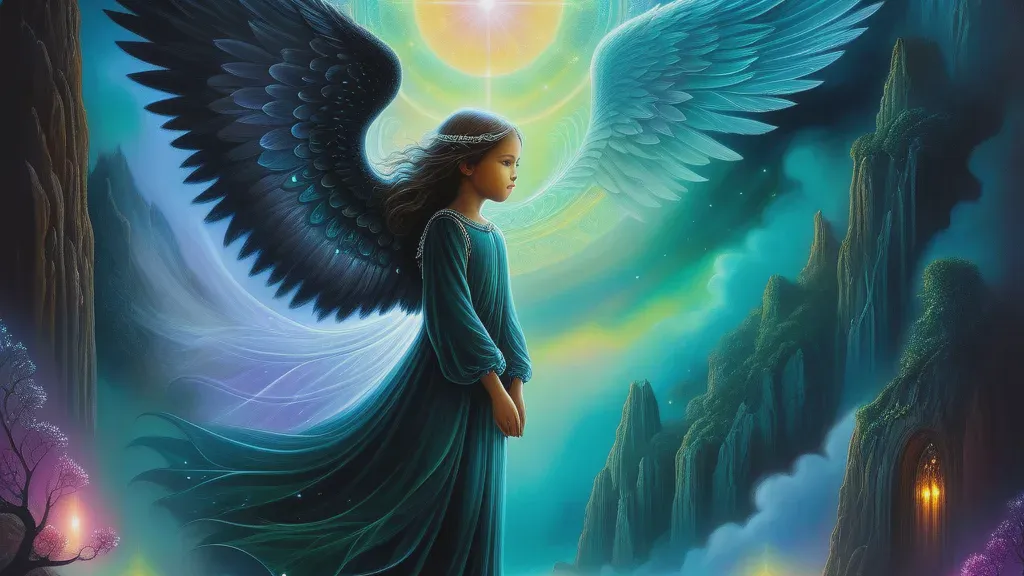
Dark Angel
Jungian Archetypes
Meaning
A dark angel is a messenger whose wings have gone black: a figure that keeps the angel's authority, its arrival from elsewhere and its knowledge of the dreamer, while losing the reassurance an angel is supposed to bring. In a dream it is the visitation the dreamer cannot classify as good or evil, and that inability is the point. The image comes when a person is being judged by a standard they half believe in, when grief or guilt has taken on a presence that stands at the foot of the bed, or when something in the dreamer that was meant to be holy, a talent, a love, a faith, has been hurt and returned with its brightness inverted. The dark angel does not attack. It watches, and it knows.
Psychological Interpretation
The first thing to establish is what the dark angel did. Most do very little: they stand, they watch, they wait to be acknowledged, and the terror comes from the fact that a being with that much authority is paying attention and giving no verdict. This is the shape of an unresolved judgement in the dreamer's life, a matter of conscience that has been neither condemned nor forgiven, and the psyche gives it wings and a face because a feeling that large needs a body. A dark angel that speaks usually says something the dreamer already thinks about themselves in their worst hour. One that lifts or carries the dreamer is a different image, closer to the angel of death in its older, gentler form, the one who comes to take rather than to punish, and dreamers who meet this version often wake with an unexpected calm. The darkness itself needs reading. Wings that are black by nature belong to a being that was always of the night, a guardian of thresholds and endings. Wings that have burned or been torn belong to a fallen one, something that was bright and has been damaged, and this is the version that most often concerns the dreamer's own fall: the sense of having been made for something better and having failed it, or having been failed. Whether the figure reads as accuser, mourner or guide depends on what the dreamer has done with that sense, and the dream asks that the question be answered before the angel decides for them.
Traditional Symbol Meaning
The oldest dark angel in scripture has no name. In Genesis 32 Jacob, alone at night by the river Jabbok, wrestles a stranger until dawn; the stranger wrenches his hip, refuses to give his name, and blesses him, and Hosea later calls the figure an angel. The pattern of a night visitor who wounds and blesses in the same encounter runs through the tradition. The destroyer of Exodus passes over the marked doors at midnight, an angel with a drawn sword blocks Balaam's road, and the angel of the Lord strikes the Assyrian camp in a single night. The Talmud describes the angel of death as covered in eyes, standing over the dying with a sword from which a drop of gall falls into the open mouth, and folk custom in many Jewish communities poured out every vessel of standing water in a house where someone had died, because the angel was believed to have rinsed its blade there. Christian tradition turned the tester into the rebel. Revelation's war in heaven, with Michael casting down the dragon and his angels, gave the fallen their story, and the fifteenth-century Ars moriendi woodcuts showed the deathbed as a contest, angels at one side of the dying and demons at the other, each waiting to claim the soul. In the Quran Iblis refuses to bow to Adam and is cast out; the text names him among the jinn, but popular tradition long counted him as a fallen angel, and Azrael became the figure who arrives at the appointed hour with neither malice nor mercy. John of the Cross wrote of the dark night of the soul, a period in which God's presence is felt only as absence, and some readers have found in the dark angel of dreams a personification of that night: the sacred still present, but with its light turned away. Popular dream lore is thin on the figure. Gustavus Hindman Miller's Ten Thousand Dreams Interpreted (1901) reads angels in general as signs of a change in the dreamer's lot, pleasing or ominous according to the tone of the dream, and has no entry for a dark one. Modern culture has supplied what the dictionaries lacked. Goth subculture from the 1980s onward adopted the black-winged angel as an emblem of beautiful melancholy, it became a standard tattoo, and the Cabanel painting is now shared more widely than most sacred images. A dreamer today inherits the figure already loaded with both the old dread and the new romance. Across these layers the tradition agrees on one thing: the messenger who wounds is still a messenger. Jacob limps away from the Jabbok with a new name, and the dark angel in a dream, however it frightens, is treated by the older sources as an encounter to be held rather than fled. The advice embedded in the stories is to ask its name, to refuse to let go before the blessing, and to expect to walk differently afterwards.
Contemporary Psychological
The dark angel at the foot of the bed has a well-documented physiology. J. Allan Cheyne and colleagues classified the hallucinations of sleep paralysis in 1999 into three clusters, the intruder, the incubus and the vestibular-motor, and a dark winged figure watching while the dreamer cannot move is the intruder in nearly pure form. The state arises when REM sleep's muscle atonia persists into partial waking, the amygdala is highly active, and the cortex, receiving no explanation for the paralysis and the dread, supplies an agent. David Hufford's study of the Newfoundland Old Hag, The Terror That Comes in the Night (1982), argued that the core experience is the same across cultures and that each culture dresses it in its own figure; where the culture has angels, the presence gets wings. Neuroscience has gone further into the presence itself. Olaf Blanke's group produced a shadowy person standing behind a patient by stimulating the temporoparietal junction, and in 2014 induced a felt presence in healthy volunteers with a robot that delayed the touch of their own hand on their back. The brain's model of the body, displaced by a few degrees, is experienced as someone else in the room, so that the dark angel is in a strict sense the dreamer's own body-image projected outside and given a face. Justin Barrett's work on the cognitive science of religion describes a hyperactive agency detection that reads presence and intention into ambiguous input, and a paralysed, frightened brain in the dark is the most ambiguous input there is. Emotional processing explains the dreams that are not paralysis at all. Ernest Hartmann argued that dreams build a central image that contextualises the dominant emotion, and a dark angel is an efficient image for awe mixed with dread, the feeling of being judged by something larger than oneself. Rosalind Cartwright's work on dreaming after loss and Matthew Walker's account of REM sleep as reducing the emotional charge of memories suggest that the figure is often a grief or a guilt being worked over rather than announced. In predictive processing terms the angel is a high-level prior, watched by an authority, filling in for whatever cannot be resolved awake. The practical note is simple: if the dream included paralysis, it was almost certainly sleep paralysis, common and harmless, and the figure was the brain's answer to a question the body asked.
Jungian / Archetypal
In Answer to Job (1952) Jung argued that the Christian image of God had split off its own darkness into Satan, and that the psyche pays for a wholly bright God with a wholly dark adversary. A dark angel in a dream is that split showing itself inside one person: the dreamer's idea of the good has excluded something, and the excluded thing returns with wings and authority. Jung also noted that Lucifer means light-bringer and that the fall from heaven is the story of consciousness itself, since knowledge of good and evil comes only to those who have left the undivided state. The dark angel is the Shadow of the dreamer's spiritual attitude, and its message comes from the side the attitude refused. The Anima often takes this form. In Lermontov's poem the Demon loves the mortal Tamara and destroys her, and Vrubel painted him seated, enormous and grieving; this is the anima in her deathly aspect, the inner figure who draws a man toward the depths and is also the guide through them, the psychopomp who lifts and carries. For a woman the same figure is the Animus with black wings, the inner masculine formed by fathers and confessors, judging from the foot of the bed or seducing from the window. The Child archetype enters through memory: many people first met angels as guardians in bedtime prayers, and the dark angel of adulthood is that guardian returned after the dreamer's disillusionment, carrying the child's need for protection and the adult's knowledge that protection failed. Amplification reaches Jacob at the Jabbok, wrestling until dawn with a figure who wounds and blesses, and the alchemists' Mercurius, who is at once the light of nature and the poison, duplex by definition. Individuation requires the dark angel: a Self that has integrated only its bright half is a persona of holiness, not a whole. Compensation decides who receives the dream. A devout dreamer with an all-bright God is given the black wings to balance the image; a cynical dreamer who admits no sacred at all is given the numinous in the only form their attitude can tolerate, as dread. Either way the task is the same as Jacob's: not to let go until the figure gives its name.
Gestalt / Parts of Self
The dark angel is you. It is the part of you that has wings, that can arrive from above and see the whole of your life at once, and that you have declared fallen because its power frightened you or someone else. Gestalt work does not ask what the angel means; it asks you to be it. Sit with the image and speak in the present tense: I am dark. I have wings. I stand at the foot of your bed and I do not move. I am watching you and I know what you did. Say it until a sentence lands as something you already believe about yourself, and notice which part of you was speaking: the judge, the mourner, the one who was cast out. Fritz Perls described the topdog, the inner voice of should and must, and the underdog who lies still and cannot comply. A dark angel that watches while you cannot move is that pair drawn in one scene. The angel's darkness is what happens to a moral voice that has been ignored for years: it does not go away, it goes black, and it stops explaining itself. Set two chairs. In one, be the angel and say what you require. In the other, be the one in the bed and say what you cannot give. Move between them until the polarity, holy and damned, watched and watching, turns into a conversation rather than a standoff. Contact is the issue that the image keeps circling. In Wenders' film the angels can see everything and touch nothing, and a dark angel that never lays a hand on you is your own withdrawal from contact with what is sacred or what is grieved, dressed as the other's restraint. The experiment is to let it touch you, in imagination, and to stay with what your body does. Owning the figure means being able to say I am the dark angel without flinching, which is the moment its wings become your capacity rather than its threat. The gestalt closes when the watcher and the watched are the same person, awake, in one chair.
Psychodynamic / Freudian
Freud's account of the superego in The Ego and the Id (1923) describes an internal authority formed by taking parental judgement inside, harsher than the parents were because it also carries the child's own aggression turned inward. The dark angel is the superego dreamed: it watches, it knows, it does not reassure. The bright angel of childhood prayer belongs to the ego-ideal, the image of what one was supposed to become, and the dark angel is that ideal after years of failing it. In Mourning and Melancholia (1917) Freud wrote that the shadow of the lost object falls upon the ego, and a dark angel that appears after a bereavement is often the dead person internalised as a critic, the loved one who now judges from inside. Object relations reads the black wings as a splitting that has failed to hold. Melanie Klein described the infant dividing the caregiver into an idealised figure and a persecutory one, and the dark angel is the moment the persecutory half appears wearing the idealised one's form: the protector and the punisher recognised as the same being. This is a step toward integration, however frightening, and it often marks the return of a parent who was both, warm and terrifying by turns. Donald Winnicott's idea of the use of an object adds a further reading: the object must survive the child's destruction to become real, and a dark angel can be the loved figure that has survived the dreamer's fantasied attacks and come back altered, darker, but still there. Wish and defence are both present. The wish to be watched over is reversed into the experience of being watched, and the guardian becomes the guard. Freud's paper on the economic problem of masochism (1924) describes the unconscious need for punishment, and some dark-angel dreams are the fulfilment of that need, a judge finally arriving for a guilt that has had no court. In treatment the analyst becomes the dark angel with some regularity: the one who knows, watches, and refuses either to condemn or to absolve. The dream then arrives when the patient most wants a verdict, and the analytic work is to let the figure stay silent long enough for the patient to hear whose voice it is.
Cultural & Historical Origins
The dark angel is assembled from traditions that did not originally agree. The satan of the Book of Job is a member of the divine council whose office is to test and accuse, not a rebel; the fallen angel grew from Isaiah's taunt against the king of Babylon, the morning star fallen from heaven, which the Latin Vulgate rendered as Lucifer, and from the Book of Enoch's Watchers, angels who came down to earth, took human wives and taught forbidden arts. Islamic tradition gives the angel of death, later named Azrael, the task of separating soul from body, and rabbinic and later Jewish lore assigned the same office to Samael. John Milton's Paradise Lost (1667) made the fallen angel magnificent, a Satan who would rather reign in Hell than serve in Heaven, and the Romantics took him for a hero; Gustave Doré's engravings for the poem and Alexandre Cabanel's Fallen Angel (1847), a weeping Lucifer with furious eyes, fixed the image of the beautiful damned figure that now circulates online. Mikhail Lermontov's poem The Demon and Mikhail Vrubel's paintings of it, above all Demon Seated (1890), gave Russian culture a dark angel who falls in love with a mortal woman and destroys her. Rainer Maria Rilke opened the Duino Elegies (1923) with the line that every angel is terrifying, and Wim Wenders' Wings of Desire (1987) put angels in black overcoats on the rooftops of Berlin, watching and unable to touch. The dream figure draws on all of these: the accuser, the taker of souls, the beautiful rebel, and the watcher who cannot intervene.
Contextual Variations
A dark angel standing at the foot of your bed, not moving
This is the most reported form, and if you could not move either, sleep paralysis is probably part of the story; that does not empty the image, it only explains why the brain needed one. The foot of the bed is a specific place. It is where a parent stood to check on a sleeping child, where the priest stands at a deathbed, where the Ars moriendi woodcuts put the angels and demons waiting for the soul. A figure there has come to assess, not to harm. Ask what verdict you were waiting for. The dream ended before it spoke because you have not decided what the sentence should be.
A dark angel with burnt or broken wings, weeping
Damaged wings mean a fall, and a fallen angel that weeps is grieving what it was. This version concerns something in you that was meant to be bright, a talent you stopped using, a faith you lost, a love that went wrong, and that has come back not as an accuser but as a mourner. Cabanel's weeping Lucifer is the same figure. Notice whether you wanted to comfort it or get away. The wish to comfort says you are ready to grieve the fall rather than keep blaming whoever pushed; the wish to flee says the grief is still too close to the shame.
Being lifted and carried by a dark angel
To be carried by a dark angel is to be taken rather than judged, the version closest to the old angel of death who arrives at the appointed hour without malice. People dream it during illness, exhaustion and the aftermath of a loss, and wake calmer than the image suggests they should. The dream offers an end to effort: something you have been carrying is being carried for you, and the black wings say the relief comes from a direction you were taught to fear. Ask where you were being taken. If you did not want to be put down, the dream is telling you how tired you are.
Looking down and finding the black wings are yours
When the wings turn out to be on your own back, the dream has stopped showing you a visitor and started showing you a capacity. The height, the reach and the ability to frighten are yours, and you have been filing them under fallen because somebody once needed you to be harmless. It comes to people who have spent years being the good one, the compliant one, the one without a dark side, and it is not an accusation. Notice whether you could fly. If you could, the part of you that was cast out still works.
Frequently Asked Questions
Is a dark angel in a dream a demon or an angel?
Why did I see a dark angel at the end of my bed and couldn't move?
Does dreaming of a dark angel mean someone is going to die?
Why did the dark angel in my dream feel loving instead of evil?
Journaling Prompts
- Write down exactly where the dark angel stood in relation to you: above, behind, at the foot of the bed, at the door. Then name the person or the standard in your waking life that occupies that same position, watching without speaking, and write what you imagine it is waiting for you to say.
- Think of something in you that was once bright, a talent, a faith, a love, a plan, and that has since darkened. Describe the moment it changed as if you were describing a fall: who pushed, who let go, whether anyone was there. Then write what that fallen thing would say if it came to you now with wings.
- Give the dark angel one sentence. Not a paragraph: one line it would speak if it finally spoke. Write it down, then write three different answers to it, one afraid, one angry, one grateful, and notice which answer you were able to write quickly and which took the longest.
- If the angel's darkness were your own, if the wings were yours and the night was yours, write about what you would be able to do that you cannot do now. Be specific: who you would visit, what you would say, what you would stop pretending. Then write what you would have to give up in daylight to keep it.
Related Symbols
Dreamed about Dark Angel?
Get a personalized AI interpretation that connects this symbol to your specific life circumstances.
Interpret My Dream