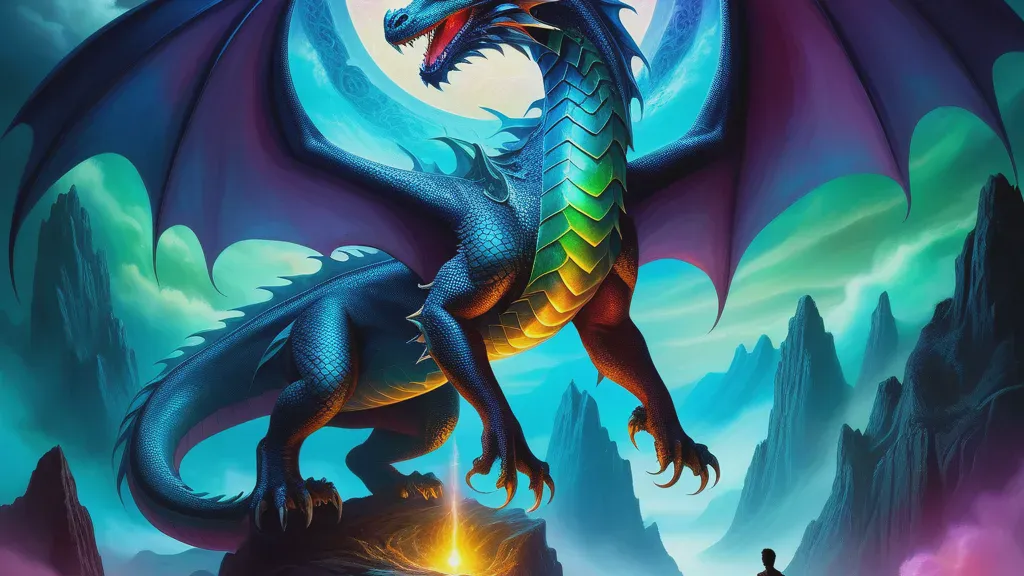
Dragon
Jungian Archetypes
Meaning
The dragon is a powerful symbol of primal force, wisdom, and transformation, representing both creative and destructive energy. It embodies the shadow self—raw power, greed, and danger—while also symbolizing protection, treasure, and spiritual awakening. Dragons appear across cultures as guardians of sacred knowledge and transformative power.
Psychological Interpretation
In Jungian terms, the dragon represents the Shadow archetype and the Hero's challenge, embodying the primal forces that must be confronted and integrated for psychological growth. Dreaming of a dragon suggests encountering your own untamed power and the need to either conquer or befriend this inner force. The dragon may represent obstacles to overcome or treasures of wisdom to claim.
Contemporary Psychological
The dragon in dreams represents the brain's threat simulation system operating at maximum intensity—a mythic-scale embodiment of overwhelming challenge, existential pressure, or catastrophic risk. From a contemporary neuroscience perspective, the dragon is not a symbol to decode but a functional construct: the dreaming brain's way of generating and rehearsing responses to threats perceived as beyond normal coping capacity. When a dragon appears, the threat simulation network is running a high-stakes scenario, testing emotional regulation and problem-solving under conditions of maximum cognitive arousal. The dragon's size, power, and often impossible nature reflect the dreamer's current sense that the waking challenge is disproportionate to available resources. The dragon functions as a cognitive stress-test. Rather than processing a manageable threat, the brain is simulating an encounter with something that cannot be defeated through ordinary means—requiring either radical adaptation, acceptance of vulnerability, or discovery of hidden strength. This is memory consolidation at work: the brain is integrating recent experiences of feeling overwhelmed, powerless, or facing a seemingly insurmountable obstacle. The dragon's presence signals that the emotional load has reached a threshold where the threat simulation system must escalate its rehearsal intensity. The dreamer's response to the dragon—whether they flee, fight, negotiate, or discover unexpected power—reveals the cognitive strategies the brain is testing for real-world application. Neurologically, the dragon dream indicates high amygdala activation combined with prefrontal engagement: the emotional alarm system is firing intensely while the reasoning brain attempts to model solutions. This is not pathological; it is the brain's way of preparing for genuine challenge. The mythic scale of the dragon suggests the threat is not concrete but existential—a career crossroads, identity crisis, relationship rupture, or confrontation with personal limitation. The dream is not predicting disaster; it is rehearsing emotional resilience and exploring whether the dreamer possesses untapped resources. The dragon's appearance is a sign that the brain recognizes the waking situation as genuinely significant and is mobilizing its most powerful cognitive and emotional machinery to process it. The contemporary reading of the dragon emphasizes agency and integration rather than fear. The dragon is not an enemy to be vanquished but a mirror of the dreamer's own intensity—a projection of the magnitude of the challenge being faced and the magnitude of the response required. Whether the dream ends in victory, negotiation, or transformation, the dragon's presence indicates the brain is actively working to consolidate new understanding about the dreamer's capacity to endure, adapt, and survive overwhelming circumstances. This is threat simulation in service of psychological growth: the brain is not predicting failure but rehearsing the emotional and cognitive flexibility needed to navigate genuine adversity.
Gestalt / Parts of Self
In Gestalt dream work, the dragon represents the dreamer's own power—the fierce, untamed, and formidable force that lives within. When a dragon appears in a dream, it is not an external threat or enemy, but rather a disowned part of the self that the dreamer has relegated to the realm of the dangerous or forbidden. The dragon embodies raw strength, dominion, and the capacity to destroy or transform. It is the part of the dreamer that refuses to be small, controlled, or domesticated. In claiming the dragon, the dreamer reclaims their own authority, their right to take up space, and their capacity to act with conviction and power. The fear that often surrounds the dragon in dreams points to a crucial Gestalt insight: the dreamer has learned to fear their own power. This fear may stem from early messages that power is dangerous, that strength is unfeminine or unacceptable, or that to be powerful is to be monstrous. The dragon, then, becomes the repository for all the qualities the dreamer has been taught to suppress or deny in themselves. The dream invites the dreamer to notice this projection—to see that the dragon is not attacking from outside, but calling from within, asking to be acknowledged and integrated rather than slain or avoided. In Gestalt terms, the dragon is an invitation to wholeness. It asks: What part of your own power have you disowned? What strength have you labeled as dangerous or unacceptable? The dragon's presence in a dream is not a warning but a summons—a call to reclaim the fierce, awe-inspiring, and transformative force that belongs to you. When the dreamer can stand with the dragon rather than against it, when they can say "this power is mine," the dragon ceases to be a threat and becomes an ally. The integration of the dragon represents the dreamer's willingness to be fully themselves—powerful, unapologetic, and alive.
Jungian / Archetypal
The dragon in dreams represents one of the most potent archetypal forces in the collective unconscious—a manifestation of primordial power that stands at the threshold between chaos and order, between the known and the unknowable. In Jungian analysis, the dragon embodies the raw, undifferentiated energy of the Self in its most formidable aspect, the supreme Shadow that contains both creative potential and destructive force. This creature guards the treasure—whether literal gold or the psychological gold of wholeness and self-realization—and demands that the dreamer develop sufficient consciousness and courage to approach it. The dragon is not merely an obstacle to overcome but a necessary adversary whose integration marks a crucial stage in the individuation journey. The dragon's connection to kundalini energy further illuminates its symbolic significance. In Eastern traditions mirrored within Jungian psychology, the serpentine or draconic force represents the coiled potential of the psyche, the dormant power that, when awakened and properly integrated, transforms consciousness itself. The dreamer who encounters a dragon is being confronted with their own untapped power—the aspects of themselves that are wild, instinctual, and potentially dangerous if left unconscious. This is the Shadow in its most archetypal form: not merely the repressed personal shadow, but the transpersonal shadow that connects the individual to the collective forces of nature and the unconscious itself. To face the dragon is to face the ultimate challenge of individuation. Unlike lesser obstacles in the psyche, the dragon cannot be defeated through ego-consciousness alone; it must be recognized, respected, and ultimately integrated. The hero's encounter with the dragon represents the moment when the conscious ego must acknowledge its own limitations and open itself to the transformative power of the unconscious. This integration does not mean domination or destruction of the dragon, but rather a conscious relationship with the primordial forces within—a marriage of consciousness and instinct that produces genuine wholeness. The treasure the dragon guards is not external wealth but the Self itself, the unified center of the psyche that emerges only when all its disparate and shadow elements are brought into conscious relationship.
Psychodynamic / Freudian
The dragon in dreams represents the archaic imago of parental authority—most often the father, but sometimes the mother—magnified to mythic proportions. In psychodynamic terms, the dragon embodies the superego in its most primitive, punitive form: the internalized voice of parental prohibition, judgment, and control that has been repressed into the unconscious. When a dreamer encounters a dragon, they are meeting the manifest expression of a latent conflict between their own desires (the id's impulses) and the internalized parental law that forbids them. The dragon's fire, its scales, its territorial dominance—these are the dream's way of representing the overwhelming power differential experienced in childhood, the sense that parental authority was absolute, unquestionable, and potentially destructive. Beneath the dragon's fearsome exterior lies repressed rage. The dreamer's own aggression, their wish to rebel against parental control, their desire to assert autonomy—all of this has been pushed into the unconscious through the defense mechanism of repression. The dragon becomes the container for this disowned anger; it is the dreamer's own rage projected outward and made monstrous. In this way, the dragon is not truly external—it is the id's full power, the dreamer's own primitive, destructive impulses, now experienced as a threat from outside. This displacement allows the dreamer to avoid the guilt and anxiety that would arise from consciously acknowledging their own hostile wishes toward the parent. The dragon guards treasure or territory, and what it guards is often the dreamer's own forbidden desires: sexuality, autonomy, ambition, or the right to exist separately from parental will. The primal terror evoked by the dragon reflects the deepest anxiety of early childhood—the fear of abandonment, punishment, or annihilation by the all-powerful parent upon whom the child depends for survival. This is not a rational fear; it is the terror of the pre-verbal, pre-rational mind, the time before the child could distinguish between the parent's anger and actual danger to life. The dragon's presence in a dream signals that this ancient fear has not been fully integrated or resolved; it remains split off, unmetabolized, pressing toward consciousness. The dreamer may be facing a current situation—a conflict with authority, a challenge to their autonomy, a moment of assertion—that has reactivated this childhood template. The dragon appears when the dreamer is on the threshold of claiming power that the internalized parent forbade, and the unconscious resurrects the original terror to prevent that transgression. To work with the dragon psychodynamically is to recognize it as a messenger from the repressed past, not as an external enemy. The dream invites the dreamer to reclaim the rage and desire that were disowned in childhood, to distinguish between the actual parent (who is now gone or diminished) and the tyrannical imago still ruling from within. The dragon's defeat or negotiation in the dream—or the dreamer's survival of the encounter—represents the possibility of integrating these split-off parts of the self, of becoming whole by reclaiming both the id's power and the ego's capacity to choose.
Cultural & Historical Origins
Dragons appear prominently in Chinese mythology as symbols of power and good fortune, in European medieval tales as fearsome guardians, and in Norse mythology as cosmic forces. The dragon Fafnir in Norse legend guarded gold, while Chinese dragons symbolize imperial power and celestial wisdom. Many cultures viewed dragons as bridges between earthly and divine realms.
Contextual Variations
Slaying or defeating a dragon
Overcoming inner obstacles and claiming personal power
Flying on a dragon or befriending it
Integration of shadow power and spiritual elevation
Frequently Asked Questions
Does a dragon dream mean I'm in danger?
What does it mean if the dragon is friendly?
Journaling Prompts
- What primal power within me am I afraid to acknowledge or use?
- What treasure or wisdom am I seeking that feels guarded or difficult to reach?
Related Symbols
Dreamed about Dragon?
Get a personalized AI interpretation that connects this symbol to your specific life circumstances.
Interpret My Dream