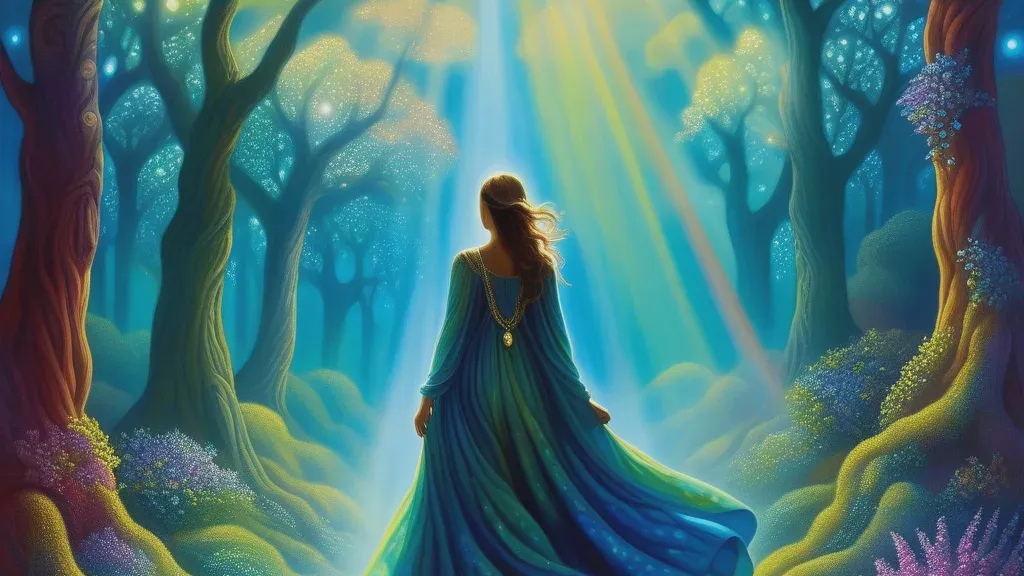
Dappled Light
Jungian Archetypes
Meaning
Dappled light is sunlight broken by leaves: a moving pattern of bright coins and soft shadow that never settles into full illumination or full dark. In a dream it is the image of partial knowing. The psyche produces it when something is becoming visible in pieces, when a truth about a relationship, a decision or the dreamer's own character is arriving as glimpses rather than as a verdict. The pattern is calm and beautiful, which is why the dream so often feels like rest, but its shifting means nothing can be held in view for long. The dreamer is being shown that the mixture of clarity and concealment is itself the situation, not an obstacle to be cleared before life can begin.
Psychological Interpretation
The first thing to ask of a dappled-light dream is what the light was falling on. On a path, it concerns a direction the dreamer can only see intermittently, a route that looks obvious in one patch and vanishes in the next. On a face, it concerns a person, or the dreamer's own identity, that cannot be read whole; the pattern moves and the expression changes with it. On a floor in a room with no window, the dream has stepped outside natural explanation and is offering a state of mind: the sense of being visited by a clarity whose source cannot be located. In every case the light is not in the dreamer's control. The wind moves the leaves, the leaves move the light, and the dreamer stands inside a pattern that is made elsewhere. That lack of control is the dream's real subject. Many people meet the image while waiting for something to resolve, a test result, an answer, a decision that belongs to someone else, and their waking mind treats the uncertainty as a failure of effort. The dream disagrees. It presents the mixture of seen and unseen as a natural condition, closer to a forest than to a fog, and it tends to bring an ease the dreamer does not feel when awake. The invitation is to notice what was visible in the bright patches, since the psyche chose what to light, and to stop trying to turn the shadows into more light.
Traditional Symbol Meaning
In European folklore the wood where light and shadow trade places is the place where identity comes loose. Shakespeare's A Midsummer Night's Dream sends its lovers into the forest outside Athens, where under broken light they mistake one another and wake unsure of what they saw. Dante begins the Commedia lost in a dark wood, and the Grail romances send their knights into the forest by paths of their own choosing, where the light through the trees is the only guide. English folk tradition speaks of being pixy-led, turned about in familiar woodland until the way home cannot be found, and the remedy was to turn one's coat inside out, an admission that in the flickering wood ordinary seeing no longer works. Religious architecture has long used broken light on purpose. Abbot Suger, rebuilding Saint-Denis in the twelfth century, wrote of the coloured light of the new windows as a way of lifting the mind from the material toward the immaterial, and Gothic churches became machines for dappling sunlight across stone floors. Islamic mashrabiya screens and the carved jali of Mughal India break daylight into moving lattices so that those inside can see without being seen, and the roji, the garden path to the Japanese tea house, was laid out so that the guest walked through shade and scattered light before entering, leaving the ordinary world one patch at a time. In each case the pattern is a passage rather than a destination, and the person inside it is understood to be between states. Popular dream books have no entry for dappled light. They file sunlight under good fortune and shade under concealment or trouble, so a dreamer who consults them receives both verdicts at once, which is not far wrong. Modern practice has added a third reading: the Japanese Forestry Agency coined shinrin-yoku, forest bathing, in 1982, and the moving canopy light of a forest walk is now prescribed as a way to recover attention and lower stress. A dream of dappled light draws on all three layers, the enchanted wood where the way is lost, the sacred screen where light is turned into passage, and the restorative canopy under which the mind lets go of the demand to see everything at once.
Jungian / Archetypal
Jung did not picture consciousness as a single sun. In On the Nature of the Psyche (1947) he gathered the alchemists' images of scintillae, sparks or seeds of light scattered through the darkness of the prima materia, and proposed that the unconscious contains many small luminosities, partial awarenesses that have not yet been drawn together into the ego's daylight. Dappled light on a forest floor is nearly a diagram of this. The dreamer is shown their own awareness as it actually works: not one beam but a field of small lights, each illuminating a patch and then moving on, with darkness between them that is not empty but unlit. The forest is one of Jung's oldest images of the unconscious, and the Hero enters it in every tradition he drew on, from the fairy tales in which a child is sent into the wood to the romances in which a knight follows a white hart past the last path. Dappled light describes the condition between the ego's cleared ground and the deep dark: the dreamer has gone in, and can still see, but only in pieces. The Shadow here is not a monster in the undergrowth but the pattern of withholding itself, the fact that something keeps moving out of view just as it is about to be recognised. Compensation explains who receives the dream. A person who demands total clarity of themselves and others is shown that knowing comes in patches; a person who has been living in fog is offered light, but a light that asks them to walk rather than wait. Amplification reaches the alchemical stage the old texts called the cauda pavonis, the peacock's tail, when many colours appear in the vessel just before the work turns toward unity. Jung treated this display of multiplicity as a sign that synthesis was near, and dappled light in a dream carries the same promise: the many small lights are the stage before they gather. The Taoist emblem of yin and yang, each half holding a seed of the other, belongs to the same family of images. In individuation terms the dream asks the dreamer to accept a path lit unevenly, to trust that the bright patches are placed rather than random, and to keep moving through the shade between them without turning it into an enemy.
Gestalt / Parts of Self
Gestalt psychology began with figure and ground, the observation that perception works by letting one shape come forward from a field and hold there, and Gestalt therapy borrowed the idea for the life of need: a want rises from the background, becomes the figure, is met, and recedes. Dappled light is a field in which nothing will stay figure. The patches form and dissolve before anything can be looked at. If this is your dream, ask what need you are not allowing to come forward and hold its shape, and what would happen if one bright patch stayed on one thing long enough for you to want it out loud. The method is to become the pieces. Be the patch of light: I land on you for a moment and then I am gone. Be the shadow: I fall across your face so no one can read it. Be the leaf that moves, and then be the wind that moves the leaf, since the wind is the part of you that keeps everything from settling. Speak each one in the present tense until a sentence catches. Fritz Perls called the habit of glancing off contact deflection, meeting someone and then sliding away before anything lands, and dappled light is deflection made visible: touched, then withdrawn, then touched again, never held. Ownership is the turn. The moving pattern is yours; you are the one who lets yourself be seen in patches, and you are also the one who cannot see others whole because you keep moving. Contact and withdrawal are both healthy in rhythm, and a forest floor is a picture of a good rhythm as much as of avoidance, so the question is not whether to stop the flicker but whether you can choose it. The experiment the dream proposes is to stand still in one bright patch, in imagination or in life, and stay there while someone looks at you. Notice what you want to do after five seconds. That impulse is the polarity you have been working around.
Psychodynamic / Freudian
Freud described screen memories in 1899 as vivid, innocent recollections that stand in front of something the mind does not want to see, and dappled light is that structure in visual form: bright, pleasant patches that hold the eye while the shaded content between them goes unexamined. The manifest dream, a pretty path under trees, covers a latent one about what the dreamer is choosing not to know. Displacement puts the emphasis on the light; condensation is in the pattern itself, since every bright spot on a forest floor is a small image of the same sun, one thing seen many times and never whole. Object relations reads the flicker through the earliest experience of a face. Melanie Klein described the infant as knowing the mother first in parts, the good breast and the bad, and reaching the depressive position only when those parts are recognised as one person who can be both. A face crossed by moving shadow in a dream is the picture of that integration not yet achieved, or lost again under strain: the loved figure appears in patches and cannot be held as whole. Donald Winnicott wrote that the mother's face is the child's first mirror, and where that face was intermittent, present and then absent, warm and then unreadable, the adult may dream exactly this light. Wilfred Bion once suggested that the analyst must sometimes shine a beam of darkness so that what is hidden by too much light can be seen, and the dream may be doing that work on its own. Wish and defence are both present. The wish is to be seen without being fully seen, a compromise between the longing for recognition and the fear of exposure, and dappled light satisfies both at once, which is why it is so restful. Early experiences of glimpsing what one was not supposed to see, a parental argument through a door left ajar, a scene half understood, can return as this image with its mixture of pleasure and unease. In treatment the same pattern appears in the transference when a patient tells the story in bright fragments and leaves the connecting shade unspoken; the dream is the psyche noticing that this is how it has been showing itself.
Contemporary Psychological
Environmental psychology has a name for what dappled light does to attention. Rachel and Stephen Kaplan's attention restoration theory (1989) describes soft fascination, the effortless hold of moving foliage and light that lets directed attention recover, and canopy light is their standard example. Roger Ulrich's 1984 study found that surgical patients with a window onto trees recovered faster than those facing a wall, and the physicist Richard Taylor has shown that natural scenes with the fractal dimension of tree canopies and their shadows lower physiological stress in viewers. A brain that produces dappled light in a dream is reproducing a scene it has learned is restorative, which fits Rosalind Cartwright's finding that dreaming regulates mood overnight and Matthew Walker's account of REM sleep as stripping the emotional charge from memories. Visual neuroscience explains why the same image can be unsettling. The visual cortex is built to detect edges and stabilise objects, and a face or a path under moving shadow gives it input that never settles, so the higher visual areas responsible for recognising faces and scenes cannot complete their work. In predictive processing terms, the account of the brain as a prediction machine developed by Karl Friston and others, dappled light is a stimulus whose prediction error never drops to zero; the model keeps updating and never converges. A dream built around that condition is the brain representing an unstable model of something in waking life, a person or a situation it cannot resolve into a stable prediction. Memory consolidation adds a final layer. Hippocampal replay during sleep is fragmentary, reactivating pieces of experience rather than continuous episodes, and the dreaming brain assembles those pieces into scenes that Ernest Hartmann argued organise around a central image carrying the dominant emotion. Dappled light is a good candidate for the central image of an emotion that has no simple name, something between safety and suspense, being sheltered and being unable to see. Antti Revonsuo's threat simulation theory places such dreams at the low end of the threat scale, which matches the calm most dreamers report. What separates a restorative dappled dream from an unsettling one is usually whether anything in the scene was trying, and failing, to be recognised.
Cultural & Historical Origins
The Japanese word komorebi, sunlight leaking through trees, names the phenomenon so exactly that it has travelled into other languages untranslated, and the aesthetic behind it, from the tea garden's shaded path to Junichirō Tanizaki's In Praise of Shadows (1933), treats half-light as a richer condition than full brightness. Gerard Manley Hopkins opened his 1877 poem Pied Beauty with praise for dappled things, listing brinded cows, stippled trout and the patched fields of a farmed landscape, and made unevenness itself a mark of the sacred. The Impressionists built a technique out of the effect: Renoir's Bal du moulin de la Galette (1876) shows dancers spotted with light through the acacias, and Monet's garden canvases dissolve figures into the same flicker. Older layers are less benign. Sacred groves, the Celtic nemeton and the Roman lucus, were places where the light was broken and the gods were near, and the Roman poet Lucan describes a Druidic grove near Massilia so shadowed that its own priests avoided it at noon. Folk belief in parts of Britain and Ireland placed the fairy world at the edge of woodland where light and shade change places, a threshold where a traveller could be led astray. The Aristotelian Problems already noticed that sunlight passing through gaps in foliage projects round images of the sun, and crescents during an eclipse, an observation that makes every dappled floor a field of small pinhole images, the sky reproduced many times on the ground.
Contextual Variations
Walking a forest path where the light moves as the wind moves the leaves
The classic form of the dream, and its subject is a route you can only see in pieces. Something in your waking life, a change of work, a new relationship, a move half decided on, is lit intermittently: obvious for a moment, then gone. Notice whether you kept walking. If you did, the dream is confirming that you can travel by glimpses and that waiting for the whole path to be lit would mean never leaving. If you stopped at every patch of shade, ask what you fear will happen in the dark between one clarity and the next, and whether it ever has.
A face you cannot read because dappled shadow keeps moving across it
A face under moving shadow is a person you know only in patches, and the dream is honest about the fact that you have been filling in the gaps. It often concerns someone whose feelings toward you change, or seem to, depending on the day: a parent who was warm and then unreadable, a partner whose moods you track. It can also be your own face, seen in a window, when your sense of who you are depends on the light other people cast. Ask which parts of the face were clear. Those are the parts you trust. The rest is where you have been guessing.
Dappled light on the floor of a room that has no window
When the pattern appears where no tree or sun could make it, the dream has left nature and is describing a state of mind. Light that arrives from nowhere and moves as if leaves stirred above a closed ceiling is the experience of clarity without a visible source: understanding that comes in pieces while you are shut in, grieving, recovering or stuck. People often wake from it feeling visited. Ask what the room was: a childhood bedroom, an office or a hospital corridor each says where in your life the unexpected light is falling.
Trying to photograph dappled light that vanishes when you raise the camera
The wish to capture the pattern is the wish to make partial knowing permanent, to hold a glimpse still so it can be examined or proved. The dream refuses, and the refusal is its point. Whatever you are trying to fix in place, an insight about yourself, a moment of closeness, a feeling that things are finally clear, exists only while it moves. Notice how you felt when the light went: frustration says you are still trying to manage the process by documenting it; amusement or relief says you already know that some understandings are meant to be walked through rather than kept.
Frequently Asked Questions
Why did the dappled light in my dream feel so peaceful?
Is dreaming of sunlight through trees a good sign?
Why couldn't I see the person's face in the dappled light?
Why do I keep dreaming of the same forest with light through the leaves?
Journaling Prompts
- Draw or describe the pattern from your dream: where the bright patches fell, what they landed on, what stayed in shade. Then write one sentence for each bright patch naming a thing in your life you can currently see clearly, and one for each shadow naming what you have decided not to look at yet.
- Recall a time when something you had only half-seen for months finally came fully into view: a result, a decision, the truth about a person. Write about how you behaved during the half-lit stretch before it cleared, what you told yourself in the shade, and whether the full light turned out kinder or harsher than the pattern of glimpses had led you to expect.
- Recall the last time you waited for an answer that belonged to someone else. Describe what it felt like in the body to be neither told yes nor told no. Then write about what you did with the waiting, whether you tried to force the light or let it move, and which of those you would choose again.
- The wind moved the leaves and the leaves moved the light, and none of it was yours to control. Write a paragraph beginning with the words 'The thing I cannot make clear right now is' and keep going until you find the sentence that makes you want to stop writing. That sentence is the one the dream was lighting.
Related Symbols
Dreamed about Dappled Light?
Get a personalized AI interpretation that connects this symbol to your specific life circumstances.
Interpret My Dream