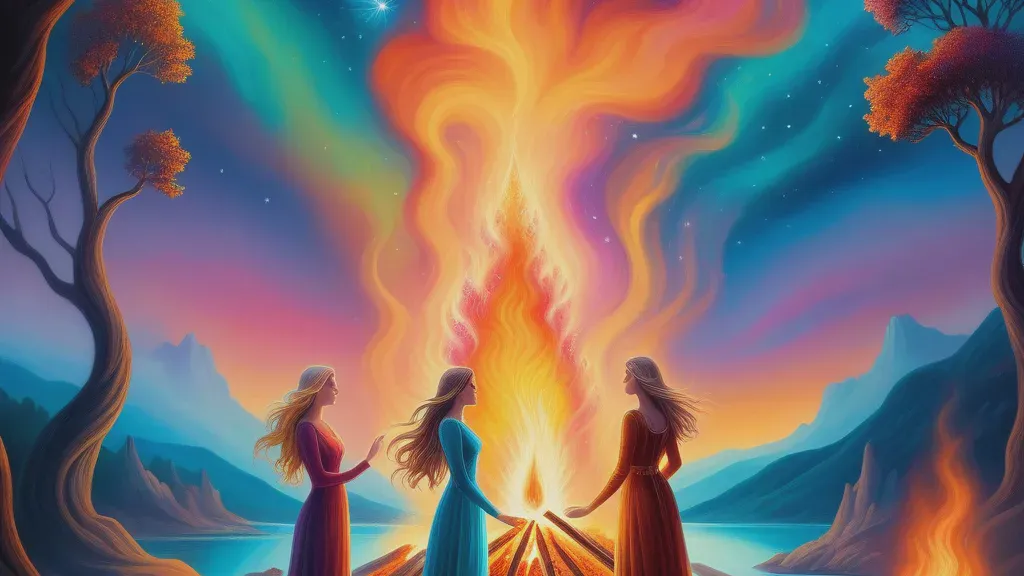
Bonfire
Jungian Archetypes
Meaning
A bonfire is fire made large and public on purpose: a heap of what is finished, set alight in the open so that others can gather round. In a dream it marks a moment when the psyche wants something consumed rather than stored, and wants witnesses for the burning. The pile is the dream's real subject, old possessions, old roles, the bones the word originally named, and the flame is the energy the dreamer is willing to spend on ending it. Because a bonfire also warms, lights faces, and holds a circle of people at a set distance from its heat, the image speaks at once of release, of belonging, and of the line between what one can approach and what one can only feed from a few steps away.
Psychological Interpretation
The first question to put to a dream bonfire is what it is burning, because the fuel names the sacrifice. A pyre of furniture, letters, or the contents of a childhood bedroom points to a chapter the dreamer is ready to close but has not closed in waking life; a fire of brush and deadfall suggests a more diffuse clearing, the psychic equivalent of tidying land after a storm. The second question is where the dreamer stands. Sitting in the ring of warmth, face lit and back cold, is the position of someone held by a group while something ends; standing alone at a fire nobody else attends is a private cremation of the past. Feeding the blaze is agency, choosing what goes in. Being unable to light it is the more common and more telling failure, a sign that the material is still too damp with feeling to burn. Jung treated fire-making as one of the oldest images of libido, energy rubbed out of friction, and a bonfire that catches easily says that energy is available for change. When the fire jumps its ring and runs for the trees or the roof, the dream is registering that a release meant to be contained has got loose: anger, grief, or an ending the dreamer began and can no longer steer.
Traditional Symbol Meaning
In the older dream books fire is one of the few symbols whose auspices flip entirely on a single detail: a fire that warms without burning is good fortune, a fire that consumes what one owns is loss. The bonfire, being a fire one builds on purpose, mostly landed on the favourable side. The popular dream dictionaries of the late nineteenth and early twentieth centuries mostly read a bonfire as pleasant times with friends and a run of good fortune, and a bonfire that went out as illness or a loss; the life of the fire was the life of the dreamer's prospects. The festival fires carried more precise expectations, and those expectations are the real folklore of the symbol. On Beltane and Midsummer, brands from the communal fire were carried home to relight the hearth, so that every household's fire descended from the one on the hill; ash was scattered on fields; couples who jumped the flames together were expected to marry within the year, and the height of a jump was read as the height of the coming crop. Frazer recorded a Perthshire Beltane at which a cake was divided so that one piece was blackened, and whoever drew it became the 'devoted', the mock victim who had to leap the fire three times. He collected such accounts because he heard in them the echo of a real burning, and whether or not he was right, folk memory around the bonfire holds a faint sense that the fire wants something living. That is why a bonfire in the traditional reading is never only warmth. It is the fire that takes: bones, effigies, the Guy, Holika, the old year, the possessions of the dead burned so that a house could be clean. Where cremation was practised, from the ghats of the Ganges to the Rus ship burning that Ibn Fadlan witnessed on the Volga in 922, fire was the vehicle by which the dead left, and a dream of a great outdoor fire kept some of that gravity even in cultures that had turned to burial. To watch a bonfire, in this register, was to attend an ending with dignity. The counter-tradition treats the bonfire as the beacon: the chain of hilltop fires that carried news of the Armada, a coronation, or a jubilee across a whole country in a night. Here the fire is not consumption but signal, a way of being seen at distance, and to dream of lighting one on a hill has been read as a wish to be found, to summon help, or to announce oneself to people too far away to hear a voice. Between the pyre and the beacon lies the full range of what the image carries: to burn what is over, and to say with light that one is still here.
Jungian / Archetypal
Jung read the making of fire as one of the primal images of libido, psychic energy that has to be produced by friction and then fed if it is to persist, and in Symbols of Transformation he traced fire-boring rites to the same root as sexuality and speech. A bonfire in a dream is that energy at its most social and most excessive. It is fire that has outgrown the hearth, built by a dreamer with more heat than their domestic life can contain. Compensation is the first thing to look for: a dreamer whose waking attitude is cool, orderly, or dutiful is sent a bonfire because the unconscious is balancing the books, and the size of the blaze measures how much has been kept cold. The pile that burns is often the persona's wardrobe, and the flame belongs to the Self. What goes into the fire tells the dreamer which adapted structure is being sacrificed so that a truer arrangement can appear, and the warmth the group feels is the psychic yield of that sacrifice. The archetypal background is the Great Mother in her double form, the fire that cooks and the fire that consumes, Hestia's hearth and Kali's cremation ground. Brigid of Ireland kept both faces, goddess of the forge and of poetry, whose perpetual flame at Kildare was tended, as Gerald of Wales reported in the twelfth century, by nineteen nuns and never by a man. A bonfire tended by a single girl is the Maiden feeding the fire: the psyche's young, still-forming attitude offering itself to a transformation it does not yet understand. Individuation proceeds through such burnings. The alchemists Jung studied called the operation calcinatio, the reduction of the matter to ash by dry heat, and placed it early, because nothing could be joined that had not first been reduced. A dreamer who cannot get the bonfire to light is at the threshold of that stage with damp material: feelings not yet dried enough to burn, an ending still being argued with. A dreamer who leaps the fire is enacting the rite of passage the festivals preserved, a crossing from one condition to another through a moment of controlled danger. A bonfire that gets away, running into the trees or onto the roof, is the classic warning of enantiodromia, the swing of an over-contained attitude into its opposite. The dream is not condemning the fire. It is asking the ego to build the ring of stones.
Gestalt / Parts of Self
Gestalt dreamwork begins by refusing the distance the bonfire creates. In the dream you sit at a comfortable remove from the flames, and the work asks you to give that up and become each part of the scene in turn: the fire, the fuel, the ring of stones, the person who cannot get it to catch, the smoke that drifts into someone's eyes. Say it in the first person and the present tense. 'I am the bonfire. I am loud and bright and everyone looks at me but nobody comes closer than six feet.' Notice what happens in your body when you speak that line, because a bonfire that wants to be approached and cannot be is a precise description of a certain kind of person, and it may be you. Then be the wood. 'I am the old chair. I am being burned and I did nothing wrong.' Fuel in a bonfire dream is almost always a disowned piece of your own history, something you have decided is finished and are trying to dispose of publicly, and the fuel's own voice tends to be more grieving, or more furious, than the person doing the burning wants to hear. Fritz Perls would put the two on facing chairs: the tidy self who says 'this needs to go' and the chair, the letters, the wedding dress that answers 'you never actually looked at me.' The polarity here is between the incinerator and the keeper, and neither is the whole of you. Most people who dream of bonfires are living from one pole and have exiled the other. The circle of people is the contact boundary made visible. Warmth on the face, cold on the back, is the exact experience of partial contact: you are meeting the group with your front and holding your withdrawal behind you. Ask who is in the ring and who is missing, and whether you are looking at the fire or at the faces, because a group that all stares into the flames is a group avoiding each other's eyes. If in the dream the fire will not light, do not interpret it. Become the damp log and say what you need before you can burn; usually the answer is time, or air, or for someone to stop poking you. Finishing the gestalt means letting the fire do what it wants in the imagined scene, all the way to ash, and staying present for the cold that comes after, which is the part of the ending most dreamers have never allowed themselves to feel.
Psychodynamic / Freudian
Freud found fire so charged that he returned to it late, in a 1932 essay on the acquisition of fire and in a footnote to Civilization and Its Discontents, where he proposed that early man's first response to a flame was to put it out with a stream of urine, and that culture began when someone renounced that pleasure and let the fire live. Whatever the anthropology is worth, the point holds: fire in a dream is drive, and a bonfire is drive on display, with the renunciation that keeps it useful either present or missing. The manifest content is a festive blaze. The latent content is often a wish to destroy something, or someone, dressed as a party so that the wish can be enjoyed without guilt. Condensation loves a bonfire because a pile can hold everything at once. The heap in the dream may contain a parent's belongings, a rival's letters, and the dreamer's own younger self, burned together in a single act that would be unbearable if it were sorted into its parts. Displacement moves the burning from the person onto their things, which is why dream bonfires consume furniture, clothes, and papers rather than bodies. Reversal turns the wish to be warmed into the act of warming others, so that the dreamer who hosts the fire is disguising a hunger to be gathered around. In Kleinian terms the bonfire sits at the edge of the depressive position: the destructive impulse is fully expressed, and the question is whether anything can be repaired afterward, whether the ash can be raked into the garden or only mourned. The circle around the fire carries the earliest material. Winnicott's holding environment is a ring of warmth in which a small self can be excited without being scorched, and a dream of sitting safely in that ring is often a memory, or a wish, of being held while feeling something large. A bonfire no one else attends points to a holding that failed, and the dreamer's solitary vigil is an attempt to be both the infant and the adult who watches. Bion's container and contained is visible in the ring of stones: the capacity to take a violent affect, hold it inside a boundary, and let it burn down into something thinkable. In treatment a bonfire dream often arrives when the transference has warmed and the patient needs to test whether the room can hold the heat. The analyst's job is to be the stones, not the water.
Contemporary Psychological
Humans may have been sitting round controlled fire for something like a million years. Richard Wrangham argued in Catching Fire that cooking over controlled flame reshaped the human gut, brain, and social day, and Polly Wiessner, recording Ju/'hoansi conversation in the Kalahari, found that daytime talk was mostly work and gossip while talk by firelight turned to stories, song, and the imagined lives of people far away. Christopher Lynn's experiments with recorded hearth fires found that watching flames with sound lowered blood pressure, the longer the exposure the larger the drop. A dreaming brain that summons a bonfire is reaching for a scene its own history associates with safety, story, and a slowing heart. That makes the bonfire dream a good test case for the emotional regulation theories of sleep. Rosalind Cartwright showed that dreamers who worked through a painful separation across a night's dreams woke in better moods than those who did not, and Matthew Walker's laboratory has argued that REM sleep, with noradrenaline switched off, lets the brain replay charged memories with the alarm removed. A bonfire is an apt vehicle for that operation: the dream places old material in a fire and watches it lose its form while the dreamer sits at a safe distance. The continuity hypothesis, as William Domhoff developed it from Calvin Hall's content analyses, predicts that the fuel will be recent and personal, the argument from Tuesday, the box of a parent's things, continued in a warmer setting rather than symbolised. Threat simulation theory, Antti Revonsuo's proposal that dreaming evolved to rehearse danger, explains the darker variants. A bonfire that spreads, leaps to a roof, or cannot be controlled is the brain running a scenario about a release that gets loose, and such dreams become more common after real fires and in dry seasons. Predictive processing adds a further reading: the brain holds a model in which fire is dangerous unless bounded, and a dream bonfire that behaves is the model confirmed, while one that escapes its ring is a large prediction error the brain is learning from. Memory consolidation may explain how often bonfire dreams seat people from different eras of a life in one circle; the hippocampus recombines during sleep, and a fire that draws a crowd is a convenient stage.
Cultural & Historical Origins
The English word keeps the ritual inside it: bonfire is Middle English bonefire, a fire of bones, and the fifteenth-century preacher John Mirk explained in his Festial that the Midsummer fires of St John's Eve came in three kinds, the bone fire, the wake fire of wood, and the saint's fire that mixed both, the burning bones being thought to drive off the dragons that poisoned summer air. Gaelic Beltane on the first of May was a fire festival before it was anything else: the tenth-century glossary Sanas Cormaic describes druids kindling two fires and driving cattle between them, and hilltop fires at Samhain opened the dark half of the year. Slavic Ivan Kupala night still involves leaping over flames, and at Iranian Chaharshanbe Suri, the last Wednesday before Nowruz, the jumper tells the fire to take their yellow sickness and give back its red health. India's Holika Dahan burns an effigy of the demoness Holika on the eve of Holi, remembering the boy Prahlad who walked out of her fire alive. James Frazer gave long chapters of The Golden Bough to the European fire festivals and weighed Wilhelm Mannhardt's reading of them as sun-charms against Edward Westermarck's reading of them as purification, finally siding with Westermarck: people burned what threatened them. England's Bonfire Night of 5 November, which still burns Guy Fawkes in effigy, and Savonarola's 1497 Bonfire of the Vanities in Florence show the same fire turned political and moral.
Contextual Variations
A bonfire that will not catch no matter how much you add
You are trying to end something before it is dry enough to burn. Damp wood in the dream is feeling that has not finished being felt: a relationship, a job, a version of yourself that you have declared over but still argue with at night. Adding more fuel does not help; the pile only smokes. The dream is not saying the ending is wrong, it is saying the sequence is wrong. Let the material sit in the air, name what is still wet in it, and the fire tends to take on its own once you stop forcing it.
Sitting in a ring of people around a bonfire, faces lit, backs cold
This is the image of being held while something burns. The warmth on your face is the part of you in contact with others; the cold on your back is the part you keep out of the light. Look at who is in the circle, especially anyone who could not share a room in waking life, because the dream has seated them together for a reason. Being handed a stick to add is your own agency inside the group's process. Being unable to find a seat is the opposite: a fear that the release is communal and you are not included.
Throwing your own belongings onto a bonfire one by one
Each object you choose is a piece of identity you are testing for whether you can live without it. Notice the order, because the sequence of the burning is the psyche's ranking of what is most finished. Notice also what you hesitate over, or pull back out with singed fingers, because that is the thing you are not ready to release and the dream has let you keep it. This variant comes at real moves, divorces, and career changes, and it is generally a good sign: the fire is under your control and you are deciding its diet.
A bonfire that jumps its ring and runs into the trees
A release that was meant to be contained has escaped. Anger you thought you had expressed in proportion, grief you tried to schedule, an ending you began with a single message and cannot now steer, all show up as fire heading for the woods. The feeling in the dream matters: exhilaration says some part of you wanted the excess and finds the destruction clean; terror says you are already sensing consequences. Find the ring of stones in your waking life, the boundary, person, or routine that keeps your heat useful.
Frequently Asked Questions
Is a bonfire dream a good sign or a bad one?
Why did I dream of burning my own things in a bonfire?
Why couldn't I light the bonfire in my dream?
Does a bonfire dream mean I am angry at someone?
Journaling Prompts
- Picture the pile before it was lit. List, as exactly as you can, what was in it: the chair, the letters, the coat, the box from your parents' house. Beside each item write one sentence about the part of your life it belongs to, and then note which item you had forgotten you owned until the dream put it on the pile.
- Who sat in the ring with you, and who was missing? Write about the empty place in the circle first: who should have been there, what stopped them coming, and whether you would have moved your seat to make room. Then write about the person sitting closest to the fire, and what they were willing to feel that you were not.
- Think about the last fire you lit on purpose in waking life, a real one or a figurative one: the letter sent, the account closed, the thing given away. Write what it felt like the morning after, and whether you swept up the ash or left it where it fell. Then describe what you would do differently with the ending that is coming next.
- Describe the heat you carry that has nowhere to go: the argument you keep rehearsing, the enthusiasm no one has asked for, the grief you are keeping off the calendar. Then write about the last time some of it got out unplanned, what it burned, and who raked the ash afterwards.
Related Symbols
Dreamed about Bonfire?
Get a personalized AI interpretation that connects this symbol to your specific life circumstances.
Interpret My Dream