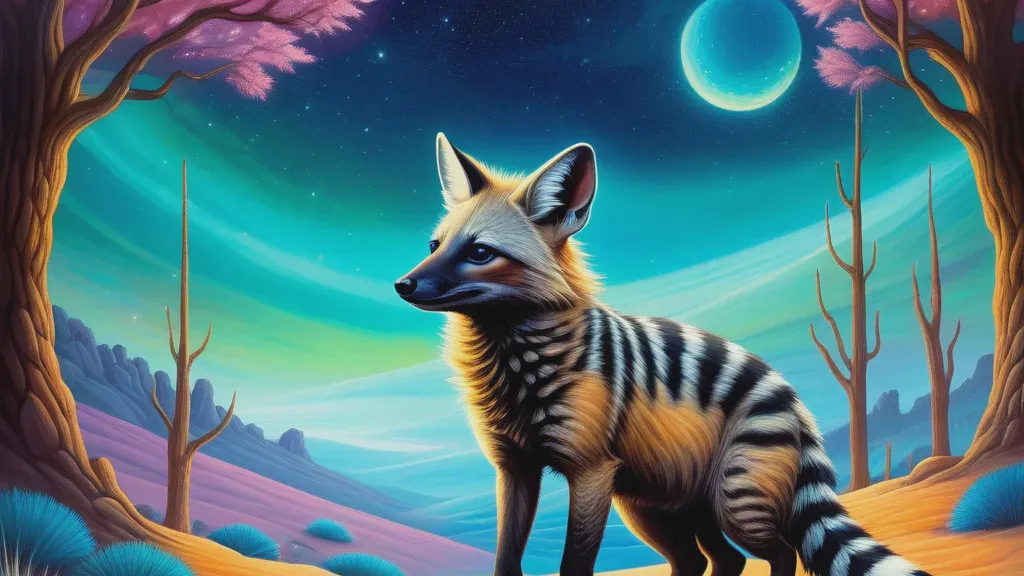
Aardwolf
Jungian Archetypes
Meaning
The aardwolf is the hyena that never learned to kill. Striped, maned and slinking through the southern African night, it casts the silhouette of a predator while living on termites, lapping up two hundred thousand a night with a broad sticky tongue; its cheek teeth have dwindled to pegs, and its jaws could not hold a lamb if it wanted one. In dreams it stands for the gap between the shape a thing casts and what it actually does: the fearsome-looking person who is harmless, the menace that is only minding its own small business, or the dreamer raising their own mane to look larger than they feel. It arrives when a reputation, inherited or self-made, is about to be measured against the truth.
Psychological Interpretation
An aardwolf in a dream asks the dreamer to look twice. The animal's entire defence is a bluff: cornered, it raises the long crest along its spine to look nearly twice its size, having nothing else to threaten with. The psyche reaches for this creature when someone is being read by outline rather than by conduct. Often the figure it points to is a person feared by association, a colleague or relative who shares a manner, a surname or a job title with someone who once did harm and has quietly inherited the suspicion. Just as often the aardwolf is the dreamer's own mask, the striped coat worn to survive a family or a workplace that respects toughness, while the real appetite underneath is for something small, steady and nocturnal: work done in the dark that nobody applauds. How the dream animal behaves is the key. One that flees or bristles suggests the bluff is wearing thin. One that calmly feeds while the dreamer watches gives permission to stop performing danger and get on with the modest, sustaining thing one is built for. The termites matter too. The aardwolf makes a whole living from what every other carnivore overlooks, and the dream may be pointing at an unglamorous niche where the dreamer would thrive if they stopped auditioning for the part of the hyena.
Traditional Symbol Meaning
No classical dream book has an entry for the aardwolf. Artemidorus never saw one, and the Victorian dictionaries that catalogued everything from abscesses to zinc skipped it too, so whatever traditional reading exists has been assembled from the two animals in its name. From the hyena side it inherits the oldest suspicion in the bestiary: the beast of two natures. Pliny gave it a sex that changed every year and a voice that called shepherds by name to draw them out of their huts; the medieval Physiologus made it a creature that lived among tombs and fed on the dead, an emblem of the double-minded. From the wolf side comes the bestiary belief that if the wolf sees a man before the man sees it, the man is struck dumb. To dream of a wolf-thing, in this tradition, was to dream of an enemy or of one's own greed, and the reading carried over to anything that moved like one. African traditions supply the second layer. Across much of the continent the hyena is the animal of the night side of the village: in parts of Zimbabwe, Tanzania and West Africa it is spoken of as the mount or familiar of witches, while in Swahili and Hausa tale cycles it plays the greedy fool who is forever outwitted. Herders who met the smaller striped animal at dusk lumped it in, calling it a little hyena or a maned jackal and crediting it with the lamb-killing that jackals actually did. The aardwolf's own habits pull the other way. It is an earth-dweller and a termite-eater, and termite mounds are treated as places of power in a number of West and Southern African traditions, sites where ancestors are addressed and offerings left. A beast that lives underground and feeds from those mounds sits close to the ancestral dead, not as a scavenger of corpses but as a quiet tenant of the same soil. Put together, the folk reading that emerges for the dream aardwolf is the false alarm and the wrongly accused. Older interpreters, had they known the animal, would have read it the way they read any creature that is not what it seems: as a warning that the dreamer is being deceived by a resemblance, or is deceiving others with one. Modern dream dictionaries that do list it make the same move and call it the harmless enemy, the danger that dissolves on inspection. What the older material adds, through the earth-wolf's burrow and its termite diet, is the chthonic note. The aardwolf belongs to the underground and the night, the territory of ancestors and hidden work, and its appearance in a dream can carry the sense of something modest and long-lived stirring beneath a frightening surface.
Gestalt / Parts of Self
Gestalt work begins by refusing the idea that the aardwolf is about anyone but you. Every figure in the dream is a piece of your own experience that you have set at a distance, so the first move is to become the animal and speak in the present tense: I am striped. I look dangerous. I raise the hair along my back when you come too close, and behind the hair there is nothing, only a mouth built for termites. Say it aloud and notice where it lands. Most dreamers feel something give as they say the second sentence, because the raised mane is a familiar gesture: the sharp email, the crossed arms, the reputation you let people keep because it saves you from being approached. The polarity the aardwolf holds is fierce against gentle, or displayed against hidden, and Gestalt reads a polarity as two halves of one capacity that have stopped talking to each other. Put the hyena you perform in one chair and the aardwolf you are in the other and let them argue. The hyena will say that the bluff is what keeps you fed and unbothered; the aardwolf will say that it is tired of eating in the dark and being shot at by farmers who never bothered to look. Neither wins. The work is to feel both as yours and to notice which one you disown in daily life, because the disowned half is the one that runs your dreams. If in the dream you were the one fleeing the animal, take the projection back: the danger you ran from is a quality of your own that you have never inspected. Then attend to contact. The aardwolf is a creature of withdrawal, solitary, nocturnal, feeding where nobody watches, and the bristled crest is a way of managing the boundary, a deflection that keeps others from arriving. Ask what happens to your breathing when you imagine someone stepping past the mane and seeing the small animal plainly. Ask whether you would rather be feared inaccurately or known accurately, and stay with the discomfort of an honest answer. The dream is not asking you to become something fiercer or softer. It is asking you to let the two meet at the surface of your skin, where contact happens, instead of keeping one of them underground.
Psychodynamic / Freudian
Read psychodynamically, the aardwolf is an image of disarmed aggression. Its manifest form is a wolf; its latent truth is a mouth that cannot bite, and the dream trades on that contradiction. Klein placed the earliest aggression in the mouth, the infant's wish to bite and devour the breast, and the wolf of nursery tales is that wish given fur. A wolf whose teeth have been reduced to pegs suggests a dreamer who has turned their own oral aggression into something safe, or has had it turned for them: the child told so often to be gentle that the ferocity survived only as a coat and a crest. The dream may then be a wish in disguise, the wish to be taken for dangerous while remaining unable to harm, a way of having the appetite and the innocence at once. Reversal and reaction formation are the defences the image stages. Ferocity displayed over timidity is a reaction formation; harmlessness worn over a real capacity for cruelty is its mirror, and the aardwolf can carry either, depending on the dreamer's history. Winnicott's distinction between the true and the false self fits the animal closely. The striped coat is a false self built to survive an environment that would not tolerate the small termite-eater underneath, and the dream's affect tells the dreamer how far that adaptation has hardened. Fear of the animal means the dreamer still believes their own bluff; tenderness toward it means the true self has begun to be recognised. Condensation is at work as well, one image compressing wolf, hyena and anteater into a single body, and noticing which the dreamer's associations reach for first often uncovers who in their early life wore this disguise. Object relations give the dream its cast. The aardwolf frequently stands for a parent or sibling feared in the family by shape alone, the quiet one everyone treated as the hyena, or for the dreamer as a child misread as fierce or as feeble who never corrected the record. In the consulting room the animal surfaces in the transference when the analyst is experienced as the predator and then, disconcertingly, as harmless, and the patient must work out what to do with a fear that has lost its object. That loss is the dream's real subject. Once the aardwolf is seen for what it is, the dreamer has to decide whether they preferred being frightened, because fear at least organised the relationship.
Contemporary Psychological
Most people who dream of an aardwolf have never stood in front of one, so the first question for cognitive science is how the sleeping brain builds a creature it has barely seen. The answer is that it assembles it from parts. Dreaming draws on schematic memory rather than photographs, and an aardwolf is an efficient composite: dog body, hyena stripes, a mane, a fox's muzzle. The continuity hypothesis associated with G. William Domhoff predicts that the raw material is recent and personal, a nature documentary, a zoo visit, a stray fact about termite-eaters, folded into whatever social concern the dreamer carried to bed. The animal is not chosen for its zoology but for its usefulness as a shape that says predator while the story says otherwise. That mismatch is where the dream does its work. Antti Revonsuo's threat simulation theory holds that dreaming evolved partly to rehearse responses to danger, and the brain's threat detector responds to silhouette and posture long before it checks capacity; the amygdala fires for the outline of a hyena, not for its dentition. An aardwolf dream can be understood as the classifier being tested against a hard case, an animal that trips every visual alarm and then fails to attack. In predictive processing terms the dream generates a strong prior, dangerous animal, and then feeds it a prediction error, harmless behaviour, and the surprise of that error is the memorable core of the dream. The likely function is calibration: the dreamer has recently misjudged someone, or been misjudged, and the brain is re-tuning its threat model overnight. The emotional side follows the same logic. Rosalind Cartwright's studies showed that dreams during difficult periods tend to work over the day's emotional residue, and Matthew Walker has described REM sleep as a kind of overnight therapy in which the charge is stripped from memories while their content is kept. A dream in which a feared figure turns out to be feeding quietly on termites is a compact version of that process, fear defused by reappraisal within the dream itself. Recurrence is the signal to watch. If the aardwolf keeps coming back, the misjudgement it encodes has not yet been resolved in waking life, and the practical step is to identify who, this week, was read by outline.
Jungian / Archetypal
Jung took the word persona from the mask of the Roman stage, and few animals wear a mask as complete as the aardwolf: coat, stripes and raised crest all say hyena to any eye that does not look closely. In a dream the aardwolf appears when the persona has drifted too far from the person, when a dreamer has been surviving on borrowed ferocity or when someone in their life is being met only through the mask. The usual arrangement is inverted here. Ordinarily the Shadow holds what is fierce and unacceptable while the persona shows something civil; with the aardwolf the disowned material is the softness. The gentleness, the small appetite, the preference for quiet night work have been pushed into the dark, and the dream returns them wearing a predator's coat so that the ego will at least let them in the door. The compensatory logic of dreams shows which way the image cuts. A dreamer who has over-identified with toughness, who has become the hyena of the family or the office, may be shown the aardwolf as a correction: this is what you actually are, and it is enough. A dreamer who has collapsed into harmlessness, frightened by silhouettes, may be shown the aardwolf raising its mane to make the point that even a termite-eater can hold its ground by posture. Amplification adds a mythic register. The genus name Proteles echoes, in sound if not in derivation, Proteus, the sea-god who changed shape to avoid questioning and told the truth only when held fast, and the dream aardwolf often wants to be held until its shape settles. Behind it stand the wolf of Romulus and the wolf Fenrir, all the wolves the psyche has stored, and the point of the dream is that this one is none of them. The Great Mother is present in the earth the animal lives in and the termites it eats. The aardwolf feeds directly from the ground, from mounds that in many African traditions belong to the ancestors, and sleeps in burrows dug by other creatures. For a dreamer this can figure the humble nourishment that keeps a life going: not the kill but the steady lapping. As a task of individuation the aardwolf poses a plain question. Can the dreamer take off the hyena's coat, or stop putting it on other people, and acknowledge the smaller true animal underneath without treating that admission as a defeat? The Self, in Jung's sense, is not diminished by being modest. It is diminished only by pretending.
Cultural & Historical Origins
The aardwolf has almost no mythology of its own, and that absence is the point: its symbolic life is borrowed from the animals it resembles. The Swedish naturalist Anders Sparrman, who travelled at the Cape in the 1770s, published the first scientific description in 1783 and filed it beside the civets; Isidore Geoffroy Saint-Hilaire later gave it its own genus, Proteles, 'complete in front', for the five toes on its forefeet against four behind. The Afrikaans and Dutch name, aardwolf, 'earth wolf', ties it to the burrow, usually one dug by an aardvark or springhare and taken over, while the older maanhaarjakkals, 'mane-haired jackal', records the crest it raises in alarm. Its fearful reputation came second-hand from its cousin. Pliny the Elder's Natural History has the hyena changing sex each year and imitating human speech to lure victims, a slander Aristotle had already doubted, and in parts of Southern and East Africa the spotted hyena is bound up with witchcraft belief as the night-mount of sorcerers. The aardwolf, striped and slinking at dusk, was tarred with the same brush. Cape farmers long poisoned it in vermin campaigns aimed at jackals, believing it took lambs, when its diet of termites made it one of the pasture's quiet allies.
Contextual Variations
An aardwolf raising its mane at you
The raised crest is the whole of the aardwolf's arsenal, and a dream that shows you the display is usually about a bluff, yours or someone else's. If a person in your waking life has been bristling, all volume and posture, the dream is telling you there is little behind it and that standing still would be enough. If you felt the mane rising on your own back, ask what you were protecting. The animal bristles because it cannot bite; you may be performing anger or authority exactly where you feel least able to defend yourself.
An aardwolf feeding at a termite mound in the dark
Watching the animal eat is the calmest form of this dream and often the most useful. The aardwolf lives entirely on what other carnivores ignore, working through the night at a mound nobody else wants, and the image points at your own overlooked niche: the steady, unglamorous work that actually sustains you, done without an audience. If you felt peace watching it, the dream is confirming that you do not need to hunt to be fed. If you felt contempt or impatience, ask whose standard of success you are applying.
Running from an animal you took for a hyena, then seeing its stripes
This is the misidentification dream in its purest form. You fled, and only afterwards did the detail arrive that the creature was an aardwolf and could not have hurt you. In waking life the equivalent is a fear built on resemblance: someone reminds you of a person who did harm, or a situation looks like an old one, and you react to the outline before the facts come in. The dream is not mocking you for running; it is showing you the exact moment when a second look would have changed everything. Ask who, recently, you have judged by silhouette.
An aardwolf shot or poisoned as vermin by a farmer
Cape farmers killed aardwolves for generations on the belief that they took lambs, when they were eating the termites that stripped the pasture. A dream in which the animal is destroyed as a pest carries that injustice into your life: something harmless and useful, a habit, a gentle trait, a person, is being attacked because it looks like a threat. If you were the farmer, ask what you are trying to eradicate in yourself on someone else's say-so. If you were the aardwolf, you are being punished for a resemblance, and the dream wants you to stop agreeing with the verdict.
Frequently Asked Questions
Why would I dream about an aardwolf when I have never seen one?
Is an aardwolf in a dream a good or a bad sign?
Is dreaming of an aardwolf different from dreaming of a hyena?
Could the aardwolf in my dream stand for a specific person?
Journaling Prompts
- Picture the moment the aardwolf raises its mane. Now find your own version of that gesture: the tone, the posture, the reputation you let stand because it keeps people at a distance. Write about the last time you used it, what you were protecting, and what would have happened if the other person had simply waited for the hair to settle.
- The aardwolf feeds all night on something no other predator wants. Name the part of your life that works the same way: unglamorous, steady, done without applause, and quietly keeping you alive. Then write about why you have been treating it as a consolation prize instead of the thing you are actually built for.
- Think of someone you have been wary of because they resemble a person who once hurt you, in manner or role or even name. Write down the evidence you have about who they really are, separated from the evidence you have about the person they remind you of. Notice how much of your fear survives the sorting.
- The aardwolf spent generations being blamed for the jackal's lambs. Consider whether some harmless trait of yours has been receiving that treatment, from others or from you: a softness, a slowness, an appetite for quiet. Write about who first called it a threat, and what it would take to stop agreeing with them.
Related Symbols
Dreamed about Aardwolf?
Get a personalized AI interpretation that connects this symbol to your specific life circumstances.
Interpret My Dream