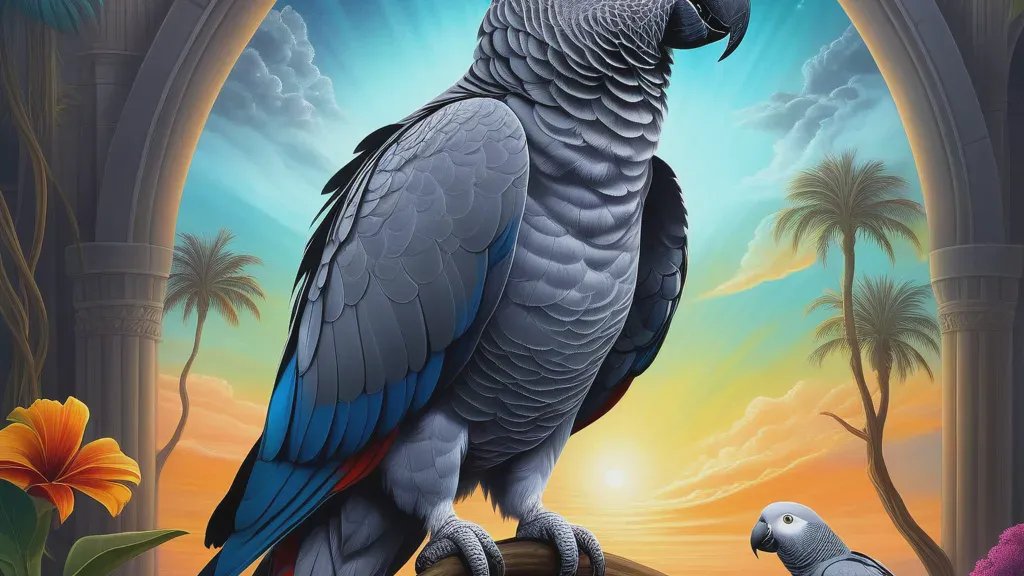
African Grey Parrot
Jungian Archetypes
Meaning
The African grey is the bird that gives words back. Native to the forests of the Congo basin and West Africa, grey except for a scarlet tail, it can hold hundreds of words and, as Irene Pepperberg's parrot Alex showed over thirty years, use some of them with understanding. In dreams it is the psyche's auditor of language: the creature that repeats what the dreamer said in a voice that exposes what they meant, that carries a dead relative's phrases into the present, or that sits caged and self-plucked, a long-lived intelligence kept for its cleverness and starved of its flock. It arrives when the dreamer's words, or someone else's words living in the dreamer's mouth, need to be heard from outside.
Psychological Interpretation
The parrot's speech is the first thing to examine, and the question is not only what it said but whose voice it used. A grey that returns the dreamer's own words in a parent's cadence is showing where the words came from; a grey that repeats a phrase said in anger, and repeats it again, is holding up a sentence the dreamer would prefer to forget and refusing to let it drop. Because the bird reproduces sound without editing it, the dream parrot works like an unsparing recording: tone, hesitation and contradiction come back intact, and the dreamer hears the gap between what they intended and how they sounded. Alex, who could name colours and shapes and ask for what he wanted, complicates the old dismissal of mimicry as mindless, and the dream grey often carries the same ambiguity, a voice that may or may not understand itself, which is the dreamer's own condition when repeating inherited opinions. The bird's circumstances matter as much as its speech. Greys can live for half a century, pair for life and roost in noisy flocks; a single one in a cage, plucking its chest bare, is one of the clearest dream images of a gifted, sociable part of the self kept alone and admired for its tricks. An escaped grey in the trees, or one that asks a question the dreamer has been avoiding, reverses the picture: the captive intelligence has begun to speak for itself.
Traditional Symbol Meaning
Parrots enter the dream books as gossips. Gustavus Hindman Miller's Ten Thousand Dreams Interpreted, the 1901 dictionary that shaped a century of popular reading, takes chattering parrots as a sign of idle talk and frivolous company, and folk belief across Europe agreed: the bird that repeats what it hears is the bird that will repeat the household's secrets. Behind the joke lies a real unease about speech that outlives its speaker. A grey can carry a phrase for decades and produce it, in the original voice, long after the person who taught it has died, and households that have lived with one know the moment when the dead answer the telephone. In dream lore this made the parrot a witness: whatever was said in the house, the bird has kept. The oldest parrot literature comes from India and Persia and treats the bird as a moral guardian rather than a fool. In the Sanskrit Shuka Saptati, the Seventy Tales of the Parrot, a merchant's wife is kept from adultery night after night by a parrot that tells her stories until dawn; the Persian Tutinama of Nakhshabi retold the cycle in the fourteenth century and it was later painted for the Mughal court. The parrot, shuka, is also the mount of Kama, god of desire, so the bird of speech is bound to the bird of longing. The grey is African rather than Indian, but in West Africa its red tail feathers carry comparable weight: among the Yoruba the parrot, odidere, supplies feathers worn in the crowns of kings and the regalia of Ifa priests, marking it as a creature that speaks with authority rather than merely echoes. European tradition kept the darker reading. Robert Louis Stevenson's Captain Flint, the parrot on Long John Silver's shoulder in Treasure Island, has sailed with pirates for two hundred years and swears like them; Silver calls her a witness to more wickedness than the devil himself. The bird that has heard everything and will say any of it is a figure of conscience and of blackmail at once. Philosophers coined psittacism for speech without understanding, and preachers used the parrot for the Christian who recites the creed without believing it. Set beside Loulou, the parrot who becomes the Holy Spirit in Flaubert's story, the tradition splits cleanly: the parrot is either the emptiest speech in the world or the vessel through which something beyond speech arrives. For the dreamer this leaves a compact traditional reading. A grey parrot in a dream is a witness and an echo, the keeper of what was said in the house and the voice that gives it back with interest. Where the bird speaks with authority, tradition reads a message worth taking as more than mimicry; where it chatters, a warning about words let loose; where it is caged, a long memory kept for someone else's amusement.
Gestalt / Parts of Self
Gestalt has a word for what the parrot does, and it is introjection: swallowing whole what others have said, without chewing, so that it sits inside undigested and speaks in its original voice. Perls contrasted the introjector with the person who bites and chews experience into something their own, and the grey is the introjector's emblem, a creature whose entire speech is other people's. So the first move is to become the bird. Say it in the present tense: I am grey. I repeat. I do not originate. I say what I was taught, in the voice that taught me, and I do not know what it means. Then say the phrase the dream parrot said, as the parrot, and notice whose sentence it is. It is almost never yours. Put the parrot in one chair and yourself in the other, and let the dialogue run. Ask the bird what it wants, and expect the answer to be about the flock, because the dream grey is nearly always alone. Ask it why it keeps repeating the angry line, and expect it to say that no one has told it to stop. The polarity here is echo against original voice, and the resolution is not to silence the echo but to own it: the sentence you hate hearing from the parrot is one you have said, in that tone, and until you take it back as yours it will keep being said by something outside you. Ownership sounds like this: I say this. I learned it from my mother. I am choosing whether to keep it. The plucked bird brings retroflection into the room, the turning against the self of an impulse meant for others. A grey stripped of its own chest feathers is doing to itself what it cannot do to the cage, and if that image appeared in your dream, Gestalt asks where in your body you feel the pulling and what the pulling would say if it were aimed outward. Mimicry, too, is a contact problem: the parrot appears to converse while touching no one, and a person who has learned to sound right in every room may be living the same way. The dream in which the bird asks you a real question, one you cannot interrupt, is the moment contact breaks through the performance. Stay with the question. Answer it aloud, to the empty chair, and see what the bird says next.
Psychodynamic / Freudian
Freud located the superego in the parents' voice, taken in and preserved so faithfully that a grown person can hear the prohibition in the exact tone it was first spoken. The African grey is an almost too perfect image of that structure. It keeps a household's speech for decades and replays it in the original voice, and a dream in which the bird returns the dreamer's words in a mother's or father's cadence is the superego showing its working: the sentence the dreamer thought was theirs turns out to be an introject, and the shame the dream produces is the affect of being caught in the act of quotation. The manifest content is a pet doing a trick. The latent content is the discovery of who has been speaking through the dreamer all along. Object relations extend the reading. Klein's internal objects speak inside the psyche in their own voices, and a parrot that repeats the angry phrase is a persecutory object playing back the dreamer's own aggression until it feels like an attack from outside, projection followed by its return. Winnicott's mirroring adds another layer: the infant learns what it feels by seeing it reflected in the mother's face, and a bird that reflects words without feeling is a distorted mirror, giving back the sound of the dreamer and nothing of the state behind it, which is what many people received in childhood from a parent who could echo but not attune. Alice Miller's gifted child, admired for performance and unseen as a person, is very close to the caged grey, kept for its cleverness and losing its feathers from a loneliness no one in the house has noticed. The plucked bird is where Freud's account of melancholia applies: aggression that cannot be directed at the lost or withholding object turns on the self, and the parrot tearing its own chest bare is that turn made visible. Condensation is frequently at work as well, the dream bird compressing a real parrot, a parent and the dreamer into one grey body, and the associations that arrive first usually show which of the three the dream is chiefly about. In the transference the parrot appears when the patient experiences the analyst as merely repeating their words back, and the complaint deserves to be taken seriously, because behind it lies the early experience of being echoed without being understood. The dream is asking for the other thing, and naming it is usually enough to start.
Contemporary Psychological
Parrots belong to the small group of animals, with songbirds, hummingbirds, some marine mammals and humans, capable of vocal learning, the ability to hear a sound and reproduce it, and Erich Jarvis's comparative work has shown that the brain circuits supporting it in birds and in people are convergent. Irene Pepperberg's three decades with Alex went further, demonstrating that a grey could attach labels to objects, colours, shapes and small quantities, answer which property differed between two items, and request what it wanted. A dream about a grey draws on this cultural knowledge even in people who have never held one, because the parrot has become the standard image of the question that shadows all speech: whether the speaker understands what they are saying. The dreaming brain is itself at work on speech. Research on word learning shows that newly heard vocabulary is integrated into the mental lexicon overnight, and that the sleeping brain preferentially reactivates recent material tagged with emotion. A parrot that repeats a phrase from the day is a plausible surface for that reactivation, and the phrase it chooses is diagnostic. Rosalind Cartwright's finding that dreams work over the day's affective residue predicts exactly the dream in which the bird will not stop saying the angry sentence: the brain is re-running the charged exchange, and the parrot is its loudspeaker. In predictive processing terms, hearing one's own words in another voice strips away the speaker's privileged sense of what they meant and exposes the signal as a listener received it, which is why these dreams so often carry the shock of sounding harsher than one felt. Social simulation theory, Antti Revonsuo and Katja Valli's extension of threat simulation to the social world, accounts for the bird that asks questions: the dreamer is rehearsing an interrogation they expect, with the question placed in a mouth that cannot be argued with. The continuity hypothesis reminds interpreters that the commonest reason to dream of a grey is to live with one, and that an owner's dream of a plucking bird may be first of all a worry about the bird. Even there the emotional logic holds. Feather plucking in captive greys is linked to isolation and understimulation in a species built for flocks, and the brain that dreams of a lonely, self-harming intelligence is frequently modelling, in the bird, a condition it recognises closer to home.
Jungian / Archetypal
Jung described the animus, the contrasexual figure in a woman's psyche, as characteristically a voice: a source of opinions, maxims and received judgements delivered with an authority they have not earned; the nearest male counterpart is the father complex, the internalised voice of authority and its maxims. The African grey is that voice with feathers. It reproduces, flawlessly and without comprehension, the sentences it was raised among, and a dream in which the bird speaks the dreamer's words in a parent's cadence is a portrait of possession by inherited opinion. The colour is apt. Grey is the undifferentiated, the not-yet-one's-own, and the single scarlet tail is the flash of individual libido that the rest of the bird has not caught up with. The Shadow enters when the parrot says what the dreamer would not. A bird that repeats the angry phrase, the contemptuous aside, the thing said under the breath, is the Shadow's stenographer, and the dreamer's shame at hearing it is the ego meeting material it had filed as accidental. Compensation runs the other way for the silenced: a dreamer who has stopped speaking for themselves, the quiet one in a loud house, may dream a grey that will not stop talking, the psyche restoring the voice in exaggerated form. Amplification reaches for the winged messengers, Hermes with his sandals and Thoth the ibis-headed scribe of the gods, and for Papageno, Mozart's bird-catcher whose mouth is padlocked for lying; the parrot belongs to this family of creatures that carry words between worlds and are punished or honoured for what they carry. Alex gives the symbol a heroic edge. A bird that crossed the line between mimicry and meaning, that asked for a nut by name and answered questions about colour and number, stands for the possibility that echo can become speech, that a person raised on borrowed words might come to mean them or to replace them. The individuation task the grey poses is precisely that crossing. The dreamer is asked to sort the inherited sentences from the earned ones, to notice which phrases they produce on cue and which they would say if no one had taught them, and to bear the loneliness of a bird that has left a very talkative cage. The Self, in this dream, is not the parrot; it is the one who finally hears the difference.
Cultural & Historical Origins
Psittacus erithacus, the grey of the Congo basin and the forests of West Africa, reached Europe in numbers only after Portuguese traders opened the West African coast in the fifteenth century; by tradition Henry VIII kept one at Hampton Court. The parrot of the ancient world was the Indian ring-neck, and it left two famous elegies: Ovid mourned Corinna's parrot in the Amores and Statius, in the Silvae, mourned the talking bird of his patron Atedius Melior. Medieval lore held that the parrot naturally said Ave, which made it a bird of the Annunciation, and painters from Van Eyck to Schongauer set parrots beside the Virgin. The sharpest literary parrot is Loulou in Flaubert's Un cœur simple, the stuffed bird the servant Félicité confuses with the Holy Spirit as she dies. The grey's modern fame rests on Alex, the bird Irene Pepperberg trained from 1977 until his death in 2007 and described in The Alex Studies: he labelled objects, colours and quantities, grasped same and different, and his last words to her were reported as You be good, see you tomorrow, I love you. Trapping for the pet trade collapsed wild populations, in Ghana by an estimated ninety per cent or more, and in 2016 the species was moved to CITES Appendix I; in parts of West and Central Africa its red tail feathers have long been prized for regalia and ritual.
Contextual Variations
A grey parrot repeating your words in your mother's voice
The bird has done what greys do, reproduced a sentence exactly, and the dream has added the one detail that matters: the voice. You are hearing where your words came from. The phrase you thought was yours, the judgement, the reassurance, the put-down, arrived in you through a parent, and the parrot is playing back the original recording. Ask whether you want to keep saying it. Some inherited sentences are worth keeping; the dream is not asking you to reject your mother, only to notice that when you speak in her cadence you are quoting, and to decide which quotations you will make your own.
A grey parrot that has plucked its own chest bare
Feather plucking is what a grey does when it is alone, under-stimulated and unable to reach its flock, and the dream is using the bird to show you a gifted, sociable part of yourself in the same condition. Something in you that is clever and meant for company is being kept for its tricks and starved of contact, and it has begun to turn on itself. Ask who the cage belongs to and what the bird would do if the door were open. The dream is not only a picture of distress; it is a diagnosis of loneliness disguised as competence, and the remedy it points to is a flock, not a bigger cage.
An African grey escaping its cage into the forest canopy
The bird belongs in the canopy of the Congo forest, in a flock, and a dream that returns it there is a dream of a captive intelligence going home. Notice how you felt. Loss suggests the escaping bird carries something you have relied on, a cleverness or a voice that performed for you and is no longer available on demand. Relief suggests you are the bird, and that a part of you long kept for other people's entertainment has just found the open door. Either way, ask what the cage was made of and who fed you through the bars.
A grey parrot that asks you a question you never said aloud
A parrot can only say what it has heard, so a bird that asks a question you never spoke has heard it somewhere: in your own head. The dream has given your unvoiced question a mouth that will not be interrupted, and the calm of the bird's voice is the calm of something that has waited a long time. Answer it, in the dream if you can and on paper if you cannot. The question is usually the one you have been circling for months, and the fact that it comes from a creature that cannot argue back means the dream is not attacking you; it is simply declining to let the question go unasked any longer.
Frequently Asked Questions
Why does the parrot in my dream repeat my words back to me?
Is it a bad sign to dream of a caged or plucking African grey?
Why would I dream of an African grey rather than any other parrot?
Can a parrot in my dream be a message from someone who has died?
Journaling Prompts
- Write down, word for word, the phrase the parrot repeated in your dream. Then write down where you first heard it and from whom. Read both aloud in the voice the bird used, and note what you feel in your throat and chest. Then write what the phrase was for, what it protected or achieved for the person who first said it, and whether it does the same work in your life.
- List five things you say often that you did not originate: family sayings, a teacher's maxim, a partner's verdict on the world. Beside each one, write who first said it to you and whether you have ever tested it against your own experience or simply repeated it. Pick the one you have repeated most and write what you actually think.
- Imagine the grey in your dream with its cage door open and describe what it does in the first minute. Then ask which part of you the bird is, what it has been kept for, and whose entertainment it has been providing. Write about what would change in your week if that part were allowed to fly to its flock.
- If the parrot asked you a question in the dream, write the question at the top of the page and answer it without stopping for ten minutes. If it did not, write the question you suspect it would have asked, the one you least want to see in your own handwriting, and answer that instead. Notice how much of your answer is in someone else's voice.
Related Symbols
Dreamed about African Grey Parrot?
Get a personalized AI interpretation that connects this symbol to your specific life circumstances.
Interpret My Dream