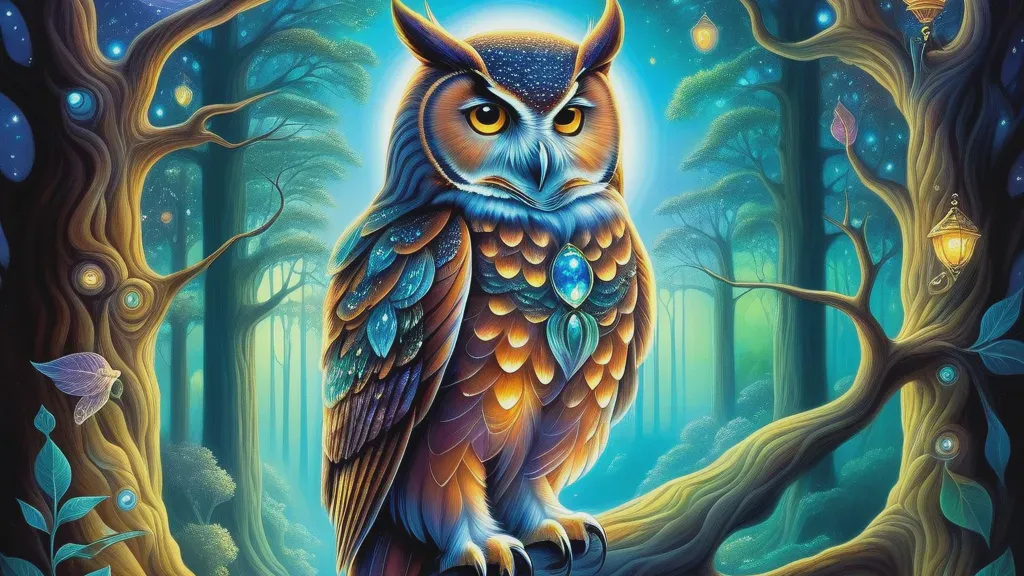
Owl
Jungian Archetypes
Meaning
The owl represents wisdom, intuition, and the ability to see what others cannot. It symbolizes mystery, transition, and the exploration of hidden truths. The owl's nocturnal nature connects it to the unconscious mind and inner knowledge.
Psychological Interpretation
In Jungian psychology, the owl embodies the Wise Old Man archetype, representing accumulated wisdom and spiritual insight. It also reflects the Shadow, the hidden aspects of the psyche that require acknowledgment and integration for wholeness.
Contemporary Psychological
The owl in dreams often represents the brain's nocturnal processing capacity—the mind's ability to work through complex emotional and cognitive material during sleep when the conscious mind is offline. From a contemporary neuroscience perspective, the owl embodies the threat simulation function of REM sleep, where the brain rehearses responses to potential dangers in a safe environment. The owl's characteristic vigilance and heightened sensory awareness mirror the hypervigilance that emerges when the brain is processing unresolved anxiety or stress. This nocturnal hunter symbolizes the brain's capacity to detect patterns and threats in darkness—both literal darkness during sleep and the metaphorical darkness of uncertainty in waking life. The owl's pattern recognition abilities reflect memory consolidation processes occurring during sleep. When the brain encounters new information or experiences during the day, sleep provides the opportunity to integrate these memories into existing knowledge networks. The owl's ability to see clearly in darkness suggests the brain's work of making sense of confusing or ambiguous situations—extracting meaningful patterns from incomplete information. This cognitive function is particularly active when the dreamer is facing complex problems, learning new skills, or integrating contradictory information that requires deeper processing than waking consciousness can manage. Emotionally, the owl can signal the brain's attempt at emotional regulation through threat simulation. If the dreamer is anxious about an upcoming challenge or uncertain about a decision, the owl may represent the brain's rehearsal of coping strategies and threat responses. The owl's predatory nature—its role as hunter rather than hunted—can indicate the brain's shift from passive worry to active problem-solving. This is the mind's way of converting free-floating anxiety into specific scenarios that can be mentally rehearsed and mastered. The vigilance of the owl reflects the emotional labor of maintaining awareness and readiness in the face of perceived threats or demands. The owl's nocturnal nature ultimately points to the brain's continuous cognitive work beneath conscious awareness. Dreams featuring owls often emerge when the dreamer is processing significant emotional material, consolidating new learning, or rehearsing responses to anticipated challenges. The owl embodies the brain's capacity to function intelligently and adaptively even in conditions of uncertainty and darkness—a reminder that much of our psychological growth and emotional regulation happens not through conscious effort, but through the brain's autonomous processing during sleep.
Gestalt / Parts of Self
The owl in dreams represents the seeing part of the dreamer's own psyche—the capacity to perceive what is hidden, to navigate darkness with clarity, and to witness without judgment. In Gestalt terms, the owl is not a separate entity offering wisdom from outside; it is the dreamer's own inner witness, the part of self that observes, knows, and understands. When the owl appears, the dreamer is being invited to own this capacity for clear seeing, to claim the wisdom that already lives within them. The owl's silent flight and nocturnal nature point to a way of knowing that operates beyond noise and daylight logic—intuitive, present, and attuned to what others miss. Often, the dreamer projects the owl's wisdom outward, treating it as something external that must be consulted or followed rather than recognized as their own. This projection can manifest as seeking guidance from others, deferring to external authorities, or believing that clarity and understanding belong to someone else. The Gestalt work here is to notice: where am I giving away my own seeing? What part of my own wisdom am I refusing to own? The owl invites the dreamer to reclaim the authority of their own perception, to trust what they already know in the darkness, and to stop waiting for permission to see clearly. The dialogue between parts becomes visible when the dreamer notices the tension between the owl's silent knowing and other parts of self that demand proof, explanation, or external validation. The owl sees; other parts doubt. The owl moves in darkness; other parts demand light and certainty. In Gestalt work, this is not a problem to solve but a conversation to have. What does the owl part need from the doubting part? What does the doubting part fear about trusting the owl's silent knowing? Integration happens when the dreamer can hold both—the owl's intuitive clarity and the rational mind's need for verification—as equally valid parts of a whole self. Ownership of the owl means claiming the right to see what you see, to know what you know, and to move through uncertainty with the quiet confidence of a creature perfectly adapted to darkness. It means recognizing that wisdom is not always loud, visible, or immediately provable. The owl calls the dreamer to trust their own perception, to value the seeing that happens in silence and solitude, and to integrate this capacity into waking life—not as something mystical or separate, but as a natural, owned part of how they navigate the world.
Jungian / Archetypal
The owl in dreams embodies the archetype of the Wise Old Man or Woman—the figure who sees what others cannot, who dwells in the liminal spaces between conscious and unconscious, between light and darkness. In Jungian psychology, the owl represents the Self's capacity for penetrating vision and transcendent knowledge. Its nocturnal nature connects it to the realm of the unconscious, where the dreamer must venture to encounter deeper truths. As Athena's sacred bird, the owl carries the wisdom of the goddess herself—not merely intellectual knowledge, but the discernment that comes from integration of shadow and light, from understanding the hidden dimensions of reality that daylight consciousness cannot access. The owl's role as a death messenger in many cultures points to its function as a psychopomp—a guide between worlds. In individuation, this death is not literal but symbolic: the death of illusions, the dissolution of the ego's false certainties, the necessary destruction that precedes rebirth into greater wholeness. The owl's penetrating gaze, its ability to see in darkness, represents the dreamer's capacity to confront what has been hidden or repressed. This is the Shadow's domain—the aspects of self that consciousness has turned away from. The owl invites the dreamer to look directly at what frightens or disturbs, to recognize that true wisdom requires acknowledging the darkness within and without. The feminine mystery associated with the owl speaks to the Anima in men's dreams and the deeper feminine principle in women's dreams—the intuitive, receptive, and transformative power that lies beneath rational consciousness. The owl's silent flight, its ability to move unseen through the night, suggests a knowledge that operates beyond the reach of the ego's controlling intellect. In the individuation process, the owl appears when the dreamer is being called to develop a more nuanced, paradoxical understanding of reality—one that holds opposites together rather than splitting them into good and evil, light and dark. The owl's collective meaning across cultures—from ancient Greece to indigenous traditions—underscores its archetypal power: it is the guardian of threshold knowledge, the keeper of secrets that only those willing to enter the darkness can discover. To encounter the owl in dreams is to be invited into a deeper conversation with the Self. It asks: What are you refusing to see? What wisdom lies in the darkness you fear? The owl's presence signals that individuation requires not the conquest of shadow but its integration, not the avoidance of death but its acknowledgment as the gateway to transformation. This is the owl's gift—not comfort, but the hard-won clarity that comes from looking directly into the abyss and discovering that the abyss, too, contains meaning.
Psychodynamic / Freudian
The owl in dreams manifests as a figure of watchfulness and judgment, yet its latent content reveals a more complex psychological dynamic: the internalized superego—that voice of parental authority and moral constraint that guards against forbidden impulses. On the surface, the owl simply observes from the darkness, a creature of nocturnal vigilance. But beneath this manifest image lies the dreamer's anxiety about being seen, known, and judged for desires or thoughts deemed unacceptable. The owl's large, unblinking eyes become the eyes of the internalized parent, the conscience that never sleeps, never looks away. This wish-defense dynamic expresses a fundamental conflict: the dreamer wishes to act on repressed desires (sexuality, aggression, autonomy) while simultaneously fearing the superego's condemnation. The owl embodies this tension—it is both the watcher and the watched, both the judge and the judged. Defense mechanisms operate powerfully through the owl symbol. Displacement allows the dreamer to project moral scrutiny onto an animal rather than consciously acknowledging the internal critic. Projection transforms the superego's judgment into an external threat—the owl becomes the source of danger rather than the dreamer's own conscience. Condensation compresses multiple anxieties into a single image: death anxiety (the owl as harbinger of mortality, the "death bird" of folklore), forbidden knowledge (the owl as keeper of secrets and hidden truths), and sexual guilt (the nocturnal, predatory nature of the creature). Through these mechanisms, the dreamer avoids direct confrontation with repressed material while allowing it to surface in disguised form. Childhood origins often anchor the owl symbol in early experiences of surveillance and control. The dreamer may recall a parent who watched closely, who seemed to know everything, who punished transgression with a look. The owl's nocturnal nature connects to bedtime—that vulnerable moment when the child was alone with thoughts and impulses, when the parent's presence lingered as an internalized watcher. Night itself becomes associated with forbidden activity, with the id's desires emerging when the conscious mind relaxes. The owl, awake when others sleep, represents the superego's relentless vigilance, its refusal to let the dreamer rest into unconscious freedom. This early pattern of being watched, judged, and constrained becomes encoded in the owl's image, making it a symbol of the repressed conflict between desire and duty that originated in childhood but persists into adult life. The owl thus functions as a psychodynamic symbol of the repressed material pressing toward consciousness—the dreamer's awareness that they are being watched, that they are watching themselves, and that the boundary between internal judge and external threat has become dangerously blurred. The forbidden knowledge the owl guards is not external wisdom but the dreamer's own disowned impulses, the truths about themselves they have learned to fear. In this way, the owl becomes a mirror of the superego's power: it sees all, forgives nothing, and ensures that the dreamer remains trapped in the nocturnal anxiety of being perpetually observed and perpetually guilty.
Cultural & Historical Origins
In ancient Greek culture, the owl was sacred to Athena, goddess of wisdom and warfare, symbolizing strategic thinking and knowledge. In Hindu tradition, the owl is associated with Lakshmi but also with ignorance in some contexts. Many indigenous cultures view the owl as a messenger between worlds and a guardian of sacred knowledge.
Contextual Variations
Dreaming of an owl watching you
Your intuition is observing your situation; pay attention to subtle signs and inner guidance
Dreaming of an owl in flight
Freedom to explore the unknown and navigate through darkness with clarity and purpose
Frequently Asked Questions
What does it mean if the owl is silent?
What if the owl's eyes are glowing?
Journaling Prompts
- What hidden truths or aspects of myself am I being called to acknowledge?
- How can I strengthen my intuition and trust my inner knowing?
Related Symbols
Dreamed about Owl?
Get a personalized AI interpretation that connects this symbol to your specific life circumstances.
Interpret My Dream