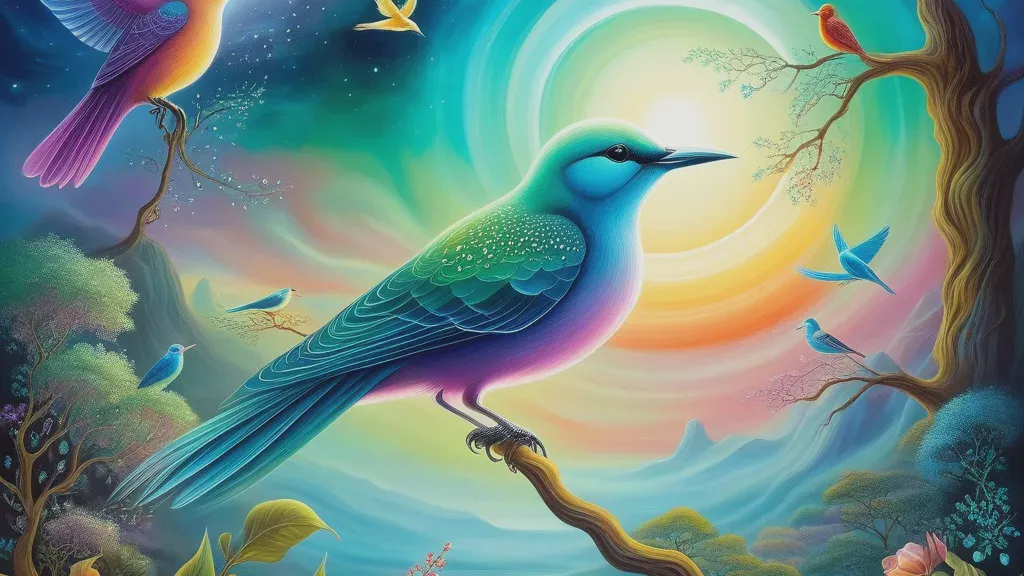
Bird
Jungian Archetypes
Meaning
Birds in dreams symbolize freedom, aspiration, and the soul's desire to transcend earthly limitations. The type and behavior of the bird significantly shapes its meaning — soaring birds suggest liberation, while caged birds reflect feeling trapped.
Psychological Interpretation
Jung viewed birds as symbols of transcendence and spiritual messengers from the unconscious. A bird in flight often represents thoughts or ideas rising from the depths of the psyche, seeking conscious expression and integration.
Contemporary Psychological
Birds in dreams often represent the brain's processing of perspective shift and cognitive freedom—the capacity to step back from immediate emotional constraints and view situations from a higher vantage point. From a contemporary neuroscience perspective, flight imagery activates spatial processing networks and engages the brain's threat-simulation function, allowing the dreamer to mentally rehearse escape routes, alternative viewpoints, or liberation from perceived constraints. The bird's ability to move through three-dimensional space mirrors the dreamer's cognitive flexibility and the brain's attempt to break free from rigid thought patterns or emotional loops that may be limiting waking-life problem-solving. The emotional regulation function of bird imagery is particularly significant when the dreamer experiences feelings of confinement, powerlessness, or being trapped in a situation. The brain uses the bird as a metaphor for agency and movement—practicing the mental experience of transcending obstacles before the waking mind needs to navigate them. This is threat simulation at work: the dream rehearses what it feels like to escape, to gain altitude, to see the bigger picture. Memory consolidation may also be operating here, as the brain integrates recent experiences of constraint or breakthrough, cementing new neural pathways associated with resilience and adaptive thinking. The narrative structure of bird dreams reveals the dreamer's current cognitive state regarding autonomy and perspective. If the bird flies freely and effortlessly, the brain is consolidating a sense of expanded possibility and emotional regulation success. If the bird struggles, is caged, or cannot take flight, the dream reflects ongoing cognitive processing of barriers—the brain is still working through the emotional weight of limitation. The bird's presence in the dream landscape signals that the brain is actively engaged in the work of perspective-taking and emotional flexibility, using spatial metaphor to process what may feel emotionally abstract or overwhelming in waking life. Ultimately, birds in dreams function as the brain's way of practicing freedom of thought and emotional mobility. They represent the dreamer's capacity—or aspiration—to transcend immediate emotional constraints and access broader cognitive resources. This is not about literal escape, but about the brain's fundamental need to rehearse flexibility, to consolidate the possibility of seeing situations differently, and to regulate the emotional weight of feeling stuck by mentally experiencing what liberation feels like.
Gestalt / Parts of Self
In Gestalt dream work, the bird is not a symbol floating outside the dreamer—it is a living part of the dreamer's own psyche taking flight. The bird represents the aspect of self that yearns for freedom, that refuses to be caged, that knows how to rise above the ground-level struggles and see the larger landscape. When a bird appears in a dream, the dreamer is encountering their own capacity for liberation, their own wings. This is not something the dreamer possesses; it is something the dreamer *is*. The bird is the voice inside that says "I can leave, I can transcend, I can see from a different vantage point." Often, the dreamer projects this freedom onto the bird as if it belongs to the bird alone—as if the bird is free and the dreamer is not. This is the projection: the dreamer watches the bird fly and feels trapped, envious, or wistful, not recognizing that the very capacity for flight lives within themselves. The dreamer may say "I wish I could be like that bird," when in fact the bird *is* the dreamer's own unowned freedom, the part of self that the dreamer has disowned or left behind. The dialogue is between the grounded self (the part that feels stuck, responsible, earthbound) and the flying self (the part that knows liberation is possible). These are not enemies; they are in conversation, and the dream invites the dreamer to own both. Ownership of the bird means reclaiming the freedom, perspective, and lightness that the dreamer has attributed to something external. It means recognizing that the capacity to rise, to see clearly from above, to move beyond constraints—these are not gifts the dreamer lacks. They are parts of the dreamer waiting to be integrated. The bird in the dream is not asking the dreamer to escape reality; it is asking the dreamer to claim the part of self that can hold both groundedness and flight, both responsibility and freedom. When the dreamer can say "I am the bird, and I am also the one who watches it," the dream has done its work. The bird becomes not a distant ideal but a living, present capacity within the dreamer's own being.
Jungian / Archetypal
In Jungian psychology, the bird represents one of the most potent archetypal symbols of transcendence and the Self—the archetype of wholeness and individuation. Birds embody the capacity to rise above earthly constraints, to perceive from a higher vantage point, and to access realms beyond the material and rational. This upward movement mirrors the individuation process itself: the journey from fragmentation toward integration and spiritual awakening. The bird's wings are instruments of liberation, suggesting the dreamer's potential to transcend psychological limitations, unconscious patterns, and the gravitational pull of the ego's narrow perspective. In this sense, the bird often appears when the psyche is calling the conscious mind toward greater consciousness and wholeness. The bird also embodies the Anima archetype—the feminine principle of soul, intuition, and inner wisdom—particularly when it appears as a graceful, luminous, or singing creature. The Anima mediates between the conscious ego and the deeper Self, and a bird in dreams frequently signals the stirring of this inner feminine wisdom, inviting the dreamer to listen to subtle inner voices and to trust non-rational knowing. Conversely, the bird can represent the Animus in its aspect as the spiritual guide or messenger—the masculine principle of aspiration, clarity, and purposeful direction. When a bird appears as a messenger or guide, it often carries communications from the unconscious, bringing news of transformation or calling attention to what the dreamer has overlooked or denied. The Shadow dimension of the bird archetype must not be ignored. A caged bird, a wounded bird, or a bird that cannot fly represents the dreamer's own imprisoned potential, the aspects of freedom and transcendence that have been suppressed, denied, or sacrificed to social conformity or fear. The Shadow here is not malevolent but rather the unlived life—the spiritual aspirations, creative impulses, or authentic self-expression that remain grounded and constrained. A predatory bird, conversely, may embody the Shadow's aggressive or predatory aspects, or it may represent the Self's fierce, penetrating gaze that cuts through illusion and self-deception. The collective meaning of the bird across cultures—from the dove of peace to the eagle of vision, from the phoenix of rebirth to the raven of wisdom—anchors it in humanity's deepest recognition that consciousness itself is a form of flight, a transcendence of the merely instinctual and material.
Psychodynamic / Freudian
In dreams, the bird represents the manifest expression of a latent wish for escape and liberation from psychological constraint. On the surface, a bird simply flies—it moves freely through space, unbound by the limitations that confine earthbound creatures. Yet beneath this literal image lies a deeper psychological truth: the bird is the dreamer's own repressed desire for autonomy, for release from internalized restrictions, for transcendence of the limitations imposed by authority, duty, or the superego. The bird's flight is wish fulfillment in its most direct form—the unconscious mind granting itself the freedom it cannot claim in waking life. The defense mechanism at work here is sublimation: the transformation of forbidden or unacceptable impulses (rebellion, aggression, the desire to abandon responsibility) into a socially acceptable and even noble aspiration—the yearning for freedom, growth, and self-actualization. Rather than the dreamer consciously acknowledging anger at parental control or resentment of obligation, these feelings are displaced onto the bird and transformed into an uplifting image of flight. The bird also operates through condensation, compressing multiple meanings—escape, aspiration, spiritual transcendence, the idealized self—into a single, elegant symbol. This allows the unconscious to express what the conscious mind has repressed: the wish to break free. Childhood origins of the bird symbol often trace to early experiences of constraint, whether literal (overprotective parenting, rigid rules) or emotional (conditional love, the demand to suppress authentic desires). The child learns that freedom is dangerous, that independence is punished, that the self must be contained. The bird in the dream resurrects this primal conflict: the longing for the freedom that was forbidden, the aspiration toward a self that was never permitted to emerge. In some cases, the bird may also represent an internalized parental figure—the idealized parent who escaped, who was free, who achieved what the dreamer could not. The dream grants the dreamer the wings the parents possessed, or the wings the dreamer was told they could never have. What presses toward consciousness through the bird is the repressed knowledge that the dreamer's own constraints are, in part, self-imposed—internalized from early relationships and now maintained through habit and fear. The bird's freedom is not distant or impossible; it is the dreamer's own potential, waiting to be claimed. The dream does not resolve this tension; it simply makes visible what has been hidden: the wish, the aspiration, the part of the self that refuses to remain caged.
Cultural & Historical Origins
In many shamanic traditions, birds serve as messengers between the human and spirit worlds. The phoenix of Greek and Egyptian lore symbolizes death and rebirth. In Hinduism, Garuda is the divine eagle, vehicle of Vishnu.
Contextual Variations
A bird flying freely in open sky
Represents a desire for freedom, spiritual growth, or liberation from current constraints.
A caged or injured bird
Suggests feelings of being trapped, restricted creativity, or suppressed aspirations.
Frequently Asked Questions
What does it mean when birds appear in dreams?
Does the color of the bird matter?
Journaling Prompts
- What aspirations or ideas are trying to take flight in my life right now?
- Do I feel free to express my true self, or do I feel caged by circumstances?
Related Symbols
Dreamed about Bird?
Get a personalized AI interpretation that connects this symbol to your specific life circumstances.
Interpret My Dream