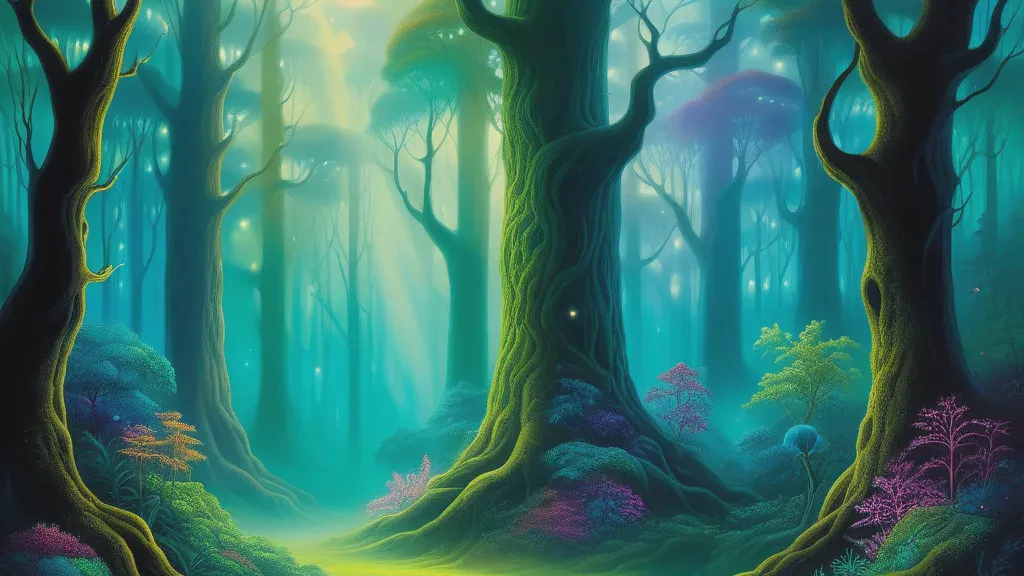
Forest
Jungian Archetypes
Meaning
The forest in dreams represents the unknown depths of the unconscious mind and the wilderness of untamed nature within you. It symbolizes mystery, danger, and the journey into the darker aspects of your psyche that require exploration and integration.
Psychological Interpretation
Jungian analysis views the forest as the realm of the Shadow archetype—the repressed, instinctual, and wild parts of yourself. Navigating the forest represents the hero's journey into the unconscious, where you must confront your fears and integrate the disowned aspects of your Self.
Contemporary Psychological
Forests in dreams often represent the brain's struggle with navigational uncertainty and cognitive complexity. From a contemporary psychology perspective, the forest functions as a metaphor for situations where the dreamer faces multiple possible paths forward but lacks clear directional cues. This reflects real-world scenarios where decision-making is ambiguous, information is incomplete, or the consequences of choices are unclear. The brain uses the forest setting to simulate the emotional and cognitive load of navigating complexity—rehearsing how it might respond when faced with competing options, hidden obstacles, or the need to make progress without a guaranteed route. The density and character of the forest in dreams often correlates with the dreamer's current cognitive processing demands. A dark, tangled forest may indicate the brain is working through a particularly complex problem or emotional situation that feels overwhelming, while a lighter forest might suggest manageable uncertainty. This environmental processing serves a threat simulation function: the brain is essentially running a "what if" scenario about navigating ambiguity, testing different strategies for moving forward when the path isn't obvious. The dreamer's emotional state within the forest—whether they feel lost, determined, curious, or anxious—reveals which emotional regulation strategies the brain is rehearsing. Memory consolidation also plays a role in forest dreams, particularly when the dreamer has recently faced complex decisions, learned new information that requires integration, or experienced situations requiring adaptive navigation. The forest becomes the stage where the brain consolidates these experiences, working through the cognitive patterns involved in managing uncertainty. Whether the dreamer finds their way out, discovers a clearing, or remains lost reflects the brain's current assessment of the dreamer's capacity to handle the complexity they're processing. This isn't prediction—it's the brain's way of emotionally and cognitively preparing for the ongoing work of navigating the ambiguous terrain of waking life.
Gestalt / Parts of Self
In Gestalt dream work, the forest represents the dreamer's own complex inner landscape—a living ecosystem of many parts growing together, each with its own nature and needs. The forest is not something external to be conquered or escaped, but rather the dreamer's own psyche made visible. The trees, undergrowth, light and shadow, paths and clearings are all aspects of the self that coexist, sometimes in harmony and sometimes in tension. To encounter a forest in a dream is to encounter the multiplicity within—the many "I's" that make up a whole person, each rooted and growing in their own way. The density and character of the forest reveals how the dreamer experiences their own complexity. A dark, tangled forest may represent parts of self that feel overwhelming, unnavigable, or disowned—the wild, instinctual, or chaotic aspects that the dreamer has not yet claimed as their own. A sunlit forest with clear paths suggests integration and flow between different parts. A forest that shifts or changes as the dreamer moves through it points to the dynamic, ever-growing nature of the psyche itself. The dreamer is not separate from the forest; they are the forest, and the forest is them. What calls for ownership in the forest dream is the recognition that all these parts—the orderly and the wild, the light and the dark, the known paths and the unexplored depths—belong to the dreamer. There is no "other" in the forest; there is only the self in its full complexity. The invitation is not to clear the forest or escape it, but to move through it with awareness, to recognize each part as a living expression of the whole self. The forest asks: Can you own all of this? Can you let your many parts grow together, each in their own way, without needing to control or eliminate any of them? The forest also speaks to the dreamer's relationship with growth itself. Trees grow slowly, deeply, and in community with other living things. They do not grow in isolation, and they do not grow in straight lines. To dream of a forest is to be invited into a slower, more organic way of being—one that honors the interconnection of all parts, the necessity of roots as well as branches, and the beauty of a life that is complex, layered, and alive with many simultaneous processes. The forest is the dreamer's own becoming, made visible.
Jungian / Archetypal
In Jungian psychology, the forest represents the unconscious mind itself—a vast, unmapped territory where the ego's rational control dissolves and the dreamer encounters the raw, autonomous forces of the psyche. To enter the forest is to step beyond the boundaries of conscious awareness, where familiar landmarks disappear and the dreamer must navigate by instinct rather than intellect. The forest embodies the natural self, the instinctual and wild aspects of human nature that civilization and socialization have often suppressed or denied. Getting lost in the forest, therefore, signals a confrontation with the unconscious: the dreamer has ventured into psychological territory where the usual rules no longer apply, where the Shadow emerges from the undergrowth, and where the ego's defenses are stripped away. This disorientation in the forest frequently marks an initiation—a threshold experience where the dreamer is forced to surrender control and undergo psychological transformation. The darkness and density of the forest create what mystics call the "dark night of the soul," a necessary descent into the depths of the psyche where old identities dissolve before new consciousness can emerge. The forest is neither inherently hostile nor welcoming; it is indifferent, governed by its own laws of growth, decay, and renewal. In this liminal space, the dreamer may encounter archetypal figures—the Wise Old Man or Woman who guides, the Shadow in animal form, or the Self as a distant light glimpsed through the trees. The forest demands that the dreamer develop new capacities: patience, trust in the unknown, and the ability to listen to inner voices rather than external direction. The forest also represents the return to the natural self, a reconnection with the instinctual wisdom that the conscious mind has often rejected or forgotten. In getting lost, the dreamer paradoxically finds access to authentic desire, genuine emotion, and the wildness that civilization has tamed. This wildness is not chaos or destruction, but rather the vital, generative force of nature itself—the capacity to grow, adapt, and survive according to one's true nature rather than imposed expectations. The forest path, even when it leads deeper into darkness and confusion, ultimately serves the individuation process: the journey toward wholeness that requires integrating the conscious and unconscious, the civilized and the wild, the known and the mysterious. To emerge from the forest transformed is to have reclaimed a part of oneself that was lost or abandoned, to have integrated the Shadow, and to have moved closer to the Self.
Psychodynamic / Freudian
In psychodynamic dream interpretation, the forest represents the dense, tangled landscape of the unconscious mind—a place where repressed material accumulates and consciousness becomes disoriented. The forest's darkness and density symbolize the layers of defense mechanisms that obscure what has been pushed out of awareness: forgotten traumas, forbidden desires, shameful impulses, and unresolved conflicts from early life. When a dreamer finds themselves lost in a forest, the manifest content of confusion and disorientation reflects the latent content of psychological material pressing toward consciousness but remaining inaccessible, defended against by the ego's protective mechanisms. The forest also embodies regression—a return to a more primitive, less differentiated state of mind. Trees without clear paths, tangled undergrowth, and the absence of familiar landmarks evoke the pre-verbal, pre-rational realm where early childhood experiences live. In this sense, the forest dream often signals that the dreamer is being pulled backward toward unfinished developmental business: early separations from caregivers, primal fears of abandonment or engulfment, or the loss of parental guidance that once provided structure and safety. The confusion of being lost in the forest mirrors the child's experience of losing their way without the protective presence of the parent. Psychodynamically, the forest can also represent the maternal body or the maternal unconscious—the undifferentiated, all-encompassing space from which the self must separate and individuate. To be lost in the forest is to be caught between the desire to merge back into that protective, boundless space and the anxiety of remaining merged, unable to establish autonomous identity. The defense mechanisms at work here often include displacement (the external forest standing in for internal psychological chaos) and condensation (the forest containing multiple repressed contents simultaneously). The dreamer's struggle to find a way out reflects the ego's effort to restore order and consciousness, to re-establish the boundaries between self and other, between what is known and what remains hidden. The forest dream ultimately signals that repressed material—whether traumatic memory, forbidden wish, or primitive fear—is demanding recognition. The disorientation and sense of being lost are not merely symptoms of confusion but invitations from the unconscious to turn inward, to explore the shadowed terrain of one's own mind, and to integrate what has been split off and hidden. The path through the forest, when found, represents the therapeutic work of bringing unconscious content into consciousness, of naming what was nameless, and of reclaiming the parts of the self that were abandoned or defended against.
Cultural & Historical Origins
Forests hold profound significance across world mythology. In Germanic and Norse traditions, the forest is home to primal forces and ancient wisdom. Celtic mythology features the Otherworld accessed through forests. Japanese folklore presents the forest as a liminal space where spirits dwell, as seen in Shinto traditions.
Contextual Variations
Being lost in a dark, dense forest
Indicates you are overwhelmed by unconscious material or facing confusion about your direction in life. It suggests a need to slow down and find your inner compass.
Walking peacefully through a sunlit forest
Represents harmony with your instinctual nature and successful integration of shadow aspects. It suggests confidence and trust in your inner guidance.
Frequently Asked Questions
What does it mean if I'm afraid in the forest?
Is the forest always a negative symbol?
Journaling Prompts
- What creatures or obstacles did you encounter in the forest, and what might they represent about your shadow self?
- How did you feel moving through the forest, and what does that emotional response reveal about your relationship with your unconscious mind?
Related Symbols
Dreamed about Forest?
Get a personalized AI interpretation that connects this symbol to your specific life circumstances.
Interpret My Dream