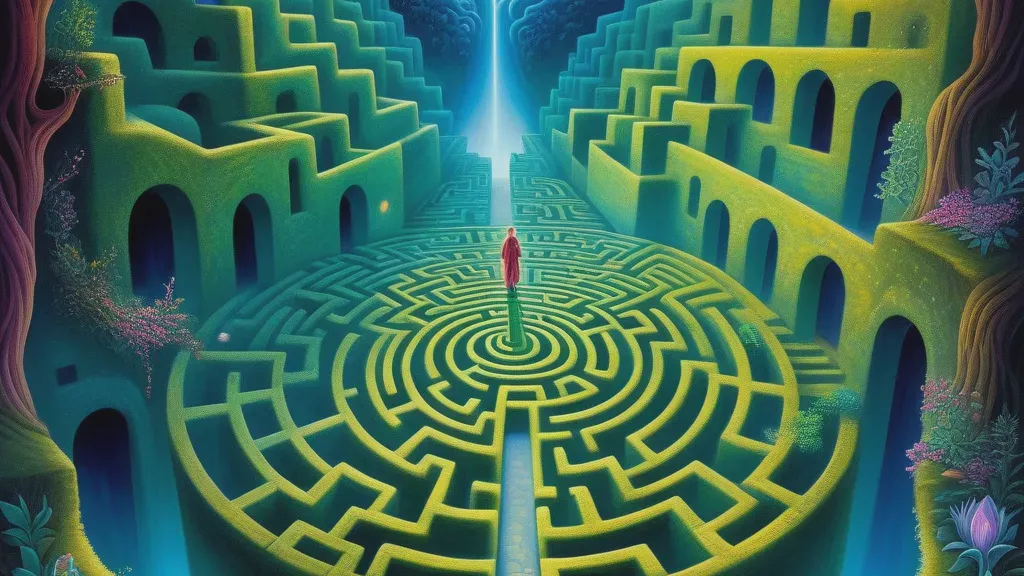
Maze
Jungian Archetypes
Meaning
A maze is a structure built to make choosing difficult. Unlike a labyrinth, which has a single winding path that cannot be got wrong, a maze branches: it offers junctions, false leads and dead ends, and it withholds the one thing that would make it solvable, which is a view from above. In dreams it stands less for confusion in general than for deciding without adequate information while the exit stays hidden. Effort stays high, progress is unverifiable, and the walls are just tall enough to block the horizon. Such dreams gather around choices with no obvious right answer, around problems being solved by repetition rather than insight, and around the slow discovery that the system one is inside was designed by someone else.
Psychological Interpretation
The useful details in a maze dream are structural. High hedges, corridors, mirrored walls, office partitions or streets that will not connect each name a different arena, and dreamers are rarely vague about which one they were in. A maze made of familiar rooms points inward, to a person's own history and habits; one made of institutional corridors points outward, to bureaucracy, a workplace, a medical or legal process where the rules exist but are not shown. Dead ends are the crucial feature. They separate a maze from mere difficulty, because a dead end punishes commitment: the dreamer went the right way as far as it could be judged and still ended at a wall. What the dreamer does inside is equally informative. Running, which most dreamers report, is the behaviour least likely to work, and the dream often shows this by making the passages repeat. Stopping, marking a turn, following a wall with one hand, or climbing to look over the top all appear when a person is beginning to change strategy in waking life, and they tend to arrive in dreams shortly before the change is conscious. Company matters too. A maze walked with someone else is a different psychological situation from one walked alone, and dreamers who report a guide, a voice or a thread are usually in touch with a resource, a relationship or a principle that has been holding their orientation while they could not see the whole.
Traditional Symbol Meaning
Older traditions did not treat the labyrinth as a picture of confusion. They treated it as an ordeal with a fixed structure, something you entered on purpose. Walking a church pavement labyrinth was penitential and meditative work, with the length of the path as the point rather than an obstacle to be defeated, and the same attitude appears in the turf mazes cut into village greens, which were paced at festivals and sometimes as a test of nerve or endurance. The single path meant the walker could not go wrong, only far, and traditional practice framed that as a comfort rather than a limitation. The Cretan story supplied the darker reading, and it is a family story before it is a monster story. The Minotaur is the consequence of a king's dishonesty about a debt, hidden underground so that a household's shame need not be spoken of, and fed with tribute to keep it quiet. Folk and literary retellings have kept that logic intact: the thing at the centre of the maze is not a stranger but a relative, and the structure exists to prevent anyone having to look at it. This is why traditional readings of maze dreams so often point towards a secret being maintained at considerable cost rather than towards mere indecision. Folk practice around stone labyrinths on Baltic and Nordic coasts suggests they were used ritually to bind or confuse harmful forces, on the principle that whatever followed a person into the coils would be delayed there. A related logic appears in the widespread idea that spirits travel in straight lines, which makes a twisting path protective. Traditional sympathy with the maze walker therefore comes with a technique attached: go steadily, do not double back in panic, keep contact with the wall or the thread, and let the structure do its work rather than fighting it. Dream lore inherited a plainer version of all this. Being lost in a winding path or a strange town was widely read as a sign of a matter that would not conclude quickly, of counsel that could not be trusted, or of a decision the dreamer had been putting off, while finding the way out or reaching the middle was taken favourably as a sign of resolution earned by persistence. Beneath the fortune telling there is an observation worth keeping: dreamers do not dream mazes about problems they have solved, and the image reliably marks a live and unfinished situation rather than a past one.
Contemporary Psychological
Maze navigation is one of the most heavily studied tasks in the neuroscience of memory, which makes this symbol unusually well grounded. John O'Keefe and Jonathan Dostrovsky's discovery of hippocampal place cells, and the finding by Matthew Wilson and Bruce McNaughton that patterns of hippocampal activity recorded while rodents run a route are replayed during subsequent sleep, established that the sleeping brain rehearses spatial paths offline. Dreaming of a maze after a day of hard navigation is not a metaphorical event; it is a plausible readout of the system that consolidates route knowledge doing its ordinary work. The most direct evidence comes from a study by Erin Wamsley, Matthew Tucker, Jessica Payne, Joseph Benavides and Robert Stickgold, published in 2010, in which participants learned a virtual maze and then either napped or stayed awake. Those who napped and reported dream content related to the maze improved markedly more on retest than those who napped without such dreams. The finding is careful and worth stating precisely: dreaming about the task predicted better performance, which suggests dream content marks memory consolidation in progress rather than causing it. Two related observations from this literature are that maze imagery in dreams is rarely a faithful replay of the actual task, and that it tends to reflect the elements a learner found difficult. Beyond spatial memory, the maze fits current accounts of the dreaming mind as a model builder. Predictive processing frames perception as the brain's ongoing attempt to predict its input and correct its errors, and a dream environment that cannot be predicted, where corridors change and landmarks fail, is a fair description of a model that has not converged. This maps onto waking life with unusual directness, since people report maze dreams during exactly those situations that resist modelling: bureaucratic processes with unstated rules, an illness without a diagnosis, a relationship whose logic keeps shifting. G. William Domhoff's continuity hypothesis would predict this, and rumination research adds the corollary that repetitive unproductive thought while awake tends to be reflected in repetitive dream content at night.
Jungian / Archetypal
Analytical psychology reads the maze as a picture of the way into the unconscious, and it insists on the difference between wandering and descent. The classical labyrinth is a mandala turned into a path: a bounded structure with a centre, walked to reach the middle, which makes it an image of the Self and of individuation as a route that cannot be shortened. A maze proper, with its false turns, belongs to different archetypal company. Here the Trickster is in charge, the figure who scrambles direction, hides the obvious, and forces the ego to abandon its confidence in method. Dreams of shifting walls and passages that were not there a moment ago are Trickster work, and Jungian practice treats them as necessary rather than hostile, since the ego's certainty about the route is usually what is being dismantled. The Minotaur gives the Shadow its precise form in this symbol. What waits at the centre is the family's disowned product, monstrous chiefly because it was concealed, and the story specifies that it was fed rather than faced for years. Dreamers who reach the middle of a maze and find something ordinary there, an empty room, a chair, a child, are usually meeting exactly this: material that was terrifying only while hidden. Compensation runs strongly in these dreams. People whose waking lives are heavily organised and efficient often dream of mazes, because the unconscious is proposing an experience their competence never permits, which is the experience of not knowing the way. Ariadne's thread is the detail Jungian readings press hardest, and it repays the attention. Theseus does not defeat the labyrinth by understanding it; he survives it because a relationship has given him a continuous connection back to the entrance. Amplified, the thread is the feeling function, the analytic relationship, a marriage, a practice, anything that maintains contact with the known world while a person goes down into what they do not know. Dreams that supply a thread, a guide, a dog, a lit window or a voice are marking that such a connection exists. Dreams in which the dreamer realises they have dropped the thread are marking the opposite, and the appropriate response is rarely to press deeper into the maze. It is to restore the connection first.
Gestalt / Parts of Self
Gestalt work turns the maze inside out by making you its author. You built these walls in your sleep, out of your own material, so start by speaking as them. I am the hedge. I am taller than you and I go on. I am the dead end. You came all this way and I am the end of it. Say those lines aloud and stay with the tone that comes out. Dreamers are frequently startled to hear their own contempt in the voice of the wall, or their own patience, and that tone is the most direct information the dream has given you. The polarity here is the seeker and the structure, and the structure is not neutral. Put the maze in one chair and yourself in the other and let them argue. The maze usually claims to be protecting something, or to be following rules laid down long ago; the seeker usually demands an exit and refuses every other outcome. Listen for the exact moment the seeker says it should not be this hard, because that sentence is where a projection lives. Then try the experiment Gestalt likes best, which is doing the opposite of your habit: sit down in the dream maze in imagination and stop looking for the way out. Notice what happens in your chest, and notice what appears once you are not moving. A dead end is worth taking as a figure in its own right, not as a failure. Be it and speak: I am where this path finishes. Nothing continues here. In waking life these correspond to efforts that were serious, correct at every step, and still concluded at a wall, and most people treat them as evidence about themselves rather than about the terrain. Owning the maze means accepting that you are also the one who set the walls at that height and who insists the exit is the only acceptable end. Contact returns the moment you address something real: the other person in the maze, the hunger, the tiredness, the actual choice in front of you rather than the whole structure at once.
Psychodynamic / Freudian
The manifest content is architecture; the latent content is usually a conflict the dreamer cannot afford to state plainly. A maze allows a wish and the defence against it to occupy the same image, because it offers a goal and an inexhaustible supply of legitimate reasons for not arriving. Dreamers who report years of maze dreams frequently turn out to be managing an ambivalence rather than a puzzle, and the dead end is a superb picture of resistance: it appears exactly where an approach was working, and it sends the dreamer back to safer ground with the sense of having tried everything. Repetition is the symptom to attend to. Freud's account of the compulsion to repeat describes how people return to the same painful configuration, not from stupidity but because unmastered material keeps seeking a resolution it never gets, and a dream of walking the same three corridors all night renders that mechanism almost diagrammatically. Klein's descriptions of confusional states, in which good and bad objects cannot be told apart, add another layer for dreamers whose maze keeps changing shape and whose landmarks will not stay put. Wilfred Bion wrote about attacks on linking, the mind's assault on the connections between its own thoughts when those connections would lead somewhere unbearable, which is close to what a dreamer describes when they say the maze rearranged itself the moment they understood it. Freud also observed that every dream contains a point where interpretation reaches down into the unknown and cannot be followed further, a place he compared to a navel. Maze dreams often carry that quality intact, and it is worth resisting the urge to force them into a single meaning. In treatment such dreams cluster at two moments: early, when defences are being surveyed and everything feels intricate and blocked, and later, when a patient is circling material they have decided not to say. Object relations offers a practical hint. A maze walked entirely alone points to an internal world short of helpful figures, and the appearance of a companion in the dream, even a silent one, is usually the more significant development.
Cultural & Historical Origins
The distinction that organises this symbol is old and often lost: a labyrinth in the classical sense is unicursal, a single path folded back on itself with no choices, while a maze is multicursal and full of decisions. The Cretan story fuses both. Ovid describes Daedalus building the labyrinth at Knossos so cunningly that its maker could scarcely find the way out, and inside it Minos hid the Minotaur, the offspring of his wife Pasiphae and a bull he had failed to sacrifice. Theseus survives it not by cleverness but by connection: Ariadne gives him a thread, and the thread, not the map, is what brings him back out. Unicursal designs turn up on Cretan coins, in Roman floor mosaics and later in the pavements of medieval churches, of which the early thirteenth century labyrinth at Chartres is the best known; by long tradition such pavements were walked as a devotional exercise, a pilgrimage made without leaving the building. In England and Scandinavia turf and stone labyrinths carried folk names such as Troy Town or Trojaborg, and coastal versions were associated with fishermen's rituals for luck and safe weather. The Tohono O'odham of the Sonoran Desert weave a maze figure into baskets, commonly explained as the man in the maze, a path representing a life with its turnings. Formal hedge mazes are a later, more playful development: the surviving hedge maze at Hampton Court was planted in the late seventeenth century, and Jerome K. Jerome made comic literature out of getting lost in it in 'Three Men in a Boat'. Scholars including W. H. Matthews and Hermann Kern have catalogued this material and kept the unicursal and multicursal traditions distinct.
Contextual Variations
Turning a corner in a hedge maze into another dead end
The dead end is the maze's real signature, and it stings because the path looked correct until it stopped. In waking life this maps onto effort that was competent and still went nowhere: applications, treatments, conversations, attempts to make a situation work that were all reasonable at the time. Notice what you did next in the dream. Turning immediately and running back suggests you are treating each failure as proof about yourself. Standing still, or checking how you came, suggests you are ready to gather information from the failures instead.
A maze whose walls move each time you look away
Shifting walls mark a situation where the rules keep changing, and dreamers usually know at once which one. Ambiguous workplaces, a person whose moods redraw the terms of a relationship, and processes with unstated criteria all produce this image. The difficulty is not your navigation; you are being asked to model something that will not hold still. The corresponding move while awake is to stop optimising the route and test the structure instead: ask for the criteria in writing, and watch what happens when the rules have to be stated out loud.
Reaching the centre of the maze and finding it empty
An empty centre is one of the most useful things this dream can show you. The whole architecture exists to protect and conceal a middle, and arriving to find nothing there suggests that the effort has outgrown its object: the goal you have been organising your life around may no longer contain what you set out for. This is common after long campaigns, promotions finally won and problems finally solved. Rather than reading it as futility, treat it as an unusually clear result. You now know that the answer is not at the centre, which frees you to ask what you actually walked in there to find.
Following someone else's chalk marks through a maze
Marks left by another walker introduce inheritance into the dream. You are navigating by a route somebody already worked out, which may be a family script, a mentor's advice, a professional path or the rules a previous generation used to survive. The marks are genuinely useful, and they were made for different conditions. Notice whether you trusted them, and whether they led you anywhere. If the trail ran out mid-corridor, the dream is pointing to the moment your inherited instructions stopped covering your situation, and asking what you intend to do at the point where the guidance ends.
Frequently Asked Questions
Why do I keep dreaming that I am going in circles?
Is there a difference between dreaming of a maze and dreaming of a labyrinth?
Why can I never reach the exit before I wake up?
Does a maze dream mean I am making the wrong decision?
Journaling Prompts
- Write down the decision you are currently circling, and then list every option you have already rejected along with the reason. Read the reasons back and mark which are genuine constraints and which are predictions about how people would react. Then write about what you would choose if only the genuine constraints applied.
- Describe a dead end from your own life: an effort that was serious and competent and still ended at a wall. Write what you concluded about yourself at the time. Then write what the same episode tells you about the terrain rather than about you, and what you learned there that you would not have learned on an easier path.
- Think about who or what has functioned as your thread during a disorienting period: a person, a routine, a place, a piece of work, a standing commitment. Write about how you kept hold of it, whether it is still attached now, and what specifically you would do this week to restore contact if you have let it go slack.
- If the maze in your life has a centre, write down what you have assumed is at it, in one sentence. Then write about who told you it was there and how long you have been walking towards it. Finally, describe honestly what you would want if you arrived and found the middle empty.
Related Symbols
Dreamed about Maze?
Get a personalized AI interpretation that connects this symbol to your specific life circumstances.
Interpret My Dream