Mythic Time
Jungian Archetypes
Meaning
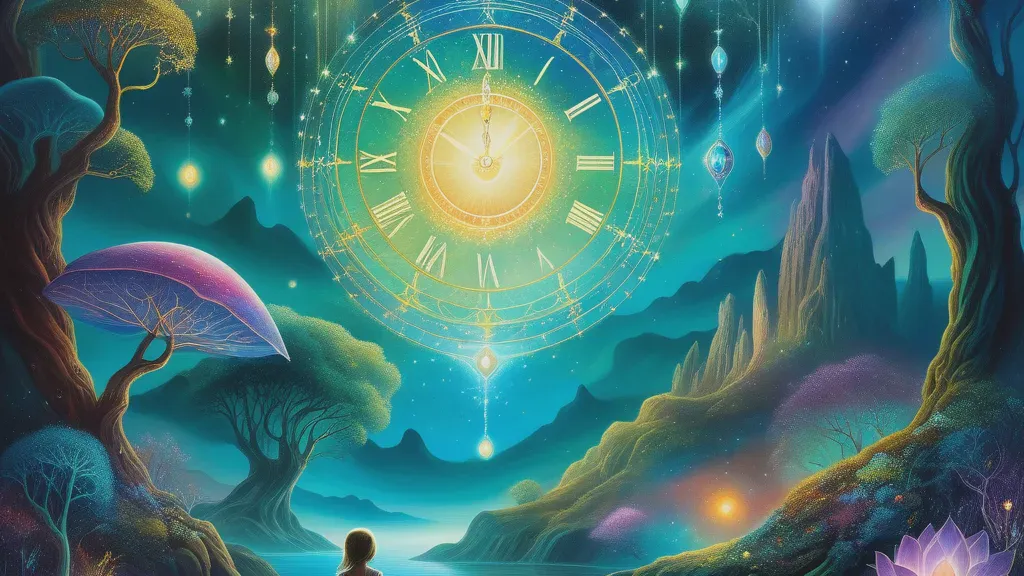
Mythic time is the time of stories rather than of clocks: the once that never quite ended, the era in which the world was made and in which it is somehow still being made. A dream carries this quality when its events feel less like something that happened last night than like something that has always been happening, with the dreamer stepping into a part already written. Ordinary chronology loosens, and a childhood kitchen, a temple and a city not yet built share a single afternoon. The image belongs to a psyche that has stopped measuring its life in dates and started measuring it in significance, testing whether one biography belongs inside a much larger pattern.
Psychological Interpretation
To dream in mythic time is to be handed a plot rather than an incident. The dreamer recognises a festival never attended, knows the words of a song never learned, or watches one day repeat with a small alteration each turn until the pattern finally declares itself. What has changed is not the content of the dream but its tense: events arrive as exemplary, as the kind of thing that happens, rather than as another entry in a personal record. Such dreams cluster around lives that have become all schedule and no story, and the compensation takes the obvious form of a time in which nothing can be late. Mood is the most reliable guide to what the dream is doing. Awe and belonging suggest that the dreamer is being enlarged, set inside a lineage, given a role with weight to it. Grandiosity, where the dreamer is the single hero of the age and everyone else a bystander, suggests inflation instead, an ego wearing borrowed divine clothing. Grief points to a longing for a lost origin, some period before a particular wound. Dread points the other way, toward a person who has slipped out of ordinary duration and cannot climb back in, for whom the eternal has stopped being an enlargement and become a way of not turning up to a life that is aging while the dream repeats.
Traditional Symbol Meaning
Dream traditions have rarely treated the legendary-feeling dream as ordinary. Homer's Penelope, in the nineteenth book of the Odyssey, describes two gates through which dreams pass, one of horn for those that come true and one of ivory for those that deceive, and the whole later literature of dream sorting descends from that division. Artemidorus of Daldis, writing his Oneirocritica in the second century, separated the enhypnion, which merely restates the sleeper's present hunger or fear, from the oneiros, which speaks about what is to come. A dream that felt like a story rather than a leftover belonged to the second class, and the interpreter's job was to establish which kind had arrived before saying anything about its content. The temple cultures went further and built rooms for it. At the Asclepieia of Epidaurus, Kos and Pergamon the suppliant slept in the abaton expecting the god himself to appear, and the surviving inscriptions record cures delivered inside the dream rather than after it. The orator Aelius Aristides spent years keeping a record of such dreams in his Sacred Tales, organising his diet, his travel and his writing around instructions received in sleep. Egyptian and later Greco-Egyptian incubation at Serapis sanctuaries followed comparable procedures. In all of them the sleeper was understood to be entering a time that belonged to the god and was already underway, not receiving a private message generated overnight. Medieval Europe inherited a formal taxonomy from Macrobius, whose commentary on the Dream of Scipio distinguished five kinds, ranking the oraculum, in which an authoritative figure speaks, and the visio, which shows what will happen, above the merely disturbed varieties. Australian Aboriginal traditions describe songs, designs and ceremonies as received from the ancestral era, though the English word Dreaming flattens distinctions the source languages keep carefully apart, and writers on the subject regularly caution against reading it as a synonym for sleeping dreams. Across these settings a shared expectation emerges. The dream that arrives in mythic time is usually held to place an obligation on the dreamer: it must be told, sung, painted, obeyed or founded on, and a dream of this class that is kept private is often considered wasted or dangerous. Alongside the reverence runs an old caution about people who prefer that time to this one, the visionary who cannot be recalled to the harvest, which is the traditional version of the psychological question a modern dreamer should still ask.
Jungian / Archetypal
Jung held that the archetypes of the collective unconscious carry no date. They are inherited dispositions to form certain images, active in the first human beings and active tonight, which is why a dream can feel considerably older than the person having it. When the atmosphere of a dream turns legendary, an archetype has been constellated and the ego is no longer the largest thing in the frame. His method of amplification, setting the dream image beside its parallels in myth, folklore and religious art, exists for exactly this material: not to decorate the dream but to demonstrate to the dreamer that the pattern they have entered has been inhabited before and survived. Liber Novus records his own extended immersion in such a period, in which he chose to treat the figures who arrived as autonomous rather than as fragments of personal memory. The Child is frequently the carrier of mythic time in dreams, and the essay Jung wrote with Karl Kerényi on the child archetype explains the paradox the dreamer notices: this figure is abandoned, small and endangered, yet somehow invincible and older than everyone around it. A child who speaks like an oracle is the archetype's signature. Marie-Louise von Franz, writing on the puer aeternus, described the shadow of the same energy, the provisional life in which everything real is about to begin and the golden time is never actually entered. The Persona has its own stake here, since a myth generously supplies costumes, and a dreamer can mistake a role handed out by the story for the Self that the story was meant to serve. Compensation explains the timing of these dreams as well as their tone. A psyche run entirely by calendar and deadline will eventually be sent a night in which nothing can be missed, and the correction is aimed at proportion rather than at productivity. Jung's late work in Aion follows a single collective image across two thousand years, a scale on which individuation looks less like a personal project than like participation in something slow. Synchronistic experiences, where events arrange themselves by meaning instead of by cause, produce in waking life precisely the sensation these dreams produce in sleep. The work afterwards is the return: carrying something back into chronology rather than staying where the clocks do not run.
Gestalt / Parts of Self
Gestalt therapy treats the dream as an existential message and every element in it as a piece of yourself you have handed away. Mythic time, on this reading, is not a setting you were placed inside; it is something you are doing. Perls would have you speak as it. Say I am the time that never runs out, and notice what your voice does. Then take the other chair and speak as your Tuesday, as the appointments and the ages and the things that expire. Both are yours, and the dream has separated them because you cannot yet hold them in the same body. The question is not which one is true but which one you have been living from and which one you visit only while asleep. The polarity usually runs between urgency and eternity, and it is sharpest in people whose waking hours are completely booked. Try the exchange out loud. Let the oracular child, or the festival, or the street where every century stands together, say what it wants from you, then answer as the person who has fourteen minutes. Do not resolve it too quickly. In Gestalt terms, awareness of the split is already the work, and the premature compromise is a way of avoiding contact with both sides. Notice where in your body the eternal side sits and where the hurried side sits, because the split is rarely only mental. The repeating day has a specific Gestalt reading. Unfinished situations press for completion, and a figure that cannot close keeps re-forming until it does, which is what a loop dream looks like from the inside. Rather than asking what the loop symbolises, ask what you keep starting and not finishing, and what would have to be said or refused for the day to be allowed to end. This school insists that the only available time is now, which makes mythic time an odd gift to it, since illud tempus is the one past that claims to be happening in the present tense. Take the claim literally. If that time is now, then the thing it is asking of you is available now, and the dream has stopped being nostalgia and become an instruction.
Psychodynamic / Freudian
Freud stated the position plainly in his 1915 paper on the unconscious: the processes of that system are timeless, unordered by time, unaltered by its passage, and with no reference to it at all. A dream in which a grandmother, a school corridor and an unborn city coexist is therefore not exotic; it is the unconscious in its usual condition, and the strangeness belongs entirely to the waking observer who expects sequence. Condensation does the rest, packing several decades of a life into one figure who is simultaneously a parent, a teacher and a stranger, and displacement moves the emotional charge from the period where it originated onto a scene remote enough to be safe. The later tradition made the temporal strangeness central rather than incidental. Freud's notion of deferred action, Nachtraglichkeit, describes a scene that acquires its meaning only when a second event reaches back and charges it, so that the past is genuinely rewritten from the future and a person can be wounded at eight by something that happens at twenty. Transference stages the same collapse in the consulting room, where a present relationship is lived through the template of a very old one, and the room becomes a small chamber of mythic time. Winnicott's paper on the fear of breakdown pushes it furthest, proposing that the catastrophe a person dreads in the future is one that already occurred, too early to be experienced, and is therefore still waiting to happen for the first time. Internal objects, in the object relations account, do not age. The mother carried inside a fifty-year-old may still be the exhausted thirty-year-old of a particular winter, and dreams that restore a golden era often express a wish for the world as it stood before some specific injury, with idealisation smoothing what was actually mixed. Freud's account of screen memories is useful here, since a luminous and oddly detailed early scene may be doing the work of concealing an adjacent one. The clinically interesting question is not whether the remembered age was really golden but what the mythic frame permits the dreamer to feel that direct recollection would not: grief, longing, or a fury that would be unbearable if it had a date and an address.
Contemporary Psychological
Laboratory work has taken some of the mystery out of dream duration without removing the puzzle. Stephen LaBerge's signalling experiments, in which lucid dreamers marked intervals with prearranged eye movements, indicated that counting inside a dream takes roughly as long as counting awake, so time in sleep is not literally stretched. The impression that a dream lasted decades appears to be a judgement made on waking, assembled from the density of scenes rather than from felt duration. What is genuinely altered is temporal structure: dream reports are full of abrupt scene changes and impossible juxtapositions, and neuroimaging of rapid eye movement sleep consistently shows reduced activity in dorsolateral prefrontal regions that support sequencing, monitoring and the ordering of events into narrative. Cognitive psychology supplies the machinery for the stranger part, the nostalgia for a future never lived. Endel Tulving described autonoetic consciousness and coined chronesthesia for the sense of subjective time that lets a person project themselves backwards and forwards, and the constructive episodic simulation hypothesis of Daniel Schacter and Donna Rose Addis showed that remembering the past and imagining the future recruit largely the same brain network. Memory, on this account, is a recombination system rather than an archive. A sleeping brain running that system without waking constraints will inevitably build scenes stitched from real fragments that have never occurred, and they will feel remembered, because remembering is the process that made them. The repeating day fits what is known about consolidation. Sleep does not simply file the day away; it abstracts, pulling regularities out of individual episodes. Jan Born's group demonstrated this with a task containing a hidden shortcut, where participants who slept between sessions were substantially more likely to notice the underlying rule. A dream that replays one day with variations, each pass adding an element until a pattern becomes visible, resembles that extraction happening in images. The continuity hypothesis developed from the content research of Calvin Hall and Robert Van de Castle and extended by G. William Domhoff would add the obvious constraint: whatever the dreamer is presently preoccupied with in waking life is the raw material the pattern is being built from.
Cultural & Historical Origins
Mircea Eliade gave the idea its working name in The Myth of the Eternal Return and The Sacred and the Profane: illud tempus, that time, the time of origins which ritual does not commemorate so much as re-enter, so that a New Year rite or a founding ceremony cancels the duration accumulated since the world began. Greek kept two words where English has one, chronos for measured succession and kairos for the charged moment that must be seized, and Plato in the Timaeus called time a moving image of eternity, a copy running in numbers of something that simply is. Hesiod's Works and Days placed human history inside a descent through ages of gold, silver, bronze and iron, a shape the Puranic yugas repeat on an immense scale as each kalpa turns and the world is remade. Australian Aboriginal traditions hold an ancestral creative period that English renders as the Dreaming, and the anthropologist W. E. H. Stanner proposed the word everywhen for it precisely because the past tense was the wrong instrument. Abrahamic liturgy works by the same logic: the Passover Haggadah instructs each person in every generation to regard themselves as having personally come out of Egypt, and the Christian year does not merely recall the nativity but arrives at it again. Nietzsche put the same structure to a modern test in The Gay Science, asking whether a life could bear being lived identically and without end.
Contextual Variations
A single day that repeats, altering slightly on every turn
The loop is not a punishment but a rehearsal. Something in your waking life is being run again because the last attempt did not complete, and each pass adds one element you missed before. Pay attention to what changes rather than to what repeats, since the variation carries the information. Ask what you keep beginning and abandoning at roughly the same point, and what would have to be said, refused or admitted for that day to be allowed to finish. Loop dreams often stop once the corresponding waking situation is either resolved or honestly named as unresolvable.
A street where ancient and modern buildings stand as one city
Your sense of identity is trying to make a continuous whole out of periods that currently feel like separate lives. The dream puts every era on one street because you have not yet found a story that connects the person you were with the person you are becoming. This kind of image often arrives after a move, a career change or the end of a long relationship, when the earlier self starts to feel like someone else's biography. The task it points to is not choosing between the versions but locating what has genuinely persisted through all of them.
A child who speaks like an oracle and tells you to start over
The figure combines beginning and antiquity, which is why it unsettles you. It usually appears to people who have been operating at speed for a long time and have confused momentum with direction. Take the instruction literally before taking it symbolically: something in your life is genuinely at the wrong point in its cycle and is being asked to return to its start rather than to push further along. The caution attached to this image is that beginning again can be a real renewal or a way of never having to complete anything, and only you know which one is being offered.
A festival you have never attended whose songs you already know
Recognition without memory is the core sensation of mythic time, and it usually signals a longing for belonging that predates and outsizes any particular group. You are not being told that you lived before; you are being shown how much you want to be part of something with a history you did not have to invent. Notice what the festival is celebrating, because that is the specific value your waking life is currently starving. Communities, crafts and traditions in the real world rarely feel this seamless, and the dream is setting a bar you may need to lower in order to actually join something.
Frequently Asked Questions
Why did my dream feel ancient or legendary rather than personal?
Why do I keep dreaming the same day over and over?
Can a dream really feel like it lasted years?
Is a dream in mythic time a sign that I am stuck in the past?
Journaling Prompts
- Write down the dream in the present tense, as though it is still going on, and then write one sentence about your current life in the same tense. Notice which one sounds more alive on the page. If your waking sentence sounds thinner, name one specific thing that has been reduced to logistics lately, and what it was before it became a task on a list.
- Think of the era in your life that the dream seemed to be reaching for, whether or not you actually lived through it. Describe one concrete detail of it: a room, a smell, a person's voice. Then ask what that period allowed you to feel that you do not currently permit yourself, and whether any version of that permission is available to you this week.
- If your life were being told as a story rather than reported as a schedule, which chapter would you be in right now, and what would an honest narrator say you are avoiding? Write the paragraph that narrator would write. Then underline the one sentence you would rather not have written down, because that is usually where the dream was pointing.
- Consider the possibility that the timeless feeling in the dream was compensating for something. List the deadlines, ages and expiry dates currently pressing on you, and mark which are genuinely urgent and which only feel that way. Then choose one hour this week to spend on something that has no completion date at all, and note afterwards what changed in your mood.
Related Symbols
Dreamed about Mythic Time?
Get a personalized AI interpretation that connects this symbol to your specific life circumstances.
Interpret My Dream