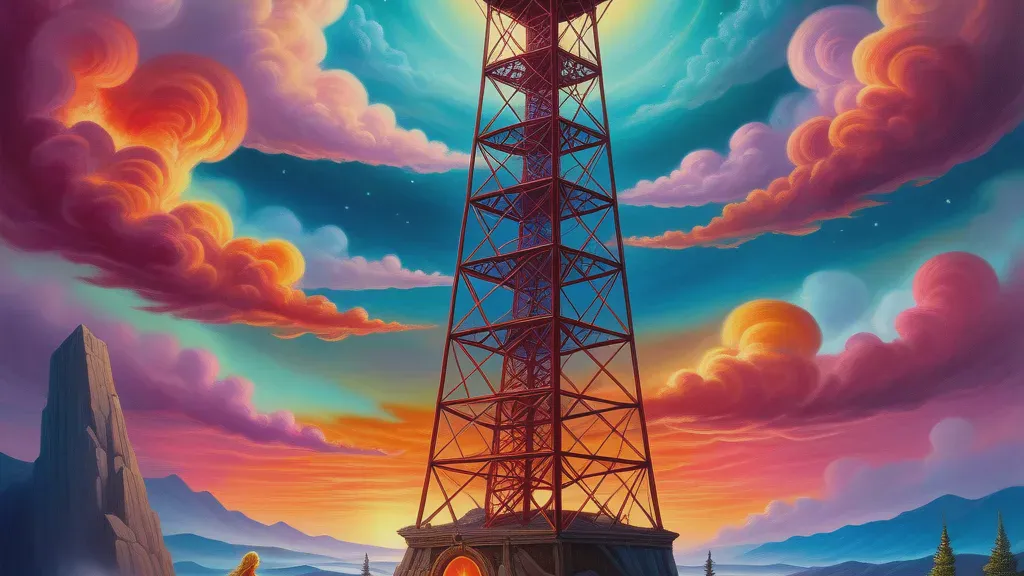
Forbidden Fire Tower
Jungian Archetypes
Meaning
A fire tower exists so that one person can see smoke before anyone else does. To dream of one that is forbidden — chained at the base, condemned by a sign, or guarded by someone who says the stairs are not yours — is to dream of a vantage point the psyche has ruled off-limits to itself. Two charges meet in the image. The tower is elevated perception, the willingness to take in a whole valley of a life at once. The prohibition is whatever in the dreamer has decided that such looking is presumptuous, disloyal, or punishable. What burns in these dreams is seldom the forest. It is the dreamer's own knowing, kept at a height where no one is obliged to answer for it.
Psychological Interpretation
The dream turns on a detail the dreamer usually recalls with unusual clarity: who forbade the tower. A padlock is not a ranger, and a ranger is not a hand-lettered sign so weathered that nobody knows who wrote it. Each names a different structure of prohibition — an old decision made and forgotten, a living authority still being obeyed, or an inherited rule with no author left to appeal to. The second detail that matters is whether smoke is already visible. A tower forbidden while the valley lies calm reads as a general ban on seeing; a tower forbidden while a plume rises on the ridge reads as an emergency, the psyche insisting that the dreamer already knows something and has been instructed not to know it. Climbing anyway changes the meaning less than most dreamers expect. The ascent brings not triumph but exposure: glass on four sides, a catwalk with no cover, the sensation of being the most visible thing for miles. A lookout sees far and is seen from everywhere, which is why the dream so reliably couples clarity with dread. Those who reach the cab and find the maps gone or the windows painted over are shown a precise frustration, perception with no means of reporting it. The dreamer who stops at the sign has not failed either; that refusal measures what the psyche currently charges for announcing that a fire has started.
Traditional Symbol Meaning
Traditional dream interpretation rarely had a fire lookout to work with, but it had towers and it had fire, and it read them by position and by measure. Artemidorus, whose second-century Oneirocritica is the fullest dream manual to survive from antiquity, judged fire dreams by where the flame sat and whether it stayed in its bounds: fire kept in its proper place carried a different verdict from fire loose in the roof. High places he read, as he read most things, by the dreamer's station, favourable to those whose position could bear elevation and ominous for those who had climbed beyond their footing. The Tower of the Tarot de Marseille, La Maison Dieu, condenses that intuition into one picture, a structure raised high, split by a bolt, figures falling from its windows. The watch-tower carries a second and warmer tradition, in which the elevated fire is service rather than vanity. Signal towers along the Great Wall passed word by smoke in daylight and flame after dark, and England kept a chain of beacon hills whose lighting in 1588 was meant to carry news of the Spanish fleet from headland to headland faster than any rider. In each case the tower is useless alone; it is a link, and its worth lies in whether the next hill answers. Folk feeling about such places is correspondingly double, since the beacon keeper is honoured and slightly feared, set apart by a job that consists of expecting disaster. The forbidden version of the image belongs to the wide family of tales built around one door, one room, one height that is off-limits. Rapunzel is shut in a tower without stairs; Danae is closed in a bronze chamber to prevent a prophecy; Bluebeard leaves a key and a prohibition in the same hand. These stories agree on a strange point: the ban is what makes the place significant, and the interdict is never finally obeyed. What was forbidden is entered, and the story only begins there. Traditional listeners understood the prohibition less as protection than as a marker on the edge of sanctioned knowledge, a line drawn around what a person of that station was permitted to look at. Read in that inheritance, a dream of a fire tower posted against the dreamer is not an omen about the forest. It is a statement about office and permission, about whether this dreamer counts among the people entitled to watch, to name what they see, and to be answered when they call it in. Older readers would have asked which duty the dreamer is dodging or has been relieved of, and the question still holds with the emphasis moved inward.
Contemporary Psychological
Sleep science reads this dream as a rehearsal, though not the kind usually assumed. Antti Revonsuo's threat simulation theory proposes that dreaming evolved in part to practise responses to danger in a safe arena, and a fire tower dream is a simulation of the detection stage rather than the fighting stage. The dreaming brain is not running an escape; it is running surveillance, sweeping a horizon for the earliest indication that something has gone wrong. That is consistent with the continuity between waking and dreaming attention, since a mind that spends its days monitoring tends to go on monitoring at night, and the prohibition in this dream adds a second layer of social monitoring on top of the environmental one. The body carried into sleep sets the dream's level. Research on insomnia has converged on a hyperarousal account, in which poor sleepers show raised heart rate, cortisol and cortical activation through the night rather than only at bedtime, and the same physiological readiness that makes a watcher effective by day leaves the sleeping brain running a low-grade alert. That is the state a locked lookout dream reports on. Dream content stays continuous with waking preoccupation, so someone who has spent the week deciding whether to raise something will find the decision restaged at altitude, with the reporting line, the chain of command and the fear of being overruled carried across intact. The prohibition is not an ornament the dream adds; it is the waking obstacle, rendered as a padlock. There is an older biology underneath the image. Studying sleep among the Hadza of Tanzania, David Samson and colleagues found that individual differences in sleep timing meant that at almost every minute of the night someone in the camp was awake, a pattern they described as sentinel-like and proposed as one reason human sleep varies so much from person to person. A fire lookout is that arrangement stripped of its rota: one sentinel, permanently on, with nobody scheduled to take over. Read that way, the dream is less about the fire than about the missing handover, and the two things that reliably shift the recurring version follow from it. Finding an actual channel for the observation in waking life, a person told or a decision made, tends to reduce the tower's urgency, and so does anything that lets the body stand down at bedtime, since a detector is calibrated by the state of the organism carrying it.
Jungian / Archetypal
Jung treated the tower as an image close to his own life. From 1923 he built and rebuilt a stone tower at Bollingen and described it as a place where he could be what he actually was, a structure that grew alongside his sense of the Self and of an ancient maternal hearth. The dream tower stands in deliberate contrast, because it has a sign on it. When the psyche produces a lookout the dreamer may not climb, it is staging a split between the function of seeing and the permission to see, and that split is exactly what analytical psychology means by a complex: an energised piece of psychic life fenced off from the ego's disposal. Fire in Symbols of Transformation is one of Jung's steady figures for libido, psychic energy in its transforming and consuming aspect. A structure built solely to watch for fire is therefore an apparatus the psyche has raised around its own vitality, a device for detecting the moment when energy stops warming and starts burning. Three archetypal figures crowd the image. The Hero supplies the impulse to climb, along with the hazard that goes with it, since a standpoint high above the valley invites the inflation of mistaking a wide view for a superior nature. The Wise Old Man appears as the ranger, the lookout already in post, the voice with the authority the dreamer feels they lack, and his refusal deserves attention rather than obedience: figures of that kind in dreams sometimes carry genuine wisdom and sometimes only carry the weight of the collective. The Maiden appears in the older office of the flame-keeper, the one whose entire task is not letting the fire go out, and whose vocation is inseparable from a prohibition. Compensation explains why this dream arrives when it does. It tends to come to people whose waking stance is that it is not their place to say, who defer, who have decided that noticing is the same as making trouble. The unconscious answers with an unclimbable tower to make the deferral visible. Individuation here does not mean living in the cab. Permanent residence at that altitude is its own pathology, the survey substituted for the life, spirit divorced from the valley where the actual trees stand. The movement the psyche asks for is a full circuit: up for the bearing, and back down with it. Prometheus is punished for the theft, but the fire stays with humanity, and the dream is generally more interested in whether the dreamer will carry the observation down than in whether they were allowed up.
Gestalt / Parts of Self
In Gestalt work nothing in this dream is scenery. You are the tower, the treads, the padlock, the ranger, the paint on the windows, the valley that has not caught fire yet, and above all you are the sign. Start there, because the sign is the part of the dream that speaks. Sit in a chair and be it. Say what you are made of, how long you have been nailed to that post, and who put you there. Then say the thing you exist to say — that these stairs are not for this person — and notice, saying it out loud, whose voice comes out of your mouth and how old the phrasing sounds. Most dreamers hear something familiar within a sentence or two. The polarity is unusually clean. Watcher and watched, forbidder and forbidden, the one who climbs and the one who bars the way are one self split into two roles and given a staircase to argue on. Fritz Perls would have named the sign the topdog, moral and impersonal, and the figure at the foot of it the underdog, agreeable and quietly sabotaging, and he would have kept the two of you talking until the impasse turned into contact. Retroflection is the mechanism to watch for. A fire lookout does to itself what it might do outward: it scans, it judges risk, it holds its own alarm. If you are the one supervising you all night, ask who you originally wanted to warn, and what stopped you from calling them. Try the experiment on the catwalk. Be the smoke on the ridge, that thin unmistakable column, and speak for it: I have started, I am small, someone can still see me. Then be the radio that no one answers. Then be the view itself, the whole valley with nothing wrong in it. Complete these sentences aloud without editing: I am not allowed to see, and if I climbed, and if I called it in they would. Track your body rather than your reasoning while you do it, because the breath usually announces which line is true. Contact here means being both the sign and the climber in the same moment rather than shuttling between them, and the dream is finished not when you win the argument but when you stop needing permission from a piece of wood you painted yourself.
Psychodynamic / Freudian
A locked staircase in the mountains is the manifest dream; what it stands in for is usually a life organised around watching. People who dream of fire towers are often people who learned early that a household could ignite without warning, and who developed an extraordinarily fine instrument for detecting the moment before it happened, reading a footstep on gravel or the particular quality of a silence at the table. That instrument does not switch off in adulthood; it goes on scanning workplaces, marriages, and friendships for the first thread of smoke. The tower is its architectural portrait, and the portrait is unsparing: a structure that is very tall, very thin, exposed on all sides, and built to hold one person. The prohibition is the interesting half. Freud, quoting Frazer with approval in Totem and Taboo, held that the law does not trouble to forbid what nobody wants to do, so the sign at the foot of the stairs is evidence of a wish rather than an absence of one. Several defensive operations tend to be visible at once. Reversal can turn a wish to burn something down into a duty to watch for burning, which is how a great deal of anger ends up disguised as vigilance. Displacement moves the whole apparatus off the person it belongs to and into an empty landscape, so the dreamer scans a valley instead of naming a colleague. Condensation packs a parent, a manager, and an internal standard into a single ranger who happens to be blocking the stairs, and the sign itself functions as a superego prohibition given a physical form and a nail. Object relations sharpen the picture further. Winnicott's false self, the compliant surface a child builds when the environment fails to adapt to it, fits the case of a child who took on the work of watching the household because the household would not reliably watch itself, and the fire tower is that adaptation rendered as a building. Bion's account of containment supplies the cruellest detail in the dream: a lookout with an alarm and a dead radio is the structural image of a mind that can register alarm but has no one to give it to, which he described as raw experience returning as nameless dread. In treatment this dream usually surfaces near a transference question, since the analyst is the first candidate in years for the voice on the other end of the line, and the dreamer must find out whether calling in a fire to someone will be met with an answer or a warning about trespassing.
Cultural & Historical Origins
Fire lookouts are a specific institution. After the August 1910 blowup burned roughly three million acres across Idaho and Montana, the young United States Forest Service answered with thousands of lookout stations on western peaks, many fitted with the Osborne Firefinder, a sighting alidade on a circular map that let one watcher give a bearing on a distant column of smoke. The posting drew writers. Jack Kerouac spent the summer of 1956 on Desolation Peak in the North Cascades and wrote that isolation into Desolation Angels and The Dharma Bums; Gary Snyder and Philip Whalen had kept watch on nearby summits; Edward Abbey later described a season at Numa Ridge in Glacier. Their accounts carry the dream's exact tension, an enormous view paired with sole responsibility for what appears in it. Older layers stand behind the wooden cab. Hesiod's Theogony has Prometheus steal fire for humanity and be chained for it, the earliest Western claim that illumination is a punishable theft. Aeschylus opens the Agamemnon with a watchman who has lain on the palace roof for a year waiting for a beacon. Ezekiel states the sentry's duty without softening it: a watchman who sees the sword coming and fails to sound the horn answers for the blood. In Rome the Vestals kept the state fire under strict prohibitions, so that tending a flame and living under interdict were one office. Jeremy Bentham's panopticon, and Michel Foucault's reading of it, supply the modern turn: a tower one watches from without being watched back, until those below take over the supervising themselves.
Contextual Variations
A padlocked fire tower you climb anyway
You go over or around the barrier and take the stairs, and the dream usually gives you the climb rather than the arrival. Expect the mixture this image specialises in: exhilaration in the legs, a running commentary about being caught, and mounting exposure as the trees drop away below you. The transgression matters more than the view. Something in your waking life has been designated none of your business, and you have privately decided to look at it regardless. Notice whether you feel like a thief or like someone doing a job nobody else showed up for.
Smoke on the ridge and a radio that will not answer
You see it clearly, you call it in, and nothing comes back but static or a dial tone. This is the most common form of the dream and the most specific. You are not being told to notice something, since you have already noticed it. You are being shown that your reporting line is broken. Somewhere in your life there is a concern you have raised, or tried to raise, and it has gone into a silence that leaves you holding the alarm alone. The dream frequently follows a week of being talked over, cc'd without reply, or reassured by someone who did not look up.
A ranger who turns you back at the first landing
Someone with a uniform, a clipboard, or simply an air of authority meets you a few steps up and sends you down, often politely. Their face is worth recovering when you wake, because it is rarely invented. This figure carries the authority you have granted to a particular person or standard, and the dream is asking whether that grant is still warranted. Notice your own compliance too. If you turned back without asking a single question, the interesting material is not the ranger but the speed with which you accepted being outranked.
Reaching the cab to find the windows painted over
You get past everything, you arrive, and the glass has been whitewashed or boarded, so the one thing the structure exists for is unavailable. This version tends to visit people who have won an argument for access and found the access hollow, promoted into a room where the real information is still elsewhere. It can also describe a subtler self-blinding, where you have arranged your attention so that you occupy the position of the person who sees without ever having to look. Ask which of the two it is by checking who did the painting.
Frequently Asked Questions
Why do I dream of climbing a tower I am not allowed to enter?
Is a fire lookout dream a sign of burnout?
Does dreaming about a fire tower mean disaster is coming?
Why is being watched part of a dream about watching?
Journaling Prompts
- Go back to the sign or the lock at the foot of the stairs and describe it in detail: the material, the wording, how long it has been there. Then answer as plainly as you can who put it there. If a person's name arrives, write what they would actually say if you told them you were going up anyway, and then write what you would say back.
- Name the smoke. There is usually one situation you have already seen clearly and have not called in, and it is generally not the largest problem in your life but the one that is least yours to mention. Write it in a single sentence, without justification. Then list every reason you have given yourself for keeping it at a distance, and mark which of those reasons you still believe.
- Consider the radio. Who, in your waking life, is at the other end when you report something? Write the name if there is one, and if the honest answer is that the channel is dead, write that instead and describe how long it has been dead. Then pick one person who could plausibly answer, and note precisely what stops you from calling them this week.
- Picture yourself coming down the stairs with the bearing rather than staying in the cab. What would you carry back into ordinary life from the vantage point, in concrete terms, and who would receive it? Describe the first hour after the descent: where you go, who you find, the first sentence out of your mouth, and what your body is doing while you say it.
Related Symbols
Dreamed about Forbidden Fire Tower?
Get a personalized AI interpretation that connects this symbol to your specific life circumstances.
Interpret My Dream