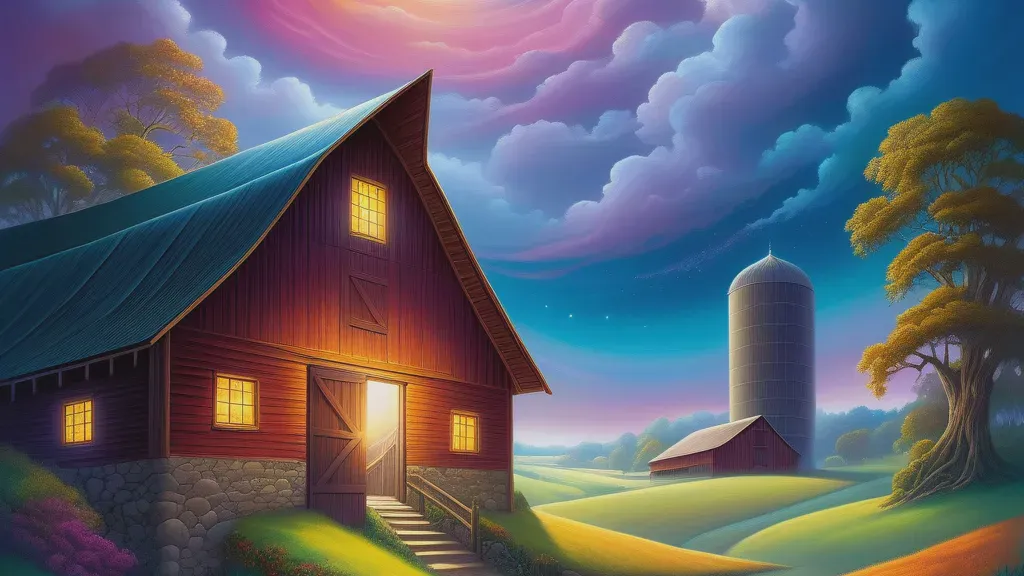
Barn
Jungian Archetypes
Meaning
A barn is the building that stands apart from the house and holds what the dreamer has raised, gathered and kept alive: hay in the loft, animals in their stalls, tools along the wall. In dreams it becomes the psyche's storehouse and stable at once, the place where instinct is kept under a roof and where the fruits of past labour wait for the lean season. Whether the barn is full or empty, tended or collapsing, thrown open or bolted, tells the dreamer something exact about their reserves, their relationship to their own animal nature, and the family or rural inheritance they carry, often without having chosen it.
Psychological Interpretation
The barn belongs to the family of house dreams, but it is not the house. The house is where the ego lives; the barn is where a household keeps everything it depends on yet does not want in the living room: the animals, the manure, the sharp tools, the stored grain. A barn dream therefore tends to concern the parts of a life that do the unglamorous work of sustaining it, bodily, instinctual, inherited, and it asks how well they are being kept. A full, warm barn with settled animals suggests reserves built patiently and an instinctual life that is fed and calm. An empty or rotting one points to depleted stores, an inheritance left to fall in, or a vitality ignored so long that the roof has gone. The dreamer's position matters as much as the building's condition. Working in the barn, mucking out, feeding, mending a stall, is a dream about taking responsibility for what one keeps. Hiding in it borrows the barn's oldest role as shelter. A barn on fire is among the more alarming dream images, since it destroys stored labour and living creatures in one stroke, and it usually marks either a fear of losing what has been quietly accumulated or a rage that wants exactly that. What the dreamer finds when the door swings open, and whether they feel they belong inside, is where the reading begins.
Traditional Symbol Meaning
Farm cultures judged a household by its barn before its house, and the old dream books followed suit. Gustavus Hindman Miller's Ten Thousand Dreams Interpreted, published in 1901, reads a barn filled with ripe grain and surrounded by fat stock as an omen of prosperity and an empty barn as its reverse, and folk dream lore across rural Europe and America says much the same. The barn was the year's labour made visible, the one building whose fullness or emptiness told the truth about the coming winter. The barn was also the animals' house, and folk belief treated the boundary between the human dwelling and the beast dwelling as a charged one. In parts of Europe the cattle in the barn were said to kneel at midnight on Christmas Eve, a belief Thomas Hardy set down in his poem The Oxen and admitted he still half wished to hold. The Nativity stable turned the barn into a sanctuary, the humble place where the sacred appears when the respectable rooms are full. A dream in which the barn animals behave strangely, speak, watch the dreamer or kneel, inherits this tradition: the instinctual world showing an intelligence the daylight mind does not credit. As granary the barn belongs to a lineage of sorting and judgement. Joseph's storehouses in Genesis held the grain of seven fat years against seven lean; the threshing floor, where Ruth lay down at the feet of Boaz and where David bought the ground on which the Temple would stand, was where grain was separated from chaff, and John the Baptist used exactly that image, wheat gathered into the barn and chaff burned. Dream tradition therefore treats the barn as the place where a life is sorted: what is worth keeping goes under the roof and what is not is left to the wind. A dreamer heaping or sorting in a barn is doing that work; a barn full of rubbish is one where the sorting has never been done. The hayloft has a lighter tradition. In folk song and rural memory the loft is where the rules of the house relax, the place of courtship and secrecy, and the barn dance was for centuries where the young of a district met. Set against this warmth is the oldest rural terror, the barn fire, which in a night could take a year's harvest and every animal in the stalls, and which folk belief blamed on lightning, spite or the barn spirit's displeasure. Old dream lore reads a burning barn as ruin of livelihood; a more modern reading sees the burning off of an old order so the ground can be worked again. Both hold. The barn in dreams keeps the sweetness of the loft and the fear of the fire in the same dark building.
Jungian / Archetypal
In analytical psychology animals in dreams carry the instinctual psyche, and a barn is the structure a culture builds to keep those animals alive, fed and at a distance from the parlour. The barn is therefore a precise image of how the ego has arranged its relation to instinct. A sound barn with calm stock shows an instinctual life housed and honoured without being allowed to run the house; a barn with the animals gone, or gone feral in the dark, shows instinct either starved out of the personality or left unattended until it turns on its keeper. The manure pile, the rats in the grain and the unlit corners are where the shadow gathers, everything the dreamer's tidy self-image keeps out of the front rooms but cannot do without. Amplification brings the manger. In the Nativity the divine child is born in the stable because the inn is full, and Jung read the child motif as the first appearance of the Self, the totality that arrives where the ego did not plan for it. A barn dream in which something unexpected is born, found or sheltered among the animals belongs to this pattern: the new centre of the personality appearing in the least prestigious building on the property. The barn also compensates. A dreamer whose waking life has become entirely urban and abstract may be returned by the dream to hay, dung and breath, the unconscious correcting a one-sidedness by insisting on the earth. The rich fool's ever-bigger barns are the opposite movement, inflation, the ego mistaking stored things for a self. Barns in dreams are very often the barns of grandparents, a farm the dreamer left or never worked, and here the symbol carries the ancestral inheritance the individuating person must sort rather than simply keep or abandon. A collapsing barn asks whether the old container has served its time; a barn fire, terrible as it is, can be the destruction of an inherited structure the dreamer could never have dismantled by choice. An empty barn is not only loss. It is floor space, and the dream may be asking what the dreamer will raise there that is their own. Whether the dreamer meets the Hero working the barn, the Maiden hiding in the loft or the Trickster barn spirit upsetting the pails, the task is the same: to bring what lives in the barn into conscious relation with the house.
Gestalt / Parts of Self
Gestalt dreamwork begins by refusing the idea that the barn is a place you visited. It is a part of you, and so is the hay, the locked door, the animal in the far stall and the wind coming under the eaves. The first experiment is to become the building and speak in the present tense: I am large and old, I stand apart from the house, I hold what the family cannot keep indoors, I smell of animals and dust and I have not been painted in years. Say it aloud and notice where the sentences land in your body. The part of you that stands apart from your presentable self, holding the working animals, is usually the one that has been waiting to be spoken for. The barn dream is built on polarities, and Gestalt work asks you to occupy both poles rather than the one you prefer. House and barn: the room you receive guests in and the shed where the labour happens. Clean and dirty, mind and body, shown and stored. Inside and outside is the polarity of contact: are you in the barn or looking at it through a door you cannot close, and who holds the key? Let the door that will not shut speak. Let the dust that keeps blowing back in say what it wants. If an animal is stalled, be the animal and say how long it has been since you were out at pasture, then switch chairs and answer as the one who keeps you in. What matters most is the unfinished business the dream leaves standing: a stall half repaired, a loft you never climbed, a bale you meant to move, a figure waiting outside while you hide among the tools. The Gestalt invitation is to finish the gesture in the session or on the page, to open the door, to lead the animal out, to face the person in the yard with the pitchfork in your hand. Notice too what you are storing that you never use and whether the barn is full because you are provident or because you cannot let anything go. When you can own the barn, its mess and its plenty and the animal noise of it, you take back a working part of yourself that you had been keeping across the yard.
Psychodynamic / Freudian
The manifest content of a barn dream, timber, hay, stalls, the smell of animals, condenses several strands of latent material. Freud linked orderliness, parsimony and obstinacy to the anal character, and the barn as storehouse, the place where the household's goods are held back against need, lends itself to conflicts over retention and release: what the dreamer keeps, what they cannot bear to give away, what they let rot rather than use. The barn is also where children on farms first see animals mate and give birth, the place of the things adults do not explain, and a hayloft in a dream often carries the trace of early sexual curiosity displaced onto a building where it was permitted to look. Object relations reads the barn as a container in the strongest sense. Winnicott's holding environment and Bion's model of the container that takes in raw, undigested experience and returns it in usable form are both pictured by a building that receives the animal and the harvest and keeps them alive through winter. Klein's infant experiences the mother's body as a storehouse of good things, and envy is the wish to spoil that fullness because it belongs to someone else; a barn burning in a dream can be an envious attack on a good object, and a barn found empty can be the depressive fear that the dreamer has used up what sustained them. Repairing stalls, feeding the stock and clearing out muck are reparation, the dream's attempt to restore the damaged container. Defence shows in the arrangement of the scene. Anxiety about money or about ageing parents is displaced onto a farm building that can be inspected safely; the dream in which the dreamer hides in the barn from someone outside yet finds their tools there is a reversal, the wish to confront expressed as flight. When the dream barn belonged to a grandparent or a dead parent, the scene also revives the earliest attachment figures and the question of whether they held the child well. In treatment such dreams tend to appear when a patient begins to allow their own animal life into the consulting room, and the barn's condition is frequently a comment on whether the analytic space feels like a place where that life can be kept without being either shamed or turned loose.
Contemporary Psychological
The continuity hypothesis, developed through the dream content research of Calvin Hall and later G. William Domhoff, holds that dreams draw on the dreamer's waking concerns and lived settings, and barns follow this rule closely. People who grew up on or around farms dream of barns readily; city dwellers dream of them rarely and, when they do, tend to build them from books and films. The barns that recur most are childhood ones, and the reason is partly olfactory. Smell reaches the amygdala and hippocampus more directly than the other senses, and the composite scent of hay, dung and old timber is among the most stable of early memory cues, which is why a dream barn so often arrives with an odour the dreamer can almost taste on waking. Sleep research gives the storehouse image a curious literal echo. During slow-wave and REM sleep the brain replays recent experience and consolidates what is worth keeping into long-term memory, and Matthew Walker's work on sleep-dependent memory and Robert Stickgold's on integration describe a nightly sorting of the day's harvest. The synaptic homeostasis hypothesis of Giulio Tononi and Chiara Cirelli adds that sleep prunes what is not needed. A dreaming brain that pictures a barn, deciding what goes into the loft and what is thrown out, is producing an image not far from its own overnight task, and dreamers who wake from barn dreams often report a sense of things having been put in order or, if the barn was chaotic, of a backlog. Antti Revonsuo's threat simulation theory accounts for the darker barn dreams. Fire, collapse and being trapped among panicking animals are rehearsals of resource loss and entrapment, and they cluster in periods of financial strain, a threatened home or a family farm being sold. Rosalind Cartwright's studies of dreaming and mood suggest that such rehearsals, unpleasant as they are, help regulate the emotion attached to a worry when they are worked through rather than avoided. Predictive processing frames the barn as the brain's running model of reserves, of what the dreamer has in hand against hard times, updated most vigorously when that estimate is in question. Writing down the barn's contents, and not only its condition, gives the dreamer that model in plain sight.
Cultural & Historical Origins
Compared with the cave or the hearth the barn is a young symbol, yet it holds two of the most familiar stories in the Western imagination. Luke's gospel lays the newborn Jesus in a manger, a feeding trough, and later tradition, borrowing Isaiah's ox and ass who know their master's crib, turned that trough into the stable of every Nativity scene: the sacred born among animals because the inn was full. The same gospel supplies the barn's shadow in the parable of the rich fool, who plans to pull down his barns and build bigger ones for a bumper harvest and is told that his life will be required of him that night. Medieval England raised monumental tithe barns, such as the thirteenth-century Cistercian barn at Great Coxwell, to hold the tenth of the harvest owed to the church, so the barn became an instrument of obligation as well as plenty. Scandinavian farms had the tomte or nisse, a small guardian who lived in the barn, tended the animals at night and expected his Christmas porridge; Slavic folklore had the far less friendly ovinnik, spirit of the drying barn, blamed for barn fires. The painted stars on Pennsylvania German barns have been read both as protective hex signs and, in the folklorist Don Yoder's account, as decoration done chust for nice. In literature the barn shelters E. B. White's Charlotte's Web and burns in Faulkner's Barn Burning, where arson is a landless man's only reply to his landlord.
Contextual Variations
A barn packed to the rafters with hay and grain
A full barn is one of the more reassuring dream images, and you can take it close to face value. Something you have worked at over a long season, a skill, a relationship, savings, a body you have looked after, has been gathered in, and the dream shows the result stacked under a roof. Notice whether you feel proud, anxious about fire or theft, or oddly unable to use any of it. Fullness that can only be guarded, never spent, is the rich fool's barn, and the dream may be asking you to take something down from the loft and live on it.
An abandoned barn caving in behind an empty field
The collapsing barn nearly always belongs to a family or a past: a grandparent's farm, a way of life you left, a vitality you stopped tending years ago. Your psyche is showing you an inherited structure that no longer holds anything and is coming down on its own timetable. Grief is appropriate, but so is honesty about whether you want to rebuild it, salvage the timber for something of your own, or let it fall. If you were standing inside as it sagged, ask which part of your present life is being sheltered by a roof that has already gone.
A barn burning at night while the animals run out
Fire in the barn destroys stored labour and living creatures at once. Ask first whether the animals escaped. If they did, the dream is burning an old container, an inherited role, a job, a family arrangement, while the living instinct in you gets clear; loss and liberation arrive together. If they did not, your fear is of losing what is alive in you along with what you have accumulated, and the dream is usually rehearsing a real waking threat. A barn you set alight yourself points to a rage against everything you have been made to keep.
Hiding in the hayloft while someone searches the stalls below
The loft is the barn's secret room, warm, dark and above the working floor, and hiding there takes you back to a child's refuge. Whoever searches below is a waking-life demand you are not ready to meet, and the dream is honest about that: you are not fighting, you are waiting it out among the stored sweetness. Yet the barn is also where the tools hang, and the same building that hides you holds what you would need to go down and face the person. Ask what you are protecting up in the loft, and how long you can stay there before the hay runs out.
Frequently Asked Questions
Why do I keep dreaming about my grandparents' barn?
Is a burning barn in a dream a bad omen?
Why were the animals loose in the barn in my dream?
I dreamed of an empty barn. Is that about money?
Journaling Prompts
- Picture the barn from your dream and walk through it slowly. Name everything stored there, the hay, the tools, the animals, the rubbish in the corners. Which of these things do you use, which do you only guard, and which had you forgotten you kept? Write about one item you would take down from the loft and use this week.
- Barns usually belong to someone before they belong to us. Whose barn was this, a grandparent's, a stranger's, your own? Write about what that person raised and stored there, and which of their habits of keeping and hoarding you have carried into your own life without ever deciding to.
- If the animals in your barn could speak, as the old Christmas legend says they do at midnight, what would the one in the far stall say about how it has been kept? Write its complaint or its thanks in the first person, and then answer it honestly as the keeper of the barn.
- Think of a barn fire, whether or not your dream had one. Which structure in your life would you secretly be relieved to see burn, and what living thing would you run back in to save? Write about the difference between the two, and what it tells you about what you maintain out of duty rather than love.
Related Symbols
Dreamed about Barn?
Get a personalized AI interpretation that connects this symbol to your specific life circumstances.
Interpret My Dream