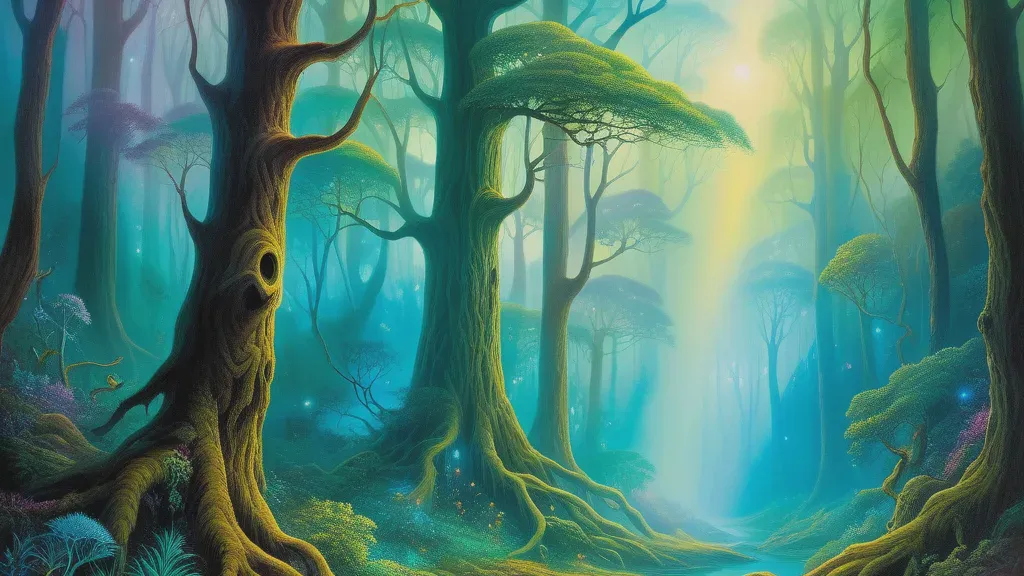
Dying Temperate Forest
Jungian Archetypes
Meaning
A temperate forest is the woodland most dreamers grew up inside, in fact or in story: oak, beech, maple and ash, leaf fall and spring return, the forest of Grimm and of childhood walks. It is nature that keeps its promises. A dying temperate forest is that promise failing. The canopy is bare in summer, trunks stand grey and hollow, there is no birdsong or the birds are heard but nothing moves, and the seasonal cycle that should bring the leaves back has stopped. Psychologically the image speaks of vitality draining from something the dreamer relied on to renew itself: a body, a marriage, a family, a vocation, or the dreamer's own capacity for feeling. It is a grief dream more than a fear dream, and it usually arrives before the loss has been admitted in daylight.
Psychological Interpretation
The dreamer's first task is to notice what kind of dying it was. A slow blight, leaves browning out of season and bark peeling, describes exhaustion that has crept up over years: the dreamer has been drawing on reserves without replenishing them, and the dream is a ledger. A forest being cut, burned or bulldozed shows an external agent, and the question is who in waking life is clearing ground that used to be the dreamer's. A forest that is simply silent, standing but lifeless like a stage set, points to numbness, the automatic functioning that follows prolonged stress or unmourned loss. The dreamer's position matters as much as the forest's condition. Searching for water that never appears repeats the wasteland motif of the Grail legends, where the land sickens because its ruler is wounded; the question becomes what wound in the dreamer's governing attitude has dried the streams. Shielding a sapling while the old trees fall is an encouraging variant: the psyche has already found what is still alive. Because temperate forests belong to the dreamer's home climate rather than to jungle or tundra, the dream almost always concerns something familiar and formative, the family, the first landscape, the ground taken for granted. And because such forests die back every autumn and return, the horror lies in the suspicion that this time the cycle will not turn.
Traditional Symbol Meaning
Traditional dream lore was unsentimental about trees. Withered, leafless or fallen trees were read almost everywhere as omens of loss, and the specific loss depended on what the tree stood for in the dreamer's world. Chinese dream manuals attributed to the Duke of Zhou associate flourishing trees with the fortunes of a household and withered ones with its decline, and nineteenth-century European dream books, Gustavus Hindman Miller's among them, treated dead timber as a warning of disappointment, sickness in the family or a failing enterprise. classical interpreters in the tradition of Artemidorus read trees by their kind and use, so that a withered or felled tree boded ill for whatever in the dreamer's life it most resembled. Behind the omen books lies an older intuition that a forest is a community, and that a dying forest is a community in trouble. Sacred groves were treated as living bodies rather than resources: the Roman lucus could not be thinned without a ritual apology to its resident spirit, Shinto shrines in Japan are still surrounded by chinju no mori, protective groves that hold the presence of the kami, and in the Buddhist account of the Buddha's death the twin sal trees at Kushinagar blossomed out of season as he lay between them. In these traditions the forest does not merely reflect human fortune; it participates in it, and a dream of the trees failing was understood as the land itself grieving or warning. Fairy tale gave the temperate forest its particular character as the place where ordinary rules are suspended. The forests of the Grimm collection and of Slavic story, where Baba Yaga's hut stands on chicken legs, are dark but not dead; they are dangerous because they are so alive. The dying forest inverts that inheritance. It is the enchanted wood after the enchantment has drained out, and modern storytellers have used the image deliberately: Tolkien's Ents rising against Saruman's clear-cutting, the stumps of the Truffula trees in The Lorax, the silent, birdless spring that opens Rachel Carson's Silent Spring in 1962. Each repeats the old lore's claim that when the forest dies something has gone wrong at the level of stewardship, and that the dreamer or the culture is implicated. The traditional readings converge on a single instruction: look for the wound upstream. The omen tradition says a loss is coming or has quietly arrived; the sacred-grove tradition says something meant to be honoured has been treated as raw material; the fairy-tale tradition says the place where the dreamer once went to be transformed has stopped transforming anyone. The forest cannot be argued back to life, but it can be tended, and the first act of tending is to stop pretending the leaves are only late.
Jungian / Archetypal
Jung treated the forest as one of the primary images of the unconscious, the dark, populated, unmapped territory outside the cleared ground of consciousness, and the tree as one of the primary images of the Self, rooted in the earth and reaching toward light. His late essay The Philosophical Tree gathered dozens of patients' paintings of trees and read them as pictures of individuation, the slow growth of the whole personality. A dying temperate forest therefore shows the dreamer something graver than a bad mood. The living matrix from which new attitudes, images and energies are supposed to grow has stopped producing them, and the seasonal rhythm of dieback and return that a deciduous forest embodies, the psyche's natural cycle of withdrawal and renewal, has jammed in the withdrawal phase. The dream is compensatory in Jung's sense: it corrects a conscious attitude that has become too dry, too willed, too cut off from the vegetative life of feeling and instinct. The Fisher King is the amplification Jung's followers reached for most often. In the Grail legends the king's wound, usually to the thigh or groin, to fertility itself, leaves the land waste, and the cure is not a remedy but a question, asked by the young knight Parzival. The Hero archetype in this dream takes exactly that form. Its task is not to slay anything but to notice the suffering and ask what ails it, which is precisely what the dreamer's ego has failed to do about its own depletion. The Norse image of Yggdrasil, the world ash gnawed at the root while the gods above go about their business, adds the point that the damage is happening underneath, in the unconscious, while consciousness attends to the canopy. The single green sapling that so often appears in this dream is the Self's answer. Jung saw the Self as the organising centre that persists through the ego's crises and that constellates most clearly when the old order is dying; in alchemical terms the forest's rot is the nigredo, the blackening in which decay becomes the ground of new growth. Fungus on a fallen trunk, a spring found under dead leaves, a witch's hut at the forest's heart, all signal that the death is not the end of the process but the middle of it. What the dream asks of the dreamer is to stop administering the dying trees and to go looking, on foot and in the dark, for what is still growing.
Gestalt / Parts of Self
Say it in the first person and the dream becomes immediate: I am a forest, I was green, and I am dying. Gestalt dreamwork asks you to take that sentence seriously, because in this tradition the forest is not a symbol of you, it is you, one of your parts speaking in the only language it has. Go further and be the specific elements. I am the bare canopy in July. I am the standing trunk, hollow but upright, still looking like a tree from a distance. I am the birdsong with no bird behind it. Each of these will say something different about how you have been living, and the one that makes your voice catch is the one to stay with. Then be the thing that is killing the forest, since that too is yours. Be the drought, the beetle, the blight, the chainsaw, and speak: I take the water, I bore under the bark, I clear the ground because I need it. Most dreamers are shocked by how fluently the destroyer talks and how reasonable it sounds; it usually turns out to be the voice of overwork, of a duty accepted without limit, of a self-improvement project that has become a clearance operation. Put the forest and the destroyer in facing chairs and let them argue until the polarity shows its shape: the part that only wants to grow against the part that only wants to use. Notice your breath and your posture in each chair. Deadness in the dream is very often desensitisation in the body, and the forest's silence is your own muted sensation. Gestalt is interested in the contact boundary, the live edge where you meet your environment, and a dying forest describes an edge that has gone numb. Ask where in your waking field you are in confluence, merged with a system that is itself dying, a workplace, a marriage, a family culture, so that its exhaustion has become yours without your noticing the seam. Ask too where you have withdrawn from contact entirely, standing like the hollow trunk, present in outline only. If there was a sapling in the dream, be the sapling last: I am small, I am green, I need shelter from the wind more than I need to be forced. That voice is usually the most honest report you will get of what your next season of contact requires.
Psychodynamic / Freudian
In psychodynamic thought the earliest landscape is the mother's body, and Melanie Klein described the infant's phantasies of that body as a place of abundance that the child both feeds from and, in rage or envy, attacks. A temperate forest, familiar, fertile, cyclical, reliable, is a mature form of that first good environment; a dying one is the good environment damaged, and the dream is very often the dreamer's unconscious reckoning with an injury to a primary source of care. The wish content is layered: beneath the manifest grief there may be a wish that the depleting environment would die, so that the dreamer could be free of it, followed by guilt at the wish and the dream's picture of the consequence. Klein's depressive position is the frame that fits the feeling of these dreams best. The dreamer discovers that the object they depended on and resented is a single vulnerable whole, and the response is mourning and the urge to repair, which is why the sapling-protecting variant is so common: it is reparation in miniature. Freud's distinction in Mourning and Melancholia between grieving a loss and identifying with it applies too. A dreamer who walks through the forest feeling that they are dying with it has taken the lost object inside; a dreamer who searches for water or shields the young tree has begun the slower work of mourning that keeps the self separate from what it has lost. Winnicott's holding environment, the surround that lets a self go on being, is the temperate forest in developmental terms, and its dying can revive very early anxieties about a world that stopped holding. Displacement deserves attention. The forest can carry a decline that the dreamer cannot yet look at directly, a parent's ageing, a partner's withdrawal, the dreamer's own body, and the choice of a whole landscape rather than a single tree suggests the loss feels systemic rather than local. In treatment such dreams often arrive when a patient begins to perceive the analyst as fallible or tired, or when a break in the work is approaching, and the dying forest is then the transference speaking about a holding relationship that seems to be failing. The clinical question is not whether the forest can be saved but whether the dreamer can bear to grieve it while remaining alive themselves.
Contemporary Psychological
Cognitive science would begin with what the dreamer has been consuming. The continuity hypothesis, developed most systematically by G. William Domhoff, holds that dream content reflects waking concerns and recent experience, and the imagery of forest death is now abundant in waking life: wildfire footage, bark beetle die-offs in Central European spruce stands, ash dieback in Britain, emerald ash borer in North America. A dreamer who has absorbed those images, or who has watched a real local woodland decline, has supplied the material. Environmental psychology has named the feeling. Glenn Albrecht's solastalgia describes the homesickness felt while still at home as a familiar landscape degrades, and Ashlee Cunsolo and Neville Ellis's 2018 work on ecological grief argued that mourning for lost environments is a genuine and increasingly common form of bereavement. But the brain also uses landscapes to represent internal states, and Ernest Hartmann's research on the central image of a dream suggested that dreaming contextualises a dominant emotion in a single picture whose intensity tracks the emotion's strength. A dying forest is an efficient picture of depletion, low mood or physical illness; people running on chronic sleep loss or in the early stages of burnout frequently dream of drained, greyed, unresponsive environments before they can articulate the state in words. Memory consolidation during sleep binds recent experience to older schemas, and the temperate forest is for many people the schema of childhood safety, so the dream may be fusing a present exhaustion with the earliest template of a world that renewed itself. Emotion regulation is the third layer. Rosalind Cartwright showed that dreams which rework a distressing situation across the night are associated with better mood on waking, and Matthew Walker's account of REM sleep as overnight therapy describes emotional memories being replayed under low noradrenaline so that their charge diminishes. A dying-forest dream that ends in searching, sheltering a sapling or finding water is the system working; one that ends in frozen witnessing may indicate a grief that has not yet found a form. From the standpoint of predictive processing, the dream is the brain's model of a reliably self-renewing environment being updated by evidence that renewal has stopped, and the dread the dreamer feels is the prediction error. Attending to what has actually changed, in the body, the relationship or the place, is how the model gets revised.
Cultural & Historical Origins
The withering of the land as the sign of a deeper wound is one of the oldest patterns in European story. In the Grail romances that begin with Chretien de Troyes' Perceval in the late twelfth century and continue through Wolfram von Eschenbach's Parzival, the Fisher King's injury leaves his kingdom barren, and Jessie Weston's From Ritual to Romance traced that motif back to vegetation rites in which the health of the ruler and the health of the land were one thing; T. S. Eliot built The Waste Land on her book. Norse cosmology hung the whole world on a temperate tree, the ash Yggdrasil, gnawed at the root by the dragon Nidhogg and browsed by deer, and the Voluspa foretells that the ash will shudder when Ragnarok comes. James Frazer's The Golden Bough opens in the sacred grove at Nemi, where the priest-king held office by killing his predecessor, and argues that the dying and reviving god of vegetation lies at the root of much religion. Pliny the Elder described the Druids' reverence for the oak, and the missionary Boniface is said to have felled the sacred oak of the god Donar at Geismar in the eighth century to prove it powerless. Dante's Inferno contains a forest of suicides, gnarled black trees that bleed and speak when broken, and Caspar David Friedrich painted dead oaks beside ruined abbeys as emblems of a whole culture's mourning. The German word Waldsterben, forest death, named the acid-rain dieback of the 1980s, and the philosopher Glenn Albrecht coined solastalgia in 2005 for the distress of watching one's home landscape degrade.
Contextual Variations
Walking through a summer forest with bare branches
Bare branches in the wrong season are the dream's way of saying that something has stopped keeping time. Leaves that should be full are gone, and the light that reaches the ground is harsh rather than filtered. This tends to appear when your reserves have run out well before the point at which you expected to need them: a project, a caregiving role or a relationship that was supposed to sustain you through the summer has left you in winter. Note whether you kept walking as if nothing were wrong. That is often the most accurate detail about your waking behaviour.
Trees falling one after another around you
Serial collapse, trunk after trunk coming down while you stand among them, describes losses arriving faster than you can mourn them, or a structure whose supports are giving way in sequence. People dream this during cascading crises, a bereavement followed by a job loss followed by an illness, and also during the dismantling of an institution they belong to. Whether you tried to hold a tree up, ran or stood still is the crucial detail. Standing still is not always paralysis; sometimes it is the only sane response to a process too large to stop, and the dream may be granting you permission not to.
A single green sapling in a forest of dead trunks
This is the most hopeful form the dream takes, and dreamers often underrate it because the dead trees dominate the picture. The sapling is what is still alive in you or in the situation, and the dream has gone to the trouble of showing you exactly where it is. What you did with it matters: shielding it from wind speaks to a need for protection rather than effort, forcing it upward speaks to impatience, walking past it speaks to a despair that has stopped looking for evidence. Whatever the sapling grows into will not resemble the old forest, and grieving that is part of tending it.
Finding the forest of your childhood grey and silent
The forest you knew as a child, now bare and soundless, points at the foundation rather than the present. Something that formed you, a family, a home town, a belief, a version of a parent, has died or is dying, and you are being shown the loss in the landscape where you first felt safe. The silence is often the most disturbing element, birds heard but not seen or no birds at all, and it corresponds to a numbness you may be carrying about the change. Go back in the dream if you can. The forest you loved is not recoverable, but the question of what you can still take from it is worth asking on foot.
Frequently Asked Questions
Why did I dream that the woods near my home were dying?
Is a dream about a dying forest connected to climate anxiety?
Does a dying forest in a dream mean someone close to me is going to die?
Why did the dying forest in my dream feel peaceful instead of frightening?
Journaling Prompts
- Draw or describe the forest in your dream as precisely as you can: which trees, which season it should have been, what the ground felt like, whether there was any sound. Then, without deciding what it means, list the three places or relationships in your life that this forest most resembles, and note which of them you have visited least this year.
- Write about the last time you felt genuinely replenished rather than merely rested. Where were you, who was there, what did the air feel like? Then write about what has happened to that source since. If it has changed, name the change plainly; if it has not, ask why you have stopped going to it.
- List the sounds that were missing from the forest in your dream: birdsong, wind in the leaves, running water, footsteps other than your own. Then list their equivalents in your waking week, the voices, music, laughter or phone calls that used to be the background noise of your life, and note beside each when you last heard it and what it would take to hear it again.
- A temperate forest goes bare every winter and comes back; a dying one does not. Divide the things in your life that feel lifeless right now into two columns, dormant and dead, and for each write the evidence that put it there. Then look for what you have been treating as dead that only needs a season, and for what you have been waiting on that is not coming back.
Related Symbols
Dreamed about Dying Temperate Forest?
Get a personalized AI interpretation that connects this symbol to your specific life circumstances.
Interpret My Dream