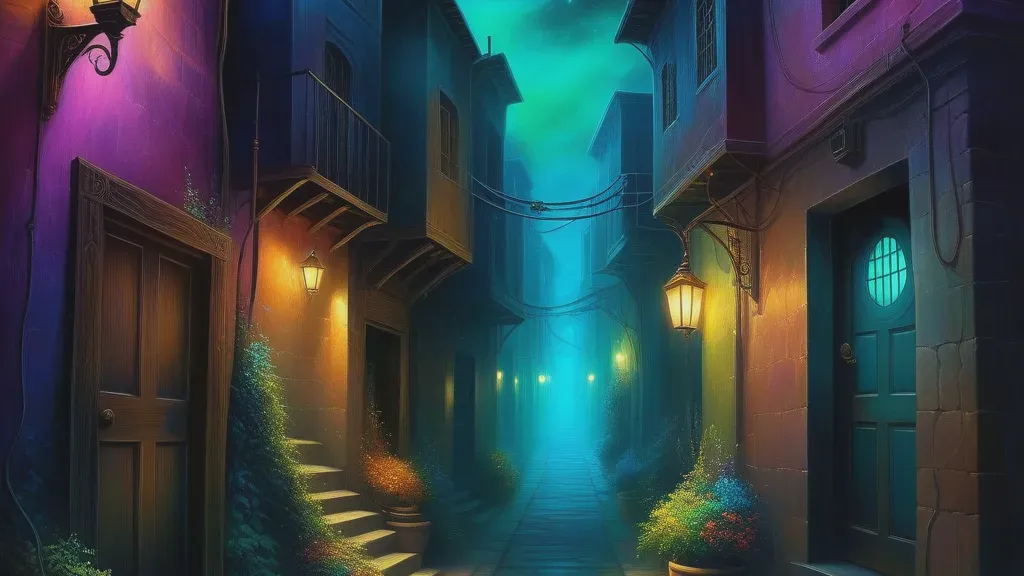
Dark Alley
Jungian Archetypes
Meaning
A dark alley is the city's back way: the narrow, unlit gap behind the lit street where the bins are kept, the deliveries come, and no one is supposed to look. In a dream it is the route the dreamer takes when the main road is closed, and the fear it carries is not of the dark as such but of being enclosed on two sides with no view ahead and no witness behind. The image tends to arrive when a person is cutting through something, a decision, a relationship, a period of life, by a way that is faster and less visible than the proper one, and when part of them suspects they are being watched or followed while they do it.
Psychological Interpretation
The alley is defined by what it is not: the street with its shopfronts and public faces, the space where the dreamer is seen. Sometimes the turn is a shortcut: the dreamer knows where they are going and takes the quicker, darker way, which in waking terms often means handling privately something that would be safer done in the open. Sometimes the alley is the only way left, and the dream is about a closure the dreamer did not choose. The characteristic feeling is exposure without visibility, being a target that cannot see what is aiming at it, and it is worth asking whether anything in the dream actually threatened the dreamer or whether the threat lived in the walls and the dark. The details that matter most are the ones the dreamer supplied without noticing. Turning into the alley from a known street means the situation has a traceable beginning; finding oneself already inside it means it has simply closed around the dreamer. Company changes the reading: an alley walked beside someone is a secret shared, one entered alone while a companion stays on the pavement is a secret kept from that person in particular. The dream rarely ends in the alley; it ends at the mouth, the exit or the locked gate, and what the dreamer did there, pushed on, turned back or stood still, carries its verdict.
Traditional Symbol Meaning
The narrow way is one of the oldest sacred images. The Gospel of Matthew sets the strait gate and the narrow road that leads to life against the broad road that leads to destruction, and Psalm 23 has its speaker walk through the valley of the shadow of death, a passage under threat made bearable by a companion. The Greeks put Hermes at the corners: the herms, square pillars with his head, stood at Athenian doorways and crossroads because he was god of roads, thresholds, thieves and the guiding of souls, and his double nature, guide and robber in one, is the alley's own. Hecate received suppers left at crossroads after dark. Arnold van Gennep's Rites of Passage (1909) and Victor Turner's later work on liminality describe the state between two social positions as a corridor, dangerous because the person inside it belongs to neither end. City folklore filled the corridor with particular fears. Medieval towns shut their gates at the curfew bell, and to be caught in the lanes after it was to be presumed a thief. Edinburgh's closes, steep passages between tenements, gathered legends like the one told of Mary King's Close, sealed with its plague victims inside, and Venice's calli were where the masked went when they did not wish to be known. In Japanese folk saying, whistling at night in the streets calls snakes or thieves. The Whitechapel murders turned this diffuse unease into a modern script, and a century of crime fiction and cinema has kept the alley as the place where the city's violence is stored. Popular dream books read the alley as a downturn. Gustavus Hindman Miller's Ten Thousand Dreams Interpreted (1901) treats walking through one as a sign that fortunes will be poorer than before, and for a young woman wandering an alley after dark it issues a warning about her company, a reading that says more about the anxieties of its era than about the dream. Later dictionaries soften this into a general caution about hidden dangers and dubious shortcuts, and most agree that reaching the end of the alley is a good sign while being trapped in it is not. Across these traditions the alley keeps one shape: a passage between two lit places where the traveller is briefly no one, watched by something that may be a guide or a thief and is often both. A dreamer who walks it is in transit between one state and another, and the tradition's advice is consistent even where its fears differ. Keep moving, carry a light if there is one, and expect to meet at the corner the god who takes and the god who shows the way, wearing the same face.
Jungian / Archetypal
The street is the Persona: the front the city shows, the shopfronts and the public faces, the arrangement by which a person is recognised and accounted for. The alley runs behind it, and a dreamer who turns into one has stepped behind their own mask into the space between what is shown and what is stored. Jung recorded a dream of his own in Memories, Dreams, Reflections in which he walked at night through wind and fog carrying a small light cupped in his hands while a gigantic black figure followed him; on waking he understood the figure as his own shadow, cast by the little light he carried. A dark alley dream often has this exact structure. The thing behind the dreamer is thrown by the dreamer's own consciousness, and it keeps pace because it belongs to them. The alley is Trickster territory. Hermes, god of roads, thieves and the guiding of souls, stood at every Athenian corner, and the figure the dreamer fears may be waiting in the dark is his descendant: the one who robs and shows the way in the same gesture. The Trickster breaks the Persona's arrangements, and an alley dream often comes when the dreamer's public life has become too orderly to admit what is happening behind it. The Self also has a claim on the image. The strait gate and the narrow road are old symbols for the way to the centre, and an alley discovered behind the dreamer's own house, unknown until that night, is the psyche revealing a route to itself that the ego had never mapped. Whether the passage reads as robbery or pilgrimage depends on what the dreamer does at its mouth. Compensation explains who receives the dream: people whose lives are all front, all street, are given the back; people who have been hiding in the back are shown that the alley has an exit onto a lit road. Amplification reaches Theseus in the labyrinth, a narrow dark passage with something waiting at its centre and a thread to find the way home, and the night sea journey, the descent that every individuation requires in miniature. The task the dream sets is not to run through the alley but to walk it at a chosen pace, to look at what follows, and to notice that the walls on either side were built by the dreamer's own choices about what may be seen.
Gestalt / Parts of Self
In Gestalt work you do not walk down the alley; you are the alley. The two walls are constraints you built, the darkness is what you have chosen not to light, the narrowness is the width you have allowed yourself, and the footsteps behind you are your own. Begin by speaking as the passage, in the present tense: I am narrow. I run behind the buildings where no one looks. People hurry through me and do not stop. Say it until a sentence turns out to be about your life now, about the part of you that everyone passes through quickly on their way somewhere brighter. Then take the chair of the thing that might be waiting. Most dreamers refuse this at first, because the figure in the dark is the most disowned part of the dream, but it is the part with the most to say. Speak as it: I am the one you are afraid of in this alley. I have been waiting for you here because you never come this way in daylight. Usually what emerges is an appetite or an anger the dreamer has exiled from their public street, and the fear in the dream is the fear of meeting it. Set up the polarity plainly, hunted and hunter, exposed and hidden, and let each side speak to the other until you can feel that both voices are yours. The alley is also a picture of avoided contact. It is the shortcut that goes around the street where people would see you, and taking it in a dream can mean that you are managing something in your life without letting anyone witness it. Fritz Perls would ask what you are doing with your fear: turning it inward, tightening your own chest instead of turning to face the dark, is retroflection, and it is why the dream body feels so constricted. The experiment is simple. In imagination, stop in the alley, turn around, and stay there. Notice what your hands want to do. The gestalt closes not when you reach the exit but when you can stand in your own back lane at your own pace, and let what follows catch up.
Psychodynamic / Freudian
Freud's writing on dream symbolism treats narrow passages, corridors and enclosed spaces as bodily symbols, and the alley in a dream can carry those meanings alongside its urban ones: the tight way through, the back entrance, the passage that leads somewhere private. The manifest content is a street; the latent content is usually a specific thing the dreamer is doing out of sight. Displacement is at work when a fear that belongs to one person, a creditor, a former partner, a boss, is spread across a whole dark street so that it cannot be named, and condensation when the alley is at once the way home from a childhood school and the route to a current secret. Object relations reads the alley through the earliest experience of persecution. Melanie Klein's paranoid-schizoid position describes a world in which the bad has been split off and projected outward, so that it seems to wait in the dark rather than live inside; the alley is that world drawn as a place. Winnicott's late paper on the fear of breakdown argued that the catastrophe a patient dreads has usually already happened, in infancy, before there was a self to experience it, and recurring dreams of an alley with something at its end can be the psyche returning to a dread that is old rather than approaching. Wilfred Bion called the raw, unprocessed fear that a mother could not take in and give back in bearable form nameless dread, and the alley, with its threat that never shows a face, is nameless dread given an address. Defences and transference shape the variations. Repetition compulsion appears when the same alley returns night after night, often the re-staging of a real event, an assault or a chase, that the mind keeps replaying in the hope of a different ending. Reversal turns the dreamer's own wish to pursue into the experience of being pursued. In treatment the consulting room can become the alley: narrow, private, with a door and something waiting to be found, and the dream frequently arrives when a patient senses that the analysis is about to turn down a street they have kept off the map. The dream is then resistance and invitation at once, the wish to be found and the terror of it, walking the same passage.
Contemporary Psychological
The dark alley is close to the ideal stimulus for Antti Revonsuo's threat simulation theory, which holds that dreaming evolved to rehearse dangerous situations in safety. Jay Appleton's prospect-refuge theory (1975) explains why the alley feels worse than an open dark field: humans prefer places that offer a view outward and cover for themselves, and an alley gives the dreamer neither while offering every doorway as refuge to a possible other. The amygdala raises vigilance in low light and enclosure before any threat is identified, and a dream alley is the brain running that alarm with no one there, which is why the walls feel dangerous even when nothing happens. Spatial memory supplies the setting. The hippocampus holds a map of places built from cells that fire at particular locations, the place cells John O'Keefe discovered and the grid cells described by May-Britt and Edvard Moser, and Matthew Wilson and Bruce McNaughton showed in 1994 that rats replay the routes they have run while they sleep. Dreams of familiar streets are likely that replay assembled into narrative, and an alley that refuses to end is a map that will not close. The continuity hypothesis predicts who dreams this: people who walk unlit streets after shifts, people who have been followed, and people whose evenings are full of crime drama; Calvin Hall and Robert Van de Castle's dream norms show aggression to be among the most common social interactions in dream reports from any population. Emotional regulation gives the dream its purpose. Rosalind Cartwright's work suggests that dreaming works over the day's worst feeling, and Matthew Walker's group describes REM sleep as gradually separating the emotional charge from a memory, so that a chase through an alley can be the brain wearing down a fear rather than warning of one. In predictive processing terms, darkness lowers the precision of what the senses can report, and the brain's priors fill the gap; the footsteps that are never seen are a prediction, not a perception. Where alley dreams recur after a real event, imagery rehearsal, Barry Krakow's method of rewriting the dream's ending while awake, has good evidence behind it, and the written record it begins with, noting how far the dreamer got and what the alley opened onto, is already part of the treatment.
Cultural & Historical Origins
The alley became a symbol of dread when cities grew large enough to have a back. Edgar Allan Poe's The Man of the Crowd (1840) follows a stranger through London's narrowing streets all night without ever learning what he is, and Robert Louis Stevenson's Strange Case of Dr Jekyll and Mr Hyde (1886) gives Hyde his own entrance through a blistered door in a by-street, the respectable house's secret access. The Whitechapel murders of 1888 fixed the image in the modern mind: the victims were found in yards and passages a few steps from busy roads, and the newspapers taught readers that the danger was the gap beside the road. Film noir made the alley its stage; Carol Reed's The Third Man (1949) lights Vienna's passages from below so that every doorway holds a possible Harry Lime. Batman's origin, told in Detective Comics in 1939 and later set in a passage Gotham calls Crime Alley, turned the image into a founding wound. The planners had their say too: Jane Jacobs argued in The Death and Life of Great American Cities (1961) that streets are kept safe by eyes upon them, and Oscar Newman's Defensible Space (1972) named the unwatched passage as the point where a neighbourhood fails. Gentler readings survive: the roji of the Japanese tea garden is a deliberately narrow path a guest walks to shed the world, and the calli of Venice were simply the way home. The alley in a dream draws on both: the place where the city hides its violence, and the private passage everyone once used.
Contextual Variations
Being followed down a dark alley by footsteps you never see
Footsteps that keep pace and never show a face are the dream's way of saying that what follows you is yours. It is usually something you did or decided that you have not finished thinking about: a debt, a lie that held, a person you left without explaining. Notice whether the footsteps sped up when you did. If they matched you exactly, the follower is part of your own history and cannot be outrun, only turned to face. If they were slower, you have more time than the fear suggests, and the dream asks why you run from what is not chasing.
Taking a shortcut through a dark alley that keeps getting longer
A shortcut that lengthens is a process you expected to be quick and private that has become neither. People dream this during drawn-out separations, legal matters, recoveries and job searches. The alley's stretching measures how far the situation has run past your plan. Ask what the proper route would have been, the one down the lit street with people watching, and whether you avoided it because it was slower or because it was visible. The dream is not punishing the shortcut; it is showing you its real length.
A dark alley behind your own house that you never knew was there
The house in a dream is the self, and a passage behind it that you never knew existed is a route into your own life that the everyday mind has not mapped. It appears when something about you, a capacity, a history, a wish, has been running behind the rooms you live in all along and is now available to be walked. Notice where the alley led. If it joined a street you recognised, the hidden route connects to your known life and can be used. If it ran into darkness, you have found the back way but not yet its destination.
A lit window halfway down a dark alley
One lit window in a dark passage is a person or a possibility you have not approached, placed exactly where you would have to leave the safe mouth of the alley to reach it. The light says someone is home; the position says that reaching them means walking through the part you fear. Dreamers often wake before deciding, which is itself the information. Ask who you imagine behind that window, and whether the dark between you and it is real danger or only the absence of anyone watching you go there.
Frequently Asked Questions
Why do I keep dreaming about walking down a dark alley?
Is a dark alley dream a warning that something bad will happen?
Why wasn't I afraid in the dark alley in my dream?
I dreamed of being chased into an alley and woke up before the end. Why?
Journaling Prompts
- Describe the alley from your dream as if you were writing directions for someone else: which street it runs behind, how wide it is, what is on the ground. Then write down which part of your life is the street and which part is the alley, and when you last took the back way instead of the front.
- Whatever was following you, give it a voice. Write three sentences it would say if you turned around, then write what you would say back. Notice whether the footsteps belong to a person you know, a debt, a decision you have been walking away from, or a version of yourself you left behind.
- Make a list of the people who would be surprised to learn what you are currently handling privately. Beside each name write the reaction you expect from them, then mark which of those reactions you have actually seen from that person and which you have only imagined. The second list is what the alley walls are made of.
- Picture the exit of the alley, whether you reached it or not. Write one paragraph about what was on the other side, inventing it if the dream did not show you, and one paragraph about what would have to be true for you to walk there in daylight, on the main street, with people watching.
Related Symbols
Dreamed about Dark Alley?
Get a personalized AI interpretation that connects this symbol to your specific life circumstances.
Interpret My Dream