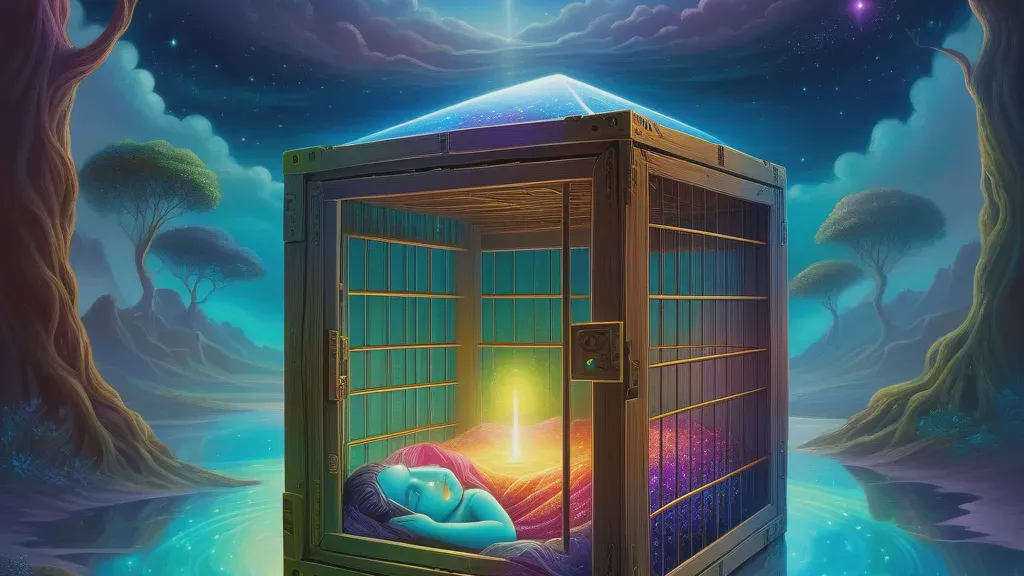
Crate
Jungian Archetypes
Meaning
A crate in a dream is a container built for transit rather than for keeping: rough slats, stencilled labels, nails instead of locks, straw instead of velvet. It belongs to the moment between one place and another, and it usually arrives when something in the dreamer's life is in the same condition, packed but not yet unpacked, sent but not yet received, decided but not yet lived. Unlike a chest or a jewellery box, a crate is not private; anyone can read the label and, through the gaps, half-see what is inside. The dream therefore turns on two questions at once: what has been packed away, and who wrote the label. The dreamer is often surprised to find their own name on it.
Psychological Interpretation
The crate's position in the story is the first clue. A crate that arrives is something coming due: a consequence, an inheritance, a truth someone has been shipping toward the dreamer for a long time. A crate waiting unopened in a garage or warehouse is the dreamer's own deferral, the part of a move, a loss or a relationship that was packed to be dealt with later and never was. A crate the dreamer is packing points to a departure being prepared, sometimes before the dreamer has admitted it. A crate the dreamer is inside reverses everything: the person has become the cargo, handled, labelled and sent by others, which is how a life can feel during a relocation, a hospital stay, a job transfer or a childhood. Then comes the opening. Crates are nailed rather than locked, so opening one is not a matter of the right key but of force and willingness; the crowbar is a decision. A dreamer who cannot find the tool, or who pries at a lid that will not lift, is being shown resistance that is their own, since nobody else sealed it. What is inside matters less than the dreamer expects. Straw and nothing, a familiar object, something alive, something that smells: each is a report on the current state of what was put away. The crate's plainness is part of the message. This is not treasure or a secret; it is ordinary material set aside for a move that has been waiting for the move to finish.
Traditional Symbol Meaning
Older dream lore has no entry for crates, which are an industrial object, but it has a great deal to say about chests, boxes and coffers, and the crate inherits it. Gustavus Hindman Miller's Ten Thousand Dreams Interpreted (1901) comes closest to the crate: opening a goods box, it says, promises wealth and journeys to distant places, while an empty one reverses the omen, and the less systematic folk readings that fed such books tended to treat a closed box as a secret kept and an opened one as a secret out. The coffer was the household's memory as well as its treasury, the place where deeds, linens and the shroud were kept together, so that to dream of one was to dream of the family's continuity and of the death folded inside it. Folk practice around containers was concerned with what should stay shut. In many European traditions a box or chest opened at the wrong moment released something that could not be recalled, the Pandora pattern, while the bride's chest or hope chest, filled over years before marriage, carried the opposite meaning of a future stored safely until its time. In Japan, the tale of Urashima Taro turns on a box, the tamatebako, that the fisherman is told never to open; when he does, the years he spent beneath the sea escape as smoke and he ages in an instant. Boxes, in this reading, hold time as much as things. The crate proper belongs to the age of freight, and its lore is modern and practical. It is the object of the docks, the warehouse, the removal van and the customs shed, and it carries the anxieties of those places: loss in transit, theft, the wrong address, the label that no longer matches the contents. It is also the coffin's plain cousin, the pine box, and the dog crate, a cage presented as a bed. The cargo cults of Melanesia, which grew up in the twentieth century around the arrival of crated goods by ship and plane, show how completely a crate could come to stand for wealth that appears from elsewhere by means nobody local controls. Read together, these traditions give the dream crate its range: a secret, a stored future, a shipped self, and a death that arrives by post.
Jungian / Archetypal
A crate is a Persona object in a way that a chest is not. The chest hides; the crate declares. Its outside is covered in the language of presentation, this side up, fragile, a name, a destination, and its contents are secondary to the label. Jung understood the Persona as the packaging a person adopts in order to be handled by the world, useful and necessary until it is mistaken for the contents, and a dream in which the dreamer's name is stencilled on a crate is a precise image of that mistake. The dreamer has become deliverable. The individuation question the dream raises is whether anyone, including the dreamer, has looked past the label recently, and what the gap between label and contents has cost. Beneath the Persona reading lies the Great Mother, whose elementary form, in Erich Neumann's account, is the vessel: the womb, the jar, the ark, the container that holds and nourishes and also encloses and buries. The crate is a rough, provisional version of that vessel, a womb made of planks, and dreams of being inside one carry the double charge of every maternal container, safety and suffocation at once. Set's chest for Osiris makes the point in myth: the container made exactly to fit is the one that kills. A dreamer who feels held by a crate is meeting the positive mother; a dreamer who feels the lid nailed down is meeting her negative aspect, and the same box serves for both. The Shadow enters through the unopened crate. Whatever was packed away and never unpacked is by definition unlived, and Jung held that unlived material does not stay dormant; it presses, it smells, it moves inside the box. Compensation is visible in who does the packing. A person who prides themselves on being open and processed dreams of a garage full of crates they have never touched; a person who fears they are closed dreams of a crate arriving already open. The crowbar, when it appears, is the ego's decision to meet the contents, and the alchemists would have recognised the sealed vessel that must be opened at the right time and not before. The dream seldom says whether it is time. It says the crate has arrived.
Gestalt / Parts of Self
Gestalt work refuses to ask what the crate stands for and asks you to be it. Say, in the present tense: I am rough. I am made of slats, so people can partly see into me but cannot reach in. I am nailed shut, not locked; nobody has the key because there is no key. Someone else wrote on my outside. I am waiting to be moved. Speak for the label too, since it is often the loudest part: I say fragile, I say this side up, I say a name. Notice which of those sentences produces a reaction in your body, because that reaction marks the piece of yourself you have stored in this object rather than carried. The crate is a polarity of container and contents, and both need a chair. The container says: I keep things safe, I keep things together, without me it would all spill. The contents say: I have been in here for years, I am going stale, I want air. Let them argue, and notice which voice sounds like a parent and which like a child, because crate dreams frequently reproduce the arrangement of a family in which one member did the containing for everyone. If in the dream you were inside the crate, add a third chair for whoever was shipping you, and ask them where you are going and why you were not consulted. Unfinished business is the Gestalt term for what an unopened crate holds, and the dream is unusually literal about it: a move that was made but not completed, a grief packed for later, a decision shipped but not received. The impasse is the nailed lid, the point where you stop and say I cannot. Stay there rather than forcing through. Ask what you expect to happen if the lid comes off, then be the thing you expect and let it speak. Most dreamers discover that the contents are far smaller than the fear of them, ordinary objects and old straw, and that the energy went into keeping the crate shut rather than into anything inside it.
Psychodynamic / Freudian
Freud placed boxes, chests and cases among the standard symbols of the female body, and his reading of Dora's dream of the jewel-case made the container a figure for sexuality and for what a young woman keeps or gives. A crate in a dream inherits that layer but coarsens it: it is the body as cargo, handled and shipped rather than treasured. Beneath the manifest image of freight, the latent content is often about being dealt with as an object, by parents, by institutions, by a partner, and the wish and the fear it carries are the same, to be delivered somewhere without having to choose. Repression is the nailed lid: what was placed inside is not lost but held out of reach, and the crate's habit of arriving unbidden is the return of the repressed by post. Bion's model of container and contained turns the crate into a question about thinking. The infant's raw, unbearable experience must be taken in by the mother, held, made sense of and returned in a form the infant can use; where that holding fails, experience stays raw, and the adult stores it in whatever containers are available. A crate full of things that smell, or that move, is experience that was contained but never processed, packed rather than digested. Winnicott's holding environment describes the good version, and the difference between a crate that feels like a cradle and one that feels like a coffin is the difference between an early environment that held the dreamer and one that merely stored them until further notice. Klein supplies the phantasy of the mother's body as a storehouse of riches that the infant longs to break into and fears to damage, and the dreamer prying at a crate with a crowbar, half desiring and half dreading what is inside, is enacting that early scene. Displacement moves the contents from a person to a box; condensation lets one crate hold a childhood home, a lost parent and the dreamer's own unwanted feelings at once; reversal turns the wish to send something away into being sent. In therapy the crate frequently stands for the treatment itself, the container in which the patient has placed material for later, and the dream of finally opening it tends to precede the session in which they do.
Contemporary Psychological
Cognitive linguistics identified the container as one of the mind's foundational image schemas: George Lakoff and Mark Johnson showed in Metaphors We Live By that we think of states, relationships and categories as things one is in or out of, and a crate is a container schema rendered in wood. The dreaming brain reaches for it when the material to be represented concerns boundaries, storage and transition. The continuity hypothesis associated with G. William Domhoff predicts crate dreams among people who are moving house, emigrating, clearing a parent's home, shipping possessions or working in logistics, and a house move is the waking situation dreamers most often report behind them. An unopened container is also a machine for producing curiosity. George Loewenstein described curiosity as the discomfort of an information gap, a felt difference between what one knows and what one wants to know, and a crate in a dream is that gap made visible, slats revealing just enough to sustain the pull. Predictive-processing accounts of dreaming treat the sleeping brain as running its generative model with sensory input turned down, and a crate is an efficient way to stage uncertainty: the model can keep the contents unspecified while the emotion attached to them is rehearsed. That the contents so often turn out to be ordinary on opening is the model resolving the gap with whatever memory is nearest. Memory consolidation and emotional regulation account for the crate's timing and its recurrence. Sleep researchers have shown that the hippocampus replays recent experience during sleep and that REM in particular reprocesses emotional memory with lowered noradrenaline, a mechanism Matthew Walker has described as overnight therapy. A crate packed and never unpacked is a memory that was encoded but not integrated, and the dream of finally prying it open often follows a day in which the dreamer touched the topic in waking life. Rosalind Cartwright's finding that dreams which move a stressful theme toward an outcome predict better mood suggests that the dream ending with the lid off, whatever lay inside, has done more for the dreamer than the one ending with the crowbar still in hand.
Cultural & Historical Origins
The crate's mythic ancestors are boxes that hold what must not be looked at. In Plutarch's telling of the Osiris myth, Set has a beautiful chest built to Osiris's exact measurements, tricks him into lying in it at a feast, nails and seals the lid and throws it into the Nile, so that the god's first coffin is a shipping box made to size. Hesiod's Pandora opens not a box but a pithos, a storage jar; Erasmus's Latin rendering turned it into a box in the sixteenth century, and the container of all ills has been a box ever since. On the Northwest Coast, the Haida story of Raven stealing the light describes an old man who kept daylight in a box inside a box inside a box, and the bentwood boxes of the region held both wealth and the dead. Erich Neumann's study The Great Mother treats the vessel as the elementary form of the feminine, the container that holds, nourishes and also imprisons. History supplies the most literal crate: in 1849 Henry Brown, enslaved in Richmond, Virginia, had himself nailed into a wooden box three feet long and mailed to abolitionists in Philadelphia, emerging after about twenty-seven hours as Henry Box Brown. Twentieth-century imagination added the warehouse: the final scene of Raiders of the Lost Ark files the Ark of the Covenant in an anonymous crate among thousands of identical ones, the sacred lost by being stored.
Contextual Variations
A crate arriving with your name stencilled on the side
A delivery addressed to you is something coming due, and the stencil, a name applied with a template rather than written by hand, suggests it was sent by a system rather than a person: an institution, a family arrangement, a consequence working its way toward you through channels. Notice whether you were expecting it. Surprise means a debt or an inheritance you have not acknowledged; dread means you know exactly what it is. The crate has your name on the outside and something else on the inside, which is the dream's quiet comment on the difference between how you are labelled and what you contain.
Prying open a nailed-shut crate with a crowbar
A crate has no key, so opening it is a matter of leverage and willingness rather than permission, and the crowbar in your hands is a decision you have already made. This dream tends to arrive when you have resolved to look at something packed away, a period of your life, a relationship, a grief, and the psyche is rehearsing the effort. The nails' resistance is your own; nobody else sealed it. Pay attention to what the wood did: splintering suggests the opening will damage the container, which is sometimes necessary, while a lid that lifts cleanly suggests the sealing was never as final as it felt.
Being shipped somewhere inside a wooden crate
Here you are the cargo, and the dream is about being handled: moved, labelled, stacked and sent by people who do not consult the contents. It comes during a transfer you did not choose, or out of a childhood spent moved between houses like luggage. Whether you could see through the slats matters: partial sight means you know where you are going and cannot intervene, darkness that you have surrendered. Henry Box Brown mailed himself to freedom in such a box, so the crate can also carry an escape you chose.
A crate with air holes and something moving inside
Air holes mean the crate was packed by someone who knew its contents were alive, and movement means they still are. Whatever you put away was not an object but a creature, a feeling, an appetite, a version of yourself, and it has survived storage. The dream arrives when a part of your life you treated as finished turns out to be only confined, and restless. The tone is your guide: curiosity suggests readiness to let it out, fear that you already know and would rather it stayed contained a while longer. The air holes, either way, were your own decision.
Frequently Asked Questions
Why do I keep dreaming about crates I never open?
I dreamed I was packed inside a crate and shipped away. Is that about feeling trapped?
Is a crate in a dream the same as a coffin?
The crate in my dream was empty. Does that mean something is missing?
Journaling Prompts
- Describe the crate in your dream as a customs officer would: size, material, markings, condition, what the label said and in whose handwriting. Then write, without stopping to judge, what you believe was inside. Compare your inventory with the last real move, ending or transition in your life and note what you left packed.
- Think of a period of your life you have described as finished. Imagine it as a crate in a storage unit and walk up to it. Is there straw, a smell, movement, silence? Write about what would have to be true in your life now for you to bring a crowbar, and what you expect to feel when the first nail comes out.
- If you were inside the crate, write the shipping manifest for yourself: origin, destination, handling instructions, who signed for you. Then rewrite it as you would fill it in yourself, and mark every field where the two versions disagree. Those fields are where the dream is asking for a conversation.
- A crate is labelled by others and filled by you. List three words people currently use to describe you, the stencil on your outside, and three things you know are inside that none of those words cover. Write about the last time someone read the label and stopped there, and what it would take to show them the contents.
Related Symbols
Dreamed about Crate?
Get a personalized AI interpretation that connects this symbol to your specific life circumstances.
Interpret My Dream