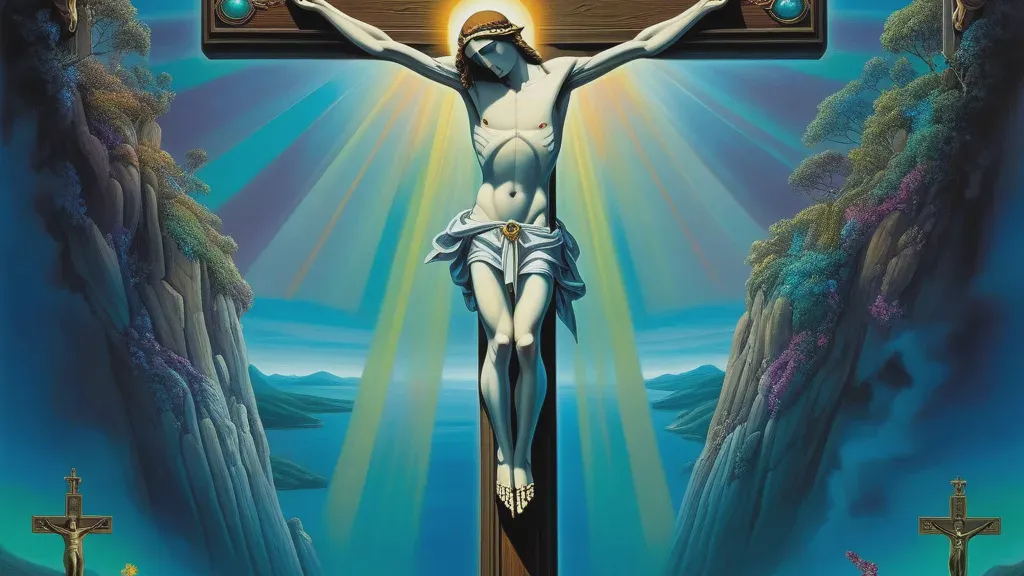
Crucifix
Jungian Archetypes
Meaning
A crucifix is not a bare cross: it carries a body. Where the plain cross turns suffering into geometry, the crucifix keeps the wound visible, which is why the dreaming mind reaches for it. The image gathers sacrifice, guilt, moral authority and the odd comfort of pain that has been given meaning. It surfaces when the dreamer is holding a burden that feels obligatory rather than chosen, when a debt of conscience is being tallied, or when a demand for self-denial handed down by family or faith is being re-examined. Whether the figure reads as accusation, protection or invitation depends on the dreamer's history with the object, and the dream is exact about that history even when waking thought is vague.
Psychological Interpretation
The first question a crucifix dream raises is where the dreamer stands in relation to the body on it. Kneeling before it makes the dreamer the petitioner, the one who owes; this is the posture of guilt looking for a ledger that can be balanced. Hanging on it, or watching someone loved hang on it, moves the dream into martyrdom: suffering made sacred so that it need not be questioned. Many people who dream of crucifixes carry exactly this kind of consecrated pain, a role of endurance in a family, a job or a marriage that everyone, the dreamer included, has agreed to call virtue. Holding the crucifix out as a ward shows the dreamer using inherited authority to keep something frightening at bay, and raises the question of what that thing is and why it needs a borrowed symbol. The crucifix is also an object of memory. It hung on a grandmother's wall, over a childhood bed, in a hospital corridor, at a funeral, and its appearance in a dream pulls those rooms into the present. The dream is then less about theology than about the people who stood beneath the object and what they required. A crucifix that glows, weeps, falls, breaks or loses its figure is the psyche editing that inheritance, and the direction of the edit, toward reverence or toward release, shows what the dreamer is doing with the moral weight they were handed.
Traditional Symbol Meaning
In Catholic and Orthodox devotion the crucifix is not a decoration but an instrument of attention. Ignatius of Loyola's Spiritual Exercises (1548) ask the person praying to place themselves before Christ on the cross and speak to him as one friend to another, and the Stations of the Cross walk the same suffering step by step. It was placed in the hands of the dying, hung over the marriage bed and the cradle, and carried in procession on Good Friday. In this tradition the object insists that pain can be looked at without looking away, and that looked-at pain becomes meaning. The tradition also has its own dream literature. The Old English poem The Dream of the Rood, preserved in the tenth-century Vercelli Book, is a vision in which the cross itself speaks to the sleeper, describing how it was cut from the forest, made to bear a young hero and drenched in his blood, then commanding the dreamer to tell what it has seen. Lactantius reports that Constantine was instructed in a dream before the battle of the Milvian Bridge in 312 to mark his soldiers' shields with a heavenly sign. Julian of Norwich, lying near death in 1373 while a priest held a crucifix before her face, saw the figure begin to bleed; the visions that followed became Revelations of Divine Love, in which the crucifix is a doorway that opens at the edge of sleep. Popular dream lore is less tender. Gustavus Hindman Miller's Ten Thousand Dreams Interpreted (1901), the best known of the popular dream books, treats the crucifix as an omen of distress that will touch other people as well as the dreamer. In Slavic and Balkan folklore the crucifix repels the undead, a belief Bram Stoker gathered into Dracula and horror cinema has repeated ever since, so that many modern dreamers meet the object first as a weapon and only later as a devotion. In Guatemala the dark wooden Cristo Negro of Esquipulas draws pilgrims who bring their illnesses to the crucified body, a practice that treats the crucifix as a place where one pain can be laid against another. Across these readings the crucifix carries one steady meaning: suffering that has been made public and given a purpose. The Reformation's removal of crucifixes from churches, from Zwingli's Zurich in 1524 to the Dutch Beeldenstorm of 1566, was a dispute about exactly this: whether the body should be shown or the cross left bare. A dreamer today inherits both sides of that argument, and the crucifix dream usually stages it again in private terms: whether one's own pain should be displayed and made holy, or taken down and allowed to heal.
Jungian / Archetypal
Jung read the crucifixion as the image of the ego suspended between irreconcilable opposites, and in Aion (1951) he treated the figure of Christ as a symbol of the Self, the totality the ego serves but does not own. A crucifix in a dream therefore tends to appear when the dreamer is nailed to a conflict that cannot be settled by choosing a side: duty against desire, the family's faith against one's own. The four arms of the cross form a quaternity, Jung's shape of wholeness, and the body fixed at its centre shows what wholeness costs. Individuation here is not escape from the cross but the willingness to hang there consciously until something in the dreamer changes. The Hero archetype supplies the crucifix's dignity and its danger. The hero's sacrifice is real, but the Shadow of the crucifix is martyrdom, a suffering that has become an identity and quietly punishes those it claims to serve. A dreamer who keeps being crucified in dreams may enjoy the moral altitude of the position more than they can admit. For a woman the crucified man often carries the Animus, the inner masculine formed by fathers, priests and teachers; a crucifix that judges, speaks or bleeds in her dream can be the Animus voicing collective opinions about what she owes, while the same figure wounded and silent can be an Animus nailed up before it ever got to act. For a man the figure invites identification, and the dream asks whether he suffers or drives the nails. Amplification widens the image. Odin hung nine nights on the world tree Yggdrasil, wounded by his own spear, an offering of himself to himself, and came down with the runes; Prometheus was fixed to the rock for giving humans fire. In both myths the suspended body is the price of a new consciousness, and the crucifix dream often announces that a price is due. Compensation explains why the object visits the wrong people: an atheist who dreams of a crucifix is shown what a purely rational attitude has excluded, while a devout dreamer whose crucifix falls, empties or burns is asked whether piety has become a way of not living. In Answer to Job (1952) Jung argued that God needs human consciousness to become whole, and the dream crucifix can be that demand in miniature: a request that the dreamer look at what has been sacrificed and decide whether it was ever necessary.
Gestalt / Parts of Self
Gestalt dreamwork refuses to let the crucifix stay on the wall. Every element of the dream is a piece of you that you have pushed out of awareness and given a separate form: the wood, the nails, the body, the person kneeling, the wall it hangs on. Fritz Perls described the inner split between a topdog who issues demands and an underdog who suffers and secretly sabotages, and the crucifix is nearly a portrait of that pair. The topdog says sacrifice is required; the underdog hangs there, admired and immobilised, unable to do anything with its hands. Ask which of these you were in the dream, and then notice that you were both. The method is to become the symbol and speak in the first person, present tense. Sit with the image and say: I am the crucifix. I am fixed to a wall. My arms are open and I cannot close them. People look at me and feel things and go away. Say it until a sentence lands in your body as true of your life now. Then take the other chair and speak as the one who hung the figure there, or as the nail, or as the wall that holds the whole arrangement up. The polarity between the one who is served and the one who serves, between the judge and the judged, will show itself in your own words, and the exercise is finished when you can feel that you are the whole scene rather than its victim. What Gestalt calls unfinished business is often literal here: a parent's religion that was never argued with, a role of endurance accepted before you had a choice, a resentment turned back on yourself because that was safer than turning it outward. Perls named that inward turn retroflection, and the crucifix is retroflection carved in wood. Contact with the image, staying with it instead of explaining it, is what lets the frozen posture move. The aim is neither to take the body down in defiance nor to leave it up in devotion, but to let the arms come down on their own, which happens when you can say aloud what you have been sacrificing and to whom.
Psychodynamic / Freudian
Freud approached the crucifix as an overdetermined object. In The Future of an Illusion (1927) he described religion as the wish for a protecting father made permanent, and in Totem and Taboo (1913) he read the son's sacrifice as atonement for an ancient crime against that father. The crucifix condenses these into one image: father, son, guilt and reconciliation held together in a single body. The manifest content, an object on a wall or in the hand, usually covers a latent content that is far more particular: a specific debt to a specific person, a wish to be forgiven for something the dreamer has never said aloud, or an anger at a parent that has been displaced onto the parent's religion because the religion cannot be hurt. Object relations reads the crucifix through the history of the dreamer's earliest bonds. In Melanie Klein's account the depressive position is reached when the child realises that the mother it attacked in fantasy is the same mother it loves, and guilt and the wish for reparation follow. The crucifix is a portrait of that realisation: a loved figure wounded, forgiving, and unable to be made whole. A crucifix that falls or breaks in a dream can carry the old terror that one's aggression destroys what one loves. Donald Winnicott would see the crucifix on a chain, a grandmother's gift kept in a drawer, as a transitional object that once held the dreamer between dependence and independence, and Wilfred Bion's idea of the container fits the object exactly: the crucifix gives an unbearable feeling a shape so that it can be held rather than evacuated. Defences shape the dream's variations. Reversal turns the humiliation of being hurt into the nobility of bearing pain; identification with the victim on the cross can hide identification with the ones who put him there. Freud wrote in Mourning and Melancholia (1917) that the shadow of the lost object falls upon the ego, and the punitive superego that results is often dreamed as a crucifix that judges from the wall. In therapy the object appears when repressed guilt approaches consciousness, and the transference gives it a face: the analyst becomes the one who will nail the patient up or take them down, and the crucifix dream is the patient asking which.
Contemporary Psychological
Cognitive science begins with the fact that, for anyone raised near one, the crucifix is among the most heavily encoded objects in memory, met early and repeatedly and almost always alongside strong emotion, and the continuity hypothesis associated with Calvin Hall and Michael Schredl predicts that such objects surface in dreams in proportion to their emotional weight in waking life. Emotionally charged memories are preferentially consolidated during sleep, replayed by the hippocampus to the cortex in fragments that the dreaming brain assembles into scenes. Ernest Hartmann argued that dreams organise around a central image that contextualises a dominant emotion, and the crucifix is an efficient central image for guilt, grief or endured pain. The body on the cross engages a specific system. Tania Singer's 2004 imaging study showed that watching a loved one receive pain activates the anterior insula and anterior cingulate, the regions that register one's own pain, and a crucifix dream likely recruits that empathy-for-pain network. Jonathan Shay's concept of moral injury, the lasting wound of having violated one's own code or been betrayed by a trusted authority, describes the waking state in which such dreams cluster. Rosalind Cartwright found that people who dreamed about the source of their distress after a loss adapted better, and Matthew Walker's group has described REM sleep as overnight therapy in which the emotional charge is stripped from a memory while its content is kept. On this account the crucifix dream is not a verdict but a session of processing. Predictive processing offers a final frame. The brain maintains models that anticipate experience, and dreaming, in the account proposed by Allan Hobson and Karl Friston, refines those models offline. A crucifix is a strongly learned template for suffering that carries meaning, and when the sleeping brain must bind a diffuse sense of guilt or endurance into a coherent scene, this template has a high prior probability. Antti Revonsuo's threat simulation theory holds that dreams rehearse danger; the social simulation theory he later developed with Tuominen and Valli adds that they rehearse bonds and witnessing, and a crucifix dream is often both, a rehearsal of being watched while in pain. Record the surrounding emotion: the object is the container the brain reached for, and the feeling is the content.
Cultural & Historical Origins
The crucifix took centuries to become thinkable. Crucifixion was a Roman punishment for slaves and rebels, and early Christianity avoided depicting it; the oldest surviving image of a crucified Christ is the Alexamenos graffito, a mocking scratch on a Roman wall from around 200 CE showing a donkey-headed figure on a cross. Only in the fifth century, on the carved doors of Santa Sabina in Rome and an ivory casket now in the British Museum, does the crucified body appear as devotion rather than insult. The Gero Cross in Cologne Cathedral, carved around 970, is the first monumental crucifix to show Christ dead and slumped, opening the medieval shift from the crowned, open-eyed Christus triumphans to the suffering Christus patiens. Matthias Grünewald's Isenheim Altarpiece, painted around 1515 for a hospital run by Antonine monks, pushed that realism to its limit: a green, pocked, tortured body made to be looked at by patients dying of ergotism. Francis of Assisi's conversion began before the San Damiano crucifix, which he said spoke to him. Catholic and Orthodox Christianity kept the body on the cross while much of Protestantism kept the cross bare, a difference that matters when a dreamer raised in one tradition dreams the other's object. Folklore gave the crucifix a second life as a ward: Bram Stoker's Dracula (1897) fixed the image of the crucifix thrust at the vampire, and the one over a child's bed carried the same protective charge from Poland to Mexico.
Contextual Variations
A crucifix that falls from the wall above your bed
The wall above the bed is where a crucifix hangs in a Catholic household to watch over sleep, so its fall touches the oldest layer of protection you were given. The dream usually arrives when an inherited guarantee has stopped holding: a parent's certainty, a rule that kept you safe by keeping you small, a faith that was more your family's than yours. Notice whether you felt exposed or relieved when it hit the floor. Exposure says you still need the guardian; relief says you have been ready to sleep unwatched and are only now admitting it.
A crucifix hanging upside down
Before it became horror-film shorthand, the inverted cross was the Cross of Saint Peter, who by tradition asked to be crucified head-down because he felt unworthy to die as his teacher had. Your dream may draw on either meaning. If the reversal felt blasphemous, ask which authority in your life you are secretly turning on its head, and whether the rebellion is against the belief or against the people who used it on you. If it felt humbling rather than sinister, the image points to a wish to serve without claiming the centre, a quieter devotion than the one you were taught.
The figure missing from the crucifix, leaving only the cross
An empty cross is a resurrection image in Christian art, but in a dream the absence is more often felt as a disappearance: the one who was supposed to carry the suffering has gone. This appears when the person who bore the moral weight of a family, a parent, an older sibling or a partner, has died, left or stepped back, and you sense that the role is now waiting for you. Look at where the figure went. If you took it down yourself, you are trying to release someone from pain. If it simply vanished, the dream is asking who will be crucified next, and whether anyone has to be.
Holding a crucifix out toward something in the dark
This is the gesture from Dracula, the crucifix thrust at the vampire, and your dream borrows it because something in you needs to be held back with an authority not your own. The frightening thing is usually a part of yourself: an appetite, a rage, a wish that your upbringing named as evil. The telling detail is whether the crucifix worked. If the darkness retreated, the old defences still function and the question is what they cost you. If it had no effect, the dream is saying that a borrowed symbol cannot manage this, and that you will have to meet the thing in the dark without it.
Frequently Asked Questions
Why did I dream of a crucifix when I'm not religious?
Is a crucifix dream a warning or a blessing?
What is the difference between dreaming of a cross and a crucifix?
Why did the crucifix in my dream burn or hurt me?
Journaling Prompts
- Think of the thing you endure that people praise you for enduring. Write down who benefits from your staying on that cross, what would actually happen in the household or the workplace if you climbed down for a week, and whether virtue is the honest word for what you are doing or only the polite one.
- Picture the crucifix from your dream and describe the wall it was on. Whose house was that? Write about the person who hung it there, what they required of you when you were small, and which of their requirements you are still meeting without ever having agreed to them.
- Write a short letter from the figure on the cross to you, in its own voice, without theology. Let it say what it is tired of, what it wants taken down, and what it would do with its hands if they were free. Then answer it in one paragraph, telling it what you are prepared to change.
- List three things you have done in the past year that you would call unforgivable if someone else had done them. Beside each, write the sentence you would need to hear from another person to consider the matter closed. Notice whether anyone alive could say it, or whether the only judge left is you.
Related Symbols
Dreamed about Crucifix?
Get a personalized AI interpretation that connects this symbol to your specific life circumstances.
Interpret My Dream