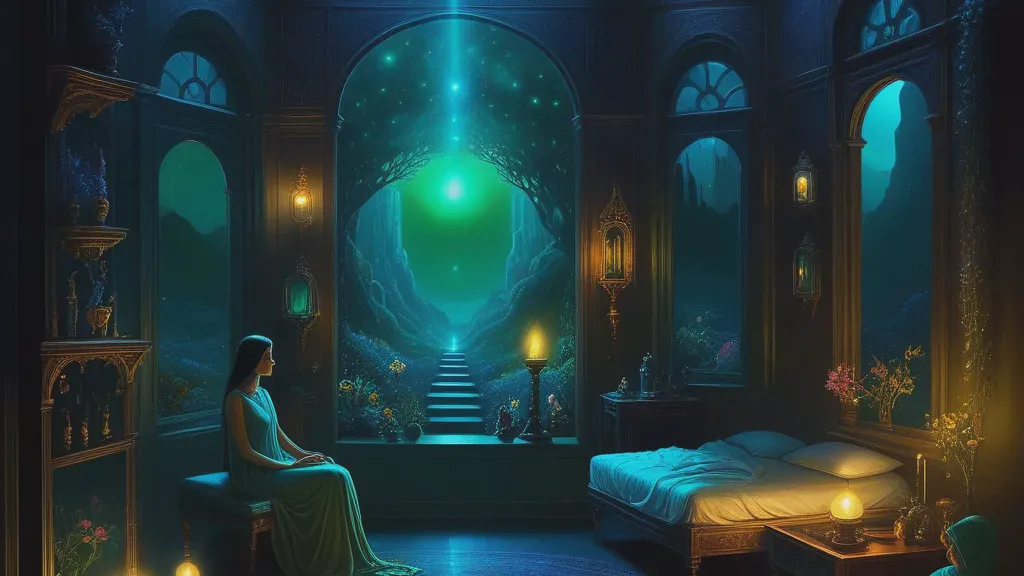
Dark Room
Jungian Archetypes
Meaning
Dreaming of a dark room symbolizes feelings of confinement or uncertainty, reflecting the subconscious mind's struggle with hidden fears and the desire for clarity in unresolved situations.
Psychological Interpretation
Jungian theory associates it with the Shadow and the need for introspection. Cognitive psychology frames it as a metaphor for repressed memories, while practical psychology suggests it represents a space for self-discovery and healing.
Cultural & Historical Origins
The dark room motif appears in Edgar Allan Poe's works, illustrating psychological horror, and in the Bible, where darkness often symbolizes ignorance, reflecting the quest for enlightenment.
Contextual Variations
You wake up inside a familiar apartment, but every light switch does nothing and the hallway keeps stretching into a pitch-black room. You feel your breathing get louder as you search for an exit that never appears.
This often reflects the psyche encountering a fear that feels “stuck” in ordinary life—something you know is there, but you can’t quite access or name. The endless hallway suggests avoidance loops: the mind keeps returning to the same uncertainty until you bring attention to what you’re not facing.
In the dark room, you find a chair with your name on it, and when you sit, a memory you haven’t thought about in years flashes briefly and then disappears. You wake with a tight chest and a sense of unfinished emotional business.
The room functions like a container for repressed material, and the chair “invites” your attention to a specific unresolved theme. The fast memory flash points to selective readiness—your system is trying to open, but it’s not yet safe enough for the full story.
You’re holding a phone flashlight that flickers; every time the beam steadies, you notice new objects in the room—old photos, a broken mirror, a locked door—then the light fails again.
Flickering light mirrors shifting emotional capacity: you can approach the fear briefly, but regulation breaks down under sustained contact. The locked door and changing objects suggest the fear is broad (identity, shame, grief, or uncertainty) rather than one single incident.
Frequently Asked Questions
Why do I keep dreaming of a dark room when nothing “bad” is happening in my life?
What does it mean if I can’t find the light switch or the exit?
Why do I feel calmer after I stop searching in the dream?
Journaling Prompts
- When you enter the dark room in the dream, what is the first specific thing you notice (sound, smell, object)—and what feeling does it carry?
- If the locked door in the dark room could speak, what would it demand you look at in your waking life?
- What do you do with your body in the dream (run, freeze, search, hide), and what does that pattern resemble in real-life stress?
Related Symbols
Dreamed about Dark Room?
Get a personalized AI interpretation that connects this symbol to your specific life circumstances.
Interpret My Dream