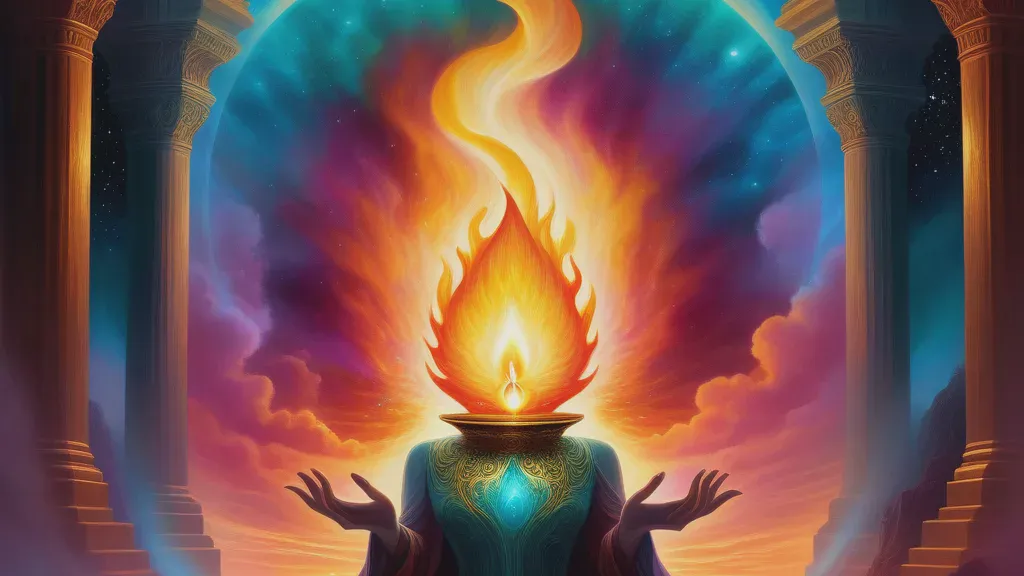
Corrupted Sacred Flame
Jungian Archetypes
Meaning
A sacred flame in a dream is the fire a person keeps at the centre of their meaning: a faith, a vocation, a marriage, a cause, a teacher, an idea of themselves as good. A corrupted sacred flame is that fire still burning but burning wrong, smoking, discoloured, cold, fed on the wrong fuel or tended by the wrong hands. The dream does not show loss of belief; an extinguished flame would do that. It shows belief that continues while its object has been spoiled, and the dreamer's growing suspicion that what they kneel before is no longer what it was, or never was. It tends to come during a disillusionment that has not yet been admitted.
Psychological Interpretation
The qualifier carries the psychology. Fire in dreams is energy, and sacred fire is energy consecrated to something beyond the dreamer's appetite. Corruption enters in one of three ways. When the flame itself changes, turning green or black, giving smoke without light, burning without heat, the dreamer's own devotion has been contaminated by resentment, ambition, fear or exhaustion that crept into a commitment once made cleanly. When the tending is wrong, someone feeding rubbish to the fire, a ritual performed for an audience, the dream is about a person or institution that holds the flame on the dreamer's behalf and has betrayed it. When the fire is relit improperly, the dreamer is questioning the origin of what they hold sacred. The dreamer's response matters as much as the image. Continuing to worship at the corrupted flame while noticing the soot is the position of a person who has seen through something and stayed. Trying to purify it and making it worse is the rescuer whose efforts feed the problem. Walking away with both grief and relief is someone whose disillusionment is nearly complete. In every case the dream is protecting the capacity for reverence itself. The flame is corrupted, not gone, and the psyche keeps showing it because the dreamer has not yet decided whether to clean it, carry it elsewhere, or let it die and light another.
Traditional Symbol Meaning
Traditions that keep a perpetual flame agree on what corrupts it. It is fouled by contact with the dead or the unclean, by impure fuel, by breath, by wrong intention, and above all by strange fire, a flame brought from outside the sanctioned source. Zoroastrian priests distinguish grades of fire, consecrated from many sources over months, and the lower can never be allowed to mix with the higher. The Vestals of Rome relit an extinguished hearth only by friction or by concentrating sunlight, never from a household fire. The Jerusalem Temple kept the altar burning without interruption. In each system a dream of the sacred fire smoking or turning colour would have been read as an omen of pollution in the community and a call to find the offender. The Christian centuries absorbed both halves of the image. Pentecost gave the pure sacred flame, tongues of fire on the disciples; hell gave the corrupted one, fire that burns without consuming and gives no light. Medieval preachers drew on both when they warned against false zeal, the burning that looks like devotion and is in fact pride, and the Church's own reformers, from the mendicant friars to Luther, accused the institution of tending a defiled fire. Popular dream lore of the eighteenth and nineteenth centuries treated a bright clean flame as good fortune and a smoky, guttering one as quarrels, sickness or a false friend, without any special category for the sacred; the sanctity, in the folk mind, was in the hearth itself. Eastern traditions put the corruption inside the worshipper. The Buddha's three fires burn in the senses, and liberation is described as their going out, so that a dream of an altar flame turned foul is a picture of one's own passion dressed as piety. Vedic practice attends to the purity of the sacrificial fire, kindled by friction from the aranis and fed with prescribed offerings, and a fire fed carelessly is said to consume the offering without carrying it upward. The alchemists, whose fire was a sacred one in all but name, warned endlessly about its regulation: too hot and the vessel cracks, too fast and the work is spoiled, and the impatient operator who forced the flame with bellows was mocked by the adepts as a mere puffer who would never see the material change. Together the traditions say the same thing in different registers: a sacred flame is corrupted by what is brought to it, and the remedy is rarely a new flame. It is a return to the source and a cleaning of the hands.
Jungian / Archetypal
Jung read fire as libido, psychic energy in its most concentrated form, and in Symbols of Transformation he traced the ritual kindling of fire by friction back to an image of the energy that creates. A sacred flame in a dream is that energy after it has been given a direction and a name: God, the work, the beloved, the cause. Its corruption is what happens when the Shadow enters the sanctuary. Jung insisted that the Shadow follows a person into their highest commitments rather than being left at the door, and that religiosity, idealism and devotion have shadows of their own: fanaticism, contempt, the wish to be seen kneeling. The smoke in the dream is the part of the dreamer's devotion that was always about something else. The image is also a warning against inflation. Jung described the danger of the ego identifying with the Self, of the person who tends the flame beginning to believe they are the flame, and he called the result the mana-personality: the guru, the prophet, the one who cannot be questioned. Corruption of the sacred fire in a dream may show the dreamer's own inflation, or it may show what happens when the dreamer has projected the Self onto a teacher, a church or a partner and that carrier has failed. Answer to Job is the text to amplify here, Jung's argument that even the image of God has a dark side which the worshipper must eventually confront, and that a faith which cannot survive that confrontation was never faith in anything but the light. Alchemy gives the process its shape. The nigredo, the blackening, is the stage in which the prima materia rots and darkens before anything of value can emerge, and Jung treated it as the psychological state of depression and disillusionment that precedes real change. A sacred flame that turns black, smokes and cools is the nigredo applied to the dreamer's beliefs. The compensatory function is precise: a person who has split the world into pure and impure, sacred and profane, dreams of the sacred being impure, because the psyche will not tolerate the split. Individuation asks the dreamer not to restore the flame to a purity it never had, but to keep tending a fire they now know can smoke.
Gestalt / Parts of Self
The Gestalt approach declines to treat the sacred flame as a symbol and asks you to be it. Speak as the fire in the present tense: I was lit to be pure and I am smoking. I am giving heat to no one. I am being fed things I was not meant to burn. Then be the corruption itself, the soot, the smoke, the cold: I am what has been added, I am what you could not admit. Most dreamers find the second voice harder, and that difficulty locates the disowned part. The corruption in the dream is not an outside contaminant. It is a piece of you that the sacred part of you has refused to include, and it is in the fire now because there was nowhere else to put it. Perls had a word for beliefs taken in whole without chewing: introjects. A sacred flame that has never been questioned is often an introject, a faith, a family creed or a professional ideal swallowed early and kept burning in the chest without ever being digested. The dream of its corruption can be the organism's attempt to spit it out, or at least to taste it. Set up the polarity: in one chair the keeper of the flame, who says it must be protected at any cost; in the other the person who noticed the soot and said nothing. Let them speak. The keeper usually turns out to be frightened, and the noticer usually turns out to be angry, and neither has been allowed to say so. Contact and withdrawal decide the ending. In the dream you either stayed at the altar, tried to fix the fire, or walked out, and each is a style of contact with what matters to you. Staying in front of a corrupted flame while pretending it is clean is deflection, a way of being present without meeting what is there. Frantically purifying it is confluence, losing yourself in the object. Walking away with grief and relief is a completed contact followed by a clean withdrawal, and it is the only one of the three that leaves you free to light another fire. Ask which you did, and then ask whether that is also what you do with people.
Psychodynamic / Freudian
The manifest image is a fire in a temple; the latent content is the fate of an idealised object. Heinz Kohut described the child's need to idealise a parent and to feel merged with that parent's calm and power, and he argued that adult meaning depends on how those idealisations were disappointed: gradually, allowing the ideal to be taken inside, or suddenly, leaving a hunger for perfect figures and a rage when they fail. A corrupted sacred flame is the dream of an idealisation failing, and the dreamer's reaction in the dream, contempt, despair, frantic repair, indicates which history is being repeated. The temple is often the family, the priest a parent, and the strange fire the discovery that they were ordinary. Klein added the mechanism by which the good is spoiled from within. Envy, in her account, attacks the very goodness it depends on, so that the infant spoils the breast in phantasy because it cannot bear to need it, and idealisation is the defence that keeps the good object impossibly pure so it will not be contaminated by hate. A sacred flame that turns black under the dreamer's own hands is an image of envy at work on something the dreamer loves, and the guilt on waking is the depressive position recognising the damage. Winnicott's false self supplies the other reading: a flame kept burning for approval, performed sacredness, is the compliance that protects a true self nobody has asked to see. Defence shapes the dream's surface. Displacement moves the corruption from the dreamer onto a priest or a stranger who feeds the fire wrongly; reversal turns the dreamer's own wish to defile something into the discovery that it was already defiled; condensation lets a single fire stand for a church, a marriage and a father at once. Bion argued that a lie requires a thinker to sustain it and that the mind can attack its own links to the truth; a sacred flame that gives smoke instead of light is knowledge being obscured by the dreamer's own need not to see. In the consulting room this dream often arrives when the patient has begun to notice the analyst's ordinariness and does not yet know whether the treatment can survive it.
Contemporary Psychological
Cognitive science has a name for the state this dream depicts: dissonance between a strongly held belief and evidence that contradicts it. Leon Festinger's study of a group whose prophecy failed, published as When Prophecy Fails in 1956, showed that believers often respond to disconfirmation by intensifying rather than abandoning commitment, and the dream of a flame that keeps burning while it smokes is a fair portrait of that intensification. In predictive-processing terms, the brain holds a strong prior, this is sacred, and receives prediction error, this is not behaving as sacred things should; sleep is one of the periods in which such errors are integrated, and the dream is the integration in progress, with neither prior nor error yet winning. The continuity hypothesis developed by G. William Domhoff predicts that this dream will cluster in people whose waking life contains a crisis of trust: leaving a religion, discovering an institution's wrongdoing, watching a mentor fail, or working inside an organisation whose stated values and actual conduct have diverged. The temple need not be literal. Research on moral injury, a term introduced by the psychiatrist Jonathan Shay for the wound of witnessing or committing a betrayal of what is right, describes exactly the mixture of grief, disgust and disorientation that dreamers report on waking from a corrupted flame, and disgust in particular is an emotion that dreams tend to render through images of contamination, soot and smell. Emotional regulation accounts for the dream's repetition and its resolution. Matthew Walker has described REM sleep as a period in which the brain reprocesses emotional memories with reduced noradrenaline, allowing their charge to fade while their content is retained; Rosalind Cartwright found that dreams which move a stressful theme toward some narrative outcome predict better mood on waking. A corrupted flame that simply smokes, night after night, is a memory whose charge is not fading, usually because the dreamer has not yet named the betrayal in daylight. A dream in which the flame reaches any outcome at all, restored, abandoned or replaced, is the same material finally moving, and dreamers who reach one typically report that the disillusionment became bearable soon after.
Cultural & Historical Origins
Zoroastrianism made fire the most sacred of substances and its corruption the clearest image of evil. In the Bundahishn, the Middle Persian account of creation, the assault of Ahriman on the good creation includes mixing smoke and darkness into fire, so that every flame since carries something of the adversary; priests in fire temples wear a cloth over the mouth so that breath will not defile the flame, and the Iranshah fire at Udvada in Gujarat has by tradition been kept burning since the eighth century. The Hebrew Bible supplies the sharpest story of a spoiled sacred fire: in Leviticus 10, Aaron's sons Nadab and Abihu offer strange fire before the Lord, fire he had not commanded, and are consumed by fire in return, while Leviticus 6 orders that the altar fire must never go out. Rome guarded the hearth of Vesta with virgin priestesses, and a Vestal who let the flame die was scourged; the fire was finally put out by Christian decree in the late fourth century. The Buddha's Fire Sermon turns the image inward, declaring that eye, ear and mind are all burning with the fires of greed, hatred and delusion. Prometheus steals sacred fire for humanity and is punished for it, and Dante's Inferno wraps the false counsellors, Ulysses among them, in tongues of flame that hide rather than illuminate. The modern Olympic flame, lit at Olympia by mirror, acquired its torch relay at the 1936 Berlin Games, a sacred fire pressed into the service of a regime.
Contextual Variations
An altar flame that turns black and smokes as you approach
The flame was fine until you came near, which is the detail the dream wants you to notice. Something you hold sacred appears to be spoiled by your own approach: your scrutiny, your need, your growing knowledge of how it actually works. This belongs to people who have moved close to the centre of an institution or a relationship they once admired from afar and found that proximity revealed the soot. The dream is not saying you caused the corruption, only that you can now see it, and it asks whether you will step back to where the flame looks clean again or stay close and deal with what you know.
A priest feeding rubbish into the temple fire
When someone else tends the flame and feeds it what it should never burn, the dream is about delegated sacredness: a leader, a parent or an institution that holds your meaning on your behalf and has been careless with it. Notice whether the priest knew you were watching. A priest who hides the rubbish points to deception you have half-detected; one who does it openly points to a betrayal everyone around you has agreed not to see. Your position in the dream, silent in the congregation or stepping forward to intervene, shows where you currently stand between loyalty and honesty.
The sacred flame inside your chest burning cold
Here the flame is your own and the corruption is thermal: it gives light but no warmth, or burns blue and chills you from inside. This is the burned-out believer's dream, the image of a vocation, a love or a faith you still perform with full outward correctness while the feeling has gone out of it. People who have spent years giving heat to others without being warmed themselves report it often. The dream is not asking you to abandon the flame. It is saying the fuel has run out and no amount of tending will produce warmth until something new is added, usually rest, honesty or being cared for.
Relighting an eternal flame with a cigarette lighter
The eternal flame has gone out and you relight it with whatever is in your pocket, which every tradition of sacred fire would call strange fire. The dream captures a private, improvised restoration: you have lost the original source of what you believed and are keeping the practice going from your own resources. Some dreamers wake ashamed, feeling they have faked something; others wake oddly relieved. Both reactions are useful. The dream asks whether sacredness came from the source or from the tending, and whether a fire you lit yourself, honestly, is less holy than one you inherited and let go out.
Frequently Asked Questions
Why did the sacred fire in my dream give off black smoke instead of light?
Does dreaming of a corrupted sacred flame mean I am losing my faith?
In my dream I was the one who polluted the sacred flame. Why?
Can a corrupted sacred flame in a dream be restored, and does that matter?
Journaling Prompts
- Name the sacred flame in your dream as precisely as you can: not fire in general, but the specific belief, person, vocation or institution it most resembles in your life. Then describe the corruption in the dream's own terms, smoke, colour, cold, wrong fuel, wrong hands, and write about when you first noticed the same thing in waking life and what you did with the noticing.
- List the rules you keep around the thing you hold most sacred: what may not be said about it, who may not be criticised, which questions you do not ask even in private. Beside each rule write who taught it to you and whether you have ever tested it. Then write about the last time keeping one of those rules cost you a truth you already knew, and what the smoke in your dream might have been made of.
- Sit for a moment with the possibility that part of you wanted the flame corrupted. Write, in the first person and without justifying yourself, what that part gets from the spoiling: relief from a standard, revenge on an ideal, permission to leave. Then write what the part that grieves the flame would say back.
- Imagine the dream continuing past the point where you woke. Do you clean the altar, carry the fire somewhere else, let it die, or keep kneeling in the smoke? Write the ending you would choose and then the ending you fear is true, and note what each would require of you in the coming month.
Related Symbols
Dreamed about Corrupted Sacred Flame?
Get a personalized AI interpretation that connects this symbol to your specific life circumstances.
Interpret My Dream