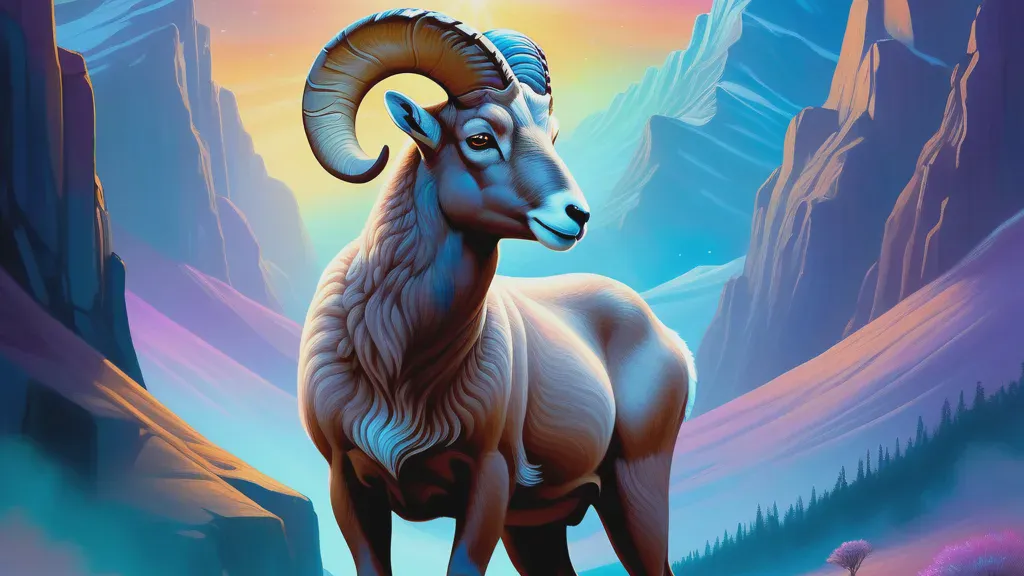
Bighorn Sheep
Jungian Archetypes
Meaning
The bighorn sheep is the animal of the impossible ledge: a heavy-bodied, thick-horned grazer that lives where nothing that size should be able to stand, on cliff faces and scree above the tree line, and that settles its rivalries by running headlong into another skull at full speed. In dreams it carries a specific pairing of qualities, sure footing on terrain that would kill the careless and a willingness to take the collision head-on. A bighorn dream tends to appear when the dreamer is climbing something steep, a career, a recovery, a grief, and needs to know whether they have the feet for it, and when a confrontation is coming that cannot be sidestepped, only met.
Psychological Interpretation
Wild sheep are not the sheep of the fold. The domestic flock in dreams means conformity and being led; the bighorn is an animal that has never been herded and chooses ground precisely because nothing can follow it there. It shows the dreamer a self-reliance that is more physical than intellectual, a knowledge held in the feet rather than the head. How the animal moves is the first thing to read. A ram standing still on a ledge above the dreamer is a guide or a judge, calm at a height the dreamer has not reached; a herd flowing up a rock face shows the instinct for a route where the mind sees only wall; a bighorn on flat ground, a road, a town, is a mountain creature out of its element and mirrors the dreamer's own displacement. The horns carry the second theme. A ram's curled horns can weigh as much as all the bones in its body, and rams settle rank by colliding skull to skull, a crack that carries across valleys. Dreams of rams clashing stage a conflict in which two stubborn forces, inside the dreamer or between the dreamer and someone else, will meet head-on and neither will yield first. The bighorn does not flee such meetings; it braces, meets and, after the crash, walks away. Precarious footing held with composure and confrontation met without malice: that is the symbol's signature.
Traditional Symbol Meaning
For the peoples who lived among them, bighorn sheep were food, tools and power at once. The Tukudika made bows of their horns and clothing of their hides, and hunters across the Great Basin and the Colorado Plateau prepared for the sheep hunt with observances that treated the animal as a person to be persuaded rather than a quarry to be taken. The rock art of the Coso Range, if David Whitley's reading is right, records visions in which the bighorn was the rain shaman's helper, so that the animal of the driest, highest places was also the bringer of water; dream tradition among those peoples, so far as it can be recovered, placed a bighorn seen in vision on the side of power and weather rather than danger. The bighorn also carries the general inheritance of the ram, which is among the oldest of horned symbols. Aries opens the zodiac with the ram's head-first initiative; Khnum, the ram-headed god of Egypt, shaped people on a potter's wheel; the Golden Fleece hung from a winged ram; and the ram caught in the thicket took Isaac's place on the altar, so that a ram's horn, the shofar, still sounds at the Jewish new year. In folk dream reading a ram is a strong opponent or a stubborn man, and a ram's horn is a summons. A bighorn in a dream inherits this: the horn as the instrument of both battle and awakening, and the animal as the one that takes the blow meant for someone else. The settler tradition made the bighorn the summit of difficulty. Hunters ranked it the hardest trophy in North America; by the early twentieth century the animal had been shot and crowded out of most of its range, with Seton guessing at a population once in the millions that had shrunk in his lifetime to a small remnant, and it survives now largely by reintroduction to cliffs it once owned. That history gives the dream bighorn a second layer: it is the survivor, the creature that came back to the ledge, and dreams of a lone ram on a peak sometimes carry exactly that quality of something nearly lost and holding on. The old dream dictionaries knew only the domestic ram. Gustavus Hindman Miller's dictionary of 1901 reads a ram that pursues the dreamer as misfortune threatening and one that grazes quietly as a sign of powerful friends, and modern spirit-animal lore assigns the bighorn confidence and new beginnings. Neither is wrong so much as thin. The tradition that matters most for the dreamer is the older one: a bighorn seen is a bighorn that chose to be seen, on ground it commands, and the question the traditions all ask is what it wants of the person below.
Gestalt / Parts of Self
In Gestalt dreamwork the bighorn is not something you saw; it is you, and so is the ledge it stood on, the cliff you could not climb, the horn and the crack of the collision. Begin by becoming the animal and speaking in the present tense: I stand on a ledge two inches wide above a drop that would kill you, and I am not afraid, because my feet know what your head does not. I carry thirty pounds of horn and I have never been herded. Say it aloud and notice what happens in your body, where the certainty lands and where it will not go. The part of you that knows its footing, and the part of you that is the cliff, are both in the room. The two rams colliding are the clearest picture Gestalt has of the top dog and the underdog, Perls's names for the two voices that argue inside almost everyone: the one that demands, should, must, and the one that stalls, cannot, will not. In your dream they have horns and are settling the matter at twenty miles an hour. Give each ram a chair and let them speak in turn until you hear which one you usually are and which one you disown. Watch for retroflection, the ram that butts its own head against the rock, which is what happens when the charge meant for someone else is turned back on yourself as tension, headache or self-attack. Contact is the point of the collision. The bighorn's clash is complete contact, full weight met with full weight and then withdrawal, walking away without grudge, and many dreamers are shown it precisely because they avoid it, softening every confrontation into something that neither meets nor ends. The experiment is to finish what the dream left open. If you hesitated in the narrow pass, take the step in imagination and say what you see from the other side. If the sheep climbed a wall you could not, be the wall and say why you are keeping this person down here. If a lamb was stranded below the herd, be the lamb and ask for what it needs, then be the herd and answer.
Psychodynamic / Freudian
The manifest bighorn, all horn and haunch on a cliff, condenses a set of latent themes that psychoanalysis would recognise at once. The great curled horns are phallic and paternal, and the collision of rams is a picture of the rivalry between a young male and an old one for rank and mates, which is to say of the Oedipal contest in its zoological form. A dreamer who watches two rams fight is often watching the self and the father, or the self and whoever has inherited the father's place at work or in a marriage, and the cliff edge beneath them carries the fear that the contest could end in someone's fall. The ram that turns after the crash and looks calmly at the dreamer is the father who survives the challenge without retaliating, which is the outcome the wish both wants and dreads. Object relations reads the mountain and the herd as an early family. Bowlby's secure base is drawn literally: the lamb climbs because the ewe is below, and a dreamer who can follow the bighorn up the rock face is one who carried a reliable enough attachment to explore from it. A lamb stranded on the scree while the herd moves on is the opposite figure, the child whose base was not there when the ground got steep. Winnicott's going-on-being, the unbroken continuity of an infant who is well held, is pictured in the ram at rest on a ledge, entirely at ease in a place of danger. Klein would see in the head-butting the infant's aggression turned into a structure, rank and order instead of destruction, which is what a good enough early environment allows aggression to become. Defence arranges the scene. Displacement moves a workplace rivalry or a marital standoff onto two animals on a mountain where it can be looked at; idealisation makes the lone ram on the summit into the perfect father or the perfect self, unreachable and unmoved; reversal has the dreamer chasing the sheep when it is the dreamer's own drive that is being fled. In treatment the bighorn on the ledge is a common transference image, the analyst seen as calm, high up, watching and not coming down, and a dream in which the sheep stops and waits for the hesitating dreamer at a narrow pass is frequently a comment on whether the analyst will wait or will go on without them.
Contemporary Psychological
Most people who dream of a bighorn sheep have never stood near one. The image reaches the dreaming brain through documentaries, park visits and sports emblems, and the continuity hypothesis predicts that dreamers living in the Rockies or the desert Southwest will meet the animal in sleep more often than dreamers elsewhere. Animals in general are picked out by the visual system faster than most other things in a scene, and a large one with weapons on its head is retained with particular ease, so a ram lodges in memory as readily as a bull. When the dream generator needs an animal to stand for composure under threat, or for a collision that is coming, the bighorn is a well-fitted candidate assembled from a handful of memorable images. Antti Revonsuo's threat simulation theory accounts for the two commonest bighorn scenes. A ram charging is a rehearsal of impact; a cliff face is a rehearsal of falling, among the most frequent dream contents in every survey, and the vestibular system is active during REM sleep in ways that plausibly feed dreams of balance, height and lost footing. Dreams of climbing behind the sheep may also reflect procedural memory at work: Robert Stickgold's studies of newly learned tasks reappearing in sleep suggest that the brain rehearses motor skills overnight, and people in the middle of learning to climb, hike or recover from an injury report an unusual number of such dreams. In predictive terms the bighorn on impossible ground is the brain testing its model of the body against terrain it would never risk awake. Emotional regulation research explains the tone. Rosalind Cartwright's work on dreaming and mood and Matthew Walker's account of REM sleep as overnight therapy both suggest that an image of composure appearing during a stressful period is part of the processing, the brain supplying a model of steadiness while it discharges the charge attached to a coming confrontation. Research on awe, associated with Dacher Keltner, finds that encounters with vast or powerful natural things reduce self-focus and increase the sense of being part of something larger, and the bighorn on its ledge is awe in a single animal. Noting what was being climbed, and what was about to collide, in the week before the dream will usually locate its source.
Jungian / Archetypal
Jung observed that the Self, the centre and totality of the psyche, often first shows itself in dreams as an animal of unusual dignity, and the bighorn ram standing motionless on a ledge above the dreamer is a classic form of this. It is at a height the ego has not reached, it is unhurried, and it is looking at the dreamer, which is the mark of a figure that carries consciousness of its own. The curled horn supplies an image of the process in miniature: a spiral that grows outward around a fixed centre, adding a ring each year so that the animal wears its whole history on its head. Individuation has that shape, a circling that is not repetition because each turn is wider, and the dream ram carries it as a living emblem. The Hero and the Child appear as the two ends of the climb. The Hero is the dreamer scrambling after the sheep, testing each hold, failing at the sheer wall; the mountain is where the Self is revealed in every tradition, Sinai, the Transfiguration, the peak the shaman climbs, and the bighorn is the guide who knows the route. The Child is the lamb on the scree, the new and precarious self that must learn its feet before it can follow the herd. Amplification brings in the ram of Abraham, the substitute sacrifice, and a dream in which a bighorn takes a fall or a blow meant for the dreamer belongs to that image: something instinctual paying so that the ego can go on. The clash of rams is where the shadow enters. The charging ram is the dreamer's disowned aggression, or the opponent onto whom that aggression has been projected, and the two animals colliding in the dream are frequently two positions inside one person, both stubborn, both unwilling to give ground. Compensation is at work in who receives the dream. The over-cautious dreamer is given an animal that leaps; the reckless one is given an animal that tests every hold before committing its weight. In either case the bighorn is the unconscious offering a model of instinct that is neither timid nor wild, and the individuating task is to climb after it rather than watch it from the valley floor.
Cultural & Historical Origins
The bighorn belongs to the mountain West of North America, and its oldest record is cut into rock. The Coso Range of eastern California holds the densest concentration of bighorn petroglyphs on the continent, thousands of them, some beside horned human figures. Robert Heizer and Martin Baumhoff read these in the 1960s as hunting magic; the archaeologist David Whitley later argued that among the Numic-speaking peoples of the Great Basin the bighorn was the spirit helper of the rain shaman, so that to kill a sheep in vision was to make rain, and the debate continues. The Fremont people of Utah carved bighorn processions into Nine Mile Canyon, and the Tukudika, the Sheepeater band of the Mountain Shoshone in what is now Yellowstone, lived on the animal and made from its horns, steamed and recurved, some of the most powerful bows on the continent. Among the Hopi a mountain-sheep katsina, Pangwu, is associated in some accounts with rain and with curing, and Northwest Coast carvers turned mountain-sheep horn into ceremonial ladles. Ernest Thompson Seton's story Krag, the Kootenay Ram, published in 1901, gave the animal its first literary life as a tragic monarch of the peaks. Behind the North American record stands the older ram symbolism of the Old World: Amun's curled horns in Egypt, the ram caught in the thicket that spared Isaac, the shofar sounded from a ram's horn at the new year. The bighorn inherits all of that, but its own myth is Western, high and dry.
Contextual Variations
A ram standing motionless on a ledge above you, watching
The watching ram tests your own stillness. Rams on a ledge do not fidget, and a dream that puts one above you and holds the scene asks whether you can hold it too: look back, look away, or start to climb. Ask who in your waking life watches you from a height without coming down, a mentor, an elder who has died, an older self you are trying to become. Then ask whether the gaze felt like judgment or like company, since the same image serves both. The ram will not fetch you and will not leave. Its message is that the ledge can be stood on; its question is what you do while it watches.
Two bighorn rams crashing horns at the edge of a cliff
Rams settle rank by meeting head-on, and a dream that stages that collision announces a confrontation that cannot be finessed. Rams rear and pause before they run, and the dream often lingers on that pause; that is where you are now, with a rival, a parent, a partner, or a decision that will not be finessed. The cliff edge is the dream's warning that the stakes are real. Notice who stood after the crash and whether the loser fell or walked away, as bighorns usually do. The dream is not telling you to avoid the clash; it is asking you to meet it squarely, without malice, and to walk off afterwards.
A bighorn climbing a sheer wall that you cannot follow
This is a dream about a route you cannot yet see. The animal goes straight up a face that looks blank to you, finding holds your eyes and nerve do not, and you are left at the bottom knowing it can be done. It appears when you face something your reasoning calls impossible but your instinct has already begun to solve: a career move, a recovery, a leaving. Do not read the failure to follow as inadequacy. The sheep is showing you the wall is climbable; the dream's second question is whether you will study the holds it used or turn back to easier ground.
A bighorn lamb stranded alone on the scree below the herd
The stranded lamb is the young, precarious part of you, a new skill or role, that has not yet learned its feet, while the herd of your established competences moves on above. Your first feeling is the guide: pity means you know which part of yourself has been left behind; irritation means you are the herd and want it to keep up. Either way the dream asks for a rescue that is patient rather than heroic. Lambs on the scree are not carried up; they are waited for. Ask what in you needs time on the loose stones before it is expected on the ledge.
Frequently Asked Questions
Why did I dream about a bighorn sheep when I have never seen one?
Is a ram charging at me in a dream a warning?
Does a bighorn sheep in a dream mean I am being stubborn?
Is the bighorn sheep my spirit animal if I dream about it?
Journaling Prompts
- Name the steepest thing in your life right now, the climb you are partway up. Write about where your feet are on it today: which holds feel solid, which you are not sure will take your weight, and whether you are looking up at the route or down at the drop. Then describe the next single hold, not the summit.
- Bighorn rams meet head-on and then walk away. Write about a confrontation you can feel coming, with a person or with a decision, and describe how you would meet it if you could do so without malice and without flinching. What would you say, what would you brace against, and what would walking away afterwards look like?
- If a lamb was in your dream, or if you can imagine one, write about the youngest, least steady part of yourself at the moment, a new skill, a new role, a recent vulnerability. Describe what it needs in order to learn its feet, and whether you have been carrying it, waiting for it, or leaving it behind on the loose stones.
- A ram's horns can be counted like a tree, one ring for each year survived. Write your own rings: the seasons that added weight and width to who you are. Which of them are you proud to carry on your head, which have made you heavy, and which have taught your feet where to stand? Finish with what the next ring should contain.
Related Symbols
Dreamed about Bighorn Sheep?
Get a personalized AI interpretation that connects this symbol to your specific life circumstances.
Interpret My Dream