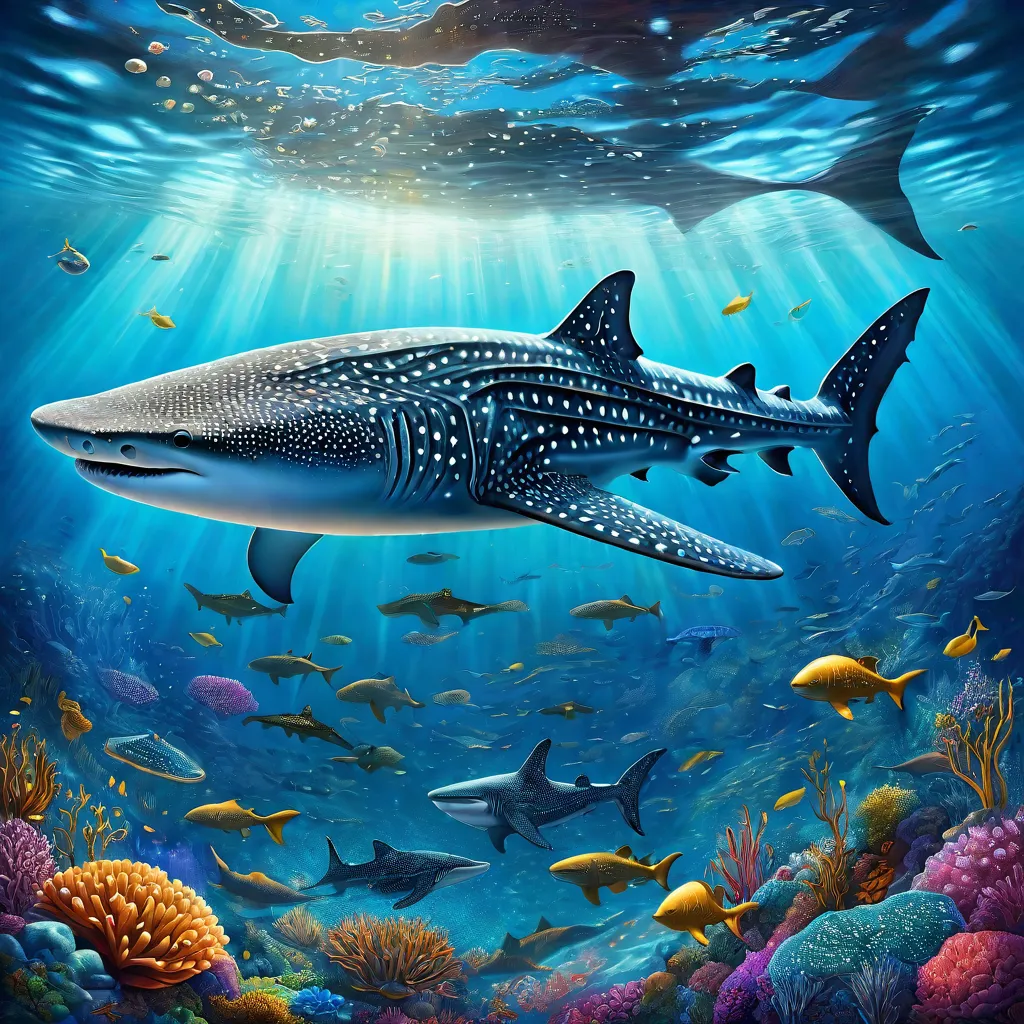
Whale Shark
Jungian Archetypes
Meaning
Meeting a whale shark in a dream stages a specific recalibration: something enormous approaches, and the expected danger never arrives. As the largest fish in the ocean, built like a predator but feeding by filtering plankton through an open mouth wider than a doorway, the whale shark embodies scale without menace, big enough to trigger every instinctive alarm the dreamer owns while doing nothing to justify it. The dream tends to surface when the dreamer faces something overwhelming from a distance, a feeling, a decision, a stretch of the unknown, and asks whether its size has been mistaken for a threat. Swimming close rather than fleeing marks a willingness to let something vast be examined instead of avoided on principle.
Psychological Interpretation
What the dreamer does in proximity to the whale shark matters more than the animal's mere appearance. Swimming alongside it calmly suggests the dreamer has found, at least temporarily, a way to hold something large and emotionally loaded without being destabilized by it, a rare and worth-noting capacity. Watching it rise slowly from far below into clearer view often names a shift from avoidance to active curiosity about buried material, the pace of the ascent mattering as much as the eventual encounter. A whale shark that follows without attacking, staying close while the dreamer tries to swim away, tends to mark a feeling or a fact that refuses to be outrun, not because it is hostile but because it has already been noticed and cannot be unnoticed. Because the animal is classified as a shark yet acts nothing like one, dreams featuring it often carry a specific corrective charge: something the dreamer has been treating as dangerous by category may need to be reassessed by behavior instead.
Traditional Symbol Meaning
Coastal communities that lived alongside whale sharks long before marine biology gave the species its name tended to treat its size as a sign of guardianship rather than danger. Vietnamese fishing villages that revere Ca Ong describe great fish, whale sharks among them, as protectors who nudge drowning sailors toward shore, a belief serious enough that a beached animal traditionally received burial rites usually reserved for people. This reverence reads scale itself as evidence of benevolence: a creature large enough to reshape the sea around it is assumed to use that power on behalf of the vulnerable, not against them. The animal's more recent scientific history complicates any single reading. For most of the twentieth century whale sharks were hunted commercially, their meat sold in Taiwanese markets under a name, tofu shark, that stripped the animal of any mythic weight and reduced it to texture and yield. Only after population studies revealed how slowly the species reproduces and how vulnerable it is to overfishing did protective status arrive, in Taiwan in 2007 and in a growing list of other nations soon after. The whale shark's meaning shifted within living memory from resource to icon, a change driven by data rather than legend. That shift produced a third, distinctly modern layer: the whale shark as centerpiece of ecotourism, most visibly in Donsol in the Philippines, where a town that once had little economic use for the animal now depends on visitors coming specifically to swim beside it. The whale shark's traditional meaning, then, is not fixed but staged in phases, feared or revered guardian, exploited resource, protected marvel, each phase readable in a dream as a different stance toward whatever in the dreamer's life currently feels too large to categorize simply.
Jungian / Archetypal
The whale shark's enormous, ancient-seeming presence aligns it readily with the Wise Old Man archetype, though here the wisdom is embodied rather than spoken: a silent, patient intelligence that has survived by moving slowly and taking in what the ocean offers rather than by force. When this figure appears in a dream, it frequently signals contact with a layer of the unconscious older and calmer than the dreamer's everyday concerns, a perspective from which the current crisis looks smaller than it feels up close. The animal's association with Anima is strengthened by its filter-feeding nature: rather than seizing or attacking, it takes in enormous volumes of the sea and processes them continuously, a fitting image for the anima's function of absorbing emotional and intuitive material the conscious mind cannot yet organize. A dreamer who watches the whale shark feed, rather than fearing its open mouth, may be witnessing their own capacity to metabolize a large volume of feeling without being harmed by the encounter. The Hero thread in this symbol is unconventional: no battle occurs, no monster is slain. Instead the heroism lies in proximity itself, in the dreamer's willingness to swim beside something vast rather than flee it. Individuation sometimes advances less through confrontation than through this kind of sustained, curious nearness to what initially looks unmanageable, and the whale shark gives that quieter form of courage a body large enough to take seriously.
Gestalt / Parts of Self
In Gestalt dreamwork you are not only the swimmer in this dream but the whale shark as well, and the encounter is really two parts of yourself meeting at very different scales. Speak as the whale shark for a moment: what are you carrying that feels too large to explain quickly, and what happens when someone finally swims close enough to see that your size was never the danger they assumed? The fear or awe you feel toward the creature is worth tracing back to your own capacity for bigness, an emotion, an ambition, a grief, that you have learned to treat as inherently threatening simply because of its scale. Ask what would change if you stopped requiring something to be small before you let yourself get close to it. The whale shark that follows without attacking is often you refusing to let yourself be avoided any longer. Practice the reverse dialogue too: let the swimmer speak honestly about what kept them at a distance before curiosity won out. Most people carry both positions, the part that wants to investigate the enormous thing and the part still bracing for teeth that were never there. Integration here means letting both voices finish talking before deciding how close you actually want to be.
Psychodynamic / Freudian
Wilfred Bion's concept of container and contained describes how an infant's overwhelming, undigested feelings are taken in by a caregiver, processed, and returned in a form the infant can bear; the whale shark's sheer capacity, a body built to take in enormous volumes of the sea without being destabilized by them, offers an unusually apt image for this function. A dream in which the animal calmly absorbs what looks dangerous or excessive may reflect the dreamer's search for, or memory of, being held by something large enough to metabolize an emotion they could not process alone. When the whale shark instead pursues the dreamer, the dynamic shifts toward something closer to an unmet need pressing for acknowledgment rather than a soothing presence. The animal's refusal to be outswum can represent a feeling, often one rooted in early experience, that was never adequately contained the first time and continues to surface until someone finally lets it get close enough to be examined rather than fled. The mismatch between the whale shark's frightening classification and its actual gentleness also lends itself to a reading about early object relations distorted by anticipation: a person or situation expected to be harmful, based on an old template, that turns out on contact to behave nothing like the feared original. Dreams built around this specific mismatch are often doing corrective work, updating an outdated internal expectation with more current evidence.
Contemporary Psychological
Psychologist Dacher Keltner's research on awe defines the emotion through two components, perceived vastness and the need to accommodate that vastness by revising one's existing mental models, and few images match that definition as literally as a whale shark filling the visual field of a dreamer's sleeping mind. Awe of this kind tends to arise in waking life around genuine encounters with scale, a career shift, a diagnosis, a birth, a loss, anything that will not fit inside the frameworks the dreamer used the week before. Sleep researchers studying emotional processing note that dreams involving large, non-threatening animals often coincide with periods when the dreamer is adjusting to something that initially registered as overwhelming but has begun to feel manageable. The dream's calm tone, if present, is itself informative: it suggests the accommodation Keltner describes is already underway rather than still resisted. The specific detail of the 1996 discovery that a single whale shark could carry roughly three hundred embryos gives the species an association with concentrated, almost incomprehensible abundance, a detail dreamers processing a period of unexpected growth, in a project, a family, a body of work, sometimes report finding oddly resonant once they learn it, as though the dream had reached for a creature whose biology already matched the scale of what they were carrying.
Cultural & Historical Origins
In parts of coastal Vietnam, great fish including whale sharks have historically been venerated under the title Ca Ong, Sir Fish, tied to a belief that they guide or rescue drowning fishermen, a reverence that some communities formalized with funeral rites and shrines when a stranded animal died on shore. Taiwanese fisheries once caught and sold whale shark meat under the market name tofu shark, for its pale, soft flesh, a trade ended by a 2007 fishing ban after population declines made the species a conservation priority. The one confirmed pregnant whale shark ever examined by scientists, caught off Taiwan in 1996, carried close to three hundred embryos at once, a discovery that reshaped biologists' understanding of the species' reproduction and its outsized capacity for renewal. In the Philippines, the town of Donsol rebuilt its economy around butanding watching, turning what fishermen once avoided or hunted into the centerpiece of a protected ecotourism industry, a shift from fear to stewardship condensed into a single generation.
Contextual Variations
Swimming calmly beside a whale shark in clear water
Calm proximity to the animal usually indicates the dreamer has found a workable way to stay close to something emotionally large without being overwhelmed by it. The clear water matters: visibility suggests the dreamer already has enough information about whatever the whale shark represents to trust the encounter rather than fear it.
A whale shark rising slowly from dark water below you
A slow ascent from depth into visibility reflects a shift from avoidance toward willingness, buried material approaching at a pace the dreamer can track rather than surfacing all at once. The dream is marking readiness building gradually rather than arriving as a single dramatic revelation.
A whale shark that follows no matter how fast you swim away
Persistent, non-aggressive following usually names an emotional truth that has been noticed and cannot be unnoticed, regardless of how much distance the dreamer tries to put between themselves and it. The absence of attack is the key detail: this is demand for attention, not danger.
Watching a whale shark feed with its mouth wide open
Witnessing the animal's enormous, toothless feeding often reassures the dreamer that something they feared would consume or overwhelm them is actually built to process large volumes gently. The image frequently appears when the dreamer is learning to metabolize a big feeling rather than being swallowed by it.
Frequently Asked Questions
Why does a whale shark feel more calming than frightening in some dreams?
Why does a whale shark keep following me in my dream?
Why do I dream about being small next to something enormous like a whale shark?
Is dreaming of a whale shark connected to depression or emotional numbness?
Journaling Prompts
- Think of something in your life right now that feels enormous from a distance. If you let yourself get closer to it, the way you approached the whale shark, what might you learn that fear has kept you from noticing?
- Recall the feeling you had in the dream, calm, awe, unease, and name one place in your waking life where you have felt that exact combination recently.
- If something in you has been quietly following you the way the whale shark did, refusing to be outrun, what do you think it actually wants you to acknowledge?
- Picture the whale shark's open mouth taking in the whole sea without being harmed by it. What would it look like for you to take in a big, difficult feeling the same way, gradually and without panic?
Related Symbols
Dreamed about Whale Shark?
Get a personalized AI interpretation that connects this symbol to your specific life circumstances.
Interpret My Dream