Star
Jungian Archetypes
Meaning
A star in a dream marks a fixed point of orientation, something distant, reliable, and only visible against real darkness, which is precisely why the symbol tends to surface during periods when the dreamer is searching for direction rather than already standing in it. Unlike the sun, a star offers no warmth and asks for no immediate approach; it exists to be steered by rather than reached. A star that is bright and steady in a dream usually signals confidence in a long-held goal or value, while a falling or fading star more often marks the loss of a direction the dreamer had been quietly relying on.
Psychological Interpretation
Stars function in dreams as instruments of orientation rather than sources of energy, and this distinction from the sun matters: a dreamer navigating by starlight is usually managing a long, uncertain journey rather than responding to an immediate demand. A single bright star the dreamer keeps returning to in a dream often marks a value, relationship, or ambition being used, consciously or not, as a fixed reference point when everything else feels unstable. A sky full of stars can mark abundance of possibility, sometimes disorienting rather than reassuring, since too many fixed points can make it as hard to choose direction as too few. A falling or shooting star carries urgency precisely because it breaks the pattern that makes stars useful in the first place, their stillness, so its appearance often marks a moment when a formerly stable source of guidance has become unexpectedly in motion, for better or worse. Darkness surrounding the star matters as much as the star itself; stars are only visible at all against a sufficiently dark sky, so their appearance can mark the dreamer's growing tolerance for uncertainty rather than its resolution.
Traditional Symbol Meaning
Before any written navigation system existed, human beings were already using stars to answer the single most practical question a traveler can ask: which way is true. Pacific Islander wayfinding preserved this knowledge in extraordinary detail; navigators like Mau Piailug held an entire star compass in memory, tracking dozens of rising and setting stars to hold a course across open ocean with no instruments and no land in sight. A star, in this tradition, was never decorative. It was the only reliable fact available in an otherwise featureless environment. The same logic reappears, centuries later and in a very different context, in the Underground Railroad. Enslaved people fleeing toward freedom used the song Follow the Drinking Gourd to encode a literal set of directions, its gourd referring to the Big Dipper, whose position points reliably to Polaris. For people who could carry no map, the star itself became the map, fixed, visible, and impossible for anyone to confiscate. Religious tradition adds a further layer in which a star does not merely orient a traveler but actively signals meaning. The Gospel of Matthew's star of Bethlehem leads the Magi not just in a direction but toward a specific significance, treating the star's movement as confirmation rather than simple guidance. Babylonian astronomers, whose careful star catalogs became the foundation of the zodiac later inherited by Greek and then Western astrology, extended this same instinct into a full system, treating the fixed stars as a text that could be read for meaning about a person's character and fate, not only a traveler's direction.
Psychodynamic / Freudian
A dream star, distant, idealized, and unreachable by definition, often carries the emotional signature of an idealized object, a person, ambition, or version of the self held at a safe remove precisely because closeness would risk disappointment or loss of the fantasy. This kind of idealization at a distance is a familiar defense: admiring something from far away costs nothing and reveals nothing, which is exactly why a star, rather than a person standing in the same room, is often the psyche's chosen vessel for it. The star's fixed position allows it to function almost as a stable internal object in Winnicott's sense, something relied upon precisely because it does not change or demand anything in return, unlike the more volatile relationships or ambitions it may be quietly standing in for. A parent or early figure who was physically or emotionally distant, present but never quite reachable, can leave behind exactly this template: someone learned to find comfort in a steady, admired presence that asked nothing of them and gave nothing tangible back either. A falling star disturbs this arrangement by making the idealized object suddenly move, and the anxiety this can provoke on waking often has less to do with the star itself than with what it represents: an idealization the dreamer has been protecting from ordinary disappointment, now behaving unpredictably. The dream's real subject in these cases is rarely the star at all, but the dreamer's tolerance for watching something long held as perfect turn out to be subject to change like everything else.
Contemporary Psychological
Human beings are unusually good at pattern recognition in sparse visual fields, a tendency called pareidolia, and a night sky full of stars is one of the richest natural fields for this kind of pattern-making, which may partly explain why dreaming minds so readily organize scattered points of light into meaningful shapes and messages rather than random noise. Predictive processing accounts of dreaming suggest the brain is constantly generating a best guess about what should be there based on prior expectation, and a star dream, built almost entirely from expectation rather than sensory detail since stars provide so little visual information, may be an unusually pure example of the dreaming brain filling in meaning from memory and belief rather than raw perception. Falling stars in dreams may also draw on a simple associative link most people carry from waking life, the folk custom of making a wish on a shooting star, which means the dream image arrives pre-loaded with an expectation of significance before any personal interpretation even begins. The dream may be borrowing this ready-made cultural meaning rather than generating its urgency from scratch.
Jungian / Archetypal
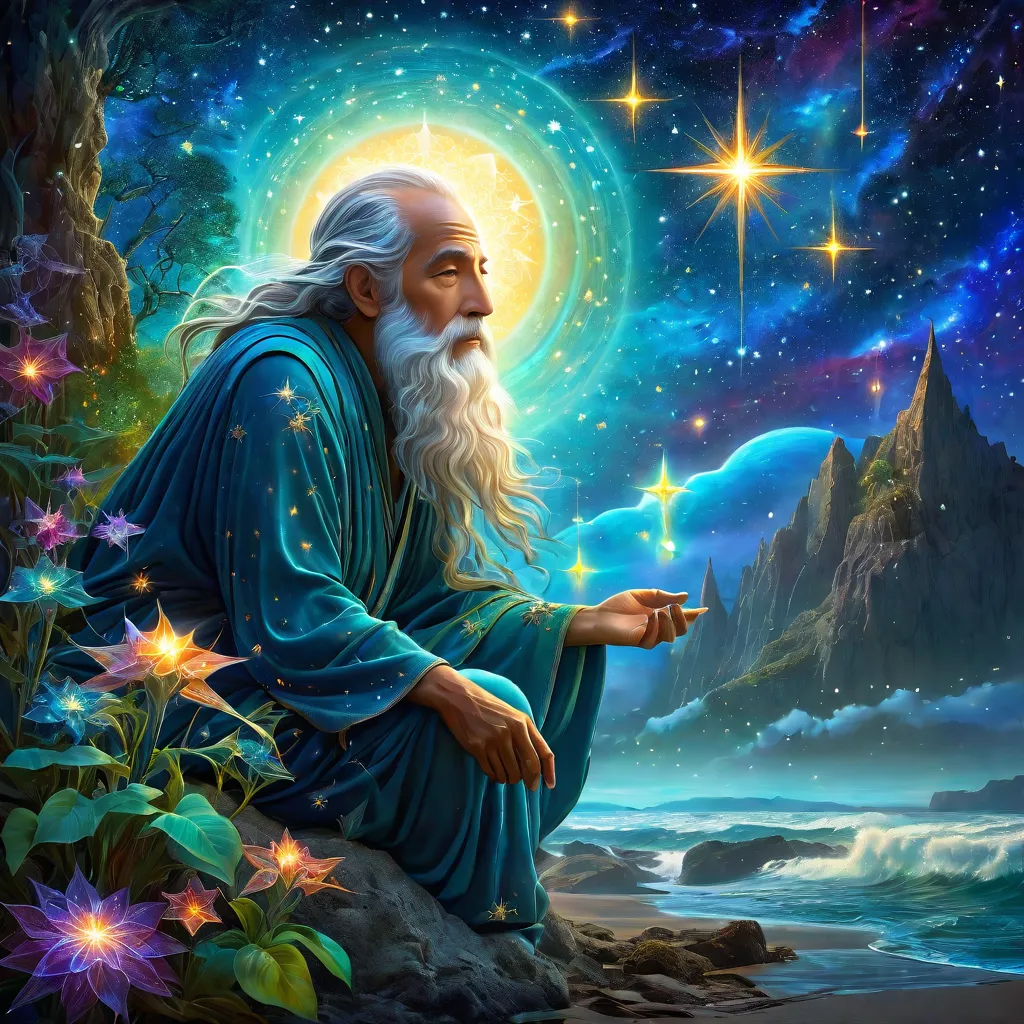
Jung frequently used celestial imagery for the Self, and the star's particular contribution to that symbolism is its fixedness: unlike the sun, which dominates and can overwhelm, a star is a quiet, distant point the dreamer can orient around without being consumed by it, making it an unusually stable image of the Self as a guiding center rather than an overwhelming one. The Wise Old Man archetype appears in the star's traditional role as a source of accumulated, inherited guidance, knowledge older than the dreamer's own experience, passed down the way navigational knowledge of the stars was once passed between generations of sailors who never wrote it down. A dream in which a star seems to know the way before the dreamer does often carries exactly this quality of borrowed wisdom. A falling or fading star complicates this reassurance. Jungian thought would read this less as loss than as a call for a new fixed point, since a guiding value or ideal that has stopped fitting the dreamer's actual life eventually has to fall from the sky before something more accurate can take its place in the psyche's own constellation.
Gestalt / Parts of Self
Speak as the star in your dream rather than about it. A star that says I'm here whether or not you're looking is describing a part of you that has learned to hold steady regardless of attention, a quiet form of self-trust you may not be crediting yourself with while awake. If the star in your dream is falling, ask it directly what it's leaving behind and where it thinks it's going. Falling stars in Gestalt terms are rarely catastrophes; they're transitions mid-motion, and rushing to interpret the fall as loss can skip past the more useful question of what new position this part of you is moving toward. A sky so full of stars that none stand out deserves the same direct address. Ask that overwhelming sky what it wants you to notice, and stay with the discomfort of not immediately knowing; too many options can be as disorienting in a dream as too few, and the dream may simply be asking you to sit with that crowded uncertainty a little longer before choosing.
Cultural & Historical Origins
Enslaved people escaping toward freedom on the Underground Railroad used the folk song Follow the Drinking Gourd as a coded set of directions, its Drinking Gourd referring to the Big Dipper, whose outer stars point directly to Polaris, the fixed North Star that let travelers hold a true direction through unfamiliar and dangerous territory at night. The Gospel of Matthew describes a star guiding the Magi to Bethlehem, using a single celestial light as confirmation that they were moving toward something of real significance rather than simply traveling. Pacific Islander navigators, most famously the Micronesian master navigator Mau Piailug, crossed thousands of miles of open ocean without instruments by memorizing a star compass, a mental map of rising and setting stars used to hold a course when no land was visible for days at a time. Babylonian astronomers were among the first to catalog the fixed positions of stars into named constellations, a system of celestial record-keeping later absorbed into Greek astrology and, eventually, into the zodiac still referenced today.
Contextual Variations
Following a single bright star through unfamiliar terrain
This image usually shows up when you're relying on one clear value, relationship, or goal to hold your direction through a period where little else feels certain. Notice what that star represents for you specifically; it's likely something you'd keep trusting even if everything around it changed. The terrain being unfamiliar matters less than the fact that you're not walking without a reference point.
A star falling and streaking across the sky
A falling star often marks a source of guidance or belief that's shifting rather than one that's failed. Even though the motion can feel alarming, most falling star dreams describe transition, not disaster, a value or direction moving toward a new position rather than disappearing. Consider what you were using that star for, and where you'd look next if it settled somewhere else.
A sky so crowded with stars that none of them stand out
Too many stars can be as disorienting as too few, and this dream often shows up when you have more options, paths, or possibilities than you currently have a way to choose between. Rather than forcing one star to matter more than the rest, consider whether the real task is narrowing your criteria, not staring harder at the sky.
Reaching toward a star that stays just out of reach
A star that won't be reached is usually doing its job correctly; stars are meant to orient you, not to be arrived at. This dream often surfaces when you're treating a long-term goal as something to grab immediately rather than something to steer by over time. Consider whether the frustration is really about distance, or about wanting a finish line where the value is actually in the direction itself.
Frequently Asked Questions
Why do I keep dreaming about the same star or constellation?
Is a falling star a bad sign in a dream?
Why does the sky in my dream feel too full of stars to make sense of?
Why can't I reach the star I keep dreaming about?
Journaling Prompts
- Name one star in your life right now, a value, a person, a long-held goal, that you keep orienting toward even when everything else feels uncertain. Consider what it has kept steady for you lately that you haven't given it credit for.
- If a guiding belief or ambition of yours has recently started to feel less fixed than it used to, describe what's actually shifting. Consider whether it's falling away, or simply moving to a new position you haven't located yet.
- List every direction currently pulling at your attention, then circle only the one you'd still choose if you could only keep one star in the sky. Consider what that choice tells you about what actually matters most right now.
- Think about a long-term goal you've been treating like a destination to reach immediately rather than a direction to steer by. Describe what it would look like to keep moving toward it patiently instead of demanding you arrive today.
Related Symbols
Dreamed about Star?
Get a personalized AI interpretation that connects this symbol to your specific life circumstances.
Interpret My Dream