Jungian Archetypes
Meaning
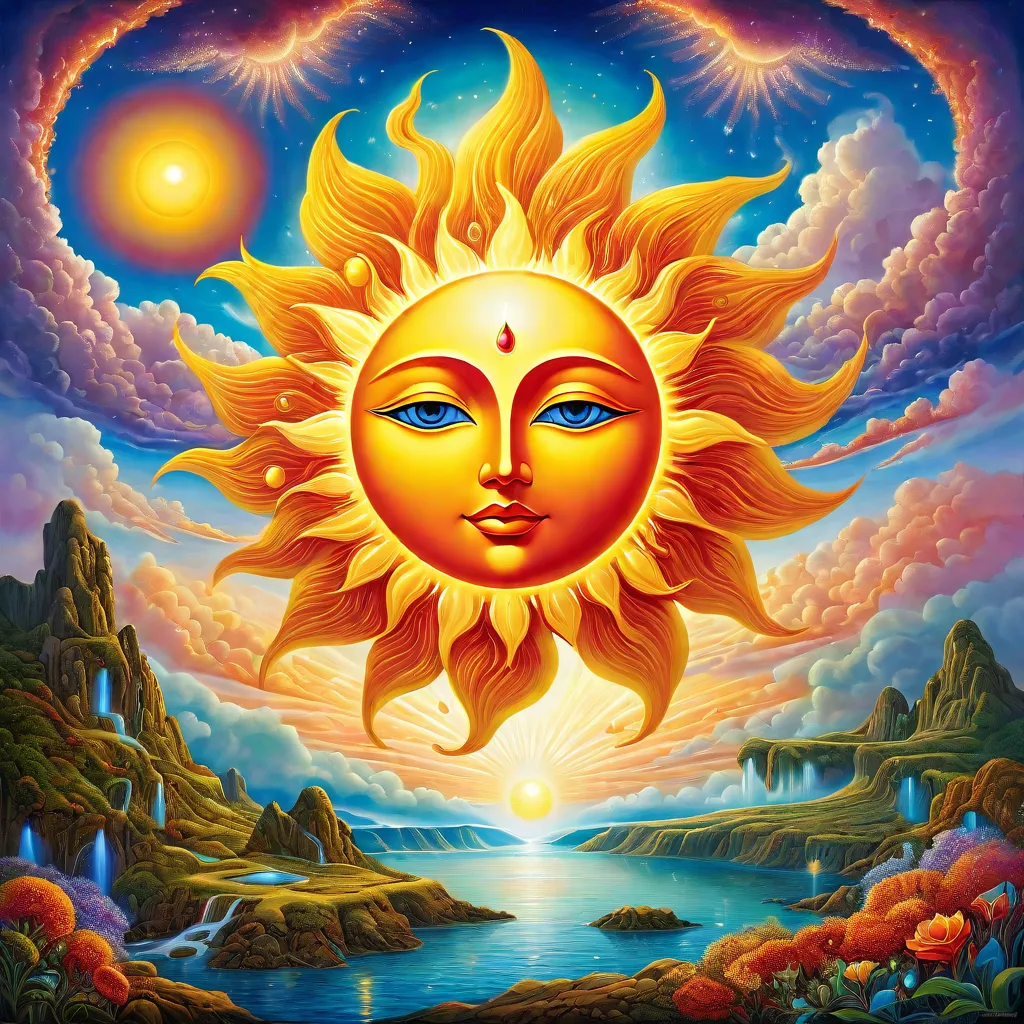
The sun in a dream marks the location of consciousness itself, the point around which the rest of the dream's psychological weather organizes. A rising sun tends to register as new awareness breaking into view after a period spent in the dark, while a sun that is setting, blocked, or eclipsed often reflects clarity fading, energy running low, or a truth the dreamer is not yet ready to face directly. Because sunlight in these dreams so rarely functions as mere weather, its brightness, position, and visibility usually track the dreamer's own relationship to insight, vitality, and how much reality they can currently tolerate seeing.
Psychological Interpretation
A dream sun behaves less like scenery and more like a gauge of how much awareness the dreamer can currently hold. When it rises cleanly and warms rather than burns, the image tends to mark a genuine expansion of self-understanding, arriving on its own schedule rather than being forced. A sun that scorches or blinds shifts the same symbol toward excess: an insight, ambition, or self-image that has grown large enough to damage rather than illuminate, closer to inflation than to clarity. When the sun is obscured, by cloud, smoke, or eclipse, the dream is usually pointing to something the dreamer already senses but cannot yet look at fully, a truth still gathering enough strength to surface. Distance from the sun carries its own charge: reaching toward it, flying near it, or watching it recede all describe different relationships to a goal, an ideal, or a level of self-exposure the dreamer is testing rather than yet living inside.
Traditional Symbol Meaning
Solar mythology across unrelated civilizations keeps arriving at the same basic image: the sun as a life that dies and is renewed on a daily cycle rather than a static object in the sky. Egyptian religion made this most explicit in Ra, who sailed across the daytime sky in a solar barque and journeyed through the underworld by night to be born again each dawn, a cycle the Egyptians linked directly to the soul's own passage through death toward renewal. The sunrise, in this framework, was never simply the return of light. It was proof that a nightly death could be survived. Vedic religion took the sun's association with the mind rather than only the body furthest. Surya's radiance is invoked in the Gayatri Mantra specifically to sharpen intellect and awaken right thought, treating solar light as the model for clear cognition itself rather than a metaphor bolted on afterward. Later Hindu and yogic traditions carried this forward in Surya Namaskar, the sun salutation, a sequence still practiced today that stages a physical dialogue with solar energy each morning. Greek thought supplies both the philosophical and the cautionary poles of solar symbolism. Plato's cave allegory casts the sun as the Form of the Good, the source that makes every other truth visible, so that stepping into sunlight becomes the culminating image of philosophical awakening despite the pain of eyes unused to real light. Icarus, by contrast, shows what happens when the same sun is approached with insufficient humility, his wax wings melting as he closed the distance his father had explicitly warned him not to close. Between these two figures, one gradually opened to truth and one destroyed by getting too near it too fast, most solar dreams find their actual emotional register.
Jungian / Archetypal
The sun is among Jung's clearest natural images for the Self, the psyche's organizing center and the ultimate goal of individuation, precisely because it occupies the same structural position in the sky that the Self occupies in the personality: a single source around which everything else visibly orbits. A dream sun rising after darkness often marks a genuine, hard-won expansion of self-awareness rather than a superficial mood lift. The Hero archetype supplies the sun's more active register, since solar myths across cultures typically involve a Hero-like figure who must earn the sun's light through struggle, Ra's nightly underworld crossing being one clear example. A dreamer moving toward a rising sun, or undertaking some task in order to reach it, is often rehearsing this same pattern: a claim on greater consciousness that has to be worked for rather than simply granted. A sun that overwhelms, blinds, or scorches in a dream typically signals inflation, the ego mistaking a genuine insight or success for permission to identify with the Self itself rather than remain in relationship to it. Icarus's fall is the mythic shorthand for this danger: proximity to the source of light and life is not the same as safe possession of it, and the dream's heat is often a corrective rather than a punishment.
Gestalt / Parts of Self
Become the sun in your dream and notice what wants to be said. A sun that shines steadily whether or not anyone is watching often speaks as a disowned part of you that has stopped needing permission to be visible, a confidence you haven't yet claimed while awake. If the sun in your dream blinds or scorches, ask what in you has been burning too hot for too long without rest, an ambition, a standard, a level of output you've been sustaining as though it were sustainable indefinitely. The scorching sun is rarely an outside force in Gestalt terms; it's usually your own intensity, projected outward because it has felt too dangerous to own directly. A sun that sets or disappears behind cloud is worth sitting with rather than resolving quickly. Ask it directly why it's going, and listen for whether the answer sounds like retreat or like rest. The difference tells you whether you're currently withdrawing from contact with your own clarity or simply allowing it a needed pause.
Psychodynamic / Freudian
Solar imagery in dreams has long been associated in psychoanalytic thought with the father, authority, and the ego-ideal, the internalized standard of who one is supposed to become, since the sun's position as a single dominant, illuminating force maps easily onto an idealized paternal figure watched from below. A dream in which the sun is unreachable, blocked, or too intense to look at directly may encode an ambivalent relationship to that ego-ideal: the wish to be recognized or approved of by a powerful figure, alongside the fear that direct exposure to their full attention would be overwhelming rather than nourishing. The manifest brightness disguises a more conflicted latent wish. A sun that warms without overwhelming, by contrast, often marks a more integrated relationship to the same internal authority, one where standards and ideals are experienced as supportive rather than persecutory. Tracking whether the dream sun feels benevolent or punishing is usually more informative than tracking its literal brightness.
Contemporary Psychological
Circadian biology gives the sun a more literal claim on dream content than most symbols receive: light exposure directly regulates the body's sleep-wake cycle, and disrupted or unusual light patterns during the day, a very bright morning, a missed sunset, jet lag, show measurable links to unusual or vivid dream reports that night. Beyond biology, a dream sun often functions as a straightforward register of the dreamer's energy and mood at the time of the dream, tracking closely with research on how dream affect mirrors waking emotional state rather than predicting future events. A dim, weak, or absent sun in a dream is a fairly common companion to periods of low mood or depleted motivation, not a separate signal requiring outside interpretation. What distinguishes solar dreams from other bright imagery is their intensity ceiling: a scorching or blinding sun sits at an extreme few other dream images reach, which may explain why these dreams are reported as more memorable and more emotionally loaded than most. The brain appears to reserve this particular level of visual intensity for material it judges genuinely significant rather than incidental.
Cultural & Historical Origins
Ancient Egyptian religion pictured the sun god Ra crossing the sky each day in a solar barque and passing through the underworld each night to be reborn at dawn, treating sunrise as a literal daily resurrection rather than a simple return of daylight. Vedic tradition addresses the sun as Surya, and the Gayatri Mantra, one of Hinduism's oldest and most widely recited hymns, calls on the sun's radiance specifically to illuminate the intellect, tying sunlight directly to clarity of mind rather than only physical warmth. Plato's allegory of the cave uses the sun outside the cave as the Form of the Good itself, the source that makes all other truths visible, so that the prisoner's final ascent into sunlight becomes philosophy's central image for the discomfort and reward of real understanding. Greek myth also supplies the sun's cautionary register in Icarus, who ignored his father Daedalus's warning and flew close enough to the sun that its heat melted his wax wings, a story that has long stood for ambition or self-belief pursued past the point it can be sustained.
Contextual Variations
A brilliant sunrise after a long stretch of darkness
This image usually arrives when something in you has genuinely shifted, not a mood lift but a real change in how much you can now see about your situation. Trust the timing more than the drama; sunrises in dreams tend to follow real internal movement rather than wishful thinking. Notice what you can suddenly name about your life that felt unclear even a few weeks ago.
A sun so bright it becomes impossible to look at directly
A blinding sun often shows up when a truth, an achievement, or your own self-image has grown large enough to overwhelm rather than clarify. This isn't necessarily a warning; it can simply mean you're standing closer to something significant than you've fully adjusted to yet. Consider what you've been staring at too directly and for too long without looking away to rest.
Watching the sun sink below the horizon and refuse to return
A sun that sets and doesn't come back can reflect a period where motivation, clarity, or hope feels like it's draining rather than simply resting for the night. Pay attention to whether the dream felt peaceful or frightening; a calm sunset can mark healthy closure, while a frightening one often points to something ending before you feel ready.
Flying toward the sun and feeling your wings begin to weaken
This image carries a built-in warning about pace: you may be pursuing a goal, recognition, or ideal faster or closer than your current resources can sustain. It doesn't mean the goal is wrong, only that the approach needs adjusting before the heat does the damage for you. Consider what would let you get closer without needing to arrive all at once.
Frequently Asked Questions
Why do I dream about the sun rising when nothing has changed in my life?
Is it bad to dream about the sun going dark or disappearing?
Why does the sun in my dreams sometimes feel dangerous instead of comforting?
Why do dreams about flying close to the sun feel like a warning?
Journaling Prompts
- Think about what has genuinely shifted for you recently, even quietly, that a rising sun might be marking. Write down the smallest piece of evidence that your awareness has actually expanded, not just your hope that it has.
- Notice where in your life you might be standing too close to something bright, an achievement, a role, a version of yourself, that has started to overwhelm rather than clarify. Consider what a half step back would let you see more clearly.
- If your motivation or clarity currently feels like a sun setting, describe honestly whether it feels like rest or like loss. Consider what would need to happen for you to trust it's the kind of ending that comes back around.
- Think of a goal you've been pursuing with real intensity lately. Notice where the wax in your wings is starting to soften, and what pace would let you keep climbing without losing what's holding you together.
Related Symbols
Dreamed about Sun?
Get a personalized AI interpretation that connects this symbol to your specific life circumstances.
Interpret My Dream