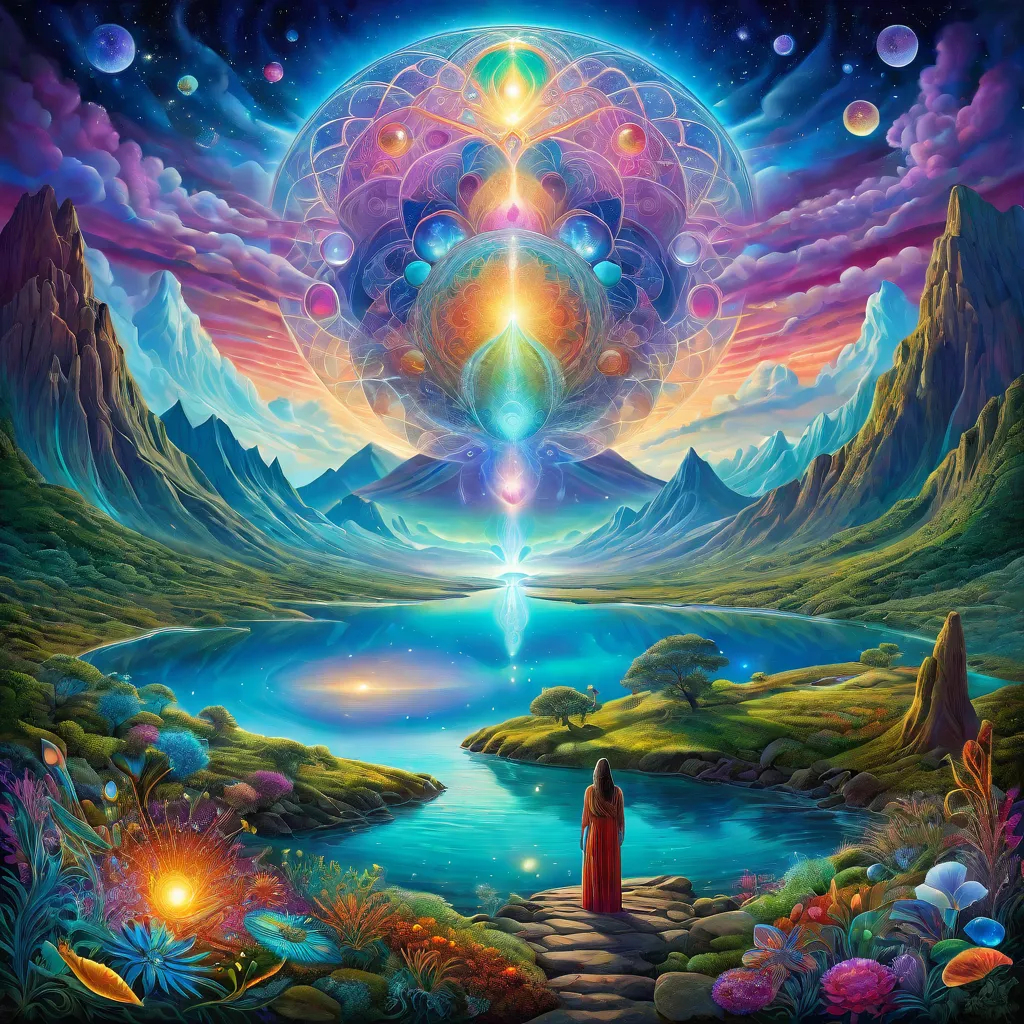
Shamanic Journey
Jungian Archetypes
Meaning
Dreaming of a shamanic journey signifies exploration of the unconscious and personal transformation. This process reflects psychological mechanisms of self-discovery and healing, where individuals confront inner conflicts and seek deeper understanding.
Psychological Interpretation
Jungian perspectives highlight the shamanic journey as a path to individuation, integrating shadow aspects. Cognitive psychology often sees it as a metaphor for the search for personal meaning, while practical psychology emphasizes the therapeutic value of such explorations for growth.
Cultural & Historical Origins
Shamanic journeys are integral to many indigenous cultures, such as the Inuit, where they seek guidance from spirits. Additionally, in the 'Tao Te Ching', the journey symbolizes the balance between opposites, embodying the path toward enlightenment and self-realization.
Contextual Variations
You close your eyes and travel through a tunnel of repeating patterns until you reach a quiet place with a lake that reflects your face at different ages. You feel sadness, then gratitude as the reflections align.
A shamanic journey symbolizes altered-state processing—your mind exploring inner time and meaning. Psychologically, it can indicate readiness to integrate past identities, moving from grief toward coherence and acceptance.
You follow a path marked by animal tracks, but each track leads to a different memory. When you choose one, the others fade, and you feel both relief and guilt for leaving them behind.
The branching memories suggest multiple emotional threads seeking attention. The relief-guilt combination points to selective focus: healing may require prioritizing one wound at a time, and learning to release the pressure to address everything at once.
In the journey, a protective presence guides you through a storm, then asks you to name what you’re afraid to lose. When you speak the name, the wind becomes music and you can breathe again.
Naming fear is central in shamanic imagery—transforming raw emotion into something you can hold. Psychologically, it indicates that your system is capable of regulation once the threat is clearly identified and expressed.
Frequently Asked Questions
Why do shamanic journey dreams feel so vivid compared to other dreams?
What if the journey ends abruptly or I can’t remember it clearly?
Does the presence of a guide mean I’m relying on others instead of myself?
Journaling Prompts
- What was the emotional turning point in the journey—sadness to gratitude, fear to breath, confusion to clarity—and what triggered it?
- Which memory or theme did the journey prioritize, and what does that say about what your psyche needs most right now?
- If the journey had a lesson you could apply today, what would it be in one concrete action?
Related Symbols
Dreamed about Shamanic Journey?
Get a personalized AI interpretation that connects this symbol to your specific life circumstances.
Interpret My Dream