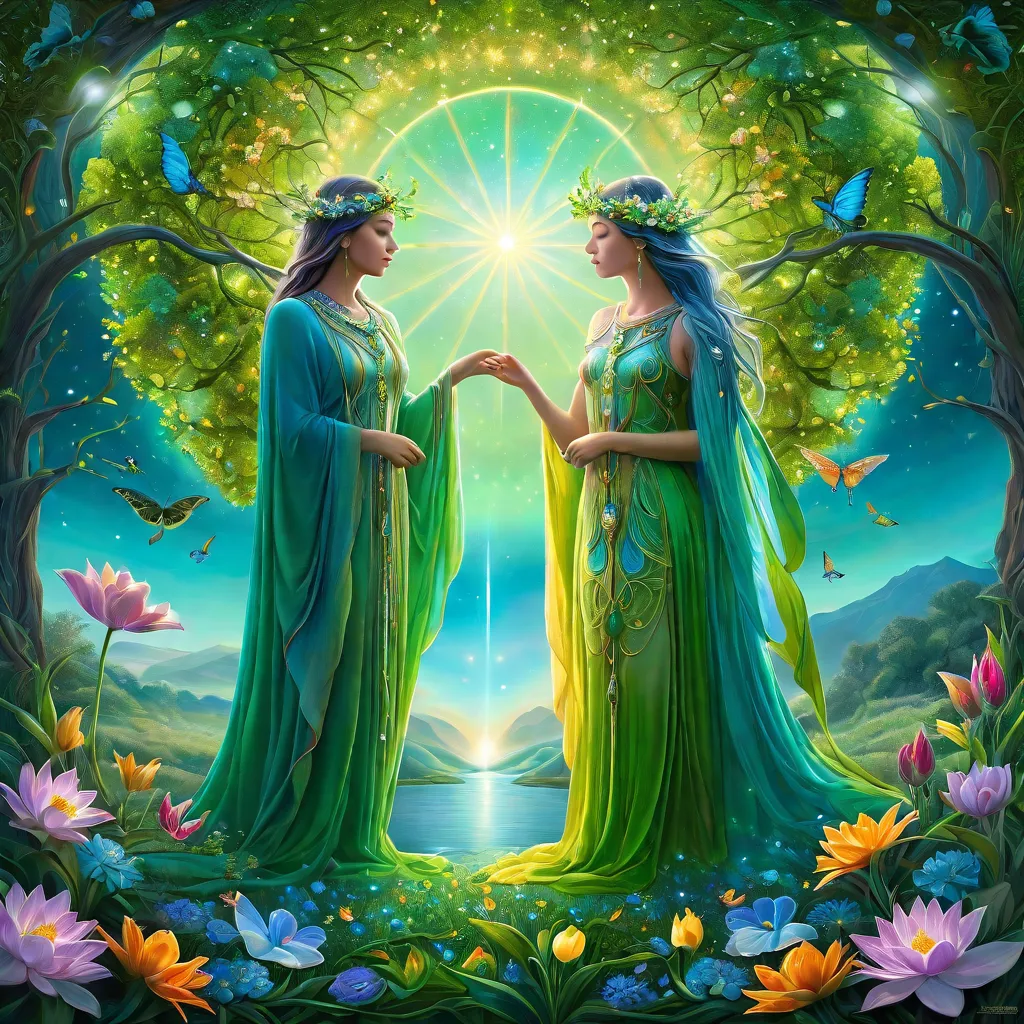
Spring Equinox
Jungian Archetypes
Meaning
The spring equinox in a dream marks a moment the dreamer's psyche has flagged as balanced but not stable, the brief point where two opposing conditions carry equal weight before one of them starts to dominate again. Unlike a dream of pure renewal, an equinox dream tends to arrive while the dreamer is still suspended between an ending and a beginning, neither fully released from what came before nor committed to what comes next. The dream's real subject is usually this in-between position itself, not the growth that will eventually follow it.
Psychological Interpretation
What the dreamer does with the balance matters more than the balance itself. A dream in which day and night, or two people, or two versions of a plan sit in genuine equilibrium without anxiety suggests the dreamer can currently tolerate a transition without forcing its outcome, a harder achievement than it sounds. A dream in which the dreamer tries to measure, freeze, or control the exact moment of balance, and fails, usually reflects a wish to guarantee an outcome that a season, like a life transition, will not actually hold still long enough to be verified. The specific thing being balanced is worth naming honestly: professional ambition against rest, an old identity against an emerging one, a relationship's past against its possible future. Equinox dreams that emphasize light returning, longer days, warmth, tend to lean toward anticipation and readiness for the growth still to come, while equinox dreams that dwell on the equal dark still present tend to mark a dreamer who has not yet finished whatever the winter period required of them, even as spring technically arrives on schedule around them.
Traditional Symbol Meaning
The Persephone myth, preserved most fully in the Homeric Hymn to Demeter, gave the ancient Greek world its central image of seasonal return: a daughter abducted into the underworld, a grieving mother whose sorrow strips the earth bare, and a negotiated yearly return that restores growth without erasing the reality of the descent that preceded it. The Eleusinian Mysteries, one of the most enduring initiatory cults in the ancient Mediterranean, built a secret rite around this myth precisely because it offered initiates a template for facing loss and return without needing either winter or the underworld to be denied. Nowruz, the Persian new year rooted in Zoroastrian cosmology, treats the equinox less as a myth to be reenacted than as a threshold requiring active preparation: khooneh tekouni, a thorough household cleaning, clears the old year's residue before the new one arrives, while jumping over small fires on the eve beforehand is understood as burning off illness and misfortune rather than simply waiting for renewal to happen on its own. The holiday's emphasis on reconciling with estranged family members before the new year begins treats balance as a relational achievement, not only a solar one. The equinox's meaning shifts depending on hemisphere and religious frame in ways that are easy to forget from a single cultural vantage point. In Japan, Shunbun no Hi falls during the Buddhist observance of Higan, a week set aside for visiting family graves and reflecting on the passage between this world and the other shore, treating the astronomical balance as an opportunity for remembrance rather than celebration. South of the equator, the same day marks the autumn equinox and the descent toward winter, a reminder that the psychological weight dreamers attach to spring, hope, growth, second chances, is a product of hemisphere and culture rather than something built into the astronomy itself.
Jungian / Archetypal
Jung drew directly on the Persephone myth when describing the Kore, or Maiden, as one face of the anima: the part of the soul capable of descending into difficult, unconscious territory and returning changed rather than destroyed. An equinox dream that features a passage between two states, dark and light, closed and open, held and free, often activates this same figure, less as a specific woman than as the psyche's own capacity to survive a descent and come back different rather than diminished by it. The persona is also close to the surface in these dreams, since many people quietly adopt a more guarded, conserving version of themselves during difficult periods, the psychological equivalent of winter, and an equinox dream can mark the moment that protective persona is due for renegotiation. Anxiety in the dream about the timing, about whether it is really safe to soften or open up yet, often reflects a legitimate uncertainty about whether the winter persona can be safely set down or whether it is being shed too early. Individuation itself is a slow negotiation between opposites that never fully resolve into one side winning, and the equinox is one of the clearest natural images Jung's framework has for this ongoing balance: light and dark holding equal weight, however briefly, before the arrangement shifts again. A dream that lingers on this exact point of balance, rather than rushing toward the growth that follows it, may be honoring a moment of genuine psychic reconciliation that the dreamer's waking mind is too impatient to notice on its own.
Gestalt / Parts of Self
Gestalt dreamwork reads an equinox dream as a staged conversation between two disowned halves of the dreamer rather than as a comment on the calendar. Whatever stands for winter in the dream, stillness, darkness, withdrawal, and whatever stands for spring, light, activity, growth, are both the dreamer, currently kept apart and taking turns rather than integrated into one continuous experience of themselves. The Gestalt instruction is to give each half a voice and let them address each other directly. What is the winter part still needing before it is willing to step back, and what is the spring part impatient to begin that it has been holding back out of deference to the older, more tired half? Dreamers who run this dialogue honestly often find that the two halves are not actually opposed to each other's timeline so much as poorly introduced, each one assuming the other will simply take over without a negotiation. Contact and withdrawal show up literally in how the dream handles the threshold moment itself. A dreamer straining to freeze the point of balance or measure it precisely is in withdrawal, refusing to let the moment simply pass through them; a dreamer who can stand at the threshold without trying to hold it still is in full contact with a transition, which is the more difficult and more valuable of the two positions Gestalt work aims for.
Psychodynamic / Freudian
The manifest content of an equinox dream, a moment where two conditions balance, typically conceals a more specific latent ambivalence: a wish to move forward paired with an equally real wish that nothing yet be required to change. The dream produces a scene where both can be true simultaneously, which waking life rarely permits for long, and that suspended quality is often exactly what makes the dream feel significant enough to remember. Margaret Mahler's account of separation-individuation, particularly the rapprochement phase in which a child moves unevenly between wanting independence and wanting to return to the safety of the earlier attachment, offers a useful frame for adult equinox dreams that stage the same oscillation around a relationship, a role, or an identity the dreamer is not fully ready to leave. The dream's insistence on measuring or verifying the exact moment of transition can function as an undoing defense, an attempt to control precisely when and how much change occurs rather than letting it happen at its own uneven pace. What the dream chooses to place on either side of the balance, an old role against a new one, a person against a plan, deserves attention as encoded material in its own right. The specific pairing is rarely arbitrary; it usually names the actual ambivalence the dreamer has not yet allowed themselves to state directly in waking language.
Contemporary Psychological
Human biology runs on more than the twenty-four-hour circadian clock; longer seasonal, or circannual, rhythms regulate hormone levels, mood, and energy across the year in response to changing day length, a process called photoperiodism. The equinox marks the specific point where this internal seasonal clock and the external light cycle briefly agree exactly, which may be part of why the dreaming brain treats it as worth flagging: a rare moment of alignment between an internal rhythm and the world outside it. Psychiatrist Norman Rosenthal's research identifying seasonal affective disorder established that changing daylight measurably affects mood through pathways involving melatonin and serotonin regulation, giving scientific grounding to the old intuition that light itself, not just temperature or foliage, drives psychological states across the seasons. A dream that treats the return of light with more anticipation than the return of warmth may be tracking this same biological sensitivity, ahead of any conscious mood change the dreamer has noticed yet. The specific difficulty this dream often stages, an inability to pin down the exact moment of balance, may reflect something literal about seasonal adjustment: the body's internal clock typically lags behind the external light change by days or weeks, similar to the disorientation of jet lag, rather than resetting instantly at the equinox itself. A dream about chasing a moment that keeps slipping away as clouds or confusion interfere may be an accurate, if unflattering, picture of how slowly the dreamer's own biology is actually catching up to the calendar.
Cultural & Historical Origins
Few natural events have accumulated as many overlapping renewal myths as the point where day and night briefly stand equal. The Homeric Hymn to Demeter ties this moment to Persephone's return from the underworld to her mother, ending the barren season and restoring fertility to the earth, a myth the Eleusinian Mysteries built an entire initiatory tradition around. Persian and Zoroastrian tradition marks the same astronomical moment as Nowruz, the new year, a festival of purification, family reconciliation, and renewal that predates Islam in the region and remains one of the oldest continuously celebrated new year observances still practiced today. The English word Easter is generally traced to Eostre or Ostara, a goddess mentioned by the eighth-century monk Bede in his account of the Anglo-Saxon calendar, associated with the dawn and the direction of sunrise the season itself moves toward. At Chichen Itza in Mexico, Maya builders aligned the pyramid of Kukulkan so precisely that the spring equinox sun casts a shadow resembling a serpent descending its staircase, a deliberate architectural encoding of the same threshold the dreamer's own psyche marks less visibly.
Contextual Variations
Day and night keep swapping while you hold a compass
A compass that will not settle while day and night trade places suggests you are looking for an external instrument to tell you when a transition is finished, rather than trusting a sense that has to be felt rather than measured. Consider what you are currently trying to verify with certainty that may only ever be knowable in hindsight.
You measure the equinox but clouds keep hiding it
Clouds that repeatedly block your attempt to pin down the exact moment of balance point to a transition that cannot be forced into a precise schedule, no matter how much you want proof that you have reached it. The dream may be suggesting you rely on how your body and mood are actually shifting, rather than waiting for an unambiguous external sign.
A ceremony has you exchanging promises with a stranger
Exchanging promises with someone you don't fully know in a spring ceremony often reflects a commitment you are making more to a new phase of your own life than to the other person specifically. Notice what you are promising and to whom, since the ceremony's real subject may be your own readiness rather than the relationship it appears to involve.
Spring arrives but part of the dream stays wintered
Spring returning on schedule while some part of the dream world remains stuck in winter suggests the calendar has moved faster than your own internal process. Rather than forcing yourself to match the season's timeline, consider what unfinished business from the harder period still needs attention before you can fully join the growth already visible around you.
Frequently Asked Questions
Why did I dream specifically about the spring equinox?
Why can't I pin down the exact moment of the equinox in my dream?
Is an equinox dream a sign that good change is coming?
Why does part of my dream still feel wintery even though it's spring in the dream?
Journaling Prompts
- Name the two things in your life that currently feel balanced but not resolved, an old role against a new one, rest against ambition. What would tip that balance, and are you ready for it to tip yet?
- Where are you currently trying to measure or verify that a transition is complete, rather than trusting how you actually feel? What would it mean to let the timing stay uncertain a little longer?
- If part of you still feels wintered even as spring arrives around you, what unfinished business from the harder season is asking for attention before you move on from it?
- Think about a promise or commitment you are currently making more to a new chapter of your life than to any one person involved. What are you really agreeing to, underneath the specific words?
Related Symbols
Dreamed about Spring Equinox?
Get a personalized AI interpretation that connects this symbol to your specific life circumstances.
Interpret My Dream