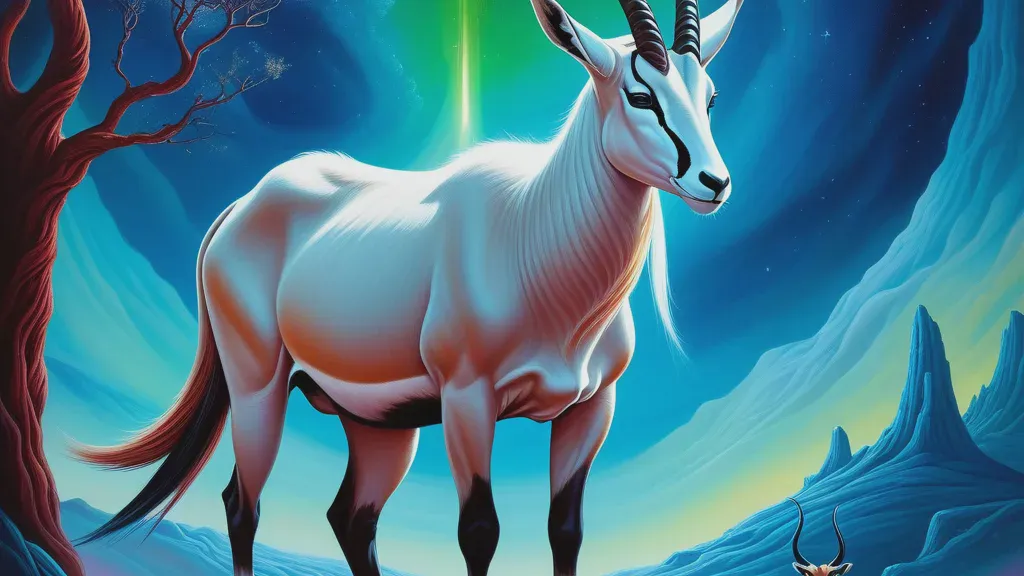
Oryx
Jungian Archetypes
Meaning
The oryx is the antelope that has solved the desert by refusing to spend anything. It can go months without drinking, taking its water from melons, roots and the moisture that condenses on grass before dawn, and it lets its own body temperature climb past the point that would kill most mammals rather than lose fluid to sweat. Its horns are almost straight and longer than its head and neck together, and seen from the side the two read as one. A dream oryx carries that whole arrangement: endurance bought by strict economy, a beauty that comes out of scarcity, and a weapon carried in the open by an animal that would far rather walk away.
Psychological Interpretation
The oryx dream is about distance and composure rather than danger. The animal is nearly always seen across open ground, standing still in heat that has emptied the landscape, and it does not come closer unless the dreamer stops moving. What unsettles people is the absence of visible strain. Nothing about the oryx admits the conditions are difficult, and the dreamer, generally sweating, thirsty or lost in the same dream, is shown a way of being under pressure that costs nothing to look at and a great deal to keep up. The details that carry meaning are the dreamer's own state, the direction the animal faces, and what happens to the horns. An oryx grazing with its side turned is an untroubled image of a capacity working properly. An oryx that turns head-on lines its horns up into a single point, and the mood of the dream changes at once, because this is the posture of an animal that has decided to stop retreating. A dreamer who is following the oryx is usually being led further into dry country than they meant to go, which tends to accompany a stretch of waking life spent admiring someone's self-sufficiency and copying it past the point of sense. A collapsed oryx, horns still perfect, points the other way: the strategy has failed, and the composure outlasted the animal wearing it.
Traditional Symbol Meaning
The European dream books have no oryx in them, because they were written and copied in countries where nobody had seen one. What the tradition holds instead is the desert quarry, and the oryx inherits that reading. In Arabian hunting lore the maha was the prize that tested a rider and his camels to their limit, an animal that could not be run down in a straight chase and had to be found, followed and waited out. Accounts from the peninsula credit the meat and the hide with unusual strength-giving properties and treat a successful hunt as proof of a man's endurance rather than his marksmanship. The extinction of the wild herds came when the chase stopped being a contest, once vehicles and rifles removed the endurance from both sides of it. The unicorn strand runs alongside. When the Hebrew scriptures were translated into Greek, the re'em, a wild horned animal, was rendered monokeros, and the King James Bible carried it into English as the unicorn, giving the West a scriptural one-horned beast in need of a body. The Physiologus, the early bestiary that shaped medieval animal lore, supplied the famous solution: the one-horned animal cannot be taken by force and will come only to a maiden sitting quietly, laying its head in her lap. Whatever creature stood behind the story, the moral attached to it is the one that fits the oryx exactly, that this animal is not overpowered but only approached, and only by someone who has stopped chasing. Egyptian ritual pushed in the opposite direction. The desert animals were what lay outside the ordered world, and hunting scenes in which the king takes oryx and gazelle have long been read as images of order asserting itself against the chaos at the edge of the cultivated land. The same animal is therefore, in the older material, both the chaos and the trophy: the thing that survives where nothing should, and the thing whose capture proves the survival can be owned. Dream traditions that inherit from either strand tend to treat the appearance of a desert antelope as a question about which side of that line the dreamer is currently standing on. The modern reading has quietly absorbed the extinction and the return, and any oryx dream now arrives with that history behind it. What runs through every layer is an animal defined by what it does without. It is admired for a discipline that was never voluntary, and the tradition keeps circling the same uneasy point: the qualities that make the oryx survive the desert are the qualities that make it unreachable, and the two cannot be separated by anyone hoping to take one home.
Jungian / Archetypal
The oryx belongs to the Great Mother in her arid aspect, the mother who provides nothing and is not cruel about it. Jung insisted that the mother archetype has a devouring and a withholding face as well as a nourishing one, and the desert is the withholding face made into a landscape. The oryx is the child of that mother who has adapted completely: it has stopped asking, learned to draw water from what is already there, and made a life out of not needing the thing that is not coming. Dreamers who meet this animal have often organised a whole personality around the same discovery, usually early, and the dream shows it back to them in a form beautiful enough to be admired rather than mourned. There is an Anima quality in how the animal is encountered. It is met at a distance, it will not be closed with, and it draws the dreamer further out than they meant to walk. Arabic poets fixed on the eye of the maha as the measure of beauty precisely because it is a look that does not respond, and the figure that leads a person into unfamiliar country while remaining unreachable is the classic behaviour of an inner image projected outward. Amplification supplies the parallel in the unicorn of the medieval bestiaries, an animal no hunt can take, that gives itself only to someone sitting still. Both stories say the same thing about approach: force fails here, and patience is not a technique but a change of intention. The horns hold the individuation image. They are a pair, they diverge slightly, and from the side they collapse into a single line, which is why an entire tradition believed this animal had one horn. That is a precise picture of what Jung meant by holding the opposites: nothing is fused and nothing is discarded, but from a particular angle the two are seen as one thing. Compensation decides who gets the dream. The person who has been extravagant, loud or dependent dreams of the oryx as a discipline they lack, while the person who has lived on nothing for years dreams of it collapsed in the sand, because the psyche is finally arguing that the economy has gone too far.
Gestalt / Parts of Self
In Gestalt work the oryx is not an animal you saw; it is a part of you standing at a distance because you cannot yet hold it as yours. Speak from inside it, in the present tense, and stay there: I am standing in full sun. I am not looking for shade. I have not drunk for a long time and I am not going to tell you about it. Keep going until a sentence arrives that you recognise from your own week. The one that usually lands is some version of I do not show what this costs, and the moment you say it in the animal's voice, it stops being a virtue and becomes a description. The polarity to work is the one who endures and the one who needs. Most dreamers have exiled the second entirely, and the desert in the dream is how much room the exile takes up. Set two chairs. In one, be the oryx and say exactly what you can do without. In the other, be the thirsty one and ask for something specific, out loud, without justifying the request. Notice where you go dry in your mouth or flat in your voice, because that is the seam. This is retroflection in its clearest form: the asking has not disappeared, it has been turned back on yourself and reprocessed into self-sufficiency, which is why the fatigue is real and unexplained. Contact and withdrawal are the animal's whole method, and it is worth respecting rather than curing. An oryx walks away from most trouble and lowers its horns only when the ground has run out, which is a functioning boundary rather than an avoidance. Ask which of your withdrawals are chosen and which are automatic. The experiment for the week is deliberately small: ask one person for one thing you could have managed alone, notice the exact moment you start explaining why you asked, and stop mid-sentence. What rises in that silence is the material the dream sent the oryx to show you.
Psychodynamic / Freudian
The manifest content is a handsome animal in a hot landscape. The latent content is nearly always a defence, and a very early one. What the oryx dramatises is the management of need in a setting where need cannot be met, and psychoanalysis has a detailed literature on the character that results. Winnicott described a false self built to spare a caregiver, competent, undemanding and quietly unreal, and Fairbairn described the schizoid solution in which the wanting part of the self is withdrawn into a closed inner world so it can no longer be disappointed. Both produce someone who looks self-possessed and reports, accurately, that they feel nothing much. The dream supplies the missing half by placing that person in a desert and letting them see what the composure is standing in. Attachment research put numbers on the same picture. In the separation studies developed from Bowlby's work by Mary Ainsworth, one group of infants shows almost no protest when the caregiver leaves and no obvious relief when she returns, while physiological measures taken during those episodes indicate arousal the behaviour is not expressing. An animal that will not sweat in order to save water is an exact image of that arrangement: the signal is suppressed for the sake of the economy, and the heat goes into the body instead. Dreamers frequently wake from oryx dreams describing them as peaceful and then find themselves inexplicably tired all morning, which is the affect arriving late by the only route left to it. Bion offers the more hopeful reading. His account of thinking begins with an absence that has to be tolerated: when the thing that is wanted does not arrive and the frustration is neither evacuated nor denied, the space it leaves is where thought becomes possible. On that view the oryx is not only a defence but a genuine achievement, an organism that turned scarcity into a way of living rather than a wound. The clinical question, and the dream's question, is whether the arrangement is still voluntary. Defences built in a real drought are not pathological. They become expensive only when the rain has come back and nobody has told the animal.
Contemporary Psychological
The physiology behind the symbol is well documented and worth knowing, because the dream is borrowing it. Field and laboratory work by C. Richard Taylor in the 1960s showed that oryx survive without drinking by allowing body temperature to rise well above the level that would be fatal in most mammals, storing heat during the day and dumping it at night instead of spending water on evaporative cooling, while a network of fine arteries at the base of the skull cools the blood on its way to the brain. Water comes from food, and from vegetation that takes up moisture from the night air. The animal is not merely tough. It has changed which variable it defends, and that is the piece of engineering the dreaming mind reaches for. Sleep science offers a striking parallel that may be part of why the image is available at all. Research on thermoregulation during sleep, associated particularly with Pier Luigi Parmeggiani, established that the regulation of body temperature is largely suspended during REM sleep, the stage in which most vivid dreaming occurs: shivering and sweating responses drop away and the sleeper drifts with the room. Bodily states also reach dream content directly. In an early experimental study, William Dement and Edward Wolpert sprayed water on sleeping volunteers and found the sensation incorporated into a substantial minority of the dreams reported on waking. A dreamer who is dehydrated, feverish or sleeping in a hot room has a plausible physical route into a desert. The rest follows the continuity hypothesis. Dream content tracks waking concerns, and content analysis in the tradition of Calvin Hall and Robert Van de Castle finds animals in a minority of adult dreams, with the species usually drawn from what a person has recently seen, read about or watched. An oryx generally arrives after a documentary, a zoo, a photograph or a conservation story, and gets attached to whatever emotional theme was looking for a body. Recurrence is the useful signal, since a scene that repeats without changing normally reports a waking situation that has not moved. Track what you are currently going without, and expect the landscape to change when the supply does.
Cultural & Historical Origins
Egypt gave the oryx its oldest recorded meanings. The white oryx belonged to the red land beyond the fields and was linked with Set, god of the desert and of disorder; the sixteenth nome of Upper Egypt was the Oryx nome, and tomb reliefs show the animals tethered, hand-fed and led to slaughter, so the desert beast appears in the record chiefly as something captured. Classical writers gave it a second life. Aristotle lists the oryx among the very few cloven-hoofed animals said to bear a single horn, and Pliny the Elder repeats the claim, which is how a real antelope whose two horns overlap in profile fed the long European argument about the unicorn. In Arabia the animal is al-maha, and classical Arabic poetry uses the eyes of the oryx as the standard against which a beloved's eyes are measured, an image so settled that maha became a girl's name. Namibia set a gemsbok in its coat of arms, and the Arabian oryx is a national emblem across the Gulf. The modern layer is a conservation story that has largely taken over the symbol: the last wild Arabian oryx were shot in the early 1970s, after a 1962 expedition by the Fauna Preservation Society took a few animals to Phoenix to found a captive World Herd, whose descendants were released back into Oman in 1982. In 2011 the species became the first ever moved on the IUCN Red List from Extinct in the Wild back to Vulnerable. Margaret Atwood borrowed the name for a character in Oryx and Crake in 2003, when the animal still stood for something gone.
Contextual Variations
An oryx standing in full sun without looking for shade
Everything else in the dream has taken cover and the animal has not moved. This is the image of composure held past the point where it is useful, and it tends to arrive during a stretch when you are the one others describe as coping well. Notice whether you envied the oryx or wanted to shout at it. Envy says you have not yet reached your own limit; irritation usually means you have, and that some part of you is furious at being required to keep standing there. Ask who would have to change their plans if you admitted the heat.
Following an oryx towards water that is never reached
The animal keeps its distance, the ground stays dry, and you keep walking anyway. Oryx do not need the water you are following them towards, which is what makes this dream painful: you are taking directions from something with a different set of requirements. It shows up when a person has modelled themselves on someone tougher, less needy or more independent, and has been quietly failing to keep up. Ask who you have been following, whether they ever promised you water, and what you would find if you stopped and dug where you stand.
An oryx lowering its horns as you come closer
Head-on, the two horns line up into one point, and an animal that has stopped retreating is showing you a boundary in the only language it has left. Gemsbok have killed predators this way and the dream knows it. The tone matters: fear suggests you have been pressing someone who has already asked you to stop, while satisfaction suggests the oryx is you, and that you are rehearsing a refusal you have not yet made out loud. Note who was standing where you were standing, and what they would hear if the refusal came.
A dead oryx in the sand with its horns unbroken
The strategy outlasted the animal. Nothing about the body says it struggled, which is precisely the grief in the image: the composure held right to the end and told nobody. This dream comes after a collapse that surprised everyone except the person it happened to, or during the slow recognition that an inherited way of coping has run out of road. The intact horns are worth sitting with. Ask what you would want kept if the way you have been living finally stopped working, and what you would let the sand have.
Frequently Asked Questions
Why did the oryx in my dream feel calm when the landscape was so harsh?
Is an oryx dream about strength or about exhaustion?
Why would I dream of a desert animal when I have never been to a desert?
Does it matter whether the oryx had one horn or two?
Journaling Prompts
- List the things you have gone without for so long that you no longer count them as going without: an income you can relax about, someone to call late, a room of your own, regular food, an unbroken night. Pick the one that surprised you most by appearing on the page, and write about when it stopped being a lack and started being your normal weather.
- The oryx does not sweat, because sweating costs water it cannot spare. Write down what your equivalent is, the signal you have trained yourself not to give off. Then trace where it goes instead: which hour of the day it shows up in, which part of your body holds it, and who in your life has learned to read it anyway despite your best efforts to keep it invisible.
- Write about the person whose toughness you have been measuring yourself against, and be specific about who they are rather than describing a quality. Then set down what you actually know about their conditions, their help, their money and their history. Where the two lists fail to match is where you have been running someone else's desert on your own supplies.
- Describe a boundary you are currently signalling instead of stating: the slower replies, the shortened answers, the plans you keep not making. Write the sentence you would say if you turned head-on and said it plainly, in the fewest words possible. Then write what you believe would happen next, and how much of that belief comes from evidence rather than habit.
Related Symbols
Dreamed about Oryx?
Get a personalized AI interpretation that connects this symbol to your specific life circumstances.
Interpret My Dream