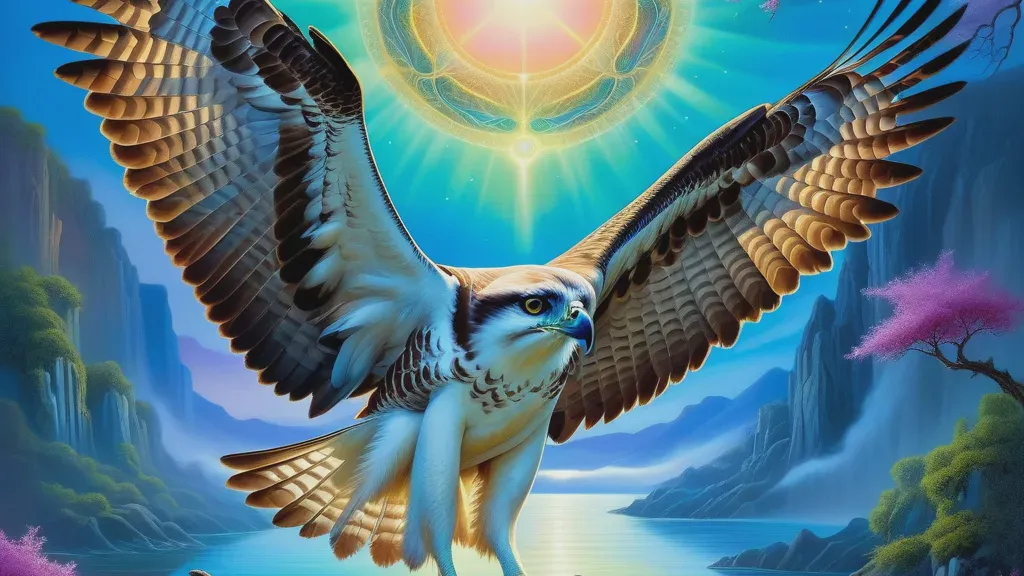
Osprey
Jungian Archetypes
Meaning
The osprey is the one bird of prey that goes all the way under the water and comes back out holding something. It hovers, corrects for the way light bends at the surface, folds and hits feet-first, and its whole body is built for that single act: an outer toe that swivels backwards to make two claws grip against two, spiny pads on the soles, nostrils that shut on impact, oiled plumage that sheds the water on the climb out. It eats almost nothing but live fish. In a dream it stands for aim that has to pass through a surface to be any use, and for the particular courage of going into what you cannot see clearly and surfacing with it in your hands.
Psychological Interpretation
Osprey dreams turn on the surface of the water and on which side of it the dreamer is standing. The bird belongs to two elements and commits fully to neither, which is why it appears to people facing a decision that requires going down into something before it can be acted on: an unopened set of accounts, a diagnosis, a family history nobody discusses, an intuition that has not been checked. The hover is the dream's most reliable image, and dreamers who wake during it are still in the phase of looking. The outcome carries the rest of the meaning. A clean dive followed by a climb-out with the catch is the psyche showing a capacity in working order, and the feeling on waking is usually cleaner than anything in the dreamer's waking week. A miss is not failure but calibration: ospreys miss most of their attempts, and the dream that includes a miss and another circuit is describing persistence rather than defeat. The dreams worth attention are the ones where the grip becomes the problem, where the fish is too heavy to lift and the bird will not let go, or where the osprey goes under and the surface closes. Those attach to something the dreamer has taken hold of that is now taking them down, and the dream is asking about release rather than about aim.
Traditional Symbol Meaning
Traditional dream lore rarely names the osprey, and where the bird appears it has been read as an eagle or simply as a hawk. That inheritance is worth knowing because it is misleading. The classical hawk of dream interpretation is a bird of seizure and of sudden loss, and Artemidorus treats birds of prey by their habits, so that what a bird takes and how it takes it decides the reading. On that principle the osprey belongs nowhere near the eagle. It does not stoop on other birds, it does not scavenge, and it takes nothing that belongs to anyone. Its whole diet comes out of a place no other raptor will enter, which makes it a symbol of acquisition without theft, and of a livelihood that has to be fetched up from below. The old belief that fish surrendered to the osprey is the most revealing thing the tradition preserved. It appears in bestiary material and in the folk knowledge Shakespeare drew on, and it says something about how people watching from a boat experienced the bird: the strike looked less like a hunt than like a claim being honoured. Anything that certain reads, to an observer, as authority rather than force. That misreading is exactly what the image does in a dream, where an osprey's accuracy tends to feel morally clean in a way that a hawk killing a songbird never does, and where dreamers frequently report admiring the bird rather than fearing it. The nest carries its own tradition. Osprey eyries are enormous, built of sticks and whatever the shoreline offers, and pairs return to the same structure year after year until it becomes a landmark that fishermen navigate by. Coastal communities on both sides of the Atlantic treated a nesting pair as a good sign and left them alone, and in some places raised poles for them long before conservation programmes formalised it. A bird is welcome near human buildings, that takes nothing from the household, and that comes back to the same spot every spring accumulates a very different set of associations from a predator that has to be driven off. The last layer of tradition is recent and heavy. Within living memory the osprey vanished from most of its range and then came back, and in Britain it went from an extinct breeder to a bird thousands of people queue to watch on a nest camera. That history has made it a standing figure for return and for something lost being recoverable, which is why the bird now arrives in dreams carrying an optimism that the older hawk material never had. What survives from every layer is the same shape: something goes down out of sight, and something comes back up.
Contemporary Psychological
Vision explains why this bird makes such a strong dream image. Raptor eyes carry a very high density of photoreceptors and a deep fovea that magnifies the central field, and an osprey hunting must additionally solve refraction, since a fish seen from the air is not where it appears to be. The hover, the head-cocking and the abandoned approaches are all visible calculation. A brain that has spent the waking week trying to locate something it can only see indirectly has a ready-made picture available, and dreams recruit pictures far more readily than arguments. The flight itself has a plausible physiological basis. J. Allan Hobson's work on the dreaming brain connected the vivid movement and vestibular sensations of dreams to brainstem activity during REM sleep, in which motor and balance systems are driven while the body stays still, and surveys of common dream themes consistently place flying among the most frequently reported experiences. A diving bird gives that internal sensation a shape and a reason. Threat simulation theory, developed by Antti Revonsuo, covers the other half of the dream: if the dreamer is the fish rather than the bird, the scene is a predator simulation of the oldest kind, rehearsing detection of something approaching from an angle the prey cannot watch. For content, the continuity hypothesis remains the most useful tool. Decades of content analysis by Calvin Hall, Robert Van de Castle and later William Domhoff show dream imagery tracking waking preoccupations, with animals appearing in a minority of adult dreams and drawn from what a person has recently encountered, so a nest camera, a coastal holiday or a documentary is often the immediate source. Research on sleep-dependent memory consolidation suggests why the retrieval imagery in particular recurs: overnight processing involves reactivating and reorganising recent traces, and a search that ends in something being brought up is not a bad metaphor for what is going on. Track what you are currently trying to retrieve, and the dives usually change when you find it.
Jungian / Archetypal
The osprey performs, in about four seconds, the movement Jung spent a career describing. Air is the medium of consciousness, thought, overview and distance; water is the unconscious. Every other raptor stays in the first and takes what it can reach. The osprey enters the second completely, disappears, and returns to the air with something living that was not visible from above. That is the night sea journey compressed into a dive, and it makes the bird an unusually exact image of a functioning relationship between the ego and the unconscious: not fusion, not avoidance, but a repeated crossing with something brought back each time. The Animus quality sits in the aim. Jung used the term for the discriminating, deciding, sharply directed function, and the osprey's hunt is discrimination made visible, since the bird must judge a target through a surface that displaces it and commit before it can confirm. Dreams in which the bird hovers and never dives belong to people whose deciding function has been talked out of acting, usually by a habit of gathering more information. The compensating dream sends a bird that does not deliberate. Whether the dreamer admires or resents it says which side of that argument the conscious attitude is currently holding. The danger in the image is precise, and it is the danger Jung called identification with unconscious content. An osprey's toes are built to lock, and a bird that seizes a fish heavier than it can lift is sometimes unable to release the grip and drowns still holding on. A dream that ends this way is not about failure of skill. It is about a person who has gone down after something genuine, taken hold of it, and lost the capacity to let go of it: a grievance, a diagnosis, a vocation, a piece of family history that was worth retrieving and has become the whole life. Individuation needs the return flight as much as the descent, and the Self is served by the bird that opens its feet.
Gestalt / Parts of Self
Take every element of this dream as yours and give each one a voice. Be the osprey first, in the present tense: I am four hundred feet up. I can see you and you cannot see me. I have been watching this water for six minutes and I have not moved. Then be the fish, which is the part most dreamers skip: I am in my own element, I am not hiding, and something is coming out of the light. Then be the surface itself, the thing that separates the two and distorts everything crossing it. Whichever one you resist speaking as is the one to stay with. The polarity here is the one who watches and the one who is caught, and it usually maps onto a live relationship. If you took the hunter's chair easily and could not sit in the fish's, look at where you are currently deciding about somebody who has not been consulted. If the reverse, look at where you are living as though a decision about you is already circling. Set both chairs out and let them talk. The sentence people commonly arrive at from the fish's side is that the water was never protection, and it is worth saying out loud rather than thinking, because the body reacts to it and the thought does not. Contact is the whole subject and the osprey is unusually good at it. It makes contact by full commitment and then withdraws completely to a perch to eat, which is a cleaner cycle than most people manage. Ask which half you are missing. Endless hovering is contact deferred; refusing to let go of the fish is withdrawal refused. The experiment for the week has two halves. Take one decision you have been circling and act on it before you feel ready, and take one thing you have been gripping and put it down for a single day, and notice which of the two you found genuinely impossible.
Psychodynamic / Freudian
The osprey dream stages the structure Freud built his whole method on. There is a surface, there is everything under it, and the surface distorts the position of whatever is down there so that what is seen is never quite where it is. Manifest content is the water seen from above; latent content is the fish. What makes the image unusually apt is that the bird has to correct for the distortion before committing, which is a fair description of interpretation itself: not reading the surface literally, but calculating from it where the thing actually lies. A dreamer who watches an osprey work is watching their own interpretive apparatus, usually at a moment when something needs to be understood rather than merely felt. The appetite in the image is worth naming plainly, because it is what the elegance conceals. This is a dream about taking and eating, and it arrives with none of the guilt that a dream of stealing would carry, since the aggression has been laundered through hunger and skill. Displacement is doing that work. An impulse to seize something in waking life, a job, a person, an inheritance, a share of attention, is relocated into a bird whose seizing is beautiful and unarguable. Klein's account of the depressive position adds the sequel: the good thing retrieved from the depths has to be kept safe and repaired rather than simply devoured, and dreamers who feel unexpectedly sad after a successful dive are usually feeling that. Bion gives the most useful frame for the whole action. In his model, raw unprocessed experience has to be taken in by a mind able to transform it into something thinkable, and only then can it be used. The osprey does the physical version: it goes into the formless medium, brings up one specific living thing, carries it head-first into the wind, and takes it somewhere it can be eaten. Nests belong to this reading too. Osprey eyries are added to for decades until they are structures in their own right, which is what an internalised good object looks like from outside, a place assembled slowly out of retrieved material that later holds the next generation.
Cultural & Historical Origins
The osprey reaches English under somebody else's name. Ospray derives from the Latin ossifraga, bone-breaker, which properly belonged to the bearded vulture, and the word drifted onto the fish hawk in medieval usage; the King James translators put ospray into the list of unclean birds in Leviticus. Medieval lore held that fish were so fascinated by the bird that they turned belly-up to be taken, and Shakespeare uses the belief in Coriolanus, where a character says the general will be to Rome as the osprey is to the fish, taking it by sovereignty of nature. The scientific name Pandion was attached in the early nineteenth century after the Athenian king whose family Ovid turns into birds in the Metamorphoses, though the myth never makes a bird of Pandion himself. Working coastal traditions read the bird as a calendar rather than an omen: on the Chesapeake and in New England the return of the fish hawk to its nest marked the start of the season, and John James Audubon painted it as the Fish Hawk. A Japanese folk tradition describes misago-zushi, fish left by ospreys in rock clefts and found fermented by seawater. The strongest modern layer is environmental: ospreys collapsed across Europe and North America in the mid-twentieth century as DDT thinned their eggshells, and their return after the 1972 American ban, alongside the recolonisation of Scotland from the 1950s, made them an emblem of the world Rachel Carson had warned about in Silent Spring.
Contextual Variations
An osprey diving and not surfacing again
The bird goes in, the water closes, and nothing comes up. This is the dream's version of a descent that did not come back, and it usually attaches to someone or something in your life that went into a difficult place and has not returned: a relative in an illness, a friend inside an addiction, a project that swallowed the person running it. Sometimes the missing bird is you, and the dream is registering how long you have been under. Note how long you waited at the surface before waking, and whether you were about to go in after it.
An osprey gripping a fish too heavy to lift
The catch is real, the aim was good, and the bird cannot get airborne. Ospreys are occasionally drowned this way, unable to release a grip built to lock, and the dream borrows the fact exactly. It comes to people who went after something genuinely worth having and can no longer put it down: a case they were right about, a role they built, a version of a family story they fought to prove. The question is not whether you were correct. Ask what it would cost you to open your hands, and who you would be for the ten minutes afterwards.
An osprey nest built on top of something you own
The mast, the chimney, the pole in your yard, and a structure of sticks on it that has clearly been there for years. Osprey nests are added to across decades until they become landmarks, and a dream that puts one on your property is describing something that has quietly taken up permanent residence in your life. The tone tells you what it is. Pride or protectiveness suggests a commitment you have grown into, while irritation at the weight and the mess suggests an arrangement you never formally agreed to and cannot now dislodge without damage.
Being underwater as a shadow crosses the surface above you
You are in your own element and something is moving in the light overhead. This is the osprey dream from the fish's side, and it is the more common version among people under scrutiny: a review, an investigation, a diagnosis being decided elsewhere, a parent's attention that arrives without warning. The helplessness is the point, since water is not cover from something that can enter it. Ask who is currently circling above your life, whether they have actually decided anything, and what you are doing with the time before they do.
Frequently Asked Questions
Why did the osprey in my dream go completely underwater?
Is dreaming of a bird catching a fish a bad sign for the fish part of me?
Why do I keep dreaming about watching a bird hunt rather than doing anything myself?
Does it change the meaning if the osprey missed the fish?
Journaling Prompts
- Write down the thing you can currently see the shape of but not the detail of: a suspicion about someone, a figure in your accounts, a symptom, a feeling about your work. Describe exactly what you can make out from where you are standing, then write what you would have to do to go in after it, in practical steps with names and dates rather than intentions.
- An osprey aims at a fish that is not where it appears to be, and corrects before it commits. Write about a recent situation where you acted on the surface reading and were wrong. What was the distortion, who or what supplied it, and what would you now say the real position was? Then name the correction you would apply next time.
- Describe something you are holding on to that you were right to take hold of and have not put down since. Write how long you have had it, what it has given you, and what it now weighs. Then write the sentence you would say to the person closest to you if you were letting it go this week, and notice how much of you objects to the sentence.
- Osprey nests are added to for decades until they hold the weight of a whole family. Write about what you have been building in that way, one piece at a time, without ever calling it a project: a home, a friendship, a body of work, a reputation. What has gone into it this year, and what would still be standing if you stopped adding to it tomorrow?
Related Symbols
Dreamed about Osprey?
Get a personalized AI interpretation that connects this symbol to your specific life circumstances.
Interpret My Dream