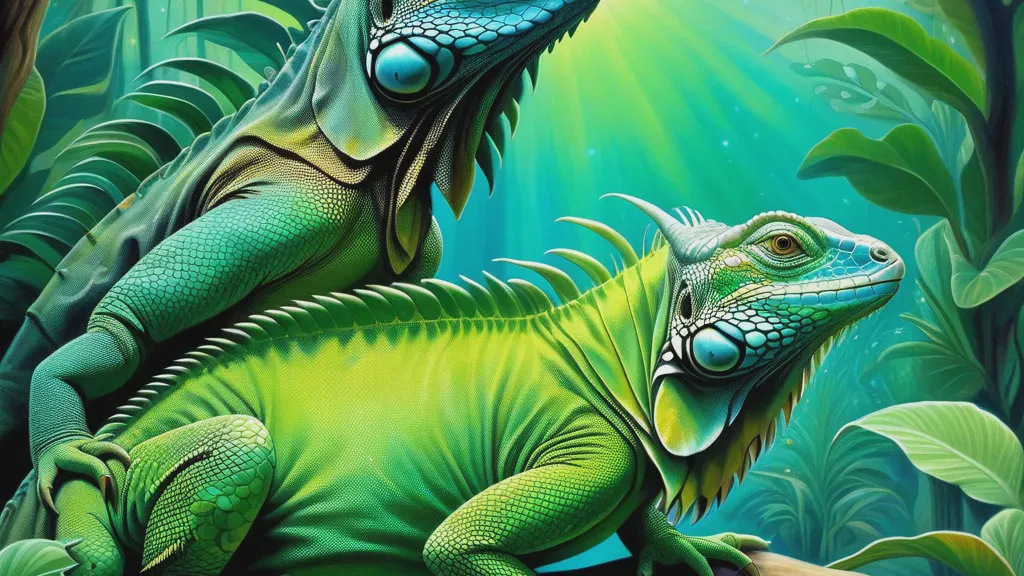
Green Iguana
Jungian Archetypes
Meaning
A green iguana is a dragon in outline and a leaf-eater in fact: a crest of spines down the back, a dewlap that swings under the jaw, a tail that cracks like a whip, and behind all of it an animal that spends most of its life motionless on a branch above water, eating flowers and young leaves. The dream almost always turns on that gap between the display and the diet. The second thing the animal carries is dependence on conditions. It makes no heat of its own, so it has to put its body where the warmth is, and when the air drops far enough it loses its grip and falls out of the canopy still alive. Dreamers tend to meet it when something in them looks armoured from the outside and is quietly at the mercy of the weather within.
Psychological Interpretation
Nearly all of the iguana's threat behaviour is bluff, and the dream usually knows it. The dewlap drops to make the animal look larger, the head bobs in a fixed rhythm to claim a branch, and only when that has failed does the tail come round. A dreamer who is frightened by the creature and then finds it will not attack is being shown their own repertoire: the raised voice, the credential produced early, every way of taking up space that has never once been followed through. Whether the discovery lands as relief or as humiliation says which end of that performance the dreamer stands at. The remaining details narrow it. A tail dropped and left twitching in the grass while the animal escapes is a picture of paying with a part of oneself for a way out, and what grows back is shorter, darker and never quite the same. Skin coming away in ragged patches rather than one clean sheet marks a change genuinely under way and genuinely unfinished. An iguana that lets go of its branch and drops into the river has chosen the element where it is unexpectedly strong. The long stillness is not laziness but thermoregulation, a body arranging itself around a heat it cannot manufacture, so a dream that lingers on the basking is asking where the dreamer has been placing themselves, and whether there was any sun in that spot at all.
Traditional Symbol Meaning
The dream manuals of nineteenth-century Europe and North America were compiled where no iguana lived, so they filed every lizard under one heading, and it was seldom a generous one. A lizard crossing the path commonly stood for an enemy working out of sight, and killing it for a reputation recovered. Those entries were written about small, quick, unreadable wall lizards that vanish into masonry, and they transfer badly to an animal the length of a man's arm that sits in a tree for three hours doing nothing whatever. Where the iguana actually lives, the regard for it was practical long before it was symbolic, and the practical reading carried its own meanings. The animal is hunted hardest in the dry season, when gravid females come down out of the canopy to dig their nests in open sand, so its appearance in village life is tied to a turn in the year rather than to omen. Folk medicine in parts of the Caribbean and Central America has long given iguana broth to the convalescent and to nursing mothers, and the eggs are prized well above the meat. An animal that arrives as food, as a sign that the rains have finished and as a creature that lays several dozen eggs in a hole is not going to be read as treachery; it is read as plenty, and as something one has to know the season for. A third layer is barely fifty years old and is the one most modern dreamers are actually drawing on. Between the nineteen seventies and the nineteen nineties the green iguana became one of the most heavily traded reptiles on earth, sold cheaply and in enormous numbers to households that wanted a dragon. Most of those animals died young, and the standard causes were insufficient heat and insufficient calcium: keepers who could not feel the animal's cold assumed it did not need warmth. The escapees and releases founded populations in south Florida, Puerto Rico and elsewhere, where the same creature is now a nuisance to be trapped. Whatever else the modern iguana means in a dream, it arrives carrying that history of a beautiful thing taken home for its appearance and then kept in conditions its owner never troubled to understand. What the layers share is a habit of reading the animal by position rather than by character. High in the tree it belongs to abundance and safety; on the ground it is prey and pest; in the water it is faster than anyone expects; on a hot rock in the open it is at its most exposed and at its most functional at once. Traditional interpretation almost never asked what an iguana was. It asked where the iguana was, and answered from that.
Contemporary Psychological
The image has an ordinary provenance and the continuity hypothesis predicts it: a documentary, a zoo enclosure, a pet in a lit tank, a winter news clip from Florida. What decides whether it gets used is salience, and reptiles are unusually salient to a primate brain. Arne Öhman and Susan Mineka's work on prepared fear learning found that people acquire and retain conditioned fear of snakes more readily than of guns or flowers, which suggests a detection system tuned to an ancient reptilian outline rather than to present danger. Predictive processing supplies the rest: an animal built like a dragon and grazing on hibiscus generates a large mismatch between what the visual system expects and what the scene delivers, and mismatch is what gets replayed. Antti Revonsuo's threat simulation theory would predict the iguana to appear as a danger and the dreamer to rehearse escape, and some of these dreams run that script start to finish. The more common report is stranger: an approach, a spike of fear, then nothing, because the animal has no intention of doing anything. That shape matches work on REM sleep and the consolidation of extinction memories, in which the sleeping brain revisits a fear association in the absence of the threat and quietly revises the prediction downward. Ernest Hartmann's idea of the central image applies too, since a large armoured animal that cannot hurt anyone is a compact picture of an emotional situation the dreamer may not yet have named in words. One physiological coincidence is worth knowing. Thermoregulatory reflexes are largely suspended during REM sleep, when most vivid dreaming happens, so shivering and sweating stop and the sleeper drifts toward the temperature of the room. For twenty minutes at a stretch a dreaming human is closer to the iguana's condition than at any other point in the day, and cold or overheated bedrooms measurably disturb REM. That does not make the dream a thermostat reading, but the body generating the image is briefly living the animal's problem. Set beside the work of Rosalind Cartwright and Matthew Walker on emotional processing during REM, the modest reading is this: the brain has picked a striking, prediction-violating animal to carry a concern about warmth, exposure and how much of one's steadiness is borrowed from the surroundings.
Jungian / Archetypal
Jung treated the animals of a dream as a scale of distance from the ego, with warm-blooded creatures standing nearer to human feeling and reptiles marking the oldest and most autonomous layers of the psyche, the part that goes about its business with no reference at all to what the conscious personality wants. The green iguana occupies an odd place on that scale, because it wears the whole reptilian threat and eats leaves. Its dependence on external heat gives the Great Mother her most literal expression in the animal world: the sun and the warm rock are not a metaphor for the mother here, they are the animal's metabolism, and without them the body slows, the grip fails and the creature comes down out of the tree. Dreamers who were never taught to generate their own warmth, who have organised a life around finding the one reliably heated place and staying in it, meet this animal often. The display belongs to the Animus, and to the Shadow of anyone whose authority rests on performance. A male iguana's entire social existence is conducted through the dewlap, the head-bob, the orange flush of the breeding season and the ownership of a good basking site; the fighting is largely notional. Read as an inner figure, that is opinion staged as dominance, argument that has learned the rhythm of conviction without ever having to test it. The Maiden shows up in the animal's colour: hatchlings are a brilliant, almost unbelievable green, and the adults grey and dull and grow spines. A dreamer mourning the loss of a brightness that once did the work of introduction for them is being handed an exact image of the cost of maturing in a body that no longer announces itself. Compensation explains most visits. The dreamer who has been all force is shown a creature whose competence is entirely a matter of arrangement, of angle to the sun and height above the ground, and who has never needed to win anything. The dreamer who has been all accommodation is shown the crest and the whip and asked to notice that it is theirs. Amplification widens the frame: the silhouette quotes the dragon of European heraldry, the guardian coiled on the hoard, and the Maya cosmos framed by iguanas puts the same body at the corners of the world. Individuation here means letting the dragon and the leaf-eater occupy one animal without either being a lie. The Self tends to signal progress in a later dream by returning the iguana to a high branch over water, warm, feeding, entirely uninterested in the dreamer's arrival.
Gestalt / Parts of Self
In Gestalt work nothing in the dream is scenery and nothing is a message from elsewhere. The iguana is a part of you that has been given a body of its own and put in a tree, and the way to find out what it wants is to become it and speak. Sit in the chair as the animal and say it in the present tense: I am green, I am fifteen feet up, I have not moved for two hours, and I am watching everything below me. Then let the dreaming self answer from the other chair. The dialogue tends to reach the point fast, because the iguana's position in the dream is usually the position you have taken in some waking room, and saying it out loud in the first person is harder to dismiss than describing it. Give the dewlap its own voice. Ask it what it is for, how long it has been doing the job, and what it thinks would happen if it stayed folded. Then ask the same of the spines, the tail and the stillness. The polarities in this dream are unusually clean, and you can work them directly: armoured against soft, display against silence, high against ground, cold against warm. Whichever pole you narrated as the animal's, you probably own the other one and have not been introduced to it. If you felt disgust, or called the thing cold, prehistoric, unreachable, that is a projection with your name on it, and the experiment is to say the sentence again in the first person and see where it catches. The iguana's repertoire is a complete cycle of contact and withdrawal, which is why it is such useful material. Basking is self-support, the withdrawal that makes anything else possible. The head-bob is contact offered on the animal's own terms. The inflated throat is contact deflected before it can happen. The drop into water is flight that looks like collapse and is actually competence. Ask yourself which of the four you did most often this week, and which one you cannot do at all. If the tail came off in the dream, stay with that image rather than explaining it: something of yours was left behind so the rest of you could leave a situation, and the twitching piece in the grass is worth talking to. Then try the experiment outside the session. Find somewhere warm, stay in it doing nothing for as long as the iguana did, and notice precisely what rises in you at the point where you want to get up.
Psychodynamic / Freudian
The manifest image of a large scaly animal on a branch is doing work for something that could not be said plainly. Freud's account of the little boy who transferred a fear of his father onto horses set the pattern for reading dream animals as substitutes for people about whom the dreamer holds forbidden feelings, and the iguana is an efficient substitute because the word cold does double duty. Someone who withholds warmth, who is unreachable and impossible to provoke into feeling, condenses neatly into a creature that is cold in the plain physiological sense and cannot be accused of anything. The giveaway is an intensity of feeling in the dream that the reptile alone does not warrant. Object relations puts the emphasis on the animal's physiology rather than its face. An ectotherm regulates its inner state entirely by placing its body in relation to something outside it, which is a precise picture of the infant who cannot yet manage arousal alone and depends on a caregiver to hold, warm and metabolise what is happening. Winnicott's environment-mother is exactly this function, and Bion described the same process as a mind that takes in raw distress and gives it back bearable. Dreamers who grew up with warmth that came and went unpredictably often produce an iguana scene in which the sun keeps being interrupted, cloud after cloud, and the animal's slow shutdown is the whole affect of the dream. Klein's contribution is the moment of discovery: a monstrous object that turns out to eat flowers marks a softening of the split between an all-bad persecutor and a real, limited, mostly harmless other. Defences leave fingerprints on the details. Reversal runs both ways, so the harmless family reptile is dreamt enormous and the genuinely frightening person appears as a lizard small enough to hold. The dropped tail reads as a compromise formation, a piece of the self surrendered to buy escape and to satisfy whatever is demanding payment, and Winnicott's account of a compliant surface built to protect a hidden core fits the dewlap well. In treatment the iguana tends to appear when a patient has begun to notice how much of their steadiness depends on the room's temperature and cannot yet ask for it aloud. The question, put gently, is who in the dreamer's history was the sun, and what the weather was like when they were gone.
Cultural & Historical Origins
The name is Caribbean. Iwana in the Arawakan speech of the Taino passed into Spanish as iguana and from there into most European languages, making it one of the small handful of Taino words that outlived the people who coined it. In the Maya lowlands the animal was huh, and J. Eric S. Thompson proposed in the middle of the twentieth century that the creator deity Itzamna be read as itzam na, iguana house, the sky and earth conceived as a dwelling framed by four great iguanas; later epigraphers, Karl Taube among them, have doubted the etymology, though the reptile keeps its place in the imagery of the world's frame. Moche ceramics from the north coast of Peru give a lizard-headed attendant catalogued by Christopher Donnan as Iguana, who walks beside the wrinkled-faced deity through burials and confrontations and recurs across the whole corpus. The fourth day sign of the Aztec calendar, Cuetzpalin, is a lizard, counted a sign of vigour and increase. Egypt had put the family to a different use much earlier: the lizard hieroglyph doubled as the word for many or numerous, so a small reptile spelled abundance. Practical regard has proved just as durable as any of this. Across parts of Mexico and Central America the green iguana is gallina de palo, chicken of the tree, taken with its eggs and eaten in some communities through Lent, while in Florida, where released pets established themselves decades ago, wildlife agencies now issue winter advisories warning that cold-stunned iguanas may drop out of the trees.
Contextual Variations
A green iguana inflating its dewlap and bobbing at you
This is the animal's whole argument, and it is theatre. The throat fan drops, the head moves in a fixed rhythm, the body turns side-on to look wider, and none of it precedes an attack. If you backed away, the dream is showing how reliably you fold in front of a confident performance without checking what stands behind it. If you found the display absurd, the bluffing animal is more likely to be your own. Notice whether you were on the ground or at branch height, because an iguana only bobs at something it counts as a rival for the warm spot.
An iguana dropping its tail into your hand as it escapes
A shed tail keeps moving for a minute or more, which is the point of it: the predator holds something alive while the animal leaves. Waking up with that in your hand usually means you paid a piece of yourself to get out of a situation, and it is worth naming what the piece was, because the price is normally something you were good at. The regrown tail is shorter, stiffer and a different colour, and no iguana grows the original back. If the dream left you guilty rather than relieved, the guilt may belong to whoever forced the exchange rather than to you.
A green iguana falling stiff from a tree in the cold
In a Florida cold snap iguanas lose their grip and come down, mostly still alive, and warm back into motion as the morning goes on. As a dream image it is one of the clearest pictures the psyche makes of shutdown that is neither death nor choice. Something in your circumstances has dropped below the temperature you can function at, and the part of you in the branches has simply stopped holding on. The reading is not that you are weak but that you have been treating warmth as a luxury rather than as the condition of staying up there. Whether you picked the animal up in the dream matters most of all.
An iguana basking on a hot rock, refusing to move
An animal that will not be shifted off a warm stone is not being stubborn; it is doing the only thing that makes the rest of its day possible. Dreams put this scene in front of people who have started to feel guilty about rest, or who are being asked to give up the one arrangement that has been keeping them functional. If you tried to move it and failed, look at what you have been trying to talk yourself out of needing. If you sat down beside it, the dream is further along than you think, and the question shifts to how you protect that rock in waking life without having to justify it to anyone.
Frequently Asked Questions
Why would I dream about an iguana when I have never owned one?
Is a green iguana in a dream a warning about someone cold in my life?
Does iguana skin shedding mean the same thing as a snake shedding?
The iguana never attacked me, so why was the dream so frightening?
Journaling Prompts
- Describe the moment the iguana made itself look bigger, the dewlap, the sideways turn, the fixed rhythm of the head. Then write about the last time you did the same thing in a room full of people: what you inflated, who it was aimed at, and what you believe would have happened if you had simply stayed the size you actually are.
- The iguana cannot manufacture its own heat and has to go and lie where the heat already is. List the four or five people, places and hours that have genuinely warmed you in the past month. Mark the ones you have been rationing, and write down the single one you could go to this week without first earning the right to it.
- Write about a tail you have already dropped: the friendship, the job, the version of your name you let go of in order to get out of something. Describe honestly what grew back in its place, whether you have ever admitted to anyone that it is not the original, and what the escape actually bought you.
- Your skin comes off in patches rather than in one clean sheet. Name the change you are in the middle of right now, and list the pieces of the old life still visibly stuck to you. Then write what you would need, and from whom, in order to stop apologising for how ragged the halfway stage looks to other people.
Related Symbols
Dreamed about Green Iguana?
Get a personalized AI interpretation that connects this symbol to your specific life circumstances.
Interpret My Dream