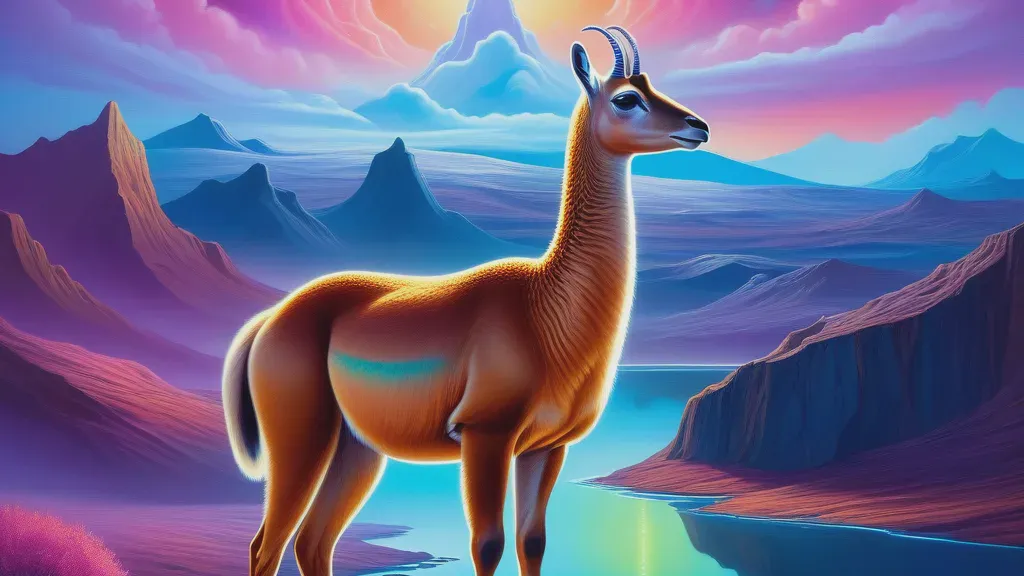
Guanaco
Jungian Archetypes
Meaning
The guanaco is the wild camelid of the Andes and the Patagonian steppe, and it is built for two things that seldom go together: scarcity and society. Its blood carries several times the red cells of a human's in the same volume, so it can graze at four thousand metres where the air gives back almost nothing, and its life runs inside a strict order of family groups, bachelor bands and solitary males, with one animal usually standing apart on higher ground while the rest feed. The dream reaches for it when belonging has turned physical: who is inside the group, who watches from the edge, and how thin the air has to get before a person will admit they are working harder than everyone else simply to breathe.
Psychological Interpretation
Where the animal stands is the first thing to establish, because the guanaco's whole meaning is positional. One up on a ridge, motionless, looking directly at the dreamer, is the sentinel, and sentinels eat last, if at all. A dreamer who identifies with that figure is usually the person in a family or a team who has taken on the watching, who cannot settle while others do, and who will be the last to notice they have not eaten. An animal in the middle of a grazing group reads quite differently and often arrives during a stretch of unexpected ease. The rest is in the movement. Guanacos cover broken ground at speed and change direction without losing it, so flight in these dreams looks like competence rather than panic, and dreamers frequently wake impressed by their own escape. If the animal spits, something the dreamer has been swallowing has come back up, and camelids spit at their own kind rather than at predators, which places the conflict inside the group. And when the dream shows a young guanaco driven off by an adult male, the material is almost always about a departure the dreamer has been reading as rejection when it may have been the ordinary way this particular herd releases its young.
Traditional Symbol Meaning
Old World dream books have nothing to say here, and the honest starting point for this symbol is that its traditional meanings were never written in the interpretive genre at all. They were carried in hunting practice, in textile and in the sky. What Andean and Patagonian traditions transmitted about the guanaco was a set of observations about how the animal behaves under pressure, and those observations function as a reading of character as surely as any dream manual entry does. The first is about clothing, and it is unusually literal. The Tehuelche quillango was worn fur inward, against the body, with the hide side painted and turned to the weather, while Selk'nam capes more often went fur out; either way the guanaco was the surface and the human was underneath. A whole vocabulary of appearing follows from that: what a person shows the wind is not what they are, and the skin that keeps them alive was taken from an animal that had to be outrun first. The fibre carried the same idea in a finer register, since guanaco wool is among the softest in the world and second only to vicuna, so the roughest terrain on the continent produced the most delicate thread anyone there could make. The second is about the group. Herding traditions across the Andes read camelid social structure closely because their livelihood depended on it, and the arrangement is not a democracy. One male holds a family group, yearlings are driven out when their time comes, and the expelled males form bands of their own that wander until one of them can hold ground. Communal dung heaps mark the territory, every animal depositing in the same appointed place, and those heaps were collected and dried as fuel where wood does not grow, so what the herd discarded together kept people warm. Nothing in that arrangement is sentimental, and nothing in it is cruel; it is simply the shape a life takes where the margin is thin. The third is about foresight, and it produced the most striking image the region left. A llama that stops eating because it has understood something about the future, told in the Huarochiri Manuscript, gives the family of animals a reputation for knowing before the humans do, and the celestial llama of the dark clouds put that reputation in the sky as a figure made from the absence of stars rather than from stars. Read forward into dreamwork, these three inheritances line up neatly with what the dream usually asks about: what the dreamer is wearing, where they stand in the group, and whether an unease they cannot justify is worth trusting.
Psychodynamic / Freudian
The expulsion scene is the heart of the material, and psychoanalysis has an unusually literal parallel for it. In Totem and Taboo, Freud imagined a primal horde in which the dominant father holds the females and drives out the sons, who then band together, and the guanaco simply lives that arrangement: one male with a family group, yearlings pushed out at around a year, and the excluded males forming wandering bachelor bands. A dreamer who produces this scene is generally working on a departure from a family system, and the useful distinction is between an expulsion that was developmental and one that was punitive. The dream tends to encode the difference in whether the young animal is pursued after it leaves, or simply no longer followed. The group itself invites a different literature. Bion described groups operating under a basic assumption of fight or flight, organised entirely around a threat and needing a leader who will keep the danger in view, and a herd with a posted sentinel is that assumption in animal form. Dreamers who hold the watching position for others often carry an early history of being the child who monitored a parent's mood, and the dream restages the arrangement with the roles drawn cleanly. Freud's account of group psychology adds the other half, since what binds such a group is not affection between members but a shared relation to the one who stands apart, which is why the sentinel is both indispensable and never quite included. Defences show up in the two most physical details. Spitting is a return of what was taken in and not digested, and it maps onto the moment when swallowed resentment comes back at the person it concerns rather than at whoever happens to be nearest, which is the difference between a projection and an honest complaint. The communal dung heap is stranger and more interesting: an entire group depositing what it will not carry in one appointed place, which is a fair picture of the family member who becomes the designated repository for everybody's disowned material. Dreamers who wake troubled by that image, without knowing why, are frequently the one who has been holding it. Winnicott's compliant surface fits the worn hide, and in treatment these dreams often surface as a patient begins to test whether a role can be set down without losing the group that came with it.
Contemporary Psychological
Few dreamers have met a guanaco, so the brain is working from a documentary, a trekking photograph, a zoo enclosure or the general category of llama-shaped animals, and what it keeps from those sources is not the species but the arrangement: a hoofed herbivore in open country with a lookout posted, which is among the most legible social diagrams available. Antti Revonsuo's threat simulation theory accounts for the vigilance directly, and the later extension of that theory into social simulation covers the rest, since the guanaco scene is essentially a rehearsal of group membership: who is in, who watches, who is driven out. Exclusion has a well-studied neural signature, and it bears on the expulsion dreams. Experiments by Naomi Eisenberger and colleagues using a simple ball-tossing game found that being left out of the game engaged regions associated with the distress of physical pain, which is a reasonable explanation of why a dream about a yearling driven off a feeding ground can wake someone with a genuine ache. Dreams that rehearse social exclusion are not indulgence; the system treats the threat as costly, and the replay is consistent with what sleep does with emotionally charged material generally. Altitude supplies one further and quite literal connection. Sleep above roughly two and a half thousand metres is reliably disrupted by periodic breathing, in which respiration waxes, wanes and briefly stops, producing frequent arousals and, in many climbers' reports, unusually vivid and fragmented dreams. Anyone who has slept high has had a night's sleep organised around the difficulty of getting enough air, which is the guanaco's permanent condition and the reason for its extraordinary blood. The coincidence does not turn every guanaco dream into a respiratory symptom, but it gives the altitude its own place in the image: a night spent short of air, in a body working harder than it looks, among others who appear to breathe easily, is the dream's most literal report on effort, and the question on waking is whether the breathlessness belonged to the animal or to the sleeper.
Jungian / Archetypal
The first archetype in this animal is the one people wore. Persona is not a metaphor in Patagonia: the Tehuelche wore the guanaco's hide fur inward and painted the skin side that faced the wind, so the surface shown to the world was animal and decorated at once, with the human body concealed beneath it. A dream that features the skin, coat or fibre rather than the animal itself is working on exactly that layer. The question it poses is not whether the outer surface is false, since everyone needs a coat in that climate, but what it cost, whether it still fits, and what has been living underneath it unattended. Dreamers whose competence has hardened into a role, admired for a surface they no longer feel connected to, tend to meet the animal in its most decorative forms. The Trickster arrives through behaviour. The alarm is a high, quavering shriek that some listeners describe as laughter, so warning and mockery come out of the same throat. The animal spits, and spits at its own kind, converting a dispute into something ridiculous before it becomes a fight. Darwin recorded its habit of approaching a person who behaves oddly, which quietly reverses the roles of hunter and hunted and cost the species dearly. Each is a Trickster move as Jung understood the figure: not malice but a disruption of settled order, arriving through the undignified and the involuntary, usually at the expense of whoever was most certain of their position. The mythic parallel, for amplification, is overhead. Andean astronomy read the Milky Way for dark cloud constellations, and the Yacana, the celestial llama of the Huarochiri Manuscript, is drawn not from stars but from the black spaces between them, a figure made entirely of what is not shining. Few images serve the Shadow better, and it belongs to this animal by inheritance. Compensation runs on the same logic: the dreamer who has become all surface is shown a creature that must live where the air is thin and cannot afford ornament, while the dreamer who has withdrawn into austerity is shown the herd, the shared dung heap, the yearling driven out and taken in by the bachelor band. Leaving the group is not what individuation asks for here. It asks the slower question of which of the three positions the species keeps open, inside the family, out on the ridge, or moving with the other exiles, the dreamer is actually living, and whether they chose it.
Gestalt / Parts of Self
Most dreamers wake from this dream still holding the sentinel's posture, so that is where the work starts. Take the chair and speak as the animal on the ridge: I am not eating, I am facing the direction the others are not, and if I move they all move. Say it several times and let the sentences get more specific. In most cases the family or the workplace fills itself in without any prompting, and the posture in the dream turns out to be the posture you have been holding for months. Then answer from the other chair as the herd with its head down, and notice how much you resent them and how much you need them to keep grazing. Give the spit its own voice, since Gestalt takes the undignified parts of a dream most seriously. Camelids bring up stomach contents and aim them at their own kind, which makes the gesture a precise picture of something swallowed, held and eventually returned to the person it belonged to. Ask what you have been keeping down. Then work the polarity that runs through the whole dream, between the one who belongs and the one who is outside, and pay attention to which of the two you narrated from. If you told the dream as the excluded one, try telling it again as the male who does the excluding, out loud, in the first person. That sentence is usually the hardest one in the session and the most productive. Contact and withdrawal have an unusual shape in this animal, and it is worth using directly. The guanaco's answer to danger is neither to fight nor to freeze; it runs brilliantly over ground that would break another animal's legs, and it stops at a distance and looks back. Withdrawal here is skilled, not cowardly, and the looking back is the part people leave out when they describe their own retreats. Ask yourself where in the past month you left a situation well, at speed, and then failed to turn round and take it in from a distance. Do the second half now, in the session. Describe the thing you ran from as it looks from where you are standing, in the present tense, and see whether the fear survives the new vantage.
Cultural & Historical Origins
Human dependence on the guanaco is about as old as human presence in southern South America. At the Cueva de las Manos in Santa Cruz, Argentina, the stencilled hands are accompanied by hunting scenes in which guanacos are driven and surrounded, painted some nine thousand years ago. The Tehuelche of Patagonia hunted the animal with boleadoras, covered their toldos with its hides and wore the quillango, a robe of sewn skins worn fur inward with its outer face painted in geometric designs, while in Tierra del Fuego the Selk'nam depended on it so completely that the fencing of the steppe for sheep, which took the guanaco range, was inseparable from their own destruction. Under the Inca the wild camelids were managed rather than merely hunted, through the chaku, a cooperative drive in which thousands of people closed a ring around the animals; Garcilaso de la Vega describes it in his Comentarios Reales, with vicunas shorn and released and guanacos taken for meat and hide. The sky held them too. The Huarochiri Manuscript, compiled in Quechua around sixteen hundred and eight, records the Yacana, a llama seen not in the stars but in the dark clouds of the Milky Way, and tells of a llama that refused to eat because it had learned the sea was about to rise, warning its herder in time for both to climb Huillcacoto. Charles Darwin met the wild animal in eighteen thirty-four, called it elegant in the Voyage of the Beagle, and remarked on its shrill alarm, its readiness to approach anyone behaving strangely, and the heaps of bones by the Santa Cruz river that local report treated as appointed dying grounds.
Contextual Variations
A guanaco standing sentinel while the rest of the herd runs
The posted animal feeds last and flees last; it faces the danger and calls, and the herd moves on its signal. If you woke identified with it, look at where you are the one who cannot relax while other people do, and be specific about what you have not eaten, slept or asked for while holding the position. The role is genuinely necessary and genuinely thankless, and the group rarely notices it is being kept safe. Ask whether anyone has ever relieved you, and whether you would let them.
A guanaco spitting stomach contents into your face
Camelids spit at each other rather than at predators, which locates this squarely inside the group. Something taken in and not digested has come back up, and the humiliation is part of the message: the return of swallowed material is never dignified. If you were the target, consider who has been holding a complaint about you that keeps surfacing sideways. If you were the animal, the dream is about what you have been keeping down and where it has started leaking out. Either way the dream is arguing that the thing should be said plainly instead.
A young guanaco driven out of its family group
Yearlings are pushed out by the dominant male at around a year, and the expulsion runs on a calendar rather than on merit: the young animal is not chosen for exile, its season has simply arrived. A dream that stages this scene usually concerns a departure you have filed under fault, yours or theirs, when the more accurate word may be timing. Ask whether you left at an offence or at an age. Then ask who else left that group at about the same point in their lives, because the answer tends to show that the door had been opening on schedule long before it opened for you.
A guanaco watching you from a ridge and not running
Darwin noted that these animals will approach a person behaving strangely rather than flee, and an animal that holds its ground and looks at you has reversed the expected roles. Dreams do this when you have been treating yourself as the pursued party in a situation where you are not, or when curiosity has begun to outweigh fear somewhere in your life. The stillness is the point. Nothing chases and nothing runs, and the two of you are simply looking. Ask what you would say if the thing you have been avoiding turned round and waited for you.
Frequently Asked Questions
Can I really dream about an animal I have never seen, like a guanaco?
Is a guanaco dream about being an outsider?
Does a guanaco spitting in a dream mean someone is disrespecting me?
Are guanaco dreams and llama dreams the same thing?
Journaling Prompts
- Write down where you were standing in the dream relative to the herd: with them, above them on the ridge, or moving away from them. Then map the same three positions onto your family or your team as they actually are this month, put yourself honestly in one, and describe what it costs you to stay there.
- The guanaco lives where the air gives back almost nothing and has the blood to manage it. List the parts of your current life that require noticeably more effort than they appear to from outside, and then write about who, if anyone, knows that. Name one place where you could stop pretending the altitude is comfortable.
- Give the expelled yearling a page of its own. Write about the moment you left a group you had assumed you belonged to, what you were told and what you concluded, and then consider whether anything about the leaving was ordinary rather than personal. Describe who was waiting further out when you got there.
- Something has been swallowed and held. Write out the complaint you have not made, in the fewest words you can manage and addressed to the actual person, without softening it for the page. Then read it back and decide which single line of it could be said aloud this week without the whole thing coming up at once.
Related Symbols
Dreamed about Guanaco?
Get a personalized AI interpretation that connects this symbol to your specific life circumstances.
Interpret My Dream