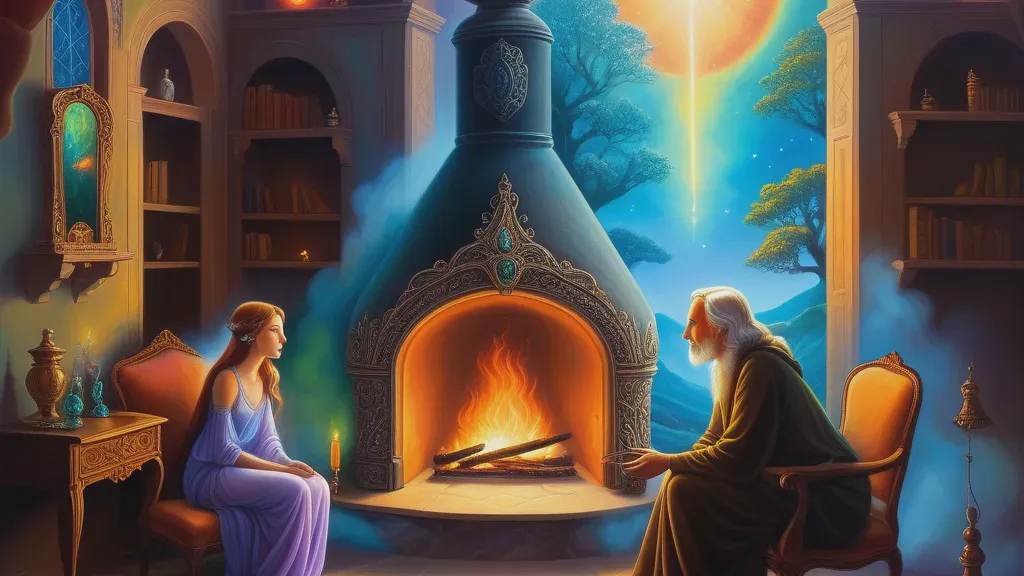
Fireplace
Jungian Archetypes
Meaning
A fireplace in a dream fixes warmth to one specific, tended point in a home rather than letting it come from anywhere, which is what makes it a symbol of deliberate, ongoing care rather than comfort that simply happens on its own. Someone has to build the fire, feed it, and keep it from either dying out or spreading past its hearth, so a dream fireplace tends to concern the effort required to sustain closeness or security rather than the wish for it alone. Whether the flame is banked and steady, roaring, or cold in the dream usually measures how well that daily maintenance currently feels handled.
Psychological Interpretation
A cold, dead fireplace carries a specific charge that differs from mere absence of fire elsewhere in a dream: hearths are built to be tended, so finding one gone out often names neglect rather than simple lack - something that requires ongoing attention has been left unattended long enough to go dark. This dream frequently surfaces when a relationship, household, or sense of belonging that used to require regular, active care has been running on old warmth rather than fresh fuel. A fireplace roaring out of proportion to the room, by contrast, tends to concern excess rather than absence - an intensity of feeling, obligation, or conflict that has outgrown the space meant to contain it safely. Sparks escaping the hearth, or a fire that will not stay behind its screen, often reflects a fear that strong emotion, once let out to warm the room, cannot easily be brought back under control if it needs to be.
Traditional Symbol Meaning
Folk dream manuals generally treat a well-tended fireplace as one of the more reliably positive images available - domestic security, family harmony, or a return to warmth after a difficult period. A dead or cold hearth was read almost as consistently as a warning: neglected family bonds, financial hardship, or a household coming apart at its actual center. The consistency across otherwise unrelated traditions reflects a genuinely universal domestic fact: before central heating, a fire kept or lost was close to survival itself. Because the hearth had to be actively maintained rather than simply installed, older customs tended to place moral weight on who kept the fire and how. Many households treated letting the fire go out overnight as a small failure of care, and some traditions specifically assigned the duty of banking the coals each evening, so they could be revived by morning, to whoever was considered responsible for the household's welfare, which folded gender expectations directly into a fire-tending ritual that was never only about heat. A dream fireplace still carries this same logic of ongoing responsibility rather than static comfort. The question an older interpreter would have asked, and the question still worth asking now, is not simply whether the fire is burning, but who is tending it, whether that arrangement still feels fair, and what happens in the dreamer's actual household when no one gets around to feeding the flame.
Jungian / Archetypal
Jung's studies of alchemy treat fire operations as some of the clearest symbolic language the alchemists left for describing inner transformation. Calcinatio, the burning away of a substance's dross to leave a purer residue, was read by Jung not as a literal chemical process but as an image for the psyche burning off outdated attachments, defenses, or self-conceptions that had served their purpose and were now simply weight to be shed. A dream fireplace, contained and deliberately fed rather than wild, can carry this same calcinatio quality: a controlled process of letting something no longer needed be consumed, rather than the destructive fire of a house burning down. Where the fireplace sits at the emotional center of a dream house, it often functions as an image close to the Self - not the household's decoration but its regulating core, the point around which the rest of the home's warmth and order actually depends. A cold hearth in this reading concerns something more central than a single relationship gone stale: a felt loss of connection to whatever has organized the dreamer's inner household, the source they have relied on without necessarily naming it. The Wise Old Man archetype appears here less as a specific figure than as the fire's own quality of patient, unglamorous tending - banking coals at night so they survive until morning, a task that requires no drama but constant attentiveness. A dream in which the dreamer discovers they have been neglecting exactly this kind of quiet maintenance may be pointing toward a wisdom the psyche already possesses but has stopped practicing.
Gestalt / Parts of Self
The fireplace in your dream is a part of you, not a household feature to analyze from outside. If it was cold, ask what in you has stopped being actively tended - what warmth you used to maintain deliberately and have let run on old fuel instead. If it was roaring too large for the room, ask what feeling in you has outgrown the space you have been giving it. Try speaking as the fire itself. A fire that says 'I need to be fed regularly, not just lit once' is describing something about your own emotional maintenance that a single grand gesture cannot substitute for - steady, unglamorous attention rather than occasional intensity. If you were the one responsible for tending the fireplace in the dream, notice how that responsibility felt: resented, natural, exhausting, or calm. That feeling is real information about how sustainable your current role as the one who keeps things warm for others actually is, and whether it is time to ask someone else in your life to take a turn at the tending.
Psychodynamic / Freudian
Wilfred Bion's model of the container and the contained offers an apt frame for the fireplace specifically: a caregiver, in Bion's account, receives an infant's raw, unprocessed distress and returns it in a form the infant can actually tolerate, much as a hearth receives raw fire and returns it as manageable, useful warmth rather than an unchecked blaze. A dream fireplace that holds its fire well may reflect confidence that some current relationship or situation can receive strong feeling without being overwhelmed by it; one where the fire keeps escaping its bounds may signal doubt that anyone, including the dreamer, is currently able to contain what is being felt. A cold hearth carries a related but distinct psychodynamic reading: the early template of a home's emotional center gone quiet. Where a child's household once organized itself, even imperfectly, around a warm, central point - a specific caregiver, a specific room, a specific ritual - an adult dream of that same hearth extinguished can revisit old anxiety about whether that containing function still exists anywhere, or whether the dreamer has had to learn to generate their own warmth without it. Who tends the fire in the dream, and who merely benefits from its warmth without contributing to it, can also displace a real domestic imbalance the dreamer has not confronted directly - an arrangement in which one person's ongoing emotional labor keeps a household warm while others simply enjoy the result.
Contemporary Psychological
Anthropologist Polly Wiessner's research comparing daytime and firelight conversation among the Ju/'hoan people of the Kalahari found a striking pattern: conversation held after dark around a fire shifted markedly away from the practical, often critical daytime talk of resource disputes and toward storytelling, shared history, and social bonding. Firelight, in this account, did not just provide warmth and light; it actively shaped what kind of talk, and what kind of closeness, became possible once the sun went down. This offers a concrete, non-symbolic reason a dream fireplace so often carries a distinctly relational charge rather than a purely practical one. A dreaming brain drawing on evolved associations between firelight and this specific, softer register of connection may be using the fireplace to flag a current hunger not just for company, but for the particular unhurried, story-sharing kind of closeness that daylight interaction rarely makes room for. A dead fireplace in a dream, read against this research, suggests something more specific than generalized loneliness: the absence of that after-dark register of connection in particular - a household or relationship where practical, daytime coordination continues, but the unhurried gathering that once accompanied it has quietly stopped happening.
Cultural & Historical Origins
Few images carry a more consistent identification between the domestic fire and the household's own life force than the hearth. In ancient Greece, Hestia, virgin goddess of the hearth, received the first and last offerings at every sacrifice and every meal, her flame in the city's public hearth treated as inseparable from the community's continuity; when Greek colonists founded a new city, they carried fire from the mother city's hearth to light the first flame of the new one, making the fire itself the literal link between old home and new. Rome's version, Vesta, was tended by the Vestal Virgins in the Temple of Vesta in the Forum, whose sole ritual duty was keeping the sacred flame from going out, since its extinguishing was treated as a genuine civic emergency rather than an inconvenience. Chinese folk religion assigns the household hearth its own resident deity, Zao Jun, the Kitchen God, believed to observe a family's conduct all year and report it to the Jade Emperor at the New Year, giving the hearth a moral as well as a domestic function that the Greco-Roman traditions do not share as explicitly.
Contextual Variations
A cold, dead fireplace in an otherwise warm house
A hearth gone cold while the rest of the house stays warm often points to one specific relationship or ritual that has been neglected even while the household otherwise functions. This dream is worth taking as a direct prompt to ask what used to be actively tended here, and when exactly it was left to run on its own.
A fire roaring too large for its hearth
Fire outgrowing its hearth typically signals emotion, conflict, or obligation that has exceeded whatever container was meant to hold it safely. This is less a warning about danger and more a signal that whatever boundary once contained this feeling needs to be rebuilt at a larger, more honest scale rather than simply reinforced.
Tending a fire that keeps needing more fuel than you have
A fire that consumes more fuel than you can supply usually reflects a real sense of being asked to sustain warmth, connection, or care beyond your current capacity. The dream is not a judgment on your effort; it is an accurate readout of a maintenance job that currently exceeds one person's reasonable resources.
Sitting by a fireplace with someone from your past
Sitting by a hearth with someone no longer part of your daily life often marks unfinished emotional business rather than literal longing for their return. The warmth in the dream belongs to a specific chapter that closed; the dream may be asking whether you have actually let that chapter finish, or are still quietly keeping its fire lit.
Frequently Asked Questions
Why did I dream about a fireplace that had gone completely cold?
Is a roaring fireplace in a dream a good sign?
Why do I keep dreaming about tending a fire that won't stay lit?
Why was I sitting by a fireplace with someone from my past in my dream?
Journaling Prompts
- Name one relationship or ritual in your life that used to be actively tended and has recently gone quiet. Write down exactly what tending it used to look like, and whether you want to restart it or let it stay cold.
- Think of a feeling or obligation right now that has grown larger than whatever was supposed to contain it. Write down what a more honest, larger boundary around that feeling would actually look like.
- If you are currently the one responsible for keeping something warm for others - a household, a friendship, a family tradition - write how sustainable that role feels right now, and who else could reasonably share it.
- Think of someone from your past who still appears warmly in memory. Write one honest sentence about whether that chapter is actually finished for you, or whether part of you is still quietly keeping it lit.
Related Symbols
Dreamed about Fireplace?
Get a personalized AI interpretation that connects this symbol to your specific life circumstances.
Interpret My Dream